A

A

Wednesday, 29 January 2020

Now lend me your ears

Now lend me your ears. For the first time in years I've read a book. Bear with me, I do read books occasionally. This was a book which made me want to page turn at an unseemly rate (cover to cover consumed in a couple of days). But for reasons I'm unable to fathom out, it left me with a sense of bewilderment that of not really knowing what it was all about. 


Reading the dust cover of Under the Tump, I gleaned from the publishers prose the knowledge that this book is about finding community in the market town of Hay on Wye and how, as an outsider, Oliver Balch used his journalism skills to decipher that often impenetrable sense of place, many of us crave when arriving unannounced to pastures new. However despite the rapid page turning, probably 100 per sitting before nightly retiring, I felt empty. Why I wonder?  

Usually whilst skimming across some honed narrative, if a book fails to hook me like a dangling trout, I simply abandon it. Regularly I have half a dozen books half-finished after drifting off to a subsequent offering . Yet this book kept me turning the pages, I couldn’t stop, all the time while it failed to instil in me anything ground-breaking or new to say. That intrigues me. 

Neither geographical nor historical in purpose, both are covered in detail. Real life characters met along the way were detailed without overblown substance; whilst events passed by without too much fanfare. It was pacey. Balch adeptly used his journalistic technique to arrive at the point quickly, revisits his own perceptions of what and whom, leaving closure somewhat in the mind of the reader’s own interpretation. Clever writing. 

In the dim past I became a journeyman writer of natural history scripts for Radio 4, it is a similar technique to journalism - yet entirely different. For radio, the script has to allow the presenter to be both the peddler of the narrative, in an entertaining way, while sounding like the easy going orator and authority on that topic, as we absorb their every nuance. When we read off the page we self-adapt the words in print to our internal ear. A million individual ways to interpret how those words are being delivered. 

Writing scripts for the radio is a single entity. The person speaking is talking to you, the listener, one to one, personal and intimate. Nobody else.

If spoken word doggedly followed the journalistic chronological principles of Who? What? When? Where? Why? and How? possibly this would lead to merry mayhem with this eye-ear coordination and if lain uncorrected ultimately lead to the switching off of the radiogram or writing a letter of complaint from ‘Disgruntled of Much Wenlock’. 

Whether spoken or read, the beginning though is a hook, it's always a hook. Once impaled through the subconscious of the reader or listener, then other important details, other subservient information can be exposed. Not before, not never. 

I've just looked back at some of the scripts I bashed out for Tweet of the Day - World Birds. An example of how facts are delivered in different ways depending on the intended audience struck me. 

The bird in question is a horned screamer (Anhima cornuta), the narrator, Sir Michael Palin.

We're off, 90 seconds of radio is about to be unleashed before the Today Programme on Radio 4. Starting sedately, 6 seconds of natural soundbites filter towards the listener... the line is cast, will it?, could it?, hook the listener. Then oration feels a bite and reels in from the seventh second... 

"It sounds as if someone is using a giant plunger in the Venezuelan marshes. But these are the mating calls of the Horned Screamer.  They’re sounds that only another Horned Screamer could love, but then screamers are very odd birds."

40 words, 22 seconds of spoken word as a most pedestrian rate of 1.8 words per second - somewhat slower than the 'standard' rate of 3 words per second normally aimed for writing for the spoken word. 

In radio waffle isn’t allowed, we don't have time, the listener has a well-educated attention span, boredom is a cancer. Yet by the time this opening salvo ends, the listener is possibly unaware 25 seconds has elapsed, nearly a third of the programme. My words spoken by Michael Palin. I can never replicate his or any other presenters’ delivery on the page; each script though is adapted to the person, their voice and timbre. Michael Palin is a slower narrator than some, but he knows how to peddle the narrative, he knows  how to deliver without undue rush. It is radio gold. 

In a ham-fisted attempt to illustrate the difference, I've just looked up horned screamer within the Cornell Lab of Ornithology Neotropical Birds website. I give you the first 44 words of that entry below; have a go at speaking what you read?

"The characteristic spiny appendage on the top of the Horned Screamer's head could rightfully earn it the title of "unicorn of the avian world." This bizarre relative of ducks and swans is found along rivers and freshwater marshes in northern and central South America."

Initially this works as I read it, my brain reformulating it into a spoken word in my head, but the second sentence is a struggle. It probably is me (I struggled as a radio reporter) yet the salient facts are there in both;  

A strange bird from South America. 

That is really all there is to glean from both the journalist born book and the spoken word. In Under the Tump, I’ve mostly got down through the first layer of the Who? What? When? Where? Why? and How? of that corner of Wales. Further knowledge can if required be found elsewhere.  In the Cornell Lab entry for the horned screamer a short synopsis follows which further reading can increase our knowledge if required.  The radio script focus is on just a fact or two, delivered entertainment coupled with a little knowledge spinning around the mating behaviour of this odd bird, as the clock ticks towards the 6am pips on Radio 4. Before then an additional sound layering, that of giant plunger,  stage left.

Less is more. Radio gold.


Links: 

Tweet of the Day : https://www.bbc.co.uk/programmes/b04t0skg

Cornell Lab : https://neotropical.birds.cornell.edu/Species-Account/nb/species/horscr1/overview

Monday, 27 May 2019

Wild Man Blues

Wild Man Blues was a 1922 New Orleans blues instrumental by Jelly Roll Morton. And in ways it is hard to explain (I'll therefore refrain from doing so) this seemed apt for today's ramble through the glorious Mendip Hills. We listened and we said very little, watching wildlife all the time on the look out for the blues. The butterflies I mean.


Near the village of Draycott lies a trio of nature reserves all around the ST500510 grid reference. Nestled high on the southern slopes of the Mendip Hills with bucolic views across the Avalonian landscape lies, firstly the Somerset Wildlife Trust reserve of Draycott Sleights.  Access to the other two sites on my radar today, owned by Butterfly Conservation, require a walk through this SWT reserve. First is Stoke Camp. At the far end of Stoke Camp lies Westbury Beacon, which today I didn't venture into but can be reached 500m away by crossing a grassy field. Westbury Beacon can wait another day however this all makes up a trio of important limestone grassland reserves.


I'd set myself the task of heading down to Cerne Abbas in Dorset for a day with his grace the Duke of Burgundy. However for various reasons this has been postponed. Stoke Camp therefore came into my radar and only 40 minutes from home.  It is a reserve I've not visited previously, though after today's rambling across the hills, I shall return. No sooner had we entered Draycott Sleights then this quite worn Small Copper Lycaena phlaeas hove into view. Nice, but it was the blues I'd come to see. And I wasn't disappointed.


Chatting to a couple at leisure with their flask and sandwiches, one informed me the common blues were flying well, 'over the top by the gorse'. There was no getting away from it, a 45 degree climb was my only option. 


But it was worth it, and true the gentleman's word the track was alive with common blue butterflies, trios and quartets pirouetting in an embrace. Singles fluttering in the breeze, which at the top of the hill was more of a full on wind. Not ideal butterfly weather, sure it was sunny and warm but anything over 2 meters and your hat would blow off.


Luckily these absolute stunning common blues were not too bothered about the wind. Difficult to photograph as the airflow made them skittish. But having been given advice many years ago I was armed with my binoculars and a camera with a telephoto lens. For years I went out to watch butterflies, only to experience gathering annoyance in that each time I tried to get close, they'd fly off never to be seen again. Guidebooks and tutorials suggest get a butterfly net and chase after the little beasties. Well that was absolutely hopeless too. Then I met the great butterfly expert Matthew Oates, who was at the time the senior conservation adviser to the National Trust. I learnt a simple lesson from Matthew. Take a good pair of binoculars to watch them flying or when they come to land. There's no need to try and get close - or as he said 

"...would you expect to get close to a bird? No you look at it through your bins. No difference in the world of Lepidoptera."

And then on the second bit of his advice, I bought myself a bridge camera with a very good x100 optical lens (which can digitally go to x200 and it's not bad indeed). All these images were taken 20-30 feet from the butterfly. Any closer they'd be off, but stand back and they will oblige with a stunning display.


Now while there were many many common blues on the wing, until well into the search no small blues. Bought in the 1990's by Butterfly Conservation, Stoke Camp reserve was acquired for the conservation of small blue colonies, the larvae of which thrive here on a heady diet of kidney vetch happily growing here. Just a single small blue Cupido minimus today. And very nice too. 


After a good hour watching these aerial blue jewels it was time to head back and up onto the Draycott Sleights reserve on the other side of the lane. On a day like today its 124 acres looked stunning from my vantage point at house grounds, a grazed part of the reserve home to many notable species.


It gets me fit walking up and down the Mendips, though between the breathless moments, a number of butterflies made the slog worthwhile such as this small heath Coenonympha pamphilus, though quite worn. 


Reaching the high point it was time to sit and catch my breath. More common blues scurried past me and then a 'little brown job'


As previously noted I've learnt not to rush about chasing butterflies. Instead I sat on this rocky outcrop and focused on another outcrop 20 feet away. Binoculars scanning there it was, a wall butterfly, Lasiommata megera. A declining species these days has designated it UK BAP status for research, thus not a species I have seen many times. I was quite pleased with this photograph it has to be said, given the distance between sitter and subject.


Almost immediately after taking this image a fluttering moth caught my eye. Skittish and seemingly unwilling to stay still for more than a second on the ground, I followed it for a quite a distance. Eventually when I did catch up with it, and get this single image, I thought it was a tiger moth. Which it is not.  Later at home I checked up what this was and it turns out to be a very tatty Wood Tiger Parasemia plantaginis. To the best of my knowledge this is a first for me. Sadly this specimen won't last long, part of its forewing was missing which may have explained why it was skittishly flying all over the place. Looking up the lifecycle this must be a male, as the females are largely nocturnal. Next time I'm here I'll look out for this lovely moth.


There is much more to say about this trio of reserves, the endless skylark chorus accompanying my Lepidopteran adventure, but that is all for another day.  Hopefully then my next visit will be as enjoyable as this Bank Holiday Monday in Somerset.


Saturday, 18 May 2019

In Search of the Pied Flycatcher & Podcast

This is an experimental first by me. A combination of a blog post and a podcast. What can possibly go wrong. The link here will take you to the 30 minute podcast which accompanies the short blog posting below.

LISTEN TO THE PODCAST ON SOUNDCLOUD

++++++++++++++++++++++++++++++++++++++++++++++++++++++++++++++++++++++++

When I began this idea to head off to Hodder's Combe in Somerset, it was late on a Wednesday afternoon. The post noon sun had gained a strength to make it feel hot, summer is calling at the door of spring, the call of the wild beckoned as I sat in my dark office. A days leave requested and duly accepted, tomorrow then, with the forecast set fair, I planned a Thursday perambulation in the Quantocks in search of a pied flycatcher.


My idea behind this podcast cum posting isn't new. The world of audio is changing and now anyone can post a recording and have it listened to by everyone. The podcast world is here.

That said after a decade making wildlife programmes for a living, actually going out and wandering about, talking, thinking, observing, is not that easy. As I discovered in Hodder's Combe. To cut down on the clobber I had to carry (professional kit is heavy and cumbersome) I only took my very basic £80 recorder with me. It does the job reasonably well, slightly better than using an i-phone, but listening back to the recordings I'd forgotten how overly sensitive the inbuilt microphones are and how the dynamic range is limited. Next time I'll use my external microphone. That grumble aside, it's small, lightweight and allowed me to spend what was nearly 4 hours in this glorious sessile oak woodland without becoming exhausted.

So why was I here?


Well simply, to walk up the Combe in the hope I may spot a pied flycatcher. As I set off up the path rambling into the microphone, my thoughts were on the fact that in 55 years I'd never seen a pied flycatcher. These monochromatic summer migrants frequent open oak woodlands mainly. Their main range is the West Country, up through Wales, North West England and a little bit of the Scottish Borders. Interestingly although it is thought numbers of pairs are declining, their range seems to be spreading north. Possibly numbers are better than suggested, not helped by the fact that despite being black and white they are surprisingly hard to spot, even on a perch. Unlike its cousin the spotted flycatcher (who often uses the same perch repeatedly), pied flycatchers move about from perch to perch, darting out to nab a flying morsel. So the guides say. In reality it is like looking for a flycatcher in a haystack. Possibly then why I'd not seen one and why I found myself outdoors. And it was very nice.


I'd never been to Hodder's Combe. I've lived in Somerset for nearly as long as I'd lived up'north. I like the Quantocks a lot, and often visit. But never to Hodder's Combe, despite driving past it many times. I discovered a magical place which on my visit was alive with birdsong. Mid May, and all the summer migrants had now arrived. Wood warblers, with their descending 'spinning coin' call. Willow warblers 'fairy ballerina skipping down the stairs' call, were in full  'get off my land' shout. Chiffchaff and cuckoo too. This latter harbinger of spring is a worry for me, as in 2018 I failed to hear a cuckoo at all for the first year ever. Until my visit to Hodder's Combe I'd not heard one this year either, but then I not only heard at least two different birds, but saw one. It's not that long ago since I could hear cuckoos from my house, not any more. However it was the black and white summer migrant I'd come here to find. I set off up the path. 


The Hodder stream runs the entire length of the Combe. My sort of feature. Shallow enough to wade through, meandering, and full of interesting nooks and crannies for birds like the dipper and grey wagtail to exploit.  

Now I have to make a confession here. I messed up with the grey wagtail recording. Messed up is too simple an explanation for the fact I absolutely failed to record anything. And the award winning image below isn't something I'm proud of either. Multitasking failure. At this point in the walk I stumbled across 3 or maybe 4 grey wagtails. The male was in full showing off display flight mode. Perching on this log (the pair if you look closely) he'd fly up and perform a figure of eight up and down the stream, before a flamboyant parachute flight onto a riparian rock. A quick call and tail wag, then he'd fly back to the perch. Sometimes a chase between male and female took place, generally though this fallen tree was a preferred spot. In my defence of a poor photo, it was quite a way away and I was concentrating on a superb recording, describing this wonderful immersion into bird behaviour. Except I had the recorded on pre-record, not record. Moving swiftly on....


Still no pied flycatchers by the mid point but the woodland itself enveloped me. A great spotted woodpecker entertained me, elusively landing on the far side of every tree rendering photography useless. This time however I recorded my excitement. 


The wren though was handsomely obliging as it's diminutive body shivered under the enormity of its song. Good lad, don't hold back, let the woodland have it large. I love wrens. When they call the often shimmer their tiny wings at great speed. It's almost as if they're in an enormous rage with the world and bursting for a fight.


There were few insects of note in the woodland, a buff tailed bumblebee, a few holly blue butterflies and this simply named Athous haemorrhoidalis who shared a log with me. I have to confess I didnt know what this was at the time, remedied at home with a flick through  my insect guide. A member of the click beetle brigade, which if provoked can flick itself into the air with a loud click. If I'd known that it could have had a longer inclusion in the podcast.


The reason for being here still avoided me. But I was enjoying myself just walking through this woodland. The Hodder stream had to be forded at times. When I say forded, one long stride and I was across. It's been a dry spring so far, we could do with a lot more rain. As rain brings out more insects for my quest the pied flycatcher. And there it was.....


I was crossing another part of the river when this bird flashed across the path.To be honest and this is in the podcast I wasn't entirely sure I'd seen a pied flycatcher. Confidence was teetering on the side of yes of course I have. But this elusive little chap was out of sight almost as quickly as I'd seen it. Positioning myself on a handy log I scanned the shrubs in front of me for what seemed hours. Then, there, a movement. I fired off a few camera shots, not really sure what I was seeing. And then it was gone. I didn't see it fly off, presumably away from me out of vision. It was only when I got home and looked at the images that one confirmed what I'd seen, a male pied flycatcher. Points are being awarded if you can spot it.


The excitement in me was visible, it was also audible. My first ever pied flycatcher. Except apparently it wasn't. Later in the day posting my find on Facebook, my friend Annali left a comment....and I quote.

"Dawesy we saw these when we were doing field work in a woodland glade somewhere back in the BSc days... I am sure you were there too. It was the last time I have seen them...1991! (Lucky you though!)"

1991 - I can't remember.that far back!

So did it work, bird watching, podcasting and photographing? Well partly. Trying to do all three meant that I forgot to record the good bits (to be fair I thought I was but didn't have my glasses on). Concentrating on birdwatching meant I'd forget to say anything. And talking into the microphone made bird-watching less productive. Trying to take images, and talk, and observe a bird was impossible. That's why when I made wildlife programmes, I recorded, the presenter talked and the expert found things. Simple really when you know how.  And.... it was my first visit here and to be honest I really had no idea where I was going. So a fair attempt I'd say. Much room for improvement for the next podcast. 

But above anything else I really enjoyed my 4 hours in a Somerset woodland.

Thursday, 9 May 2019

Magpie May

Not the best pictures I've ever taken (quickly taken through the kitchen window while rushing to work, making me late) but this is a great example of why over the last decade or so I've got to admire corvid intelligence so much.


This magpie is in the garden all the time, but recently has begun feeding from the seed feeder. With one leg on the wall, the other pulling the feeder near enough to feed, it happily munches through the seed. Many people would resent a magpie in the garden but I love them, And being an intelligent species I hope that next week I'll be posting images of it actually filling the feeder and doing a bit of housework. 


But look at the colours on that tail too. And the wing coverts. Many corvids with long tail feathers have this colouration in various degrees of intensity. Given this is breeding time the colours are intensified. What is interesting is we don't really see this blue, it is a polychromatic effect caused by light splitting within the feather structure. As individual cells of the feather are formed, they contain keratin which separates out in a number of strings, a bit like oil does on water. As they mature and then die this liquid dissipates and air spaces form in the void. Thus, when white light strikes a blue feather, the keratin pattern that remains causes red and yellow wavelengths to cancel each other out, while the blue wavelengths of light intensify and reflect back to the beholder’s eye. 


Earlier in the month I was staying at my parents house in the North East of England. In their garden is a huge holly tree. Which now that they are not as mobile as they were, sits in a garden that is reverting to wildlife in a magical way. Holly blue butterflies swarm around the tree, coal tits, greenfinch, blue tits, starlings and sparrows make their home in or around the garden. But what caught my eye this time was that a magpie pair have made a nest in the top of the tree. Nothing remarkable in that other than given all corvids are quite wary of man, nesting in a garden is a real treat. I struggled to get images of the birds entering the nest, but these will suffice as a record of nature taking over the homestead. 


The nest is just left of top dead centre in the above image, and here it is on zoom. Those holly leaves will give some protection from carrion crows I'll bet!!

Tuesday, 19 March 2019

Corvids at Dyrham Park


Anyone who knows me understands that while I'm a wildlife lover, corvids are my main interest. All of this stems from my days down in Dorset a decade or more ago, when rooks would flood into the garden on blustery mornings and I'd sit mesmerized by their behaviour. Often for hours on end. Around the same time I recorded and produced a Living World on jackdaw research at Cambridge and became absolutely fascinated at how intelligent these relatively common birds are. 


Which may seem odd that this image is of a buck fallow deer at Dyrham Park near Bath. I was here for a meeting and after this decided instead of pootling back home I'd wander about this estate, somewhere so close yet for all the time I've lived down here I'd never visited until last November, again for a meeting. So, meeting over, I got the bus back to the carpark, hurled my laptop into the car and decided to walk back down to the house. My journey was interrupted by a small herd of fallow deer running hither and yon across the estate. A couple of bucks and maybe a dozen females. I know they're not a native species, but nice to see nonetheless. However it was while watching these I heard the first soft crooooop cruooop of a raven.


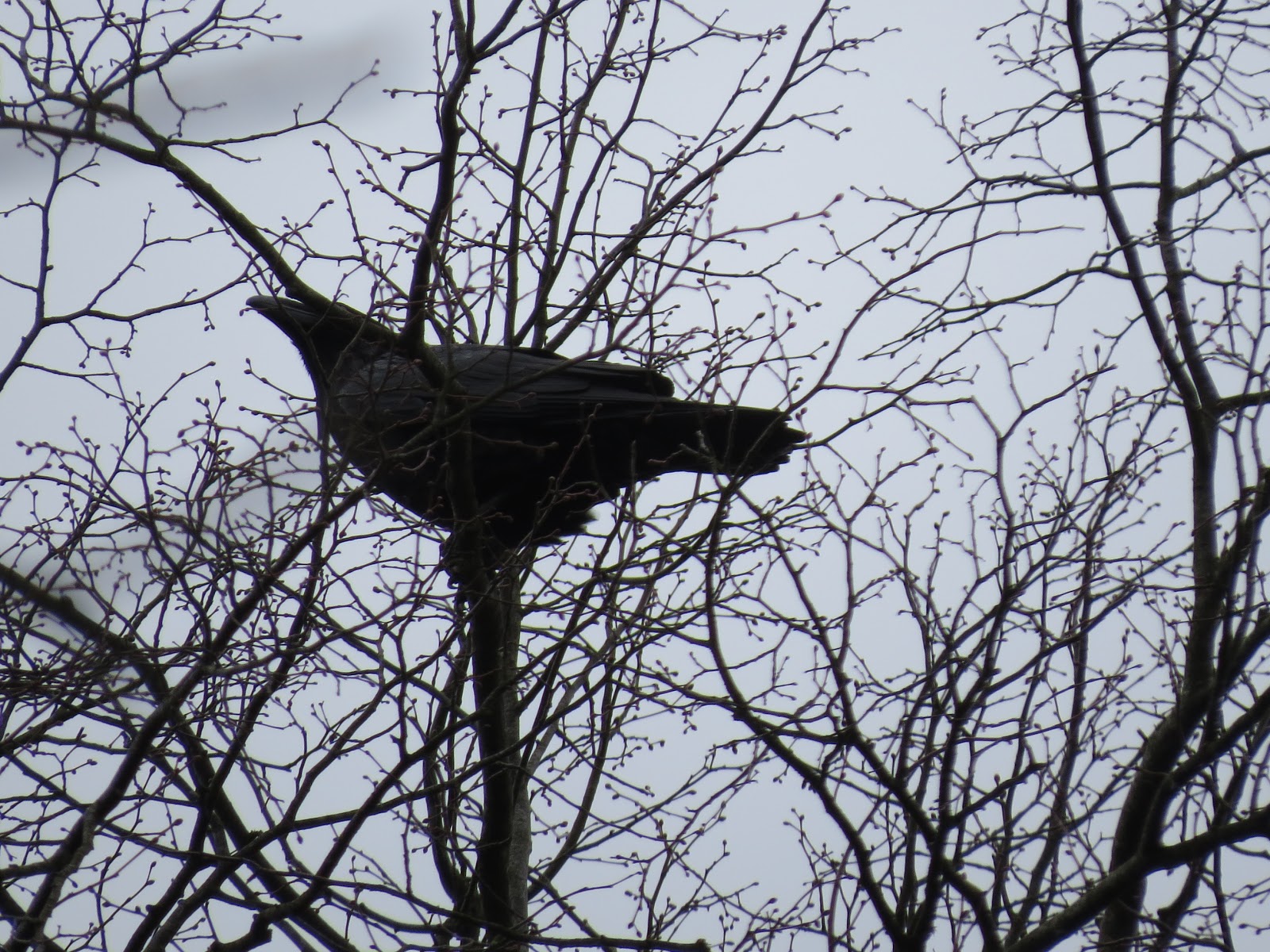
At first I had absolutely no idea where this was coming from other than behind me. I spun around and coming down the valley was this big fella. All the while soft contact calling to an bird which I never saw. But I think it might have been in a large Cyprus tree. Why did I think that? Well this raven alighted in the Cyprus and let out a number of contact calls. I couldn't see anything else as the needles were too thick, but given in the lowlands ravens love to nest in big conifers, an educated guess makes me think. After five or 10 minutes this raven then flew to neighbouring trees, calling again, then flying past the Cyprus and back to another tree. Amazingly ravens are thought to have over a hundred contact calls and today this chap was using a number of them. Soft whistles, a range of varying croop croop, a sort of low pitched whistle and many more.


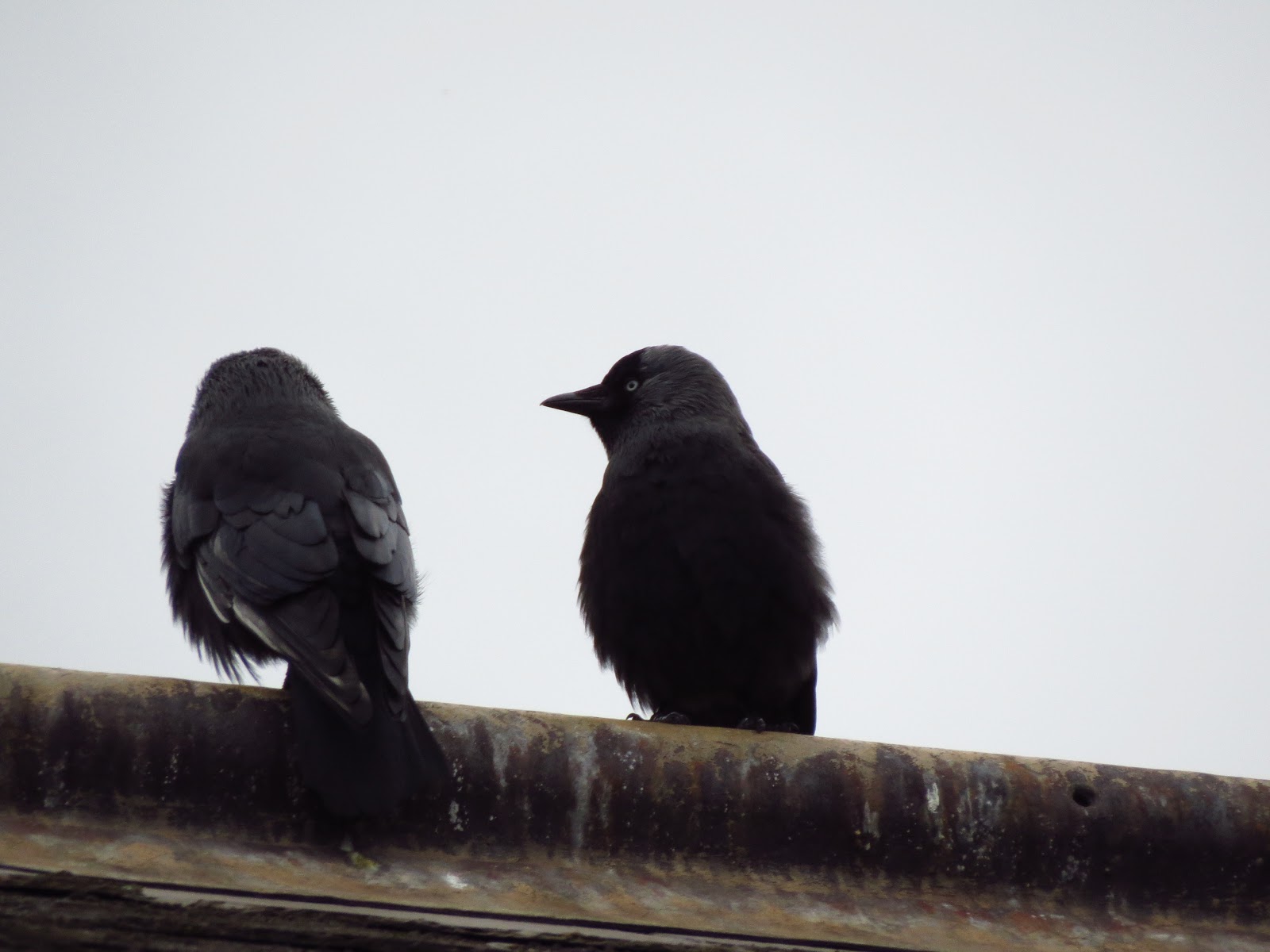
This image I love. The tree was immense, and tall, well over 50-60 feet or more. And on a slope. I stood under another tree and using my camera's fancy electronics managed a few images. But this one is my favourite. It just says, don't mess with me. Though of course we should never use anthropomorphism. Joining in with the ravens regalia, a general corvid cocophany was taking place where a number of rooks and jackdaw were either holding territories or like this pair down by the cafe, pair bonding. Impossible to show in a still image but the top bird was doing a lot of tail waggling to her mate below. This chimney stack is obviously prime real estate and a good display is definitely needed. Recently it's been suggested that jackdaws can interpret a human stare (Jackdaws are almost unique in birds in that they use eye movement for communication). I wonder then what they thought of me sitting below them, staring up at all this intimate behaviour... human voyeurism I bet!


Tuesday, 25 December 2018

Jackdaw Roost on Christmas Day


What better way to spend Christmas Day evening than immersing oneself in jackdaws.  Following the Festive Fare, I headed off to West Boldon village in Tyneside with my wife. Fresh air and a bit of exercise wrapped up in something which had intrigued me the day before. 

I was born and spent the first few faltering years of my life in West Boldon, then an urban rural district, now part of the great conurbation of the North East. Back then there were 12 farms and numerous market gardens. It's where I cut my natural history teeth. But back in the 1970's apart from a rookery in the next village, I can not recall a massed jackdaw roost. Yet on Christmas Eve driving back to my parents I spied a huge gathering of jackdaws over the old part of the village. 


Which is why at about 3.30pm I stood under this black snow. Very difficult to count them but I'd suggest 1000 as there were a hundred + in each tree in all directions. Just magical spending thirty minutes or so as the dusk gathered being enthralled by these birds. Very few rooks as far as I could tell, just jack-a-jack jackdaws, coming home to roost. The best Christmas present ever.