A

A
Showing posts with label North Somerset. Show all posts

Monday, 14 August 2023

Yatton Moth Trapping : Mid August weekend part 2

 As if Saturday's trip out to West Somerset and a wildflower field wasn't enough, at 8.30 am on Sunday I found myself driving the 8 miles or so to a friend of mine's garden in North Somerset, where, despite the rain and the wind the evening before, a moth trap had been set up the previous night. 


Higgy (for he is a man of one name) had long been trying to organise a moth trapping event for the local conservation group YACWAG (Yatton And Congresbury Wildlife Action Group) of which he is a member. This planning had been going on for weeks, but with the recent run of wet and windy weekends all attempts to fire up the moth trap had been cancelled. However this weekend despite the weather forecast being at best 'iffy' Higgy informed me the trap would be lit and come-what-may it is going ahead so come to the garden at 9am when all will be revealed. I arrived at ten to 9 in the morning, the only person at that point.

Now, I have been to moth trapping set ups before but in every case I'd been there for work. Fascinating though they were at the time, I was there to record radio programmes so having to concentrate on that I always left having absolutely no idea what I'd seen. This then would be my very first participation moment for the reveal, and I wasn't disappointed, though as 9am came and went for a while I feared no one else would turn up.


Higgy's garden is a wildlife haven - the width of a 1960's house, the garden is long, and beyond the fence he also owns a slice of the field at the back. In fact this is where YACWAG are interesting, as not only are they an excellent conservation group who run events, provide advice and can undertake surveys, but YACWAG own parcels of land around the two villages in North Somerset and once in their ownership that land is managed solely for wildlife. That alone makes it a remarkable local conservation organisation.

Not only had the trap been set up the night before but Higgy had been up since first light emptying the trap and placing examples of the 283 individual moths caught that night into specimen tubes and arranging them for us to peer at.  It was now well after 9am and I was still the only person and that made me feel sad for Higgy over the work and effort he'd put in, but eventually we swelled to a group of 4 other plus his daughter who was asked to be chief moth releaser, as all moths were released once identified. Enough people really otherwise it would become unwieldy, and as a group we set to flicking through the books and listening to Higgy's hints and tips while gazing manically at an as yet unidentified brown moth in a specimen tube. 


Some I recognised immediately like this Jersey Tiger [Euplagia quadripunctaria]. This year has been phenomenal down south for these fabulous looking moths, who seem to be exploding northwards due to climate changes. Five were caught overnight, which is interesting given they are a day flying moth. We quickly got through the easy ones, elephant hawk-moth, box bush moth, and then came the difficult ones. I was hopeless, and at one point resorted to Google Lens to identify a moth. I may end up being ex-communicated for that, but I was intrigued to see how accurate it was - as it turned out 100% and in less than 2 seconds. Impressive. But that's why I'd come, to learn. Everyone was helping each other while helping themselves to scones or flapjack made by Higgy's wife. There were far too many moths to photograph but my particular highlights were....


Uncertain moth [Hoplodrina octogenaria] - 45 caught overnight. What a beast to identify for a beginner. Scanning the books there are about a 100 near identical moths. [Update - this is a Common rustic agg. Thanks Stewart - turns out this is also how it was identified on the day - I messed up with my notes] 


Grey Dagger - [Acronicta psi] - 3 caught overnight. I loved this moth, don't think I've seen it before but its markings just say its name.  I've long loved moth names, they're so flamboyant.


Flame Carpet - Xanthorhoe designata - just the one caught overnight and it took us a good 30 minutes to work out what it was. There are so many similar species, it's going to be a while before I get my knowledge, and eye in.


Now this was my all time favourite of the day - Gold Spot - [Plusia festucae ] of which 11 were caught overnight. What a moth with it's triceratops looking shoulder plate, and burnished gold spots, it was like an art deco jewel. Loved it.
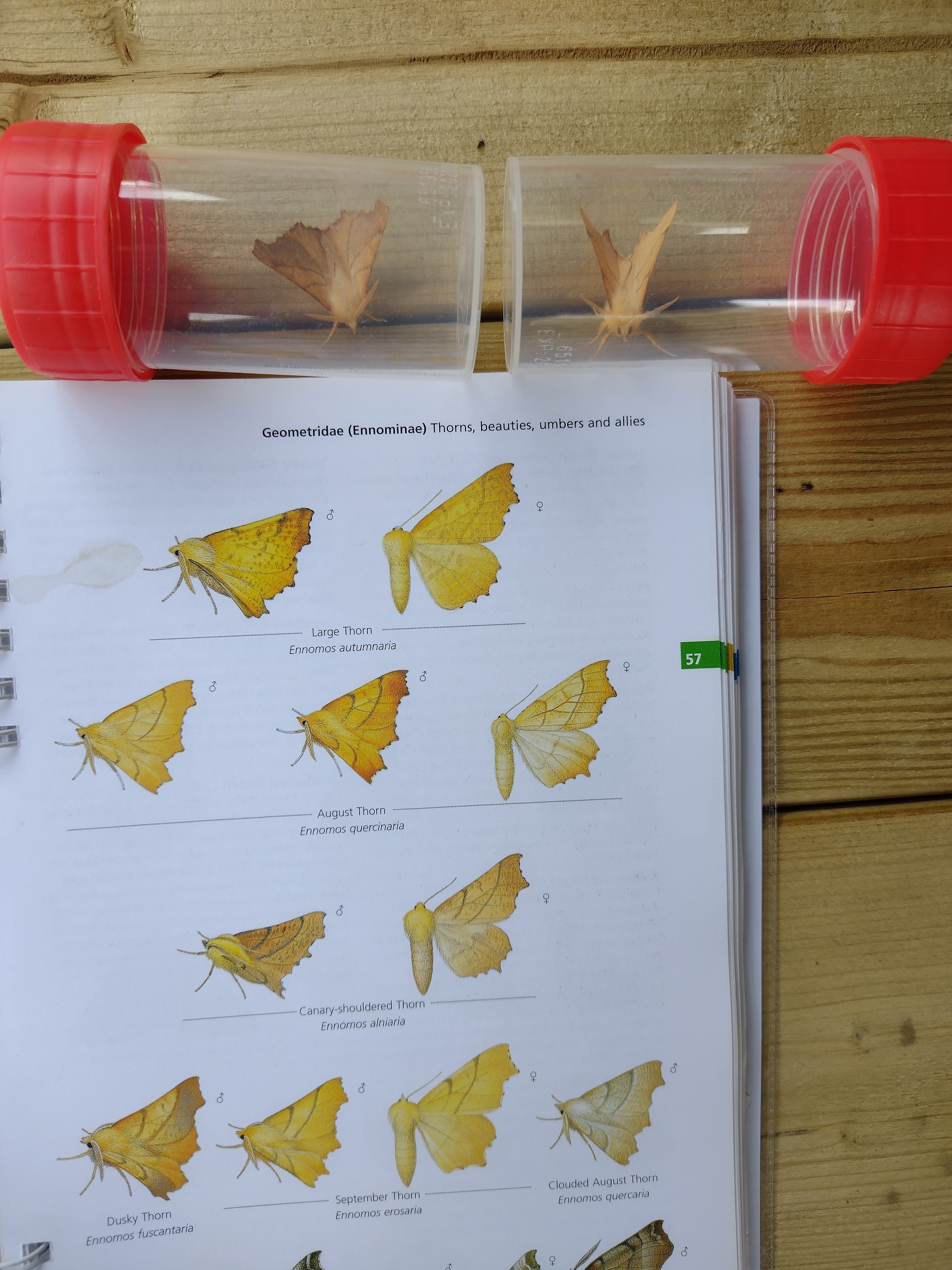

These two were interesting - I identified them as September Thorn - [Ennomos erosaria] on the right and a Dusky Thorn - [Ennomos fuscantaria] on the left. Just one of each caught overnight but Higgy was impressed I worked out they were different species of thorn moth, which is why they're photographed next to the book. In a later write up of the day for the YACWAG group I get a mention..

" I should mention Andrew J Dawes who is now my official 'September Thorn Moth & Dusky Thorn Moth' expert!"

Which fails to recognise that next week if I saw anything like this I'd fail to even recognise it as a thorn spp.


Now this beauty had us all foxed, I could see Higgy enjoying our discomfort of scratching heads and endless flicking through the identification books. After many attempts (and more than a little help) we finally got to Setaceous Hebrew Character - [Xestia c-nigrum] of which 12 were caught. Another stunning moth. I was getting quite into this.


And finally this one had us all completely stumped. Eventually we gave up and Higgy let us know that it was a Swallow Prominent - [Pheosia tremula] of which there were 2 caught. A lot of discussion took place over whether this was actually a Scarce Swallow Prominent, and in the end why it wasn't, none of which I remember writing this. 

But what a fabulous morning, three hours in the end and what I didn't realise until later was this event was being run as part of a YACWAG's "wellness-walks programme" aimed at getting people out into nature. Well we certainly did get involved and I absolutely loved it. In total 53 species were identified, which Higgy mentioned was quite low for his garden due to the weather, he can regularly collect 400 individuals and near 100 species. Amazing really from a garden that is no bigger than a cricket wicket. 

After everyone had gone Higgy and I had a chat and he invited me back one night to see the trap running and identify the moths as they come in, while having a few beers. Now that sounds like a good moth trapping experience to me. I can't wait.

YACWAGS website  https://yacwag.org.uk/

Monday, 5 June 2023

The Fox, The Cat, and The Crow

The image accompanying this short post has absolutely nothing to do with what follows, however I observed this earlier in the year at Wells Cathedral and it made me smile.


More recently for the last few nights the carrion crows in the area have been kicking up one heck of a din around and after midnight. Nights of course are short in June but this raucous harsh cawwing has pierced the silence of the darkness and has continued regularly for the last week or so. I first heard this commotion about 11.30pm one night as I stood in the garden before bed. Alerted to the noise I could see the carrion crows flying about silhouetted against the still feint blue sky to the west, but that was all. No other sound aside from their caw-caw-caw. On another occasion there was an almighty din coming from the field at the rear of the house at around 1 am. In that instance two maybe three crows were being very vocal and moving about quickly. I suspected there was a nocturnal predator about but couldn't see anything or be certain. 

But now I think I have solved the mystery - a fox. 

We have a lot of foxes around there, making best use of the mixed habitat of the very rural landscape all the way to the sea and the very built up suburbia with scavenging opportunities. Each of these two habitats is separated by the lane which runs behind our house to the village itself. On Friday night, or should I say at 2am on Saturday, our cat who is a fully trained mafia boss woke me up for a feed.  Duly fed he popped outside to sit on the drive, something he regularly does after a handsome meal. Moments later there was an explosion of caw-caw-caw from the trees behind me. The calling drew closer accompanied by wingbeats and then across the street a fox casually lolloped along the front gardens of the houses opposite, being followed, well below roof height, by a pair of crows becoming more agitated by the minute. Eventually the fox leapt up over a fence and went behind another house, closely followed by the noisy sentinels. After what seemed an age but was more likely only a minute the noise of the crows faded then died away, silence resumed. 

Gingernut our cat sat on the drive watching this unfold with resigned bemusement. He is a marvellous cat as he has absolutely no interest in birds and simply observes them even if he and they are on the lawn together. The resident hedgehog likewise gets a wide birth. I put it down to intelligence on his part after I educated him to not kill wildlife. Mrs Wessex-Reiver says he's conserving his energy as it is beneath him to react as it would be far too much effort to chase after a prey item. She may be right.

The question then on my lips is are the crows and fox interacting because of disturbance? Or, more likely, are young fledgling crows about that I can't see and the adults are simply being good parents? From what I saw of the fox it was patrolling the gardens not trying to get at something intently like a stricken bird on the ground. I can't be 100% certain every carrion crow cawing at night has been due to the fox as in the behaviour I witnessed, but it makes reasonable sense as foxes are a nightly occurrence, though of course rats or other cats may be to the creator of this darkest hour pandemonium on other occasions.

It is not the first time Gingernut our cat and the local foxes have been together. I suspect there is some interaction of sorts going on as he leads a very much nocturnal life. A month or so back I was woken by the foxes trashing a neighbours recycling boxes. Leaning out the bedroom window there were two foxes who seeing me fled down the street. Moments later Gingernut appeared from the exact same area as the recycling boxes and foxes and nonchalantly trotted over the road and into the house with an air of "nothing to see here". Was he across there with the foxes all three trashing the recycling boxes, or was he simply innocently passing? I have my suspicions he was with them and interacting to a greater or lesser degree with them as I've seen him twice now watching a fox intently on our drive, well before I have. 

Non peer-reviewed research suggests foxes and cats do interact and by and large there is no combative competition. Foxes being bigger could of course kill a cat, but cats are mean street fighters and observational research suggests foxes avoid cats due to the latter's claws and lightning fast reflexes. Even Gingernut who we think is about twelve or 13 years old can show remarkable ferocity when the neighbourhood cats enter the garden, though with the street domiciled fox, he just watches the fox trot by, which is why I have my suspicions he is a feline co-ordinator of this mayhem, like a ginger Godfather.

Now - I just need a good, unbroken, night of sleep......

Further reading  : 

Are foxes a threat to cats (2014)
http://www.catbehaviourist.com/blog/study-certified-cat-behaviourist-anita-kelsey/


Tuesday, 6 December 2022

Mixed corvid roosts


A couple of days ago I was entertained by what can loosely be described as 'a murmuration' of corvids. Of course that noun is mostly used in reference to starlings, yet on that morning what I witnessed was perfectly summed up by the word murmuration.

Corvid roosts are well known for providing spectacular displays overhead. I was once invited to view the famous Maddingly roost in Cambridgeshire with scientists from that University. On that wonderful day it was breath-taking to watch thousands of rook and jackdaw not only alight en-masse at dawn, but provide unbelievable aerial displays in the evening as they came into the roost site. What a privilege to be in amongst them, and what a noise!

And it was the noise earlier this week which caught my attention as to what on earth was going on. It was a few minutes before dawn, and in that half light a cacophony of rook and jackdaw calls drifted to me from the fields behind the house. I watched from the bedroom window. This mixed flock of around two hundred was moving swiftly and acrobatically over the fields. Some birds alighting on trees, others simply playing with the wind. Repeatedly they grouped together like black snow, twisting and turning before moving out over the landscape only to then return moments later and repeat this acrobatic show. On the side-lines carrion crow joined in and at one point a raven flew through the melee cronking loudly. I've seen these mixed flocks many times before, as I mentioned above, but always at or near to the roost site. This more recent event was across flat fields and over 2 miles from the nearest roost site on Worlebury Hill just to the south. It was all very much part of the normal behaviour of corvids at dawn as they reaffirm social bonds, however in the 20 years I've lived here I've never seen this over these particular fields. Had this flock been disturbed in the roost site and amassed over fields awaiting dawn? I wasn't sure but it was a wonderful fifteen or so minutes as the light improved.


I mentioned what I'd seen on Facebook and my friend Chris Sperring came back with an open invite to come and see his roosting corvids. These are 15 miles north of me (as the crow flies) and he mentioned that he has observed a number of ravens 'herding' jackdaw as they arrive over the woods, herding them to a specific area of the wood and therefore presumably the right part of the wood, in raven terms, to roost in. Raven have increased dramatically in this area and so later he posted a Facebook Live where indeed a dozen or so raven seemed intent on chaperoning the jackdaw to the part of the woodland the ravens wanted the smaller corvid to use that night. Time and time again watching that video, raven rose up from their perch in trees and flew with and around the jackdaw until the latter settled, with the raven then returning to their tree and waiting the next influx of jackdaw. I'll have to visit and see this for myself.

I'd not heard of this ravens providing a guard or a herding behaviour with jackdaw, or rook for that matter, so later in the evening I did a little research. Mentioned within Raven in Winter by Bernd Heinrich is an intriguing mention of Raven in Wales by W. A Cadman. In this observation from 1947 mixed flocks of corvids were observed coming to a roost with the ravens at the periphery of roost activity. This led me to another article by H. G Hurrell, A Raven Roost in Devon from 1955-56.  This was fascinating. A raven pair held a 5 acre wood as territory. While they did, they had the wood to themselves. Eventually they disappeared and a number of raven began using the wood as a winter roost, eventually over 80. However once the number of raven at the roost increased jackdaw then came to the wood and roosted there too. The summary therefore suggests that ravens provided security and support for the smaller jackdaw, both benefitting through collective feeding and roosting behaviour.

All very intriguing and leaving me wanting to know more. Are corvid roosting patterns, and indeed behaviour changing as the number of raven in lowland Britain increases? Certainly in the raven roost north of me, when I lived up that way in the mid 1990's you'd never see a raven, or maybe once a year as it flew by. Now Chris tells me 20, 30, 40 are not uncommon at night, every night.  Do these intelligent birds have a threshold number after which their influence to smaller corvids is triggered. I have read studies of ravens at a roost and there seems to be information intelligence happening, with some observations suggesting as one raven arrives one raven departs to prevent overcrowding, in other words they, the collective ravens at the roost maintain the numbers there at any one time through observation and communication amongst themselves. Society in fact. 

Whilst persecuted in the past, ravens were often describes as solitary pairs, driven to upland and wild areas. In fact throughout history ravens have been gregarious, lowland inhabiting birds, and who knows, the catalyst for extraordinary mixed corvid flocks, and behaviour as seen recently at the roost site? I simply don't know nor have the answers yet, but I have a feeling this question is going to return to me over and over again this winter, and so, I must visit that roost in the Gordano Valley and see for myself.

Monday, 26 September 2022

The Quiet Garden


The sun is out, Gingernut the cat relaxes on the shed. Our sunflower triffids look terrific in the morning sun - and yet - It is that time of year already. 

Summer memories of no rain for weeks and temperatures reaching record breaking levels seem a long way distance. The garden is still in bloom, though this is an illusion. Emergent growth is largely absence, developing growth too. Decay is arriving as the garden moves imperceptibly into that state of stasis between summer bountiful and winter famine. And while the light levels have remained good with temperatures above average, the status quo which ostensibly allowed us to enjoy these few precious days has changing. We've passed the Equinox.


At the weekend we took down the runner beans. The last few pods were blackening and unappealing. A mound of jumbled sticks appeared on the patio. One of my favourite jobs - creating order - cutting off all the string and other attachments, assessing cane structural integrity and putting them neatly away for another year. At sometime in the near distant I or Julie will have tied in the runner beans new foliage. Struggling with rampant growth we'd have tied in tendrils with string after string for days. Now in late September that long forgotten effort to control is no longer needed, the string's supporting time, like that of the beans is at an end. Sorting and unravelling the activity of summer is a pleasant job on a sunny September afternoon, but it reminds painfully that the days shorten.


The garden is quiet of wildlife now. Birds do still come to the feeders but in ones and two's, unlike in spring when the rush to breed saps avian energy, energy eagerly replenished at the smorgasbord we provision like a bandit gang of unruly teenagers. Garden snails have been a nuisance this year, if only we could encourage a song thrush. This mature one with gorgeous markings is wedged into the middle of the greenhouse door, happily sliding back and forth as we wander in and out sorting through the pots.


The tomatoes have now all been removed. Cane tops back in the storage plant pot alongside those bits and bobs we find are very useful to keep 'just in case' but in reality are never ever used again. Not much now fills the greenhouse, some lettuce seedlings are coming up on the ground bed and a lone spinach seedling fights for freedom on the bench.  Mostly it is simply quiet contemplative sorting. Pots washed and stacked up ready for a proper sort out on one of those days when in mid-winter we want to be outside but in reality it's too cold and too dark. A few hours in such a mood in the mid December greenhouse satisfies the most primeval of our needs. 


Garden spiders are ever present too - every gap decorated with a web of huge proportions. Today is the first for a while where the wind has picked up. With each gust they jostle and gyrate but remain steadfastly on station in the hope a passing fly will entrap itself. In the summer we had numerous nest explode with spiderlings. They are amazing at that stage where the slightest threat sees hundreds dart away in all directions only to slowly return to a formation of safety in numbers. Those minute humbug spiders, now demand respect in the foliage.


It's that time of year already and a time of year many people enjoy. Quiet reflective times. The heat of summer has gone, the bare nature of winter is yet to come. A time to reflect, to take stock, and plan ahead. Next week I shall be sowing the sweet peas whose seed I harvested on the 9th of August this year. All being well, come early May they will begin to bloom, a past continuity to the future. 

I really do like this time of year and just occasionally in the silence of the garden is broken. The robin reminds me his territory is being established with song, reminding us all that it is not long then until nature begins the cycle of rebirth once more. 

Christmas first though, 90 days away today. Time to light the candles.

Saturday, 13 October 2018

Jackdaws, 12 o'clock (well actually 17.35hrs)

Believe it or not, this image below was taken at 5.45pm. It could be black and white but I assure you it's colour. As I write this at 17.50, lights on and it is absolutely lashing down.


I was meant to be on the Malvern Hills today. Myself , Mr W (who presents Radio 4 wildlife programmes) and Mr C (possibly the best, but now ex BBC natural history librarian) had a long standing plan to head off to the Malverns and bag a ring ouzel or two. Migration is in full swing, I heard my first redwing on Thursday night. Mr W had been to the Golden Valley area of the Malverns during the week and saw 8 ring ouzel.  

They say we can control everything other than death, repeats of Dad's Army and the weather. Yesterday a few hundred miles to the south ex hurricane Leslie was barrelling up the Atlantic towards Blighty. By Thursday this now tropical depression was intensifying, to the point where in Eire they renamed it Storm Callum. The media went wild, there was a hooley a-coming. Yesterday (the planned day of Armagheddon) in Somerset at least it was wild, but not as bad as everyone feared. Wales and the North West bore the brunt of it. Today the forecast was for strong winds and rain, thus we abandoned the Malvern birding day.  I awoke early and it was a fantastic day. Certainly it was windy, but the rain had gone, and by the afternoon it was sunny. 

I sat in the garden for a while. Small pirouetting flocks of starling, gulls, pied wagtails, linnets and sparrows shot across the garden, energised by the tail wind from the tropics. Making a day at home seem worth while, just watching intently what was going on. Ominously, dark, quite menacing storm clouds began to gather to the south just before 5pm. Above me blue skies and white cloud, 10 miles to the south it grew foreboding.  The wind intensified (though it had been giving it some energy all day) and I watched. 


It is fascinating watching a weather system heading towards you. Suddenly everything changed. The sky was filled with gulls heading inland. Normally at this time they are heading out to their roosts on  Flat and Steep Holm islands in the Bristol Channel. Not today. The sparrows departed the feeders and one by one headed into the roof space of the house. And then I heard the familiar jak-a-jak-jack of the jackdaws, but nearly an hour earlier than normal. At the moment they are heading to roost about 6.15pm to 6.30pm depending on how light dusk is. But at 5.25pm I heard the first wave. How they pass the house each day is always the same. 

The first and often the biggest wave is a ragtag flock of about 50 to 100 birds, and can include rooks, in the image above. They are very noisy, chaotically formed as a flock with no obvious pairs visible. These are probably the family parties coming in with less experienced birds, maybe this years young with parents, unattached adults, older birds. This organic melee of individual birds flies as a single uncoordinated mass high up across the sky. Then, about 10 minutes later, pairs of jackdaws fly in but instead of a flock, a minute long stream of 20, 30, 40 paired up birds flying very low, very fast and in a direct straight line. Often these birds are silent, and in the morning when the process is reversed can be so low they are below roof height. Like black darts past the bedroom window. 

My guess, and I'd love to know for sure, is these are the dominant breeding pairs. The first wave are the scouts and pathfinders, checking the landscape to allow the second wave unhindered predator free airspace. But after this second wave it isn't over, there is a third. About about 5 minutes after the dominant pairs scud through, a second wave of paired jackdaws fly in. Obviously paired birds flying together, but higher up, in a more relaxed movement. Ostensibly each pair seemingly unconnected with those pairs around them, but they call repeatedly as they fly by in a single well spaced out group,  forming something of a coalition flock, as in the image below.


I may have missed out on a day birding on the Malvern Hills, but I absolutely love watching the jackdaws across the house each morning and evening. Their pre-roost is on Worlbury Hill about two miles away, and very noisy it is too. But the main night roost I've never found. I have my suspicions it is either by Kingston Seymour about 5 miles north of me, where I have observed jackdaws coming into a small wood at dusk. Or more likely, they fly up the coast to the extensive woods between Portishead and Clevedon, where there is a known mixed corvid roost.  I'm no Mark Cocker, but on reading his Crow Country, it warmed me to read he had the same trouble working out exactly where they went to, despite obvious clues. The trick is as with all things involving wildlife observation, planning, planning, and a lot of luck.

I didn't plan for storm Callum's arrival!!

Sunday, 6 December 2015

6th December - Project Month 12

Well that’s it.  Twelve months in the making and the final set of 17 photographs are in the bag. The wheel of the Year once more comes to rest in December.

It seems funny coming to the end of what was a short Project really, but one I have found fascinating for reasons I cannot explain.  Though I shall try.

The reason behind this Project was two fold. Firstly I wanted to mark my time here in North Somerset over the twelvemonth period. One day, and it may be far closer than I think, my time in this lovely area will stop. Nothing lasts forever. Hopefully that ending will not be for any serious or medical reasons, more that I may just move away from this area and what is now the familiar will recede into the memory.

Secondly I have long held an ambition to photograph a view on a regular basis as an endeavour to record that subtle change that occurs day by day but without record is often missed until like the first storm of winter, we realise the seasons have changed.  Until now I had not managed to do this. But now, I have succeeded.

What this Project did also allow me to do was fine tune what works as an image, and maybe more importantly what doesn’t work.  A couple of obvious learning points here was to plan the direction (and time) of an image carefully – evening photographs into sun often resulted in silhouettes at best. The scene is also important. A few images such as the barn and road don’t really change that much. My village view likewise apart from a few rogue waste and recycling bins didn’t change much either. It is a learning curve. Work in progress.  7/10 must do better.

Looking through these images across the year, these 17 unremarkable images in a way, the subtle change over the winter and high summer were almost indiscernible.  The astonishing changes in the spring and autumn show how these Equinoxial moods change the landscape with abandon.

For the moment I shall simply post these images as before in a haphazard way for December; if time allows over Christmas I shall post each location on one posting, something like the twelve images of Christmas….  Observing the images en masse is a great way to see in an instance what had happened.

For these final images however what struck me more than anything was that it was so warm, not like the beginning of winter at all – photographing in short sleeves in December is quite unusual.

Merry Christmas (when it comes)


Two ducks on the river

 
The last view of Puxton church

 
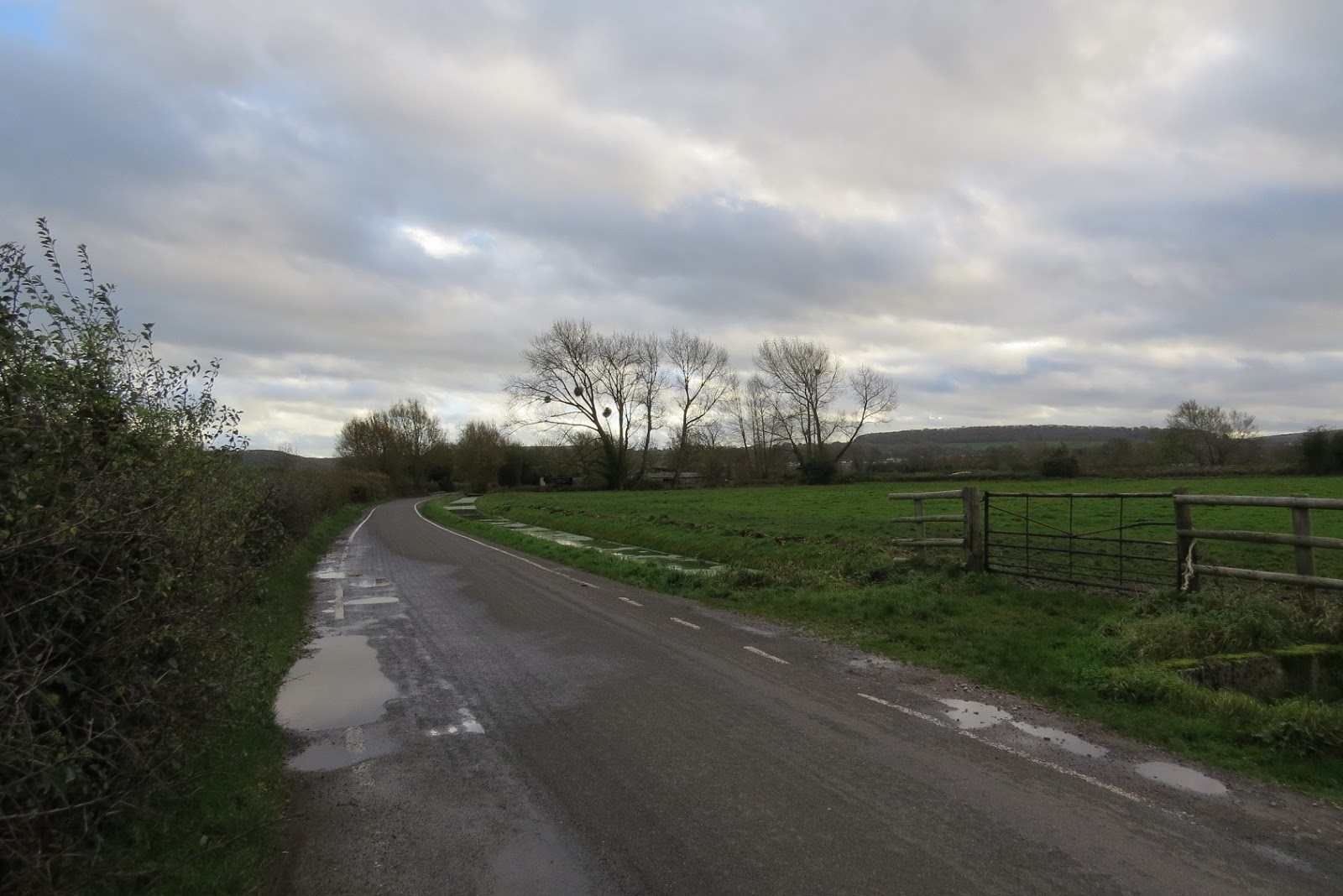
For once a dramatic sky over the lane

 
No more sheep in the orchard

 
The silent river

 
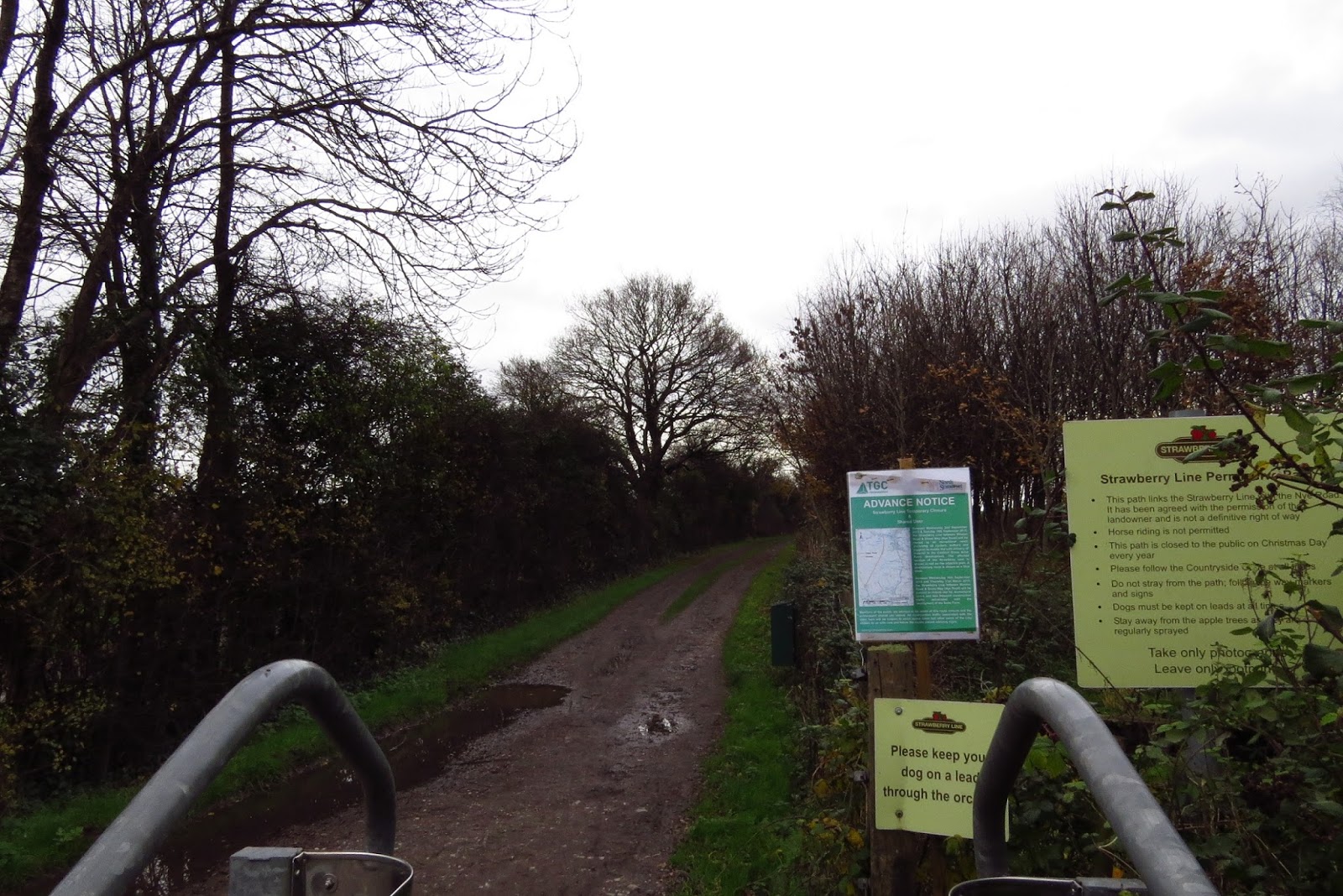
Strawberry Line puddles

 
Apples have all been picked - tomorrow's cider

 
I included the car passing as a sign of life in the village

 
Quiet corners.

 
Maize now harvested the fields left to recover

 
Cold looking river

 
Bare hedges

 
The dairy cows will stay - for a while at least

 
Late afternoon on the bridleway

 
That pink trug never moves

 
Wet, wet, wet.

 
Windblown sand in the foreground

Monday, 16 November 2015

November 15th - Project Month 11


Winter is knocking on the door. After what seems months of similar views, the difference between October and November's images was remarkable. As I'd expect. Suddenly the landscape seems stark, cold and wet. Indeed after an incredibly dry October early November has provided much needed rain. I struggled a lot with these images because of the rain, grabbing odd moments in between the showers, and the failing light levels now. In fact the final three images around Wick St Lawrence had to be taken a few days later because it was just too dark.

It was the feel and mood of the landscape that has changed so much in the 4 weeks. It feels now like the countryside is going into hibernation, a long well deserved sleep. Trees are now mostly bare, though leaves remain on the hedges. Pools of water litter the fields and while taking these images the familiar cackle of fieldfares overhead reminded me that when I began this project in January, fieldfares cackled over head. The year is coming full circle again. Next month, December will be my last month, astonishing to think this year has passed by so quickly.


Still dark after hours of rain, but blue skies arriving


A brief interlude of sunshine at Woodspring on Saturday evening


Barn track looking very soggy


Maize has been cut and the field resown


I seem to keep photographing the refuse days in the village


This years rook nests now seen again in the field


A lone horse rider in the far distance breaks up the scene


What this image does not show is how wet the graveyard was to walk over.


This lane never changes and I like it for its simplicity.


The River Banwell opening up again as the vegetation dies back


Sheep still in the orchard


Thatcher's cider trees now devoid of fruit - and a lot of mud where the tractors have been working


A soggy Strawberry line taken in the 5 minutes when it wasn't raining.


Taken a few days after the images above, Ebdon Bow bridge


Wins whipped hedge looking naked now


Soon seeing black and white cows in this farm will be no more. Sad, but that's farming for you, its a business.

Next and final images 5th and 6th of December.