A

A
Showing posts with label wildlife. Show all posts

Sunday, 7 May 2023

The Diminutive Wildflower Meadow....

I have what can laughingly be described as a wildflower meadow. But it works. In the middle of the circular lawn in our small semi rural garden, over the last five years I've developed this meadowland. I say meadowland but in reality it is a 2m circle of not cutting the grass until August with additional planting. 


The planting here is a mix of naturalising garden bulbs, snowdrop and crocus first, followed by daffodil and tulip. Lesser celendine, primrose, dandelion and cowslip are also present and encouraged. Later in the year fox and cubs will dominate before the grasses overtake everything. This year I was thrilled to see my alba fritillary in flower. This was especially joyous as I bought 12 dried shriveled corms last October for 50p, mostly as I don't like to see garden centres throwing out unsold stock. Despite these dessicated specimens looking truly dire, I planted them and crossed my fingers.


Of the twelve corms planted seven flowered. I'm hopeful then they will survive in the heavy clay, though not waterlogged, soil under the lawn.


Despite its insignificant size I love this little slice of unkempt in the garden, it changes by the week. To be honest the entire garden is wildlife friendly as Mrs Wessex Reiver being a professional plantswoman is of the organic persuasion. As am I.


The longer grass allows a small yellow meadow ant (Lasius flavus) colony to exist. Their soil 'molehill' is on sunny days alive with activity as the ants emerge from underground. Snails of all differing shapes and colours love the cover and humid vegetation too, a topic maybe for another day. But it is the accidental finds that enrich this corner of Somerset's biodiversity.


Yesterday after watching a little of the Coronation we spent an hour or so fettling the garden. It was while doing this I noticed a pair of orange bugs upto naughties in the long grass. I had an inkling what they were but thanks to the power of Google Lens, which is an amazing bit of technology, they were confirmed as cinnamon bugs (Corizus hyoscyami). I've never seen this bug species in the garden before. Difficult to photograph in situ so after they'd ahem finished I tried to do better by placing them in a plant saucer. Not great but enough to identify them. I then returned them.


I'm no entomologist so reading up on these beautiful looking bugs I noted that until recently they were localised in sandy habitats around the coasts of southern Britain, but recently (climate change?) this species range is expanding north and into an eclectic mix of habitats inland. So that's why they're in my garden. It's an eclectic habitat! And they weren't the only recent arrival to the garden.


Earlier in the week I stood admiring the cowslip,  which from one self seeded plant three years ago now number around a dozen. On one stem was a jewel-like blue beetle, resembling a dark blue marble with legs. Various ground beetles went through my mind but I had a notion this was different. 


And it was. Thanks to my go-to encyclopaedia of all British wildlife, Brett, he confirmed what I'd half thought; (Agelastica alni), the alder leaf beetle. Wow. I say wow as this beetle was thought extinct in the UK. Then in 2004 it was found in Manchester, seemingly brought in on plant stock imports. From there it slowly spread across the north midlands, before being found in a second area in southern England around a decade ago. It is spreading.

Brett informed me there is a very healthy population on the Somerset Levels where there is unsurprisingly a large number of alder. As they fly he suggested, despite no alders being near our garden, the one on my cowslip would be flight-resting between alders. Fascinating.


Definitely a first for the garden. I've not seen it since that day, assuming therefore its onwards travel to an alder has taken place.

But all this goes to show, a tiny bit of wild meadow even in a small garden can attract the most interesting of discoveries. I wonder what the next rarity will be? Osprey maybe on the 40cm pond?

Sunday, 15 November 2020

November has a sound; silence


Is there a sound to November? Or do I mean the month of November has its own sounds? I'm not sure as for me the dominant sound in November is silence. The dominant feeling stillness. On reflection November has a sound that no other month has. It is hard to explain but then on one day I realise that November has arrived. 

In his book The Quiet Fields, the writer BB describes this beautifully in his entry for November 2nd. He begins: [page 175] 

"The sudden arrival of true winter has taken me unawares. It seems only yesterday that the sun shone with warmth enough to tempt a late tortoiseshell to the fading Michaelmas daisies...." 

 He continues [p177] 

" Standing on the lawn this early evening - watching the last sad yellow leaves of the birches drift down to the dark sepia brown of the pond, I had a sudden surge of excitement that winter is almost here again - maybe it was an almost animal awareness hard to explain.... "

This still silent sound of the eleventh month appears as if by osmosis. A time when autumn has almost forgotten why it exists. Is winter here yet? Not quite, but I've lost interest and need to slow down. The sound of silence is accompanied by stillness which provides the release of an emotional connection in me at this time of the year. It's an emotion I love so much. 

Even in late October, although the days are short, the sun may still shine strong and warm, the last of the summer migrant birds are heading south, too soon yet for their winter replacements. In October the remnants of summer bounty cling on in the hedgerow larder, keeping harsh winter at bay much as lichen does on the lee of an exposed mountain wall. Then, on a single day, a day no official diary will note, the feeling changes. November is still autumn yet it cloaks this season of mellow fruitfulness with a quiet veil of wintertide.

As BB himself did 40 years ago I found myself, just a few days ago, standing in the garden at dusk. The silence alerted me to the suggestion of stillness. In reality it was already there, it waited patiently for me to notice it. The countryside felt suddenly expanded, opened out, my hearing became distant, as if the ambiance of silence was coming from somewhere unseen in the far distance. Of course partly this is a lack of foliage in November. October storms have laid bare many trees, the air has less to resit its passing than in high summer when the rustle of leaves dominates. But there was not a breath in the air, not a bird song, nothing, just November's presence. 

Moments earlier a weak yellow sun falling towards the horizon shone beneath steel grey clouds which had dominated the sky all day. For a minute or so, just beyond the garden, the yellow leaves of a field maple were illuminated into a fire-glow of colour. But what a colour! As only witnessed in November pale buttermilk hues, with the intensity of a watercolour wash, lit every branch, before, as if by the flick of a switch, the sun fell to earth. The sky itself now took centre stage, creating its own emulsion of orange and indigo; the countryside equivalent of following the harmonious suggestions of an artists colour wheel. Larger trees were now silhouetted, contrasting with the vibrancy beyond. Slowly that hue faded as dusk advanced, indigo deepened and I observed all was quiet, all was still, all was very November. 

A few days later, a number of starlings are chattering on the roof. Not the urgent banter of spring when all efforts focus towards raising a successful brood or two. In November their toil is over, simply the relaxed contact calls of adults and offspring,  like a gaggle of gossiping farmers in the auction mart weighing up cattle. Wheezes, shwees, sqwarks, high pitched rapid fire rattling chat, responding replies, all cascade from the rooftop. They nest and roost in the eves of the house and though I can't see them, there may be half a dozen birds. Starlings chatter and bicker all year of course, but in November their constant communication throws me back to winters in Newcastle, a time when thousands of starlings would come in to roost high above the Christmas shoppers below in Northumberland Street. As a child I would listen to this deafening chorus in amazement, a sound way  higher than the passing traffic, not knowing I was witnessing something which no longer occurs. Today town roosts are a thing of the past as health and safety took over the cleansing of the streets via the netting of the rooves.

Winter has always been my birdwatching season. Maybe that is it, my November moment, my own animal awareness triggered possibly with the first seep seep of redwing flying unseen overhead in a starlit sky, their calls heralding the glory days of winter wildlife watching to come. 

A few days ago with the bedroom window open I listened to a pair of tawny owls somewhere beyond the garden. It was 1.30am, pitch black of course except for the bright moonshine of a waning moon. These two males were twoo-hooting their resolve to claim and hold a territory. Possibly two young males eager to stake their claim (tawny owls can lay their first eggs in February).  One was much closer, maybe they had negotiated their patch and delighted in confirming their prize. Whatever the reason this went on for a good half an hour, in-between times absolute silence in the still and surprisingly mild night air. In spring a little owl calls in the same field, summer too, but I have never heard them in autumn. Whereas tawny owls only tend to be heard in autumn and winter - owl dynamics at play.  While listening to their contact chat minutes passed and I was lulled off to sleep, only later to be woken before daybreak by a robin.

There's nothing unusual in that, robins are early singers, well before dawn, often starting in July, so by November they've got into their stride and most mornings perform their duty as dawn-herald. This particular morning was different. Maybe the moonlight, maybe the mildness of the dawn,  or maybe just because I'd not noticed before, a hesitant dawn chorus seemed to briefly occur. As I listened to the robin, the tik tik of a blackbird, maybe two could also be heard, a tuneless mallard flew somewhere in the night sky, a wren erupted into song in the hedge boundary. Herring gulls and lesser black back gulls flew noisily from their roost in the Bristol Channel islands. Inevitably a carrion crow barked its morning command and was replied to by a grey heron. I often hear grey herons at night as they move about the landscape, avoiding potential predators, sometimes I think it is a vixen if I'm half asleep.

It was by now a half light which in turn disturbed a dunnock whose contact calling somewhere beyond the garden added to this false dawn chorus. It was a mild morning, there was a stillness, sound travels farther in the leafless countryside. 

By the time the sparrows in the eves began chattering it was almost light. They are lazy in my book, nearly always the last to emerge to feed, like teenagers after a late night. I looked at my watch, 06.50am, and as I did so a redwing overshot the house. In twenty minutes ten birds could be heard calling at different times. As dawn choruses go it was paltry, obviously, but the sound of awakening avian species, chatting and communicating before the foraging day ahead was a pleasing start to a November day. 

As it became lighter, the daily flotilla of around 100 jackdaws passed over, noisily jak-a-jak-ing in their pairs or trios as they flew by. It amazes me how regular those jackdaws are, I can almost set my watch to their passing each day, heading south in the morning, and returning north in the evening at roughly 5 minutes earlier or later than the week before. Some days they fly so low over the garden, I'm above them if looking out of an upstairs window, today though they were high, noisily keeping the young birds in line. 

That hesitant dawn chorus is not the true November sound. What is are the myriad of contact calls as late afternoon merges into dusk. That is a favourite time of mine, to sit quietly and reflect on what is happening. Go for a walk across any farmland, ramble through a deciduous woodland, or sit on a hill at dusk and I can guarantee pheasants will call somewhere. There is something primeval in that pheasant call, especially if heard from a great distance. In the right habitat, blackbirds set up a continuous tik tik, or sep sep as they jostle and fidget before sleep. Robins of course who never seem able to sleep add to the melee, and wrens too. I recently watched the silhouette of a wren at dusk. Its diminutive plumpness shook with the effort of its song. Against a sunset sky this sound which has permeated down the centuries, spoke more to me of November stillness than I could imagine. But then it was off, into the hedge across the lane and out of sight, though not out of earshot.

I could suggest the November silence is also about corvids, rooks, carrion crow and increasingly ravens calling in the distant soundscape, their caws and chatter from an unseen stubble field, is of the season. If you are lucky on that wander, jays cackle alongside fieldfares high in the trees. It may be just here in Somerset, but I feel the once wary jay is becoming bold. I now see them flying over motorways with crops stuffed with acorns or in Bristol streets where they have always been a familiar sight and of course in the silent woods as they noisily fly away from you.  

It is the lack of other ambient sounds which heightens these and all bird calls. By November most insects have done their best, the woods and farmlands fall silent of their buzzing and stridulating. Summer migrants have left, taking with them their chattering and exotic song. Trees have mostly lost their leaves, hushing the gentle rustle of air through their branches. The ground is soft, footfall across grassland is mostly silent, the dry rustle of early autumn a faded echo. Sounds travel far, scent too in the all too still landscape.

At dusk there is that scent of November which is not replicated at other times of the year. Air inversions move moist aroma upwards from the still warm soil with the lightness of touches. It's a rich mix of earth-bound mycorrhizal, associations with dampness and the thousands of microorganisms decomposing the plentiful biomass of summer in readiness for the growth year ahead. There is nothing like it, especially if mixed with wood smoke from an unseen dwelling. That for me is November. To sit outdoors on a calm late autumn evening simply absorbing nature's bounty. Not every evening will have a robin sing, but I know it is there. Likewise the starling, sparrow and tawny owl. They'll be watching me, I am blind to them, and I simply watch the mist from my mug of tea, evaporating, spiraling upwards to oblivion, ever so quietly.

I began with a quote from The Quiet Fields by BB. At the end of his entry for November 2nd he references two giants of nature writing, W.H.Hudson and Richard Jefferies within the context and reflections on the changing seasons. 

[p178] "Certainly Richard Jefferies felt it, and Hudson also who was less of a dreamer than Jefferies, but with the same keen perception and with more literary skill"

BB's view is that to connect with this primitive 'outdoor' feeling, sudden and swiftly passing can only be felt by your true countryman - your sportsman - naturalist. That is the nub of all connection with nature, that connection, that primitive outdoor feeling none of us who feel it can really explain, it is simply primeval. Jefferies, Hudson and BB all came from that era of shooting game to becoming naturalists. It is a lost world to modern naturalists. Yet for centuries, longer maybe, people have listened to November's silence, watched the sun set and connected with the landscape and wildlife around them. It is thanks to BB and all those writers throughout history, who captured those long forgotten moments in November, that we the future reader can connect across time. As ever their writing stirs the soul into stillness, reflection and November.

Reference:

BB (1981) The Quiet Fields, illustrated by D.J Watkins-Pitchford. Michael Joseph. London 

Saturday, 10 February 2018

Hodson's House Herefordshire


Saturday night in the middle of February. Saturday night in the middle of nowhere. Outside, following an altogether pleasant day bedecked with more sunshine than had been foretold,  the wind has picked up, blowing pressure wave tunes through the poplars encircling the woodman's cottage in the dark, inky night. Tomorrow we are to be treated by plunging temperatures and later if we are lucky, a light snow shower or two. I'm in Herefordshire.


There are times when no matter how hard one looks, the right place never seems to materialise. Many a rural landscape have I have nodded an acquaintance too; both for work and for play. For years however the Welsh Marches (and for that matter Wales) were like a dark grey cloud on the sunny side of Wessex Reiver's visitors map. Colleagues, friends and many a TV programme would say, this beautiful remote corner of England (or Wales, as it is hard to tell sometimes) is a must to walkers, lovers of the outdoors, and middle aged fat blokes in a funny hat. But still I resisted. Then in 2011 I made a radio programme in Snowdonia (filmy ferns if you are interested - look it up). The presenter lived in Much Wenlock. There was nothing for it, over the Severn Bridge and hope I will be able to return to civilisation.

Well, like many epiphany moments, what we think of as places not worth a second look, are in fact much better than the hotspot tourist attractions loved by the Metropole second homers down the M4, right at Bristol and keep going  till the Atlantic surf spray obscures the windscreen.  Not that there is anything wrong with that but whole tracts of the country are wonderful and never, or infrequently visited. A couple of years ago I got lost in Nottinghamshire, ending up at Southwell, famed only for its race course. An enforced couple of hours revealed a fantastic town, home of the Bramley apple, an ancient historic minster amongst others. Yet, suggest a weeks holiday in Nottinghamshire and there will be sniggering in the back, I guarantee it. 

Not that Dorstone is off the beaten tourist track. Lying at the head of Herefordshire's Golden Valley, this area sandwiched between the Brecon Beacons and Hereford has long been a tourist destination. Yet this gem of a place was unknown to me until a friend put an advert for a woodman's cottage on Facebook last autumn. Where?  I had to look it up - still couldn't find it, but the self catering abode looked wonderful, I booked the week on the spot and arrived for the very first time last September. I'm now on my second visit, with the significant other, who loves it.


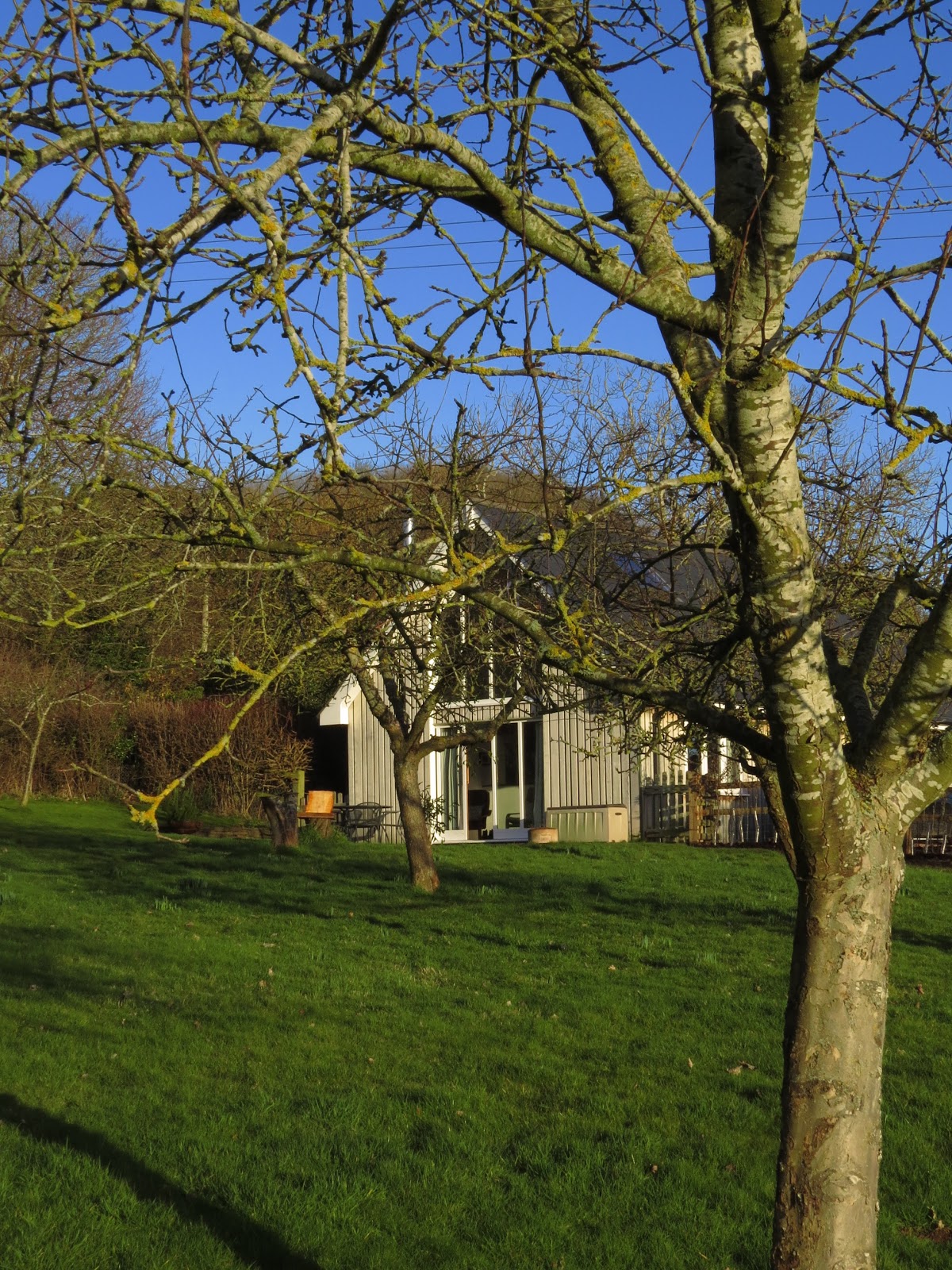
Hodsons's House  (above, grey building just left of the tree) nestles at the foot of Dorstone Hill seen in the background and well, fields. Hard by is the village of Dorstone, population about 400, and the Pandy Inn. And that's it. Yet within a gnats flight path there are fabulous walks, wonderful wildlife, ancient monuments, views that take your breath away, all without the need to get into a car. Last September we stumbled into the Den of Iniquity known as the Dorstone Front Room. Here in the former village post office residents take it in turn to offer tea, cake, printing, stamps, crafts, books, and a good chat. We only popped in for a cup of tea and left an hour later like long lost relatives embraced into the bosom of the valley. So that's why were back for a long weekend.


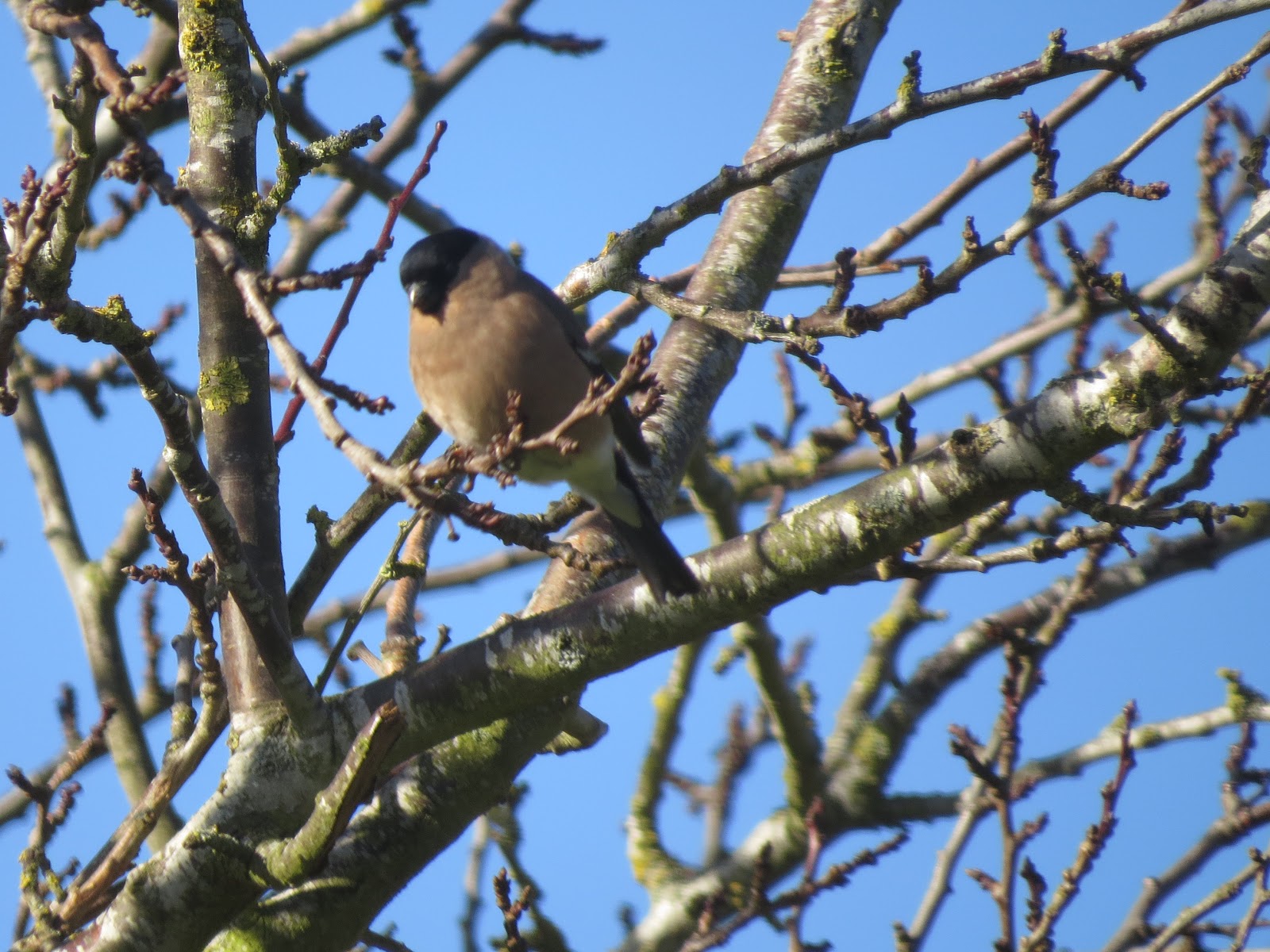
Snow had fallen on Friday morning, we could see it on the hills over the Bristol Channel and more planned over the weekend, which made for a slightly anxious packing. However the sun shone and more like a late spring day than late winter, we arrived just after noon. Kettle on, feet up, a bullfinch. Literally minutes after arriving this female bullfinch enthralled us for half an hour, debudding the fruit trees in the garden (not sure the owner would have approved). But that was the beginning of a wildlife odyssey in the garden. Nothing spectacular you understand, just lovely.


The images above were taken from indoors, from the large glass doors on the gable end of this house.


Hodson was a carpenter and woodsman. For many years this was his workshop and he designed a lot of it himself. As you can imagine there's a fair wedge of wood inside. The current owners came here a few years ago and modernised it with an open plan downstairs and astonishing mezzanine upper bedroom. We love the house, but it is the location that is the King's pyjamas. 

A log on the woodburner and a mug of tea in the hand, what better than to while away a whole day watching wildlife out the window. Last year they even made 150+ bottles of apple juice from their own trees, a much loved arrival gift indeed. Went down a treat with the homemade carrot cake also provisioned.


So what of the wildlife? We've heard enough of the house.  Well, apart from the bullfinch already mentioned, blackbirds a plenty...


.... dunnock, raven, great, blue and long tail tit, green woodpecker, fieldfare...

... tawny owl calling, a most glorious dusk chorus of tik tik-ing blackbirds and song thrush, chaffinches, sparrows, starlings, woodpigeons, and I'm sure I've forgotten many more, all seen from the window, as well as the cheeky grey squirrel.


But man can not live indoors for ever. Alongside the property is Spoon Lane, or as the Ordnance Survey calls it, "un-registered byway". Why Spoon Lane, I don't know but it is wet. Contour-lining along the base of the hill, various springs seems to weep and seep into this ancient trackway, providing, in winter at least, a small stream to walk along. Which we did, to the far end where there is an even ancienter (if that's a word) orchard on its last legs. Fabulous wildlife habitat.


The image below was taken in September 2017 - it is a wonderful walk, botanically rich.

Back in February 2018, the snowdrops are coming out and the skeletal hedges revealed a number of nests including this song thrush nest.

 Sadly we needed refreshment after the walk, where better then than to beetle across the fields and down a pint of Hereford's finest in the Pandy Inn. 


In the time it has taken to write this the wind has really pepped up, I can hear the roof slates chattering and occasionally the lights flicker. We're in for a wild night on a Saturday night in the middle of February. On a Saturday night in the middle of nowhere. Night all.

Friday, 3 June 2011

Gardening for Wildlife

Having been absent from the blog for a month now due to a hectic schedule, a quick update as I'm still hectic, but with work I went to see a very interesting trial at RHS Wisley last week. This went out as an item on Radio 4's Saving Species, but Helen Bostock of the RHS has just updated her blog. I thought you wildlife gardeners out there may be interested in this.

Plants for Bugs blog


More soon, I hope, after a mad dash to the Farnes, Wearside, Cornwall and then back to Yorkshire before the end of June..... keeps me off the streets I suppose :-)

Wednesday, 28 July 2010

Gardening by design

I'm in a musing sort of mode today, musing over something which has been flitting through my mind for a few months now, namely a plan, so far unformed, to have a sideline enterprise related to gardening. Julie (as a professional gardener) and I have many discussions over this looking ahead to 2011 when I finish my stint on Saving Species. I have in effect a career blank canvass in front of me, so now is the time to make a few preliminary doodles. My idea is something along the lines of gardening for emotions, but so far a unique idea hasn't formulated itself, as many other people also are doing something similar to this. I know there is something there I'm looking at but un-observing. Time will tell me what this is. However today I thought where better to shape and form an enterprise than on the blank canvass of my own back garden.

All my life gardening has been present in some form or another. Last night we were kindly invited to a BBQ by a producer on Saving Species for an end of current run celebration. I've known this producer for many years but have not visited their wonderful wildlife friendly home before.

The path up to the front door sets the scene exactly for what the rest of the garden is like. Exotically stuffed with flowers to attract as many insects and other wildlife as possible. Everywhere are bug boxes and tubes. On the water barrel, some bug boxes were temporarily left there before finding a home for them, and these unsecured domiciles can not now be moved as they are occupied by leaf-cutter bees happily stuffing leaves into the tubes. In the middle of the above photo is a sign, warning visitors of a subterranean wasps nest by the door.

Equally the back garden is just a myriad of pleasure, vegetables mixed in with shrubs and wild flowers, and so on an evening like last night the humm and buzz of wildlife made the heart beat just that little bit quicker as the sun danced amongst the foliage.

Returning home I looked at my own uncluttered and wildlife impoverished back garden. I've only been in this house since December 2009 and due to work commitments haven't really had a chance to do anything meaningful to change the layout. When I bought the house it had no borders or shrubs, being laid out as only lawn and decking, with a single silver birch along one edge. This suited the young family who lived here as they didn't have time, or interest to garden. It was an extension of their house for parties inclusive of 40 electric lights and a hot tub. Very easy to maintain, but not my style at all.

In the spring I did have time to dig a small border, with a tiny pond and erected an archway, but that is about all. The pond may be small but already a friendly frog has taken up residence, proving that even a tiny amount of water will bring wildlife in. I've also noticed diving beetles in there, and blanket weed from somewhere.

However this morning I spent a bit of time in the garden wandering about and wondering. In the 7 months I've been here I've not really had a chance to work out a plan. I think because there is so much decking, I can't see the wood for the trees, literally. My instinct is to dig it up as it is laid on gravel. But for the moment the decking does provide an easy to maintain hard area to sit on.

While having a cup of tea and wandering about, because of recent heavy rain, the lawn has emerged emerald green and is growing at an alarming rate. It needs cutting. So I had a thought. Instead of cutting the entire lawn tonight, I will shape beds into the lawn by mowing only part of it, therefore letting some of the grass grow longer. It's too late in the year to produce a wildflower meadow this season, but if I use the lawn as a blank canvass to draw (mow) on, I can amend the design at will before making bigger commitments (and mistakes). I also have problems with creating a wildflower meadow as this is heavy clay soil. But a good rummage through the Bright Seeds website has given me hope and inspiration.

So that's my plan, such as it is. I'd also like to get movement into the garden, and sound. As such I'm also wondering if I can construct an aeolian wind harp. Nothing as elaborate as those on this website here, but I did read an article about Mohican Wind Harps which interested me. Sand Bay my local piece of coastline has many huge pieces of driftwood brought in..... are there the bones for a wind harp to be found out there I wonder?

And so it begins. I've no timeline or plan, but any results will be sure to waft through to the blog. In the meantime I shall marvel at the ripe tomato from my much neglected outdoor plants. I bought the grow-bags and plants a month ago then didn't have time to stake them, so they're sprawling over the decking. But they are turning red!

And finally this website also interested me over the weekend..... after all we all have a need to sit back and enjoy the garden too...... now where is that bottle of wine? I must do more thinking !!