A

A
Showing posts with label Starlings. Show all posts

Sunday, 26 November 2023

The Unpredictable Draw of Nature

 As I prepared to upload the images for this posting a large flock of jackdaws has flown noisily past the back of the house. It happens every year. Every day during the winter months in the morning the daws flock noisily from their roost past our house at a very low level, so low I am at daw-level watching them from the bedroom window. Then in the afternoon they return in the reverse direction although they fly much higher over the fields at the back of the house heading to their roost, a roost that I've never actually discovered but suspect it's about 8 miles away in the woods near Clevedon.


I find winter a beautiful season, a season which if I'm truthful is the one time of the year when I have more of a craving to be outdoors observing nature than during the rest of the year.  Possibly this is to do with absorbing as much daylight as possible during these short autumnal days as they morph into the very dark days before Christmas. Or maybe it is the arrival of large winter flocks of birds to find food and shelter here away from their northern breeding grounds. Sometimes it is the sunlight light levels bursting through a crystal clear atmosphere such as I observed yesterday illuminating these reed feathers at the RSPB's Ham Wall nature reserve.


We'd arrived at Ham Wall to watch the starlings come into roost. In preference I tend to avoid visits these hot spots of nature watching at weekends as there are too many people about to observe more than the regular incumbents.  I made an exception yesterday. After the first frost of the season had blanketed the countryside in an iced dusting, the clear blue sky and surprisingly warm sunshine for the noted 5 degree temperature suggested a good day to see a starling murmuration over at the Avalon Marshes. We'd been there recently and watched a good number of starlings fly in around ten days ago but it had been a very blustery day and the starlings were quick to settle with little of their famed aerial display taking place. I hoped then that the calm but cold weather on this visit might produce a fine murmuration display.

At this time of the year the starlings come in to roost from around 4 o'clock. We arrived at the car park at 2.30pm and it was almost full, high-viz clad carpark operatives waved us to park sideways on in the carpark - they were expecting it to be busy.  It was. Sometimes though the atmosphere of hundreds of people milling about makes for the experience. We began with beverages, Mrs Wessex-Reiver having a hot chocolate and I a filter coffee. We stood by a picnic table, taking in the atmosphere, when we were joined by a chatty lady who like us visits here regularly, but had just come today for a quick visit, though not to see the starlings. During the conversation as we sipped our drinks she and her husband mentioned a huge heronry near High Ham in Mid-Somerset which I'd not heard of before, a mental note was then made to visit there in the spring.

Saying our adieus we wandered off into the reserve, and as we did so a lady in front stopped and asked if we'd been here before. She and her husband had come from Oxford especially to see the starlings coming into roost. The Avalon Marshes cover a huge area and I can well understand someone on their first visit thinking "Where do we go". We had a good chat, I pointed out nothing is guaranteed as the birds can change where they roost each day,  but I suggested she would be best to stay by Viewing Platform 1 just ahead of where we were talking and she'd be okay, not least as nearer the time the RSPB send staff along there to help people understand this marvellous piece of co-ordinated behaviour. Chatty conversation number two over, we wandered further into the reserve towards where the starlings had come in to roost ten days ago. I spied a vacant bench with a view over the reedbed, and I made myself at home here, joined by a very obliging pair of male robins who devoured the little bits of bread Mrs Wessex-Reiver had with her.

With 45 minutes before the show began Mrs Wessex-Reiver headed off for a walk while I faffed about with my camera lens which looked a little dirty. Lost in my endeavours I heard "This chap looks like he knows what he's doing, shall we stay here?"  I looked up and a family of four plus dog were surrounding me. It turned out they were staying for the weekend in Somerton as the son had bought his father a 'starling weekend' for his father's birthday earlier in the year. They'd never been to Somerset before and thus had no idea what to do, so for the second time in half an hour I passed on what paltry knowledge I could muster. They were a nice family simply having a lovely time somewhere they'd looked forward to visiting for years. The draw of nature watching is strong. As we chatted a crowd began to develop around us so by the time the starlings arrived my once clear view over the reeds had become one of bobble hats, prams, children on shoulders and dogs looking bemused.


Thankfully for my new found friends the starlings gave a reasonable performance overhead. Not huge numbers of birds but a dozen or so largish flocks milling about in the sky, not murmurating exactly but very pleasant to watch as they drifted about and then into the reeds. Thinking that was the performance over we said our goodbyes and Mrs Wessex-Reiver and I began to wander slowly back to the carpark. We'd only gone a few hundred meters when we noticed a huge flock to our right in a different part of the reedbed. Sometimes the flocks of starlings converge into a single mass of activity, this evening however the various groups had formed and then split into roosting in three different areas of the reedbed. This often happens. This flock in front of us were very restless and were rising and falling into the reeds en masse. My new friends caught up with us and they saw and heard the commotion well. The chap's wife was mesmerised by what was happening and when I mentioned the noise of the wingbeats she couldn't believe it. Afterwards she thanked me for helping them have such a wonderful time.  I pointed out it was the birds not me bringing joy, but I can understand having some local knowledge maybe helped their experience.    


By now it was getting fairly dark so we sauntered further on to Viewing Platform 1 where we joined hundreds of people milling about, families, people on bicycles, couples, individuals unwrapping sandwiches and pouring tea from a flask, it was like a mass wildlife party, everyone enjoying the last of the light with the still restless starlings bobbing up and down in the reeds a few hundred meters away providing the entertainment. We watched this all for bit then I suggested to Mrs Wessex-Reiver we could walk out in the opposite direction onto the viewing platform at the end of the boardwalk and see what might be happening there. And I'm glad we did.

The noise from this third group of starlings deciding to roost here was astonishing. That noise came from the chattering of thousands of birds trying to settle for the night coupled with whoosh-wingbeats of those who couldn't find the right spot and were then agitatedly flying about between the reeds to find a new desirable piece of real estate. So low were some of these starling groups flying, and at quite a speed, that their passing was breaking the water surface and causing ripples and wavelets to form. By now the light was fading fast, seeing individual birds was impossible, it was simply a blur of activity. That didn't dampen the enthusiasm of the large number of people crammed into the viewing platform, no one was moving. It was now 4.45pm. 
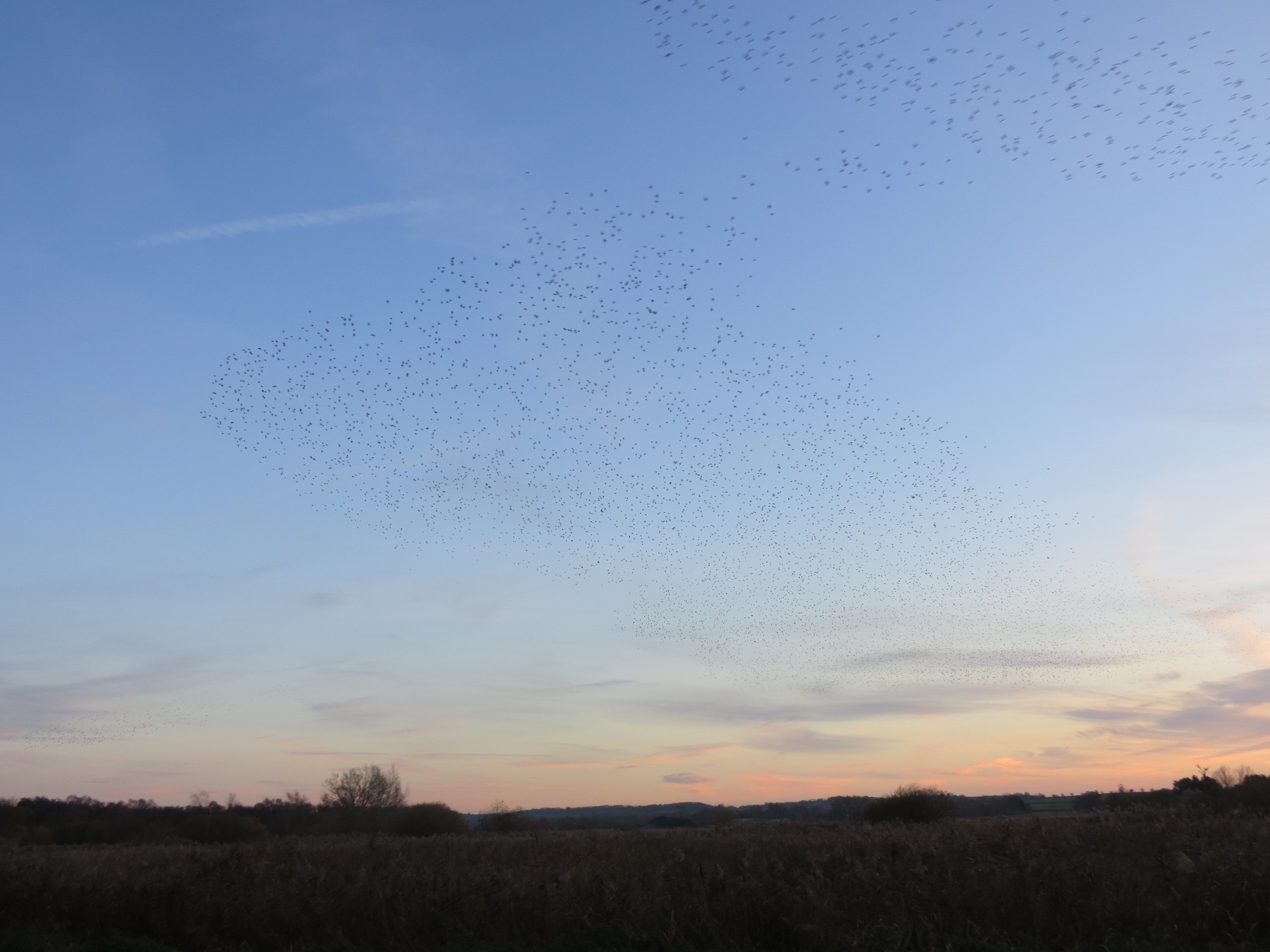

Forty five minutes of entertainment by nature just doing what it does every day. As we walked back I noticed moonlight reflected on one of the pools. A moment of stillness in a landscape still chaotic with both visitors and nature on the move. Approaching the main path through the reserve those visitors were still ten deep still watching the starlings doing their thing. That's such a lovely thing to see as I suggest most people there were very much like the people we chatted to,  day visitors, some visiting for the first time, others regulars but maybe not hardened birdwatchers, families out for a bit of exercise, friends meeting up. Simply people coming out on a Saturday evening to watch nature's own unpredictable version of Strictly Come Dancing. 

Wednesday, 1 March 2023

Before Dawn On the First Day Of Spring

They flew out of the darkness, resembling ghostly wraiths high above my head. In that strange half light it was difficult to remain unmoved as seven great white egrets gently drifted away from their night-time roost and headed off to begin the day a new.


It was with a level of madness not seen in me for a while but having woken at just after 4am, with a half- baked notion to go and see the starlings lift off from their night-roost, I tumbled out of bed and made a cup of tea. A drive down the M5 then a pootle across the Somerset Levels and by 05:45 I had arrived at Shapwick NNR, part of the mighty Avalon Marshes complex. My aim, if it could be thought of as an aim, was both to see starlings erupt en-masse from their night roost, and to hear bitterns booming, which they're now doing with daily regularity at dawn.

The creation of this pre-sunrise endeavour actually began the afternoon before. I had a notion to write a blog post based on watching starlings come into roost in the evening, on the final day of Winter, return  in the morning and revel in their morning flight on the first day of Spring. That was the plan in my head. In reality it was somewhat different. Although I'd seen thousands of starlings foraging the previous afternoon from the car window, I didn't manage to work out exactly where they roosted. Coupled with a biting wind scudding across the flat landscape of the Somerset Levels I lost the will to hang about at dusk. Standing on the bridge over the picturesquely named South Drain, the lack of starlings overhead did not dampen my spirits. I knew the massed starling flocks had moved from the RSPB's Ham Wall to Shapwick NNR in recent weeks, and knowing Shapwick intimately, I decided to just to turn up in the morning and there they'd be noisily awaiting my arrival. What could possibly go wrong.


Well almost everything!

Starling  behave differently in cloudy weather than with clear skies. Today heavy cloud made the hour or so before sunrise very dark. It really was very dark but once my eyes had adjusted there was just about enough light to see without the need for a torch. I began to walk along the track, once the bed for the Somerset and Dorset Joint Railway, and even in the near pitch darkness this arrow-straight track would not be that difficult to follow. I'd brought a hand-held sound recorder with me too, as I hypothesised this would be a recce for the parabolic kit if the bitterns boomed well. They may have been booming, however in the middle distance the chug chug chug chug of diesel pump amply reminded me that the Somerset Levels today is entirely man-made and managed. That said, above the steadily rising amplification of the chug chug chug chug a tawny owl hooted the end of the nightshift on the reserve. It was about 6am now and the merest slit of pre-dawn was visible. And below that a tiny pinprick of light. I'd hoped I'd have the reserve all to myself, but no. As I walked that tiny pin-prick of light grew closer, and bobbled about a bit not unlike a firefly, until in the darkness a lady jogger sped past with a jolly "Morning". I thought I had a slight madness about me coming birdwatching at night, but to go jogging before dawn?


It was only after the lady jogger had passed and my eyes re-adjusted again I saw another light in the distance. It's like Grand Central Station on the reserve, maybe that chug chug chug chug is the ghost of the steam engines which plied peat away from this landscape. I drew closer, this light was a fishermen combination who had with them what can only be described as a sports-stadium grade light dangling between them. Momentarily blinded as we passed, I have no idea how many there were of them but being English I bade them Good Morning. I received one in reply. I had filled in twenty minutes so far and my tally was, diesel water pump, a jogger, some fishermen and a tawny owl at some distance. It was going well then! But at least the light was gathering.

Suddenly I realised I was on my own. The din from the diesel water pump was receding and to my left a song thrush was giving it large somewhere in the woods. The water rail then started, followed by Cetti's warbler. All unseen of course but the reserve was throwing the duvet off the reedbed and waking up. Whistling from wigeon to my right caught my ear, followed closely by an eruption of jackdaw from a reedbed. In the race to take a picture in the half light I forgot to remember how dark it was. My camera did its best with me trying to follow the flock as it flew away, today though was to develop into a series of less than perfect images, which in some way I quite like as they tell of the moment. 

Back to the jackdaws. Had they roosted in the reedbed they erupted from, or were they mid-flight and simply flopped down for while? I didn't count them at the time but from the image there are about 100 individuals. Something niggled at me, although it looks lighter in the image below it really was dark and I can't envisage which woodland they'd have come from well before sunrise and why they would then settle in reeds, even temporarily. Most intriguing, had my eyes deceived me? I've not come across jackdaw roosting anywhere other than in trees or woodland before, and a quick look online didn't disprove this fact. But then I question why not. Reedbeds are a potentially safe environment, it is why starling roost here (though a good number get eaten by bittern, foxes and otters during the night). Are jackdaws, a very adaptable crow, adapting too?


Not long after the jackdaws passed by then a gaggle of Canada geese also provided an opportunity for a  less-than-perfect image. Still no starlings, but at least three bitterns were booming at some distance, which is an amazing thought for this bird that has come back from the brink. When numbers of bittern were at their lowest ebb, for years I tried and failed to hear a bittern in East Anglia. They became my bogie bird. I even spent an entire holiday in the early 1990's at the Cley Marshes in Norfolk failing to hear a bittern despite the warden telling me they were being heard daily and recommending what time to visit to guarantee (to not hear one). Nowadays on the Somerset Levels it is almost impossible not to hear a bittern in the springtime, a remarkable turnabout of fortunes. But still no starlings.


Watching starling leave the roost site should be easy. They remain where they arrived the evening before and before leaving in the morning the noise becomes astonishing as they fidget and jostle with neighbours awaiting that invisible command to go... which once issued means the entire flock rises as one. That said, this morning despite regular listening at reedbeds I heard absolutely nothing.  What was fantastic were the egrets flying from their roost. Both little and great white flew overhead  resembling ghostly wraiths inspecting the wetland underworld. Quite unearthly seeing these huge members of the heron family slowly flap and glide above me, their ghostly white plumage under-lit and in contrast with the dark sky. I still get a thrill seeing these egrets, as a boy they were rarer than hens teeth (or starlings).

By now it was heading towards sunrise and I'd been wandering about for over an hour. I'd obviously missed the starlings or they'd gone another way. Maybe then if I headed to Noah's Hide I might see something else and not be too disappointed. A call of nature first, I am of that age. Whilst carrying out my needs I heard a roaring sound behind me, like a wave crashing on a pebbly beach but in a continuous way. I looked up and there they were, thousands upon thousands of starling flying low and fast above the trees under which I stood. Wave after wave passed by making the already grey sky darken considerably. And that noise, it is astonishing. Quickly grabbing my camera I failed to record anything other than a number of abysmal record images. It was par for the course today, I'd come into woodland just as they'd passed overhead, restricting my view entirely. Given the direction they were coming from I must have passed their roost site half an hour earlier, presumably when they were still reasonably quiet, or masked by the chug chug chug chug. But good view or bad, it was all very exciting and I looked at my phone, 06.49hrs. Now I know.


I have to say my images of the passing starlings are worthy of an award. I'm not sure what that award will be but I'll accept the award now and have my speech already prepared. The last of the starling flock passed over about 3 minutes after it began. There were a couple of short breaks but otherwise three minutes of starling flying overhead at speed. Numbers must have been close 100,000 if not more. Remarkable as we're now at the very end of the winter roosting season, which was one of the reasons I found myself here today in an attempt to grab a last look before they disperse to their breeding areas.


My quest was won. I'd heard bitterns, and although I'd not seen them lift out the reeds as one organic flock, I'd seen massed flocks of starlings. I sat in Noah's Hide reflecting on my morning with a cup of flask tea, it then struck me it was only ten past seven. I'd seen so much and experienced so much in only an hour and a half (and before many people were out and about) from arriving in pitch black night-time to now a half light just after daybreak. And it wasn't over yet. As I sat in the hide a great spotted woodpecker was drumming madly close by. Behind me the woodland birds were in audible competition with their wetland cousins. I switched on the recorder and if you wish to hear a 7 minute roughly edited recording, here it is from my SoundCloud site -  CLICK HERE


What a wonderful start to spring, bitterns booming, woodpecker drumming, and a cacophony of avian sound surrounding me. I'd finished my flask and thought it's time to head home, but before that a quick look out of the hide close by, the 70 Acre Hide. 


Normally there's very little to see from here as it looks out over a vast reedbed. Not today though. I'd just packed my camera away into my rucksack when a bittern flew over the reeds to my left. I had a good view with the binoculars, however as I'd come to expect today, no camera meant no image. It was a spectacular view too for a good 10 seconds or so. Note to self, "leave camera primed just in case".

The walk back to the car was just as eventful. The woodland over the opposite side of the South Drain was alive with birdsong, so much song it was virtually impossible to differentiate each species. On the ground a number of finches were feeding and a jay spent time out in the open flicking through a recently dug area. A large flock of redwing then caught my eye, surely they'll not be here much longer. I heard an unfamiliar call like chattering schoolchildren wearing wooden clogs, one redwing was singing which while not unknown isn't that common in the UK, but then I realised that soundscape of chattering was other redwing. Spring is here, serenaded by a winter thrush, and having been on the go for the best part of three hours, it was only 8.20am.


Sunday, 14 February 2021

Inside A Ring Of Peewits.

"It is not spring yet. Spring is being dreamed, and the dream is more wonderful and more blessed than ever was spring." 
A Flock of Peewits by Denys Watkins-Pitchford

Spring may be knocking on the door, but in recent days, as a result of a dominant high pressure system over Scandinavia, blistering easterly winds have buffeted Britain from the Continent. Add to this sub zero temperatures (Braemar in Scotland nudged minus 23oC) and, despite snowdrops peaking through the ground, a late blast of winter weather has enveloped the country. Most of the country has had a covering of snow, but here in Somerset despite the odd flurry we've remained snow free, the skies predominantly blue and the countryside bathed in sunshine. 

Working at home this week I've spent a lot of time looking out of the window while having the obligatory screen breaks. I've had a lot of birds come to the feeders, the colder weather always increases usage. A great spotted woodpecker was a highlight, but I love seeing the boisterous sparrows and starlings fighting over the fat balls. The resident great tits are looking fantastic in their fresh olive-blue plumage, seeing them next to blue tits on the same feeder, the size difference is obvious. I also have a resident male blackbird with no tail, which I've imaginatively called stumpy.  It is his garden and the interloper males are given short shrift if they dare to enter, post skirmish he'll tik-tik away on the shed roof in an avian triumph.

It's not just the garden where activity this week has increased. From the house I can look over two miles of small grassland fields to the National Trust's Sand Point and then the Bristol Channel beyond. Skeins of geese often use the Bristol Channel as a land-map, mute swans too, and in late afternoon gulls fly past going to roost on Flat Holm island. But it was while casually scanning this area with my binoculars  I noticed three sizeable flocks of lapwing wheeling over the Point. Each flock was maybe one to 2 hundred in number. After a few minutes the flocks merged and dropped out of sight. We're lucky here as lapwings in winter are quite numerous. A drive north up the M5 from Weston super Mare guarantees sightings of lapwings in the adjacent fields, and only a few miles away the Somerset Levels are a favoured location. But those birds seen over towards Woodspring Priory were in greater numbers than I'd seen for a long time. 

From home it is about a 2 mile walk to where I'd seen the flock, which seemed much longer in the biting wind whipping across the flat sea-blown fields around here. Only field hedges curtail these blasts which, as anyone who has stood motionless birdwatching in winter knows, I was inordinately thankful for.  At first I could not locate the lapwings. I counted about 30 mute swans, many many rooks, carrion crows and jackdaws in the fields and a solitary song thrush. Then rounding a corner I heard the first pee-wit call disappearing in the breeze, along with the birds. I'd spooked them unknowingly.


I wasn't unduly worried as lapwing are what I call a fidgety bird.  Individuals and groups will nervously fly up and down to the same spot while foraging or resting, sometimes the whole flock takes off for no reason only to return a few minutes later as if nothing had happened. But this flock was different.


Field guides will tell you that lapwing and golden plover flocks are common in winter. I've seen these many times. This flock though was something I haven't witnessed before, a mixed starling and lapwing flock. That may sound unremarkable, but what I seemed to have stumbled on was a co-operation flock. Despite the wind making it hard to focus the binoculars, I hunkered down to watch them drop back into the field.  What I observed was possibly a wonderful example of intraspecific anti-predator behaviour. Time and time again I observed the lapwings encircling the starling flock while they foraged on the grass. Not just in one field but a number around me. In the field nearest me there were maybe 200 starlings and 50 or so lapwing.  The flock would move as one organic force, lapwings leading at the front, with sentries posted to each side and the rear. And within this ring of peewits the entire flock of starlings moved as one with and at the same speed as the peewits as they foraged. The lapwings were foraging too, but at least half of them at any one time were alert, fidgety and calling what was wonderfully described by Charles Bayne "tcher-willooch-weet'. 
 
Then, and I observed this regularly, something unseen would spook the lapwings. The leading half a dozen to a dozen  would fly up in their lazy flap flap way, noisily calling. As they rose, behind them the entire starling flock alighted as one with them, the remaining lapwings following the starling chase. Being faster fliers, quickly after taking off the massed starling flock would fly past the lapwings in a fast moving murmuration, hedge hopping inches from the hedge top into a safer field, leaving the lapwings to bring up the rear as they flapped and glided back down to join them.  Once in the field previous positions would regroup. Starlings inner, lapwings outside, foraging would begin once more, with the leading edge of the feeding mass being the advance party of lapwing walking and foraging in a planned direction, followed by the starlings en-masse, with the lapwing sentries keeping watch. Time and again I'd observe lapwings take to the air, followed by the starlings and then the remaining lapwings. Not once did I see the starlings rise up first followed by the lapwings, always the lapwings first. It was beginning to get dark by the time I'd observed maybe a dozen take off and landings, and I was cold, with a walk back to warmth ahead of me. 

The following day I went back to the fields this time with a camera. If anything the wind was stronger than the day before, and that maybe accounted for the lower numbers of birds of each species in the fields, but they were there once more repeating that co-operation behaviour of lapwing sentries and starling feeders. In the course of an hour or so watching, not once, save for a lone buzzard, did I spot a sparrow hawk or other predator. The roller coaster flights of lapwings up, starlings up, starlings down, lapwings down seemingly caused by reason's unseen.  On this second visit the only difference to the lapwing behaviour was that lapwings from a field behind me flew back and forth to the fields containing foraging starlings and lapwings. Whether this was additional reinforcements or simply wandering about I didn't know. That field behind me also contained a large corvid flock, I counted over 30 carrion crow.

What I had witnessed intrigued me. Is this a common occurrence, this lapwing starling co-operation, or simply two species cooperating in winter during a cold spell. A search on the internet failed to come up with an answer, even going through research papers into interspecific flocking behaviour in winter. I decided to head into my library and spent a few hours reading through my natural history books.

What struck me in reading through these books was how often peewits or green plover as lapwings were known of old were mentioned, but how scant those references were of detailed information. It made me realise that many of these naturalists writing 50 or more years ago tuned into the beloved sound and flight of the lapwing, but it seemed that as peewits were more numerous than today these observers seemed not to register any behaviours. Hudson, Jefferies, BB, Moore, and Drabble all note the liquidity of the lapwings call, or the flap flap flight, but though only a limited selection of my own books, that was about it. 

Even that most poetic of naturalists Edward Thomas failed to provide what I'd wished for. Thomas, finding his life as a journalist unfulfilled, set out on an 8 day bicycle journey in the pursuit of self discovery and rejuvenation. Riding from Clapham in London to The Quantocks in Somerset around the Easter period between the 21st and 28th of March 1913. His book In Pursuit of Spring does reference peewits, but in passing while on Salisbury Plain 

"Next to the dead the most numerous things on the Plain are sheep, rooks, peewits and larks. The lark is most constant here  ....the pewit is equally characteristic. His Winter and twilight cry expresses for most men both the sadness and the wildness of these solitude"

Interestingly for me Richard Jefferies writing nearly 150 years ago in Wild Life In A Southern County questions why birds 'pack' as he calls it 

".. the packing of birds is very interesting, and no thoroughly satisfactory explanation of it, that I am aware of, has ever been discovered" 

He then goes on to discuss other species and of the peewit says " Peewits or lapwings not only pack in the winter, but may almost be said to pass the nesting time together" he goes on to discuss the lapwings avoidance behaviour by the nest in spring, but adds a beautiful description of the lapwing flight: 

"Then you have a good opportunity of observing the peculiar motion of their wings, which seem to strike simply downwards, and not also backwards, as in other birds; it is a quick jerking movement, the wing giving the impression of pausing for a tenth of a second at the finish of the stroke before it is lifted again"  

A lovely observance of the flight but not what I was after. I'd drawn a blank. The closest I got to answering my question and a naturalist describing their observance of lapwing behaviour was found in Sir John Craster's book Naturalist in Northumberland.

"[February 28th]... many more peewits are, this morning, going through their courtship antics, and I stand for some time watching and enjoying this very embodiment of the spirit of spring".... 

He later describes at length watching over 200 lapwing 'whiffle' in from the sky to join a few on the ground.

Maybe it is just my books, my limited knowledge, but I have found this whole process fascinating and it is why after over 50 years of observing wildlife there is still so much more for me to learn. Not least that the old term for lapwing can be spelt either pewit or peewit... I've gone for the latter except in quotes, after all it is the sound of a magical bird flap stop flapping the wing. 

I've not been to those fields for a couple of days but hopefully on my next visit the lapwing and starlings remain, and I'll continue to observe their antics. It certainly makes sense to combine forces, and observant eyes, to avoid predators during these winter months. Natural territorial hostility replaced by the need to simply survive. No doubt in a few weeks the lapwings will disperse, some flying a long way off. The starlings too, many back to Europe. The memory of this chance behavioural encounter  will stay with me a long while yet.

As an aside in the evening I asked Julie my wife if she would do a quick sketch of a lapwing to help illustrate my memory of this. An hour later I have the best Valentine's present a man could have.... It is not spring yet, but Spring is most definitely being dreamed.


References 

Bayne, Charles S. (1944). Exploring England. Collins, London

Thomas, Edward (2002). In Pursuit of Spring (first published 1914), Laurel. 

Jefferies, Richard (2011). Wild Life In A Southern County (first published 1879). Toller

Craster, John, Sir (1969). Naturalist In Northumberland

Quote "It is not spring yet" 

Thomas, Edward (2009). The South Country (first published 1909), Toller

Lapwing illustration by Denis Watkins-Pitchford from;

Warren, C. Henry (1940). England Is A Village, illustrated by Denis Watkins-Pitchford. Eyre and Spottiswood


Sunday, 16 November 2014

November 15th 2014 - Starlings - An emotional connection

It was the writer BB who in 'Amid the Tangled Thorns'* wrote of the starling coming to roost near his Northampton home:

"As evening fell, and the owls began to hoot, I would hear and see starling flocks wheeling about overhead in a sort of tribal dance which went on until sundown, when one by one the black birds would drop like stones into the tall straggling thorns above me and there continue their deafening chatter for a while."

In this article, BB also mentions starlings coming to a city roost, presumably for warmth. This stirred a memory in me that has remained vivid for over 40 years.

As a child away from schooling, my winters were a mixture of semi rural living and, especially as Christmas approached, city shopping. I lived in a large rambling late Victorian terrace house which for reasons never fully explained sat incongruously as a pale monolith comprising 4 white terrace houses amidst a surrounding green sea of farmland,  market gardens, a spectacularly spooky rural cemetery and a golf course (my bedroom overlooked the first green).  As a child I had a vast playground on my doorstep, yet this was a mere 7 miles from the bright light city bustle of Newcastle Upon Tyne.


Newcastle today is magical regeneration city, yet back then, and I'm referring to the early 1970's, my visits to Newcastle on a winter's afternoon were thrilling for another reason. The lights, the noise, the hubbub of city folk, the shop windows - and above all of that - as dusk fell, the starlings. As we trudged up Northumberland Street or down Clayton Street, above us the deafening roar of many many thousands of starlings echoed around the man-made canyon we trod. Like their human counterparts heading in the opposite direction, these starlings were commuting into the city from their daytime rural foraging areas to roost. Virtually impossible to count, these black specks jostled and squabbled for the best real estate on the block. Sitting shoulder to shoulder wedged along a ledge they overlooked the human scene far below, reminiscent of monks in their dark robes gathered for vespers. And, like any religious evensong, only turning their heads to sing or call. Every imaginable ledge, every roof space and every archway played domicile to the developing cacophony of the sociable starling.  I can still remember as a child hearing their chattering above the humanitarian sounds from the street, before almost imperceptibly the birds fell silent and the cityscape sounds dominated once more. Christmas shopping and dodging starling droppings in a noisy man made landscape are forever interlinked. Sadly now the starlings are prevented from roosting in Newcastle and are to be found in a wilder landscape to roost.


It was a rural landscape that I found myself in yesterday, the Somerset Levels to be precise. The Levels are well known for their starling murmurations at dusk, an atmospheric ballet as thousands come in to roost amongst the reeds. Thanks to a lot of coverage by the media, especially television, the winter weekends down on the Levels can be as busy as any high street awash with the festive shopper. However I'd not come to see this, I trod a careful path along the reserve well before dawn in almost pitch darkness. I'd come to see the starlings take off.

This was a first for me, and for Julie, who joined me.  I'd seen and heard this dawn spectacle many times from a distance, via sound recordings or secondhand encounters with other naturalists. But, I'm ashamed to say that even though I am generally an early riser anyway, I'd not made the effort before to leave the house at 5am to witness this myself, a mere 25 minutes drive away. Today was that day. The night before Julie and I agreed we'd push the boat out and be ready to leave sharp at 5am. As it happened we were so excited that by 3am we were both chatting away while having breakfast and making the obligatory flask of coffee.  Dawn vigils are such a thrill but one thing I have discovered is that one can get cold very quickly - strong coffee is always a godsend.

Two other people were at the reserve but that was it, and just before 6.30am we were in position, alone in the world and looking out over a serene half light. To the east the morning light was already renting the dark horizon providing enough illumination to reflect on the calm scene in front of us. Small groups of wigeon wheezed overhead.  Not a breath of wind stirred the water which, mirror like, provided a stunning backdrop to the land, sky and a small party of mute swans at leisure before dawn. A tawny owl hooted in the far distance, and a kingfisher piped its alarm behind, but that was all, near silence.

Was that a low chattering sound floating over the surface towards us? It was almost impossible to hear.  I listened intently, yes that's them. Turning to Julie I told her to listen, she could hear them too. They'd started.

And so had the mist. Patchy mist had dogged our journey to the Levels but on arrival the moonlight was strong over the landscape. As often happens however the arrival of dawn moves the sleeping atmosphere and like a spectral being, thick mist emerged from the lake adding atmosphere to an already emotional view. We moved position slightly to be nearer the centre of the sound and as we did so the calls of possibly 100,000 starlings grew from a wall of noise to thousands of individual birds, each note jostling for dominance with its neighbour. It was time for a coffee and to sit with half a dozen other people at the viewpoint and wait. On, on came the noise, wave after wave of tumultuous chorus echoed around the reed bed. Soon small parties of starlings began to hedge hop, or should that be reed hop from one area to another, never high enough to arise suspicion by any passing predator.


Soon the pitch and notes began to change, they were getting ready for that mass lift off which some nature writers have described as an express train passing close by. It was quite light now, after 7am, yet  mist made it difficult to see what was happening. We had to focus on the noise, now pulsing through the reeds, intermingled with the odd higher pitch. Was this the starling commander blowing his whistle? "Come on chaps, over the top, last one to Westhay buys the drinks"


The noise was deafening, we humans were dwarfed by the sound just metres in front of us. And then it went quiet.

The roar that followed took us all by surprise. This was no express train but a sound resembling a huge storm wave hitting a shingle shore. It alerted us to a massed lift off. To our left, following some unknown signal,   starlings erupted individually from the reeds at speed, but viewed en-mass as if in slow motion, like a black powder cloud billowing over the battlefield. So dense was this cloud it obliterated everything beyond it. Seconds later another roar just beyond, another eruption of black, yet another behind that, a third wave. The air was filled with life, a kaleidoscope of black spiralled across the dawn sky, over the reeds in formation. Individual birds making a break for the opposite side of the open water, joined by their comrades. It was 7.13am.

In the mist this break of cover resembled the creation of a physical bridge from reedbed to reedbed. So many birds flew over this area that for nearly 5 minutes the bridge existed where it had not existed before. As the front troops crossed and dropped into cover beyond, more flew in behind and joined them. A colossus of movement, an amorphous mass of wingbeats, the place was alive with pulsating black powder billowing in form. The last troops safely over the bridge disappeared but the whole were now held within the reeds to the left. Squabbling, rising, half-heartedly making breaks for open cover, the confusion of these starling battalions seemed palpable. A loose group broke cover as a black river began to surge along a hedge line and away towards the Mendip Hills. Another river flowed to the south between some trees and before too long the whole landscape in front of us stopped moving and fell silent. It was 7.20am and the sun was just breaking the skyline and a lone female marsh harrier quartered the reeds for the walking wounded. 


The now empty landscape was still beautiful, still there, we had connected for a few short minutes to one of nature's unparalleled spectacles. Retracing our steps back to the car the landscape was bathed in a soft buttermilk glow of a November morning. The mist had lifted and other birdwatchers bristling with optics were now arriving to observe the reserves' other birds in daylight.

Had we just witnessed something that has happened for centuries across Britain? Did those who in ancient times walked the Sweettrack across this marsh witness the black cloud during their hunting trips? Presumably yes although we don't know the population of starlings back then. As a child the starlings of Newcastle were part of what made me follow a path into nature conservation, a drip-drip of many wildlife encounters that got under my skin. I didn't need equipment then to feel the force of nature, and yesterday I didn't need equipment to see the sight before me, I felt it, we felt it, we certainly heard it and above all that handful of people in amongst the reeds connected with the power nature can awaken and stir in the primeval imaginations within all of us. I may have been fifty years old when I saw this for the first time but I'll remember it until my last breath.

BB was correct when he said "...one moment there is not one in sight, the next you have a black mass, resembling a horde of shiny beetles*". Today I saw that too, but in reverse.

Sadly people of Newcastle are no longer able to relive my naturalist awakening by the starling as I once did.

*'Amid the Tangled Thorns' from The Naturalist's Bedside Book by BB, published 1980.

Tuesday, 8 November 2011

At last a weekend at home........

It's the first weekend in November 2011 and at last I've taken a breath, workload is reducing slightly and I'm taken stock, feel the embryonic energies of blogging coming back to the fold. When I began this blog 4 years or so ago, I had a completely different lifestyle, different job, different places to visit and well looking back it seems like a long time ago, especially as back in those days I seemed to have to a lot more time to go out and watch wildlife. But then again I now get paid to go out and watch wildlife, can't be bad, so I hear you say, "he doth protest too much"


So, now the mood has taken me, let me take you back to last weekend. It began with that dreadful crash on the M5 on Friday, not that far from where I live. I do a lot of driving now for my work, too much really, and what happened then really makes one stop and think of the fragility, the veneer our cosy modern life provides. What happened at Taunton really made me reassess.

So it was with a relish we woke on Saturday for a pre-planned visit to friends in Thornbury, in South Gloucestershire. The weather was fine, so we pootled off for a wonderful 3 hour walk/talk/amble along the Gloucester Canal at Purton (home of the original Bill Oddie programme on starling displays, more on that later).


Not long into our walk, we spied a rambling ivy across a stone wall. Bearing in mind this was November 5th it was covered in insects feeding on the nectar of these late season ivy flowers. A year or so back I made a Living World programme on the importance of Ivy in the winter and ever since then have been fascinated by how important this plant is to insects later in the year.


So important in fact I think a campaign should be started, "leave ivy alone" - keep it bushy, keep it messy, until April at least.


Onwards we strolled to take in the sights and sounds of the canal


Where soon we came across the undisputed highlight of the walk....


I do like gnomes. Maybe not as many as there are here, but every garden should have one. We're all much too sensible these days, and actually the original gnomes were there to bring good luck to the garden.


I'd never been this way before but had heard of the Purton Graveyard. A century or so back the Severn was a shipping highway but by the 1960's this shipping was in decline. As boats became obsolete they were rammed into the river bank to help stop river erosion from the huge tides the Severn experiences. Until recently these hulks were slowly rotting into the silt, but now these fascinating remnants of an industrial past are being preserved, with regular guided walks and information boards on each boat, when it was rammed into the riverbank and so on. Industrial archeology used to bore me rigid, but now, I love it. A sign of getting older I guess.


Not everything is about the boats though, as on the riverbank between a pair of boats this chickory was in flower, with quite a bit of it growing around this area.


This tower gives the names of all the boats lying here...


A concrete lighter


A plaque commemorating the destruction of the Wye Severn bridge when a barge hit a pillar and the whole lot came a-tumbling down.


Not the actual barge, but you get the idea


Amazing so much activity took place in what is now such a peaceful place.


Soon it was journeys end, the entrance to the Gloucester Canal, now blocked off at Sharpness with a lovely waterfall


And an interesting building, which is under threat apparently


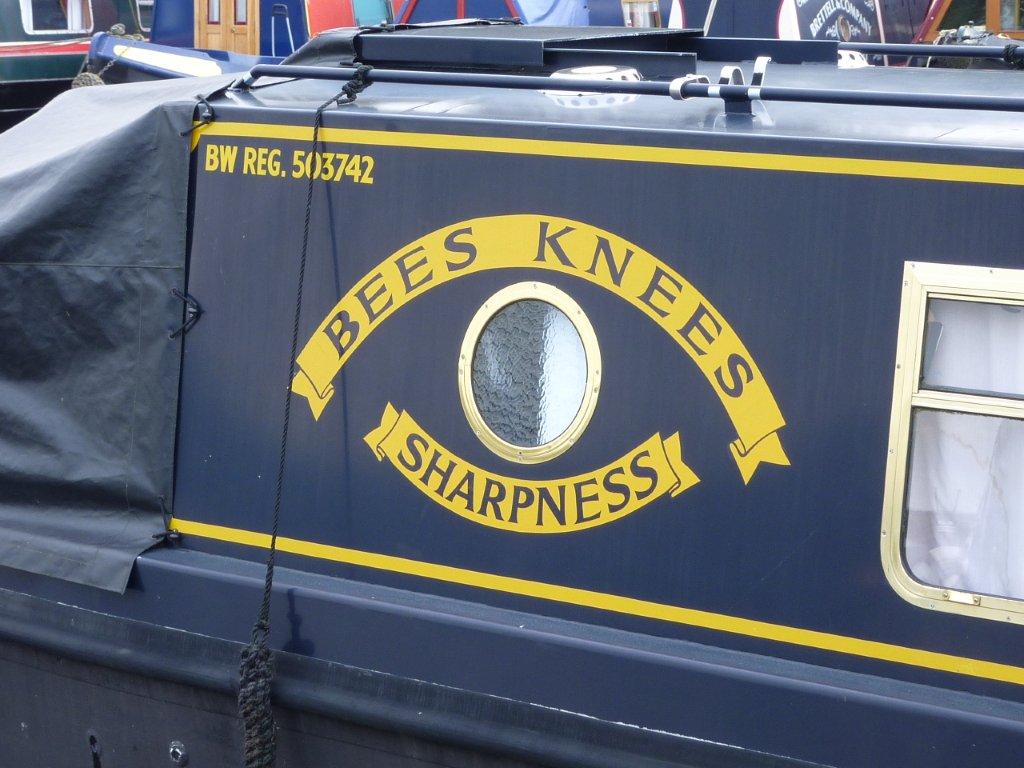
It had been a fascinating 'bees knees' of a stroll out to the end of the canal, but now it was time to return.


Which brought about the wildlife spectacle of the day, not one but three peregrines flying about the canal. Two birds were pseudo-food passing so presumably pairing up for next year. Amazing to see,especially thinking back that only a few decades ago, seeing a peregrine was a rarity and usually in very remote places. Good to see them making such a good comeback.


Nearly home now........ but it wasn't far from here we also saw a kingfisher.


That was Saturday, rounded off with a fantastic meal back at my friends and then home to see the fireworks.


Sunday dawned bright and fare. Which was good as it was destined to be make the Christmas cake day, as can be seen by the chef hard at work...... oh dear look at the state of that kitchen!!


It was all too much so we had to escape while the cake was in the oven. And escape we did, to the Somerset Levels, Canada Farm Lake to be exact, just a short drive from me.


Such a glorious late afternoon to be walking up the lane to the bird hide


And so we made ourselves comfortable in the hide and waited to see what happened.... such a wonderful and peaceful place.


We weren't expecting these but all of a sudden thousands of starlings emerged and flew right over our heads to Westhay a few miles away. This is the first winter starling flock I've seen this year and it was such a pleasure to witness it on our own, made more so by the surprise of their passing overhead. It's still early in the season for the big flocks of 1 million + birds , but a sure sign winter is on its way.


And while we waited for more to pass,we could just admire the view.


Again, again and again....


But all too soon it was getting too dark to see any more starlings so off we walked back to the car, observing this moon and sixpence view on the way back. Magical.


Lets leave the last word to the starlings though........