A

A
Showing posts with label House Sparrow. Show all posts

Wednesday, 1 February 2023

Simple Pleasures From The Office Window

February is here at last, I can feel the days relaxing, just a little, as the sun gains strength and lengthens the daylength.  Like many people I'm trapped in front of a computer most days, however since the Covid pandemic I've been able to work at home for three days a week. Three days which usher in the most simple of pleasures, watching garden birds from the office window.


This male great tit [Parus major] is in fabulous breeding form. His colours really pop in the dull beige-ness of a late winters day, especially the wing coverts which now are an almost lime green against a slate grey. In the garden I only ever see a single pair of great tit, therefore I can assume these are a resident pair. Although our own cat Gingernut has absolutely no interest in birds, we have neighbourhood cats marauding with intent within the garden. This means most of my feeders are high in shrubs outside the garden wall to keep preying moggies well away. Similarly I don't have a nest box which would invite trouble, but neighbours do. Hopefully then come the late spring there will be a few juvenile great tit coming to the garden, as I love watching them quiver on the wall waiting to be fed. 


My office is located in what can be comically be called the third bedroom. You'd have to be very thin to use this as a bedroom. As an office however it is perfect, book shelves, my desk and what I ostensibly call my reading chair, a much loved Cintique arm chair that the cat sleeps on when not being used as a storage facility. However from the desk where I'm writing this I have a view out over the countryside or look down to the feeders, from where all these photographs were taken. Adhering to strict health and safety guidelines while working on a laptop my regular long distance views are mandatory to save my eyesight, though to be honest there are maybe more views than close work script writing on some days.


Exotic and rare birds are always a fascination, yet for me I obtain just the same pleasure watching the birds using my garden as a territory. I love watching the house sparrows [Passer domesticus] bicker and squabble at the feeders. They've been a little in decline recently. They roost and nest in the roof space not just in my house but in a few neighbouring properties.  Not so many years ago I could count forty or fifty sparrows in the garden. Today half a dozen or maybe a few more is the norm. It's worrying as house sparrow are a species which require a colony to maintain a threshold size to remain viable as a breeding group. Here in the northern parts of Somerset there are whole areas which do not have any house sparrow present, and so those areas with sparrows are isolated refugia populations. Although not present in February of course, house martin [Delichon urbicum] too have all but disappeared from this area, with 2019 being the last time they nested successfully on my house. Last year I counted only a handful flying overhead in the evening and no active nests in the street. 
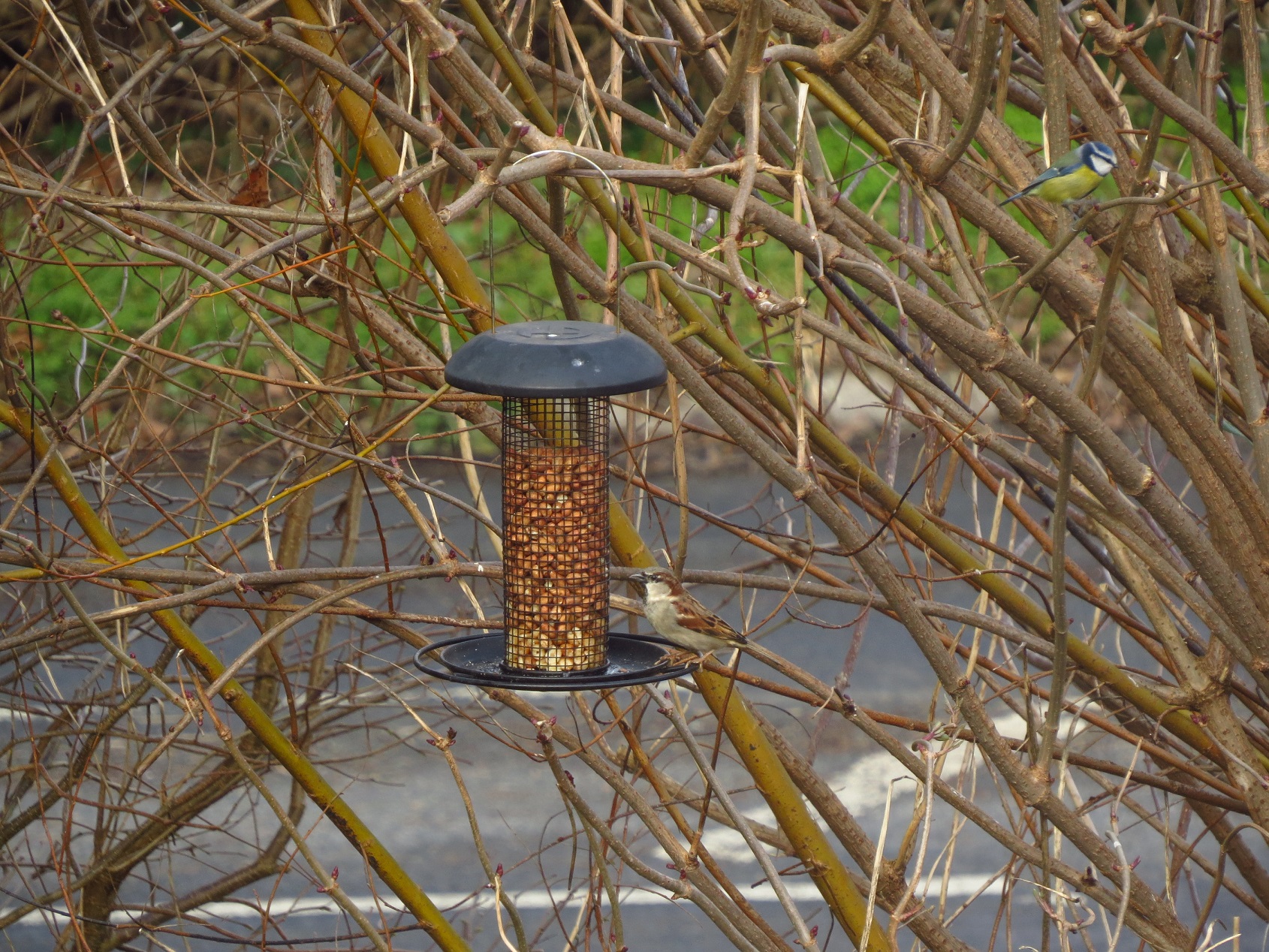

While this male house sparrow is easily identified from the female, the blue tit [Cyanistes caeruleus]  patiently waiting top right could be either sex.  Identifying male and female individuals of some common species is a tough ask.  Great tit males have a broader chest stripe to that of the female, but blue tits are pretty much identical. The books say females are not as brightly coloured as the male. In the field though this is a pointless piece of information when you have a single bird on a feeder. We get a lot of goldfinch [Carduelis carduelis] in the garden and while the males and females can be identified with a decent view, mostly they fly off before that occurs. Same with long tailed tit [Aegithalos caudatus].


Another bird exhibiting more or less sexual monomorphism [as it is called where both sexes look identical, as opposed to sexual dimorphism where they look different] is the collared dove [Streptopelia decaocto]. Now technically the males and females only look different close up, with males having a 'pinker' colouration to the neck and upper body, the female a more grey-sandy colouration. In the two images below I think - note think - the female is the one below looking left, and the male the one below that is looking right. But I may be wrong.  My inability to be certain of which sex these are by no means diminishes the joy of watching these doves with their gorgeous ruby eye during my frequent screen breaks. The same goes for the other species coming into the garden today, a pair of male robin [Erithacus rubecula] vying for domination of a feeder, or the male and female blackbird [Turdus merula] duo, the male having a well defined yellow eye ring, which at this time of year may mean it is a European migrant rather than a resident. Even the five magpie [Pica pica] cackling their annoyance in the fir tree could be of either sex, and no silver was offered either.


None of what I've noted really matters, what does for me is taking time to properly study these very common species of bird from the comfort of a warm house. In other words, detailed observation. Of course putting feeders up encourages their arrival and use of the garden but that's part of the joy. That and really studying what happens a stones throw away. How blue tit will not come to the feeders if great tit are there. Female house sparrow also dominate the feeders to the almost exclusion of males, often the latter only nip in when the females have gone, or the stand off between two male robins, or the beautiful colouration of a great tit. These really are for me quite simple pleasures on the first day of February.

Thursday, 18 August 2016

The fingers of Autumn

That feeling of the strength of the summer imperceptibly starting to wane comes stealthily every year through the back door of long late summer days. 

First it is the subtle arrival of an earlier sunset from Mid August. August is for me more a moment of changing seasons than a main fixture in the school holiday rota. For many and I count myself amongst them the first week in August is akin to the warmest and longest of summer days, yet, by its end August feels decidedly autumnal, cool evenings, a creeping damp air and much shorter days. I've just looked up some facts to near where I live. On the 1st of August there was 15 hours and 19 minutes of day length, and of course much longer twilight. The sun rose at 05.37 and set at 20.57. As someone who spends time outdoors I can remember only a few weeks ago looking at the sun setting over Wales at 9pm. By the end of the month, there will be just 13 hours and 33 minutes of day length, close to a 2 hour difference. By then the sun will set before 8pm and not rise until 6.30am. 

Why am I saying this? Well today was the first morning I have risen and it was dark enough to need a light. Admittedly it was a cloudy start to the day, but not until near 6am did it feel as though the day had begun. I know this as I was sat in the garden. Unable to get back to sleep, I made myself a cup of tea and headed onto the patio. Time, 5.30. All was still without. Overnight we had had heavy rain and through the gloom jewels of rain were across many of the leaves and flowers hard by. There was a glorious earthy aroma around me, mixed with wood smoke, from where I know not. Most noticeably however was the absolute lack of wind. It has been like this for a couple of days. Nothing stirred either, it was as if all sound had been switched off by some unseen hand. 

Not long however the call of a wren erupted from the undergrowth closely followed by a robin. The robin I'm used to who has been calling his territorial scone for about a week now, a song that will continue into mid-winter. The difference in August however is that just a few minutes later the soft chittering of house martins was overhead and mixed beautifully with the robin song. At first I could not see where this was coming from, but then high high up in the sky a half dozen dark spots zig zagged around the sky in crazy circles. The day was waking. 

The time around dawn is possibly the best time to be outdoors. From a near silent landscape, no matter the season, the landscapes offers subtle changes in sound and motion minute by minute as dawn breaks. Today was no exception as by 6.30 I'd been privileged to be under the flightpath of around 100 jak-a-jack jackdaws off to forage somewhere to the south, herring gulls coming inland from their roost to the west, and alongside a few other species such as blue and great tit, the comic circus of house sparrows cascading out of the eves and creating both a deafening din and a cartwheeling mass of brown splodges across the garden. I love these birds which have chosen to live alongside us in the roof space. Regularly we have 50 by the feeders and today it was no exception. They were everywhere and as I have often observed the males were gently feeding juveniles, who with gaping mouth and shimmering wings were attended most dutifully by dad with a soft morsel of worm, bug or grain. 

I've been to many locations around Britain looking at wildlife but an hour or so in the garden matches many a trip to far flung areas. Despite the lack of sun drenched warmth there was still a feeling of summer joy listening to the martin’s overhead, but the autumn season was much in evidence, waiting in the wings. Aside from that scent of earth, the hedge behind the garden is now covered in red berries. Above my head a few gnats jostled for space but other than a single buff tailed bumblebee no other insects came into view. Turning a little too cold in the morning maybe and many will have finished their sexual phase thus larva are hidden from view awaiting their entrance in the years to come. I don’t mind autumn creeping through the back door, but as the day length shortens, I shall miss the long summer nights with screaming swifts around the house, those screams ended on July 23rd this year. May the 4th and they’ll be back.   

Thursday, 17 March 2011

World Sparrow Day : March 20

This Sunday is World Sparrow Day, organised by Nature Forever Society who are one of the partners in this event along with the RSPB and the BTO. Link to the event can be found here World Sparrow Day.

Ahead of that the BTO have released new and exciting results from the last world Sparrow Day, which I'm posting in it's entirety here from a BTO press release.

World Sparrow Day: new results The British Trust for Ornithology’s (BTO’s) Garden BirdWatch survey has provided exciting new results for World Sparrow Day. House Sparrows are increasingly being lost from gardens between summer and autumn. However, House Sparrows have only really struggled in English, not Welsh or Scottish, gardens.

House Sparrow populations are no longer considered to be secure across Europe and, on the 20th March 2011, World Sparrow Day will highlight the plight of this charismatic and confiding bird. To coincide with the big day, BTO’s year-round Garden BirdWatch has provided illuminating new results, charting the House Sparrow’s decline.The results, which have been welcomed by wildlife expert Chris Packham, show big seasonal and geographical differences in the downward trend of this species. Overall, however, almost one in four British and Irish gardens that hosted a House Sparrow in 1995 no longer have any visiting. Summer and autumn: critical times.

The number of householders who have lost their House Sparrows between summer and autumn has doubled since 1995, supporting the theory that this is the crunch period. The BTO’s Nest Record Scheme shows that brood sizes of House Sparrows have declined steadily since the 1960s, with a shortage of invertebrate food with which to feed young in urban areas thought to be an important factor. Food scarcity can also cause chicks to fledge in poorer condition, thereby reducing their survival prospects. With increased demand for off-street parking and so called ‘garden grabbing’ (development of gardens for housing), feeding areas for urban sparrows have been reduced. Moreover, use of pesticides and planting of non-native evergreen vegetation are likely to have diminished invertebrate availability for these birds further. Regional differences.

The House Sparrow’s demise has been most marked in England, with an average of 86% of gardens visited between 1995 and 1998, down to 66% over the past four years. Over the same period, however, only around one in 20 Scottish and Welsh householders have lost their House Sparrows, with 74% and 78% of gardens still occupied in each country, respectively. Preliminary results from gardens in Northern Ireland and the Republic of Ireland suggest that House Sparrows may be faring quite well here too.


Having read this I can't see much of a decline in my own garden which is visited by 20 - 30 house sparrows each day (as witnessed by my vanishing seed and peanut stocks). I long to see a tree sparrow at home but while they are in the area, they are only in single figures, sadly. But both species of UK sparrow are delightful to look at, with their chestnut backs.

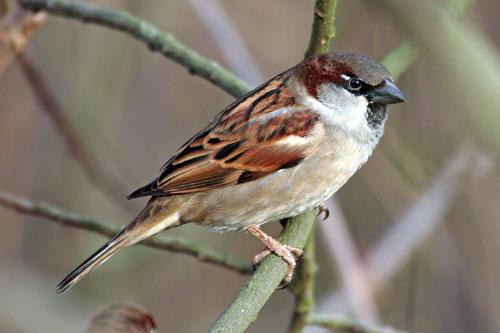
House Sparrow above, Tree Sparrow below

In response to Shysongbirds comment, here is a link to a DIY sparrow terrace nest box