A

A
Showing posts with label Collard Dove. Show all posts

Wednesday, 1 February 2023

Simple Pleasures From The Office Window

February is here at last, I can feel the days relaxing, just a little, as the sun gains strength and lengthens the daylength.  Like many people I'm trapped in front of a computer most days, however since the Covid pandemic I've been able to work at home for three days a week. Three days which usher in the most simple of pleasures, watching garden birds from the office window.


This male great tit [Parus major] is in fabulous breeding form. His colours really pop in the dull beige-ness of a late winters day, especially the wing coverts which now are an almost lime green against a slate grey. In the garden I only ever see a single pair of great tit, therefore I can assume these are a resident pair. Although our own cat Gingernut has absolutely no interest in birds, we have neighbourhood cats marauding with intent within the garden. This means most of my feeders are high in shrubs outside the garden wall to keep preying moggies well away. Similarly I don't have a nest box which would invite trouble, but neighbours do. Hopefully then come the late spring there will be a few juvenile great tit coming to the garden, as I love watching them quiver on the wall waiting to be fed. 


My office is located in what can be comically be called the third bedroom. You'd have to be very thin to use this as a bedroom. As an office however it is perfect, book shelves, my desk and what I ostensibly call my reading chair, a much loved Cintique arm chair that the cat sleeps on when not being used as a storage facility. However from the desk where I'm writing this I have a view out over the countryside or look down to the feeders, from where all these photographs were taken. Adhering to strict health and safety guidelines while working on a laptop my regular long distance views are mandatory to save my eyesight, though to be honest there are maybe more views than close work script writing on some days.


Exotic and rare birds are always a fascination, yet for me I obtain just the same pleasure watching the birds using my garden as a territory. I love watching the house sparrows [Passer domesticus] bicker and squabble at the feeders. They've been a little in decline recently. They roost and nest in the roof space not just in my house but in a few neighbouring properties.  Not so many years ago I could count forty or fifty sparrows in the garden. Today half a dozen or maybe a few more is the norm. It's worrying as house sparrow are a species which require a colony to maintain a threshold size to remain viable as a breeding group. Here in the northern parts of Somerset there are whole areas which do not have any house sparrow present, and so those areas with sparrows are isolated refugia populations. Although not present in February of course, house martin [Delichon urbicum] too have all but disappeared from this area, with 2019 being the last time they nested successfully on my house. Last year I counted only a handful flying overhead in the evening and no active nests in the street. 
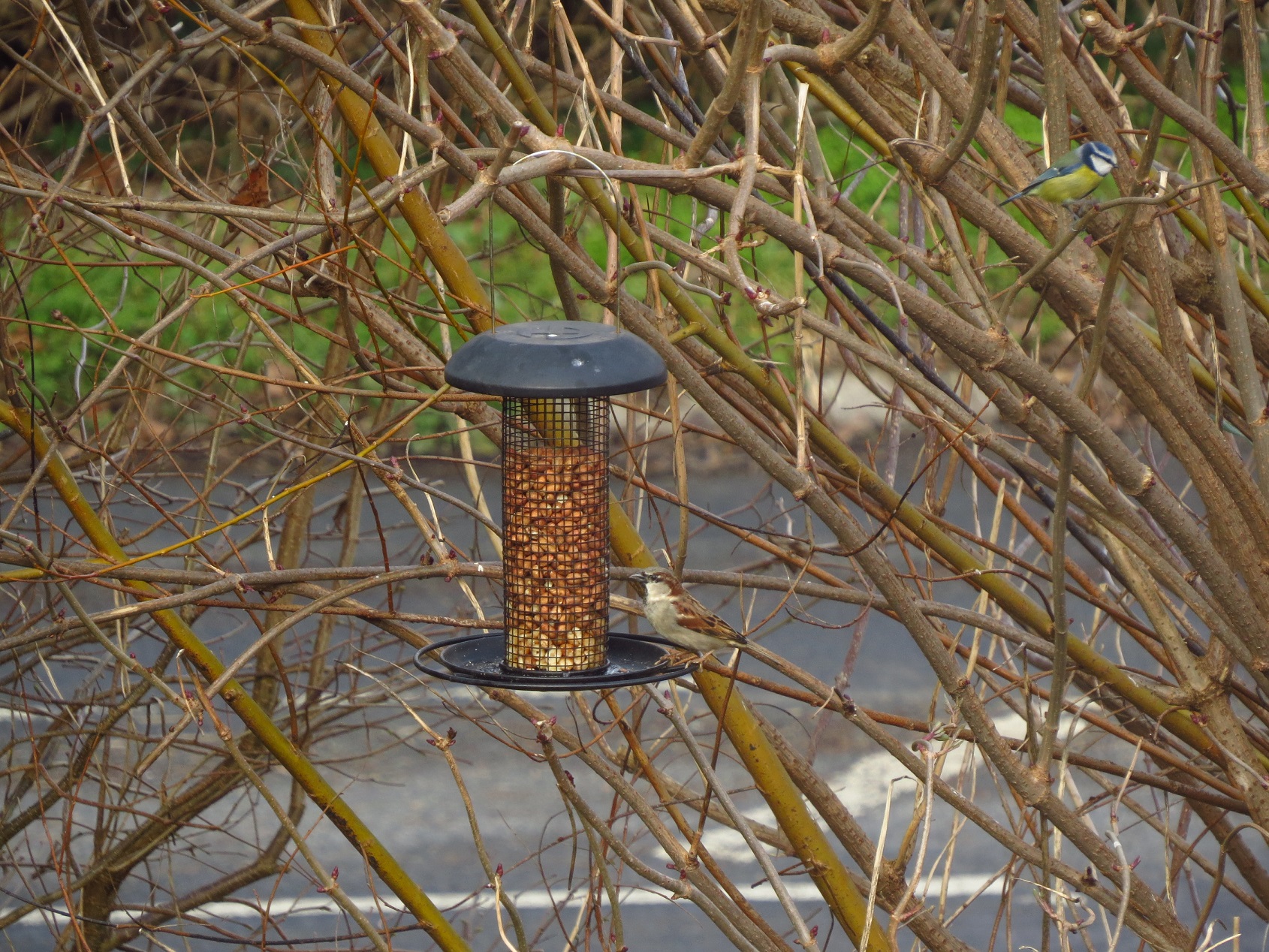

While this male house sparrow is easily identified from the female, the blue tit [Cyanistes caeruleus]  patiently waiting top right could be either sex.  Identifying male and female individuals of some common species is a tough ask.  Great tit males have a broader chest stripe to that of the female, but blue tits are pretty much identical. The books say females are not as brightly coloured as the male. In the field though this is a pointless piece of information when you have a single bird on a feeder. We get a lot of goldfinch [Carduelis carduelis] in the garden and while the males and females can be identified with a decent view, mostly they fly off before that occurs. Same with long tailed tit [Aegithalos caudatus].


Another bird exhibiting more or less sexual monomorphism [as it is called where both sexes look identical, as opposed to sexual dimorphism where they look different] is the collared dove [Streptopelia decaocto]. Now technically the males and females only look different close up, with males having a 'pinker' colouration to the neck and upper body, the female a more grey-sandy colouration. In the two images below I think - note think - the female is the one below looking left, and the male the one below that is looking right. But I may be wrong.  My inability to be certain of which sex these are by no means diminishes the joy of watching these doves with their gorgeous ruby eye during my frequent screen breaks. The same goes for the other species coming into the garden today, a pair of male robin [Erithacus rubecula] vying for domination of a feeder, or the male and female blackbird [Turdus merula] duo, the male having a well defined yellow eye ring, which at this time of year may mean it is a European migrant rather than a resident. Even the five magpie [Pica pica] cackling their annoyance in the fir tree could be of either sex, and no silver was offered either.


None of what I've noted really matters, what does for me is taking time to properly study these very common species of bird from the comfort of a warm house. In other words, detailed observation. Of course putting feeders up encourages their arrival and use of the garden but that's part of the joy. That and really studying what happens a stones throw away. How blue tit will not come to the feeders if great tit are there. Female house sparrow also dominate the feeders to the almost exclusion of males, often the latter only nip in when the females have gone, or the stand off between two male robins, or the beautiful colouration of a great tit. These really are for me quite simple pleasures on the first day of February.

Sunday, 3 February 2008

Quiet day at Wick St Lawrence

As it was Six Nations weekend, I was "asked" to stay at home to watch England. So I did.

So a nice quiet Saturday, giving me an opportunity to replace the battered bird table in the garden. The original one, the size of an undernourished postage stamp, had been a free gift when I joined the RSPB many years ago.

Trip to the local hardware store and 1 hour later, this appeared in the back garden. I was pleased to see that 15 mins later a Robin was investigating it and a few minutes later 2 greenfinch were on the feeder. Both were coming into their breeding colours, stunning in the sun.

Later on while having some soup for lunch, I noticed the garden was a hive of activity, at one point counted @ 30 different birds in the garden, mainly Starling, House Sparrow and Goldfinch, but also Robin, Wren, Great Tit, Greenfinch, single Rook on the shed, Dunnock and Blackbird. Jackdaws flew low over, as did a smattering of Herring Gull.


And of course the Collard Doves. Found a second egg in the garden, so they must have laid 2. But by the looks of it they're planning more. Spring is in the air !!

Before the match, an hour at Sand Bay didn't reveal anything new, though a group of 60 or so Oystercatchers were the largest number for a while. Chatted to a woman who grew up here, she said Flamingoes were once seen here, escapees from Slimbridge and bird numbers used to be huge in the 1950's and 60's with the area being used by wildfowlers. She also said there is an intact WW2 bomber in the mud just off the point, crew still inside, as Sand Bay was used as a WW2 bombing practice bay. Apparently the mud is littered with live ammunition. I'll stay on the beach I think.

Finally noticed as I drove to Dorset this morning, 3 dead badgers on the roadside. They're becoming active then.

Thursday, 31 January 2008

Collard Dove disaster

It's a bit blustery today. Forecast of course, but a bit of a shock to those of us living in the south. We thought Spring was on it's way !! Sadly though this morning when having breakfast, I noticed the Collard Dove wasn't on the nest. Quick investigation revealed the nest empty and an egg on the ground next to the pond. Was it the wind? A Cat?

Ahh well, maybe they'll try again, after all it is still only January !!

Yesterday Rob gave me a spare copy of the latest Avon Bird Report (2006) which I read last night (reminding me I've not entered in BTO counts from weekend). No new species were added to the County list, but some interesting facts have come to light;

  • Tree Sparrow - only 4 seen as fly overs, and now presumed a non-breeder in the county
  • Cuckoo - rapid decline in numbers from c.100 in 1996 to 8 in 2006
  • From prey remains, the Peregrines in Bath are taking a fair number of woodcock, more than recorded in the field, as a percentage
  • Dunlin numbers are increasing in the Bristol Channel - 1400 in Nov 06 - partly (from my knowledge) due to clean up of the sea, and the ending of mechanical beach cleaning.
  • Raven - rapid increase from 1's and 2's up to 2001, rising to 42 in 2006 (see below)

Given that Tree Sparrows and Corvids are species I'm particularly interested in, mixed feelings today.

Monday, 28 January 2008

Collard Dove on the nest

Didn't want to get too close and disturb them, but nesting in January?

This morning sat for the obligatory hour while munching toast watching the birds in the garden for the RSPB Garden Birdwatch. 10 Species recorded, but as the garden here is only 25x25 feet, not bad. Usual Herberts, on show, nice Wren though sat on my frog statue. However I was sat sitting, looking out of the conservatory, when one of the resident Collard Doves landed on the bird table carrying a sizeable twig. It made me sit up. Nest building already? Those of you up north will be non-believers.

Anyway watched this and in it popped into the conifer hedge. And lo and behold, another was in the hedge doing the nest building. For 15 minutes I was engrossed with the antics of this pair, managed a couple of photos from inside the conservatory so as not to spook them. Great I'm going to have Collard Dove squabs soon. It's interesting to ponder on the fact that if I'd had these nesting in the garden 50 years ago, I'd have had 2 million twitchers descend to view them. Just shows how species can advance their range if the environment is right.

After this had a walk along Sand Bay, highlight of which was singing Skylark.

In the afternoon, did a 6 mile bike ride around the lanes (thought I'd add this sartorial photo to the blog ident above). It's good birding around here but one needs to travel as no open water, so a bike is perfect. I'm also on the look out for Tree sparrows, as although scarce in Somerset, if they're here, this is as good a place as any with all the supplementary feeding. The area is predominantly dairy farms, with old hedgerows, large trees, overgrown field corners and remnant orchards. Great for farmland species, including Spotted Flycatcher in the summer. Today's highlights were a grey squirrel (unusual around here), Song Thrush, Jay, Grey Wagtail, 50+ Fieldfare, plus usual Rook, Carrion Crow, and Gt Tit, Blue Tit, plus 7 moorhen on the Blagdon. Which is also where I spied 27 Collard Doves on one phone wire. It was just a great day to be out. Oh and the Lesser Celendine's are in flower in the garden.

Finally, had a check on the Collard Doves in the evening, and one is still there. Surely they haven't laid already? They were only building the nest this morning. I'll keep you posted