A

A
Showing posts with label Mendips. Show all posts

Tuesday, 15 September 2026

A Falling Emotion : Simply Rain


A wet Northumberland National Park, viewed from our house in Harbottle.

I walked through the woods. Above, the high canopy drenched by September rain, below, little fell on me, though underfoot the soil quietly yielded to my step, a sensation I'd not experienced for many a month. These woods were redolent, an atomised perfume of emerald moss, of burnt sienna earth, of invisible mycelium. I wandered without purpose or direction until arrested in my reverie; there on the floor, glistening as if a shining beacon, a tree stump enveloped by coral fungus irradiating the most luxurious of orange in the half light.

That encounter was during an impromptu walk in East Harptree woods in the Mendip Hills in Somerset, having arranged to meet a friend for what was described as an amble with cake and a coffee. It has been so far well documented that 2026 has been the warmest, and possibly the driest, summer for decades. After over three months of dry weather here in the South West, the arrival of rain a few weeks ago was both unfamiliar and welcome. Soil remained iron-hard after those initial showers, but here, last weekend, high up on the Mendip ridge, after a few unsettled days, the soil was finally beginning to compress under my weight. Subtle, welcome and above all something to celebrate.

The change has been rapid. For months, I, along with most of the population of England and Wales, woke to strong sunlight, warm mornings, hot afternoons, nighttime too warm to sleep, with the prospect of the same tomorrow, the next day, and the next. And then, it rained. Referencing my diary, I noted 'It rained overnight. Don't get too excited as it was just enough to moisten a postage stamp.' It was the 18th of August. A few half-hearted showers arrived over the following days, but persistent rain only began on August 27th. 'It poured overnight. That is the second night running that we have had heavy rain, yet by morning you'd be fooled into thinking no rain had fallen, save a tell-tale dampness on the lawn'. Therefore, walking woods in the Mendip's during the steady rain of Sunday, September 13th, was a delicious novelty.

It was a meeting of literary minds which prompted me to mull over what rain actually means to me. I attended an Edward Thomas Fellowship walk two Sundays ago, bizarrely, in terms of my present thoughts, taking place on a gloriously warm and clear blue sky day. Thomas wrote a number of pieces about rain. One, simply titled Rain, poignantly contemplates mortality during WW1. However, in 1914 he wrote After Rain, recalling a sunrise illuminating a rain-drenched Hampshire hanger in winter; the poem begins,

The rain of a night and a day and a night
Stops at the light
Of this pale choked day. The peering sun
Sees what has been done.

I absolutely understand this sense of ending and beginning only too well. Love it or hate it, rain has that ability to reflect the mood, to enhance the scene. I've experienced that emotional uplift rain has given me since childhood. There is often a clarity created over a landscape when rain finally ends and, if lucky, the sun emerges, a sentiment Thomas brings to the end of the poem:

And on each twig of every tree in the dell
Uncountable
Crystals both dark and bright of the the rain
That begins again.

For me, with the all too logical background of a science graduate, rainfall is merely the rules of chemistry. I know it is simply two chemicals combining to produce water, add a little meteorology, the evapotranspiration and the water cycle of schooldays, but then therein lies the unfathomable kaleidoscope of emotional connection which has captivated me since childhood. It is the sound above all else which I enjoy, or is it the sight? Samuel Taylor Coleridge captured what I am trying to say in one of his notebooks. On October 21st 1803 he wrote:

    'Friday Morning. – A drisling Rain. Heavy masses of shapeless Vapour upon the mountains [O the perpetual Forms of Borrodale!] yet it is no unbroken Tale of dull Sadness...  a gleam of softest light, that brought out the rich hues of the late Autumn… the Birds are singing in the tender Rain as if it were the Rain of April, & the decaying Foliage were Flowers & Blossoms.'

A Romantic Poet view of rain indeed. Yet, how many times have I myself observed 'Heavy masses of shapeless Vapour upon the mountains'. Living for over three decades in Somerset, mountains are distant, but still, if I travel to an upland area, I am transfixed by those scudding clouds which caress the tops, often travelling quickly uphill through a gulley propelled by up-draught air. Technically, this is known as orographic lift, the clouds forming when moist air rises and the dew point is reached. But emotionally, these are fascinating connections to nature.

I experienced this only a few days ago on the Quantock Hills. Walking steadily upwards from the lower slopes, the views towards Exmoor were far-reaching and spectacular. Before long, gossamer clouds began to chase my route. Long before reaching the trig-point at the summit, I'd entered thick cloud, visibility reduced to a mere metre or two, everything, including me, coated in a fine confetti of mist. Hundreds of cobweb hammocks, now visible, glistened amongst yellow gorse flowers, strange disconnected sounds reached me, a raven, a stonechat. Neither seen. A distant steam train whistle shrilled its passage. Everyday life below, yet, on this ridge, I felt alone, abandoned, but intimately connected to this mass of vapour swirling quickly around me. Low cloud is, of course, not rain, not the rain we think of, the energy of condensation overruled by the pull of gravity.

Rain seemed to dominate my childhood. My mother bought a static caravan near Rothbury in Northumberland in 1971. Our very first night sleeping there was the eve of my seventh birthday, and we woke to rain. It rained a lot there. To this day, if I hear the percussion of rain on a metal roof, I'm instantly transported back to sleeping in our tin box. I was a self-contained only-child and allowed to free-roam the surrounding countryside. I would walk the banks of the river Coquet in all weathers, but it was the wet weather which excited my senses. Raindrops on grass could be flicked into the air as I passed. Few people ventured out during the rain, I was alone in nature, I was happy.

Much later, when at their lowest population ebb, I spent a couple of years surveying otter activity along the Coquet for the then Nature Conservancy Council. And, while I never saw the animal here, only signs (I had to travel to Skye for views of otter), memorable days were spent watching wildlife, often at dawn and dusk, often in rain. Here, without realising, I absorbed the knowledge of the sound of rain. Heavy rain on a sycamore leaf has a sound altogether different to heavy rain on the water. Light rain dampens the soundscape. Rainfall, scurrying wind chased across the landscape, has a sound altogether different to incessant drisling, as Coleridge called it. Summer rain is different, often subtler and short-lived, to winter rain with its harsh symphony and darkening sky. 

Summer rain can be cruel.  At fifteen, I spent my six-week school summer holiday working on a hill farm near Glanton in Northumberland. I was due to move there as a student the following June. It was a wet year and, try as we might, the hay crop could not be brought in dry. I can still hear the sound of mini-waterfalls cascading from the broken gutters of the barns, down into pools of water below. Everywhere was wet, yet, in an odd way, I loved it, possibly as, at that age, this was simply one big adventurous step in my chosen career, and not the anguish of a farmer surveying a ruined hay crop. And still, nearly fifty years later, I enjoy rain. 

Only this week, unable to sleep, did I sit in the conservatory at night listening to the sound made by rain falling in the garden. Hopefully, the hedgehog discovered that same day asleep in our compost heap, woke to rain and a smorgasbord of slugs that night.

I enjoy walking in it too. A few years ago, I took myself for a Sunday walk along a lane during heavy rain, well protected by my favourite Barbour coat and hat. A Land Rover pulled up, one of the local farmers offering me a lift to 'get out of this horrendous rain'. I declined his offer, stating I was enjoying the experience. I well remember his quizzical look as he closed the door and drove off into the murk. Penny for his thoughts?

But what of rainstorms? These high-energy fleeting moments of deluge are fascinating to watch, to experience, to read about. I've long admired Thomas Hardy. His description of the Wessex hinterland resonated with me as a teenager, and it has never left me. Hardy provided the perfect metaphor of the destructive powers of a summer storm in the heart of his heroine in his book Far From the Madding Crowd. Firstly, as steadfast unrequited Gabriel Oak noticed, a storm approached unprotected ricks during Bathsheba's wedding night. 'He was disturbed in his meditation by a grating noise from the coach-house. It was the vane on the roof turning round, and this change in the wind was the signal for a disastrous rain.' Oak having thus saved the harvest causes Bathsheba to reflect on her choice of husband. Later, that same husband, Sargent Troy, having rejected Bathsheba, despairs over the destruction of his true-love, Fanny Robins' grave, by rainwater falling seventy feet from the church tower. 'The persistent torrent from the gurgoyle's jaws directed all its vengeance into the grave. The rich tawny mould was stirred into motion, and boiled like chocolate. The water accumulated and washed deeper down, and the roar of the pool thus formed spread into the night as the head and chief among other noises of the kind created by the deluging rain.'

Summer thunderstorms seem less present in Somerset than of late. I so enjoy that feeling of tempestuous wind, noticed by Gabriel Oak, which often chaotically precedes the deluge, which when it arrives can be deafening, and if falling on parched summer earth accompanied by a unique aroma I struggle to describe, earth mixed with the scent of new lain tarmacadam almost suffices. One of the people I met at the Edward Thomas walk was Roz Brady. I've been reading some of her exquisitely crafted nature writing on her website. She writes outdoors and beautifully describes in Pudsham Meadow through the Seasons – A Wild Writing year (1), a storm blowing over Widecombe... winnowing summer's growth and ushering in a landscape of winter. 

All of which reminds me that while I have been writing this, I can hear steady rain falling once again. Writing about rain is one thing, but while it lasts, like Thomas, like Hardy, like Coleridge, like Roz Brady, I need to get out there and experience... Rain!


Dorset, January 2026


(1) : Roz Brady website : www.rozbrady.com

Tuesday, 11 October 2022

A Cross Walk and Art in Nature

After a long absence from regularly updating the blog, what topic is suitable for the Prodigals return? I think maybe a summary of a walk and a visit to the Art in Nature Museum this weekend. A gentle return then.

Saturday October 8th: Walk Cross to Compton Bishop and back


What a superb Autumnal day this was. Virtually no wind, not a cloud in the sky and the October sun in this part of Somerset still packed a punch. Perfect walking weather. I'm still post Covid, therefore in terms of my fitness levels this gentle 3-4 mile saunter was a most suitable length. 


Cross, the village, nestles at the base of the Mendip Hills and always seems to be sunny. A former coaching hamlet bisected by ancient roads to Bristol and Wells, hence presumably the name. There is mixed information over the origins of name, either the village was at the crossroads, or the village cross was a meeting place. Doing a little further research failed to establish any other historical evidence for its name. The village was however for the last 20 years of his life home to Frankie Howerd, and his house Wavering Down is now a tourist attraction - in fact today as we passed we watched a man cutting the grass. A highlight of the walk.


Julie had completed this walk the day before with her friend and enjoying it so much suggested it for today. Soon after leaving the village centre we entered a field running along the banks of the Old River Axe. Technically a drain rather than a small river this didn't matter, it was teeming with wildlife. I'm not great at identifying fish, certainly there were trout we could see, but possibly bream and tench in there too. They were everywhere. And hundreds of pond skaters and whirligig beetles. I can't ever recall seeing so many in one place. This seems a healthy habitat, so pencilled in as a place to definitely return to and do some proper natural history exploring.


Continuing along the Old Axe the countryside here is what I'd term gentle. Or even flat! There were a lot of corvids about in the trees, mainly rooks, carrion crow and jackdaw, noisily accompanying our stroll. A green woodpecker undulated off towards a tree yaffling away. Wrens, starlings, meadow pipits and possibly others. Walking without binoculars for exercise is a different experience to ambling along with binoculars, I was in the dog-house a few times for stopping too.


After crossing a stile the river took on a different feel, firstly a bend but then it seemed to develop a different character, the trout here were large, 30-40 cm, but very little in the way of small fish. Magpies followed us on our route squawking away, and we began to slowly walk up hill, away from the river, which eventually outpours into the Bristol Channel a few miles to the west.


Up hill along a farm track brought us to the base of the Mendips and a footpath up to Crook Peak, the highest part of this end of the hills. We were not going that far today.


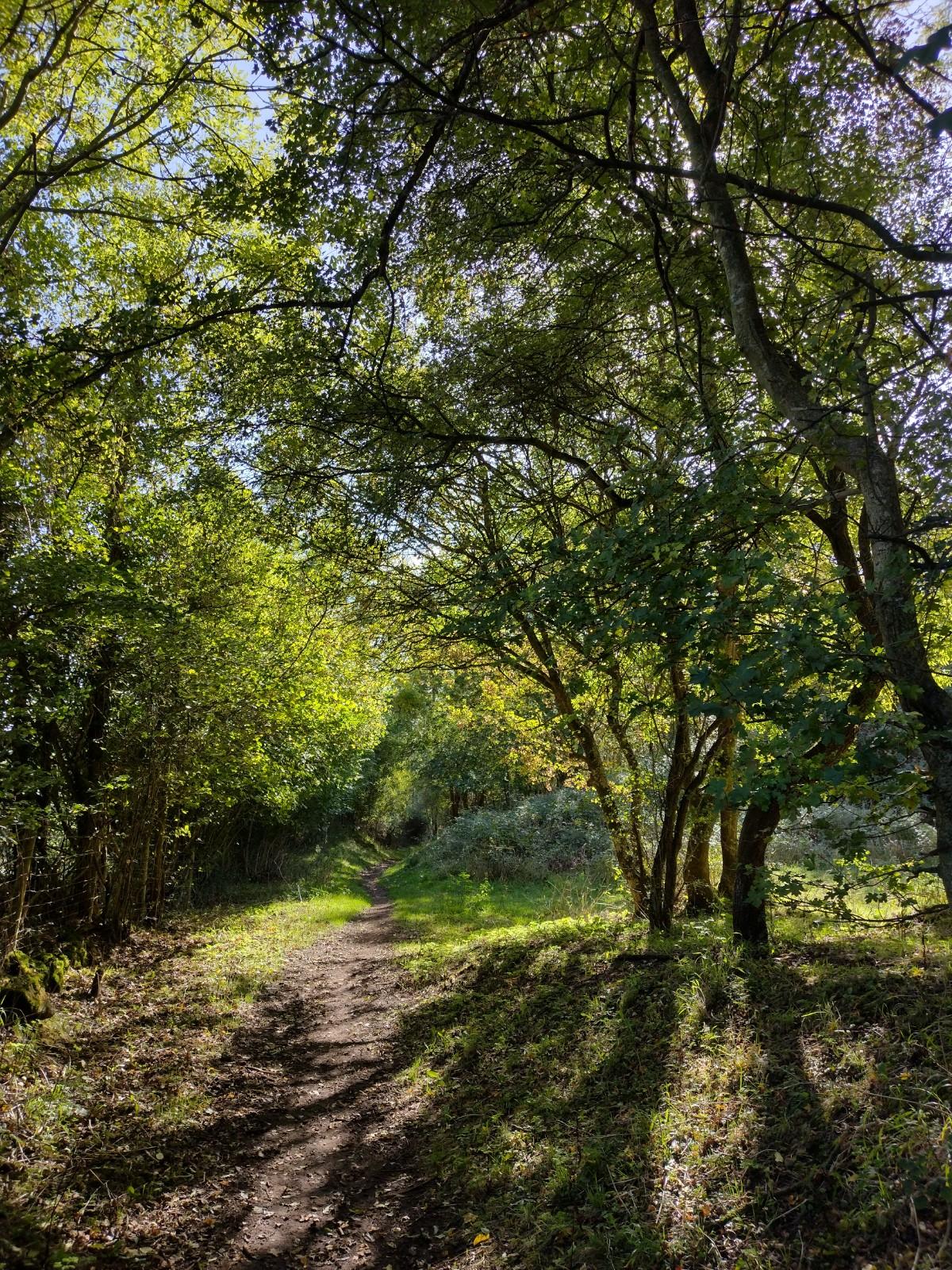
Instead we were just walking the foothills part so to speak, through woodland, which on a day like today was a magical place to be in with the sun dazzling through the branches, interspersed with shade and coolness. A few speckled wood butterfly and a single small tortoiseshell were the only insects here. It is late in the season after all.


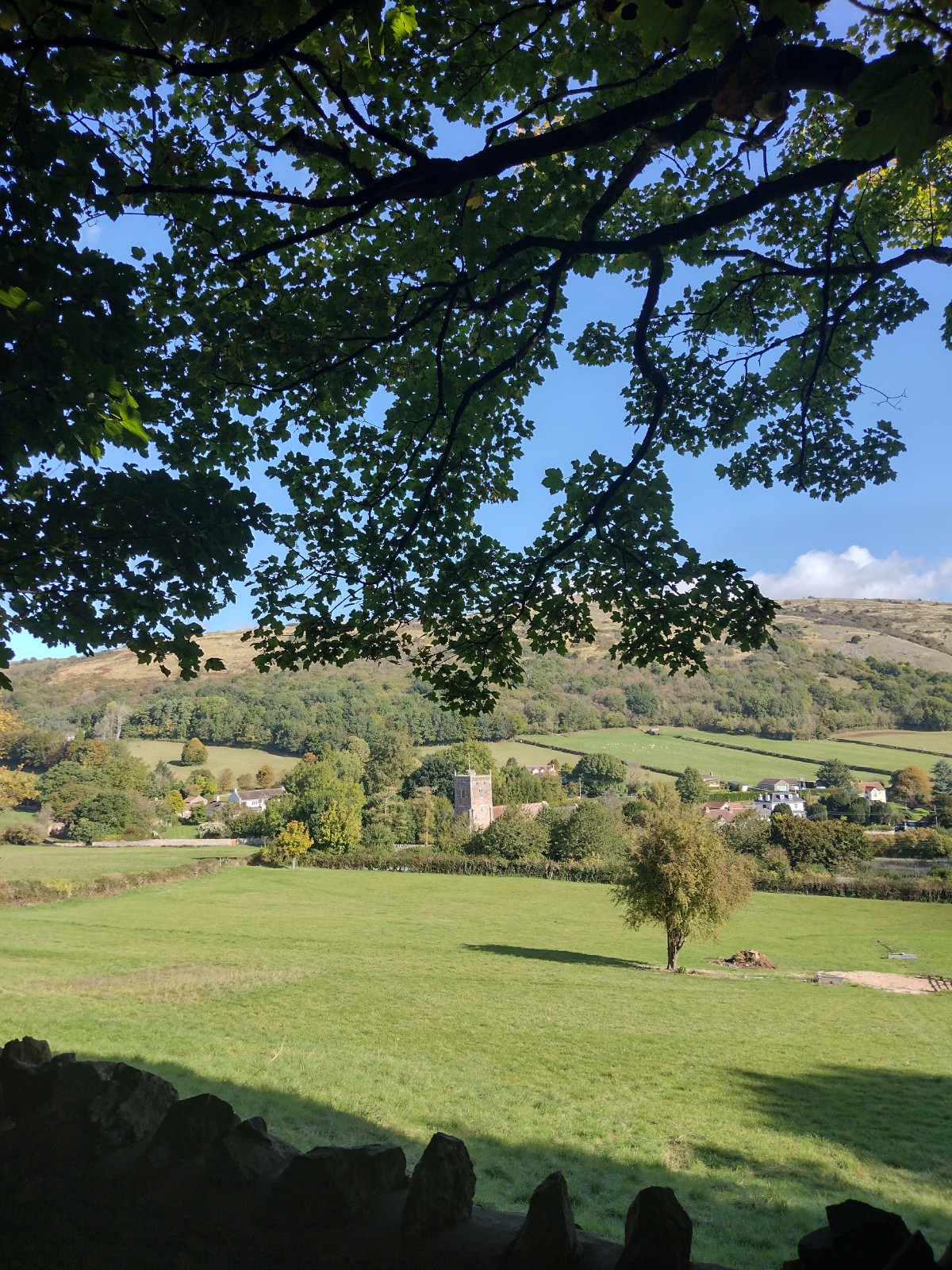
As we climbed, as one would expect, the views opened up from our vantage point hidden within shaded trees to the sun-drenched slopes of the Mendips. I've always loved this landscape on the southern slopes, and, considering we were only a couple of miles only from the M5, Weston Super Mare 8 miles distant, even Bristol less than 20 miles away, this corner of Somerset seems remote, timeless and silent. Well that is apart from the pheasant shooting happening over the valley somewhere.


Compton Bishop across the valley with the church nestled under the slopes.


Eventually we made it to the village of Compton Bishop, after a little detour and chat with a lady walking her dog, who got us back on the right track - and who suggested a longer route for another day. A sleepy backwater of a hamlet really.


Beginning our route back to Cross I spied this abundant ivy over a wall, thick with insects taking advantage of this late season nectar. Ivy in flower is such an important foodstuff for all manner of insects, and when in seed, birds and mammals. This area had not been flailed obviously, sadly further down the lane it had been shorn to within in inch of its life, here no insects could be seen. There is a moral to the story there somewhere.


Okay I know it's childish, but it made me giggle.


Finally we made it back to Cross walking along Webbington Lane rather then as planned along a footpath past an orchard. That route then is for next time, as I really want to return here and do some proper walking cum wildlife sleuthing. Note to self, bring binoculars and a good camera, there's so much to see just beyond arm distance. Walking with a smartphone does allow for lightness of foot but smartphone cameras, while good, are not nearly as good as a SLR for some images.


We got back to Cross and after a chat with a lady pruning a tree, Julie walked on another mile or so to the village of Axbridge where we planned to met up for a lunch. I had had enough, still not 100%, so I drove the car over there but before then noticed this at the outskirts of the village which I'd seen at the beginning of the walk but not really noticed. 'Maggie's Corner'. I like the sentiment of  'to find a spot of green'  very much.


Sunday October 9th : Art in Nature Museum, Gloucestershire

I'd not met up with my friend Rob for months and months, so today on his well received suggestion we met at the Art in Nature museum just north of Gloucester. Today was the last day of a Robert Gillmor  (6 July 1936 – 8 May 2022)  exhibition highlighting his artwork from teenage years to very recent. Gillmor was best known for his covers of the New Naturalist series from the 1980's. His lino-cut work is fantastic and at the exhibition there were 5 lino pads he'd cut to produce an oystercatcher image which was shown alongside. Such bewildering complexity given he had to work in negative relief for each pass of the print, each pass being a different colour. If you don't know his work, there's a nice summary here on the Society of Wildlife Artists website, a Society he co-founded.  https://swla.co.uk/members/robert-gillmor


It's a fascinating place to visit anyway as their permanent exhibitions are bolstered by special exhibitions such as the one we went to see today, and artwork and sculptures in the grounds. Plus a rather good café.


Walking around the grounds I noticed these desiccated teasels.  I've grown teasel in the garden, and seen it many times out in the wider countryside, but never noticed the leaves when crisp, form a heart. This was replicated in over half the teasels we could see. Interesting and I'll look out for this (is it just a local phenomenon) when out and about this winter.


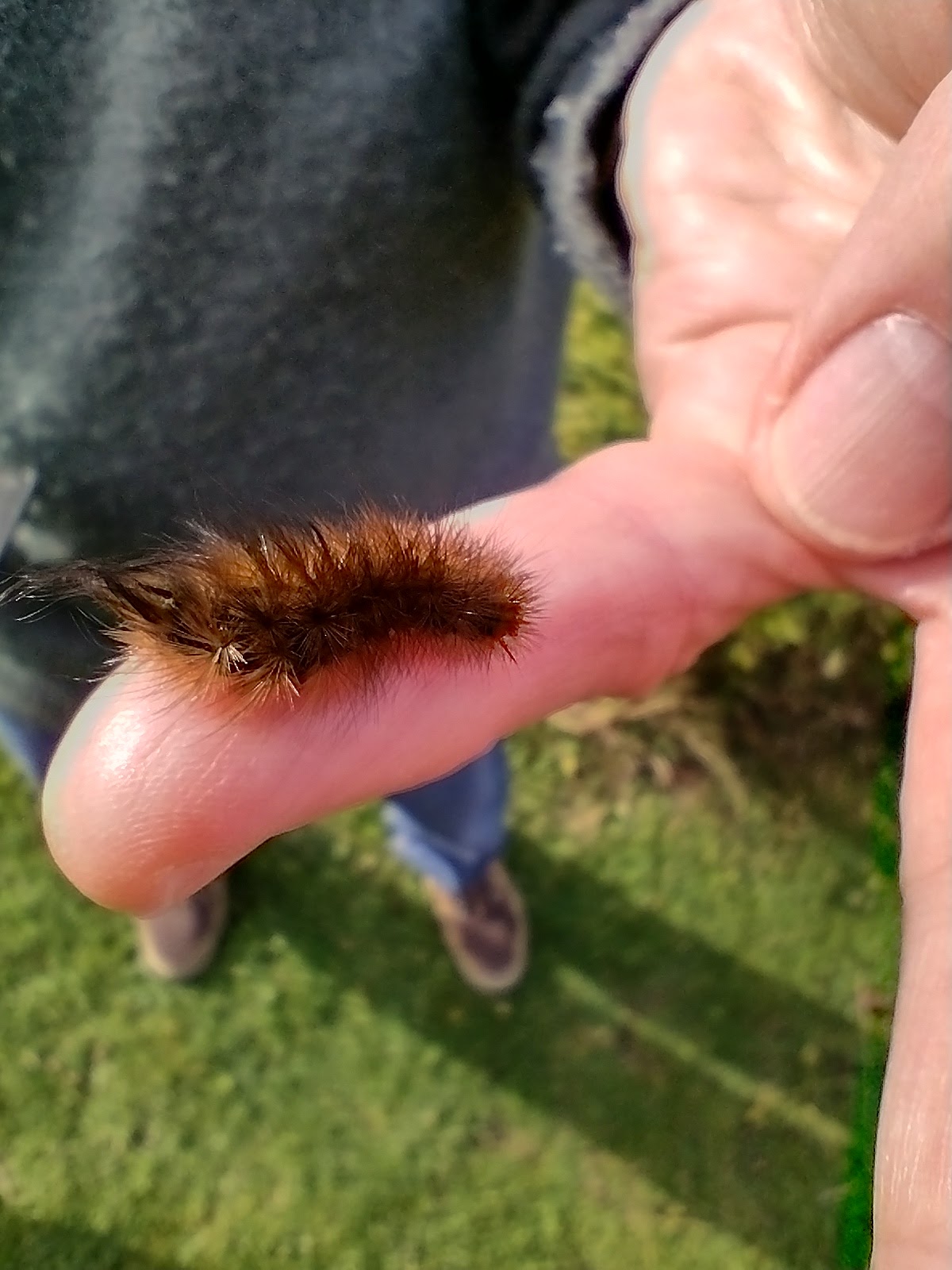
Finally, this hairy beast caught both Rob and my eye. Rob has an app on his phone which confirmed it as a tiger moth, further confirmed by a couple of better entomologists than me as the caterpillar of the ruby tiger moth Phragmatobia fuliginosa . A perfect end to a perfect weekend.


Monday, 27 May 2019

Wild Man Blues

Wild Man Blues was a 1922 New Orleans blues instrumental by Jelly Roll Morton. And in ways it is hard to explain (I'll therefore refrain from doing so) this seemed apt for today's ramble through the glorious Mendip Hills. We listened and we said very little, watching wildlife all the time on the look out for the blues. The butterflies I mean.


Near the village of Draycott lies a trio of nature reserves all around the ST500510 grid reference. Nestled high on the southern slopes of the Mendip Hills with bucolic views across the Avalonian landscape lies, firstly the Somerset Wildlife Trust reserve of Draycott Sleights.  Access to the other two sites on my radar today, owned by Butterfly Conservation, require a walk through this SWT reserve. First is Stoke Camp. At the far end of Stoke Camp lies Westbury Beacon, which today I didn't venture into but can be reached 500m away by crossing a grassy field. Westbury Beacon can wait another day however this all makes up a trio of important limestone grassland reserves.


I'd set myself the task of heading down to Cerne Abbas in Dorset for a day with his grace the Duke of Burgundy. However for various reasons this has been postponed. Stoke Camp therefore came into my radar and only 40 minutes from home.  It is a reserve I've not visited previously, though after today's rambling across the hills, I shall return. No sooner had we entered Draycott Sleights then this quite worn Small Copper Lycaena phlaeas hove into view. Nice, but it was the blues I'd come to see. And I wasn't disappointed.


Chatting to a couple at leisure with their flask and sandwiches, one informed me the common blues were flying well, 'over the top by the gorse'. There was no getting away from it, a 45 degree climb was my only option. 


But it was worth it, and true the gentleman's word the track was alive with common blue butterflies, trios and quartets pirouetting in an embrace. Singles fluttering in the breeze, which at the top of the hill was more of a full on wind. Not ideal butterfly weather, sure it was sunny and warm but anything over 2 meters and your hat would blow off.


Luckily these absolute stunning common blues were not too bothered about the wind. Difficult to photograph as the airflow made them skittish. But having been given advice many years ago I was armed with my binoculars and a camera with a telephoto lens. For years I went out to watch butterflies, only to experience gathering annoyance in that each time I tried to get close, they'd fly off never to be seen again. Guidebooks and tutorials suggest get a butterfly net and chase after the little beasties. Well that was absolutely hopeless too. Then I met the great butterfly expert Matthew Oates, who was at the time the senior conservation adviser to the National Trust. I learnt a simple lesson from Matthew. Take a good pair of binoculars to watch them flying or when they come to land. There's no need to try and get close - or as he said 

"...would you expect to get close to a bird? No you look at it through your bins. No difference in the world of Lepidoptera."

And then on the second bit of his advice, I bought myself a bridge camera with a very good x100 optical lens (which can digitally go to x200 and it's not bad indeed). All these images were taken 20-30 feet from the butterfly. Any closer they'd be off, but stand back and they will oblige with a stunning display.


Now while there were many many common blues on the wing, until well into the search no small blues. Bought in the 1990's by Butterfly Conservation, Stoke Camp reserve was acquired for the conservation of small blue colonies, the larvae of which thrive here on a heady diet of kidney vetch happily growing here. Just a single small blue Cupido minimus today. And very nice too. 


After a good hour watching these aerial blue jewels it was time to head back and up onto the Draycott Sleights reserve on the other side of the lane. On a day like today its 124 acres looked stunning from my vantage point at house grounds, a grazed part of the reserve home to many notable species.


It gets me fit walking up and down the Mendips, though between the breathless moments, a number of butterflies made the slog worthwhile such as this small heath Coenonympha pamphilus, though quite worn. 


Reaching the high point it was time to sit and catch my breath. More common blues scurried past me and then a 'little brown job'


As previously noted I've learnt not to rush about chasing butterflies. Instead I sat on this rocky outcrop and focused on another outcrop 20 feet away. Binoculars scanning there it was, a wall butterfly, Lasiommata megera. A declining species these days has designated it UK BAP status for research, thus not a species I have seen many times. I was quite pleased with this photograph it has to be said, given the distance between sitter and subject.


Almost immediately after taking this image a fluttering moth caught my eye. Skittish and seemingly unwilling to stay still for more than a second on the ground, I followed it for a quite a distance. Eventually when I did catch up with it, and get this single image, I thought it was a tiger moth. Which it is not.  Later at home I checked up what this was and it turns out to be a very tatty Wood Tiger Parasemia plantaginis. To the best of my knowledge this is a first for me. Sadly this specimen won't last long, part of its forewing was missing which may have explained why it was skittishly flying all over the place. Looking up the lifecycle this must be a male, as the females are largely nocturnal. Next time I'm here I'll look out for this lovely moth.


There is much more to say about this trio of reserves, the endless skylark chorus accompanying my Lepidopteran adventure, but that is all for another day.  Hopefully then my next visit will be as enjoyable as this Bank Holiday Monday in Somerset.


Saturday, 1 July 2017

Corvid moments on the Mendips


My nature blogging has been a bit lapse recently. I say lapse, I really mean non existent. Increasingly I've felt the pull of blogger.com and so todays observational nature experiences prompted me to once again put finger to keyboard.
 
 
I found myself on the Mendip Hills in Somerset this afternoon, a sunny and clear blue skies day, marred somewhat with the strong winds blowing off the sea, not quite gale force, but lively. I had four hours to spend up there between chauffeuring the current Mrs Dawes for a horse trek to the pub and back. Ample time for a bit of a nature ramble myself. Or so I thought.
 
 
Birds were on the wing, but that wing was an rocket in the making with the strong wind. Time after time I observed little brown jobs clinging to posts, wobbling like fruit jellies, before exhausted they flew off in an pirouetting arc. The swallows loved it in the wind, as did this buzzard.
 
I've seen buzzards hover like kestrels many times, but this one using the strong winds blowing in from sea level to 1000 feet was a superb hoverer. Can't really show what mastery it had of the air in stills photographs but the passing swallow helps show its immoveable position. Great to see. 


It was while watching and attempting to photograph the buzzard that about half a mile away in a Forestry Commission plantation I heard the unmistakable jack-a-jack-jack of alighting massed jackdaws. A quick count revealed around 100 jackdaws hurling themselves into the air, wheeling and jack-a-jack-jacking, family groups of adults and this years young, bonding, learning where the land lies and knowing corvids, just having a nice bit of fun. They rose and then landed back in the conifers twice, before the whole flock roe and flew overhead at speed in the wind. I never saw them again. Given corvids penchant for being site faithful this new area for me bodes well for winter corvid-roost-at-dusk dusk soirees.


But that wasn't the end of it. Jackdaws may be my favourite corvid, but they are closely followed by the raven. Or as todays treat became, 4 ravens, a pair and two juvenile. How I wished I'd been closer than about half a mile as through the binoculars their behaviour was fabulous, sadly the imagery less so.  At first all I heard was a buzzard 'mewing' and that familiar cronk cronk somewhere in the same trees as the jackdaws. But then four ravens flew out. Their typical languid flap and glide interspersed with dangling legs postures and wheeling in the wind , calling.  Nearby was a huge beech which all four flew into separately. I could hear their contact calls, a sort of muted carrion crow caw is my only way of describing it. I had some recording equipment with me but it was too windy and they were too far away to record.

 
Eventually the two younger birds flew out and landed on the fence posts splitting the field. One flew off almost immediately and back into the tree, but one stayed around for a while, allowing a long shot or two.  The adults flopped down onto fence posts under the beech tree, and at this point had little interest in the younger birds. All the while I could hear their contact calls, though not able to see which bird was making them to which bird. It's such a pleasure to watch ravens, possibly our most intelligent native wild bird. Their communication vocabulary has been estimated at over 100 different calls, many so subtle they are heard only in captive birds.

 
Eventually through boredom, change of location, fancied a change, I don't know but the two adult birds flew off and for around 10 minutes flew around, over and wing touching branches flyby the beech tree. Still calling their subtle contact calls, never the cronk cronk, I watched mesmerised through the binoculars - they were definitely enjoying the strong wind, but a bit of family bonding behaviour was adhered to the joy.

 
All too soon all the ravens departed and that was that, I was left with the chittering swallows and jelly wobbling sparrows on the gate.
 
A brilliant afternoon waiting for the horses to return.


Sunday, 4 January 2009

Mendip Winter Wonderland

Following on from a posting on my wildlife blog, I've added some more images of the hoar frost on the Mendips, Somerset on January 2nd. Hope you like them.