"I think we should return to the car, that looks seriously wet"
Those words passed my lips less than a minute after leaving the car. We, that is Mrs Wessex Reiver and myself, had travelled down to visit a Dorset Wildlife Trust site which had been newly added to its portfolio, Lyscombe, around ten miles north east of Dorchester.
 |
| May 2025 : The Chapel |
I first visited this site in May on a very hot and surprisingly windy day. On that occasion I had left my OS map at home and naively relied on the satellite navigation on my phone. Betty, as I call the disconnected voice who normally aides my wanderings so beautifully, fell silent on that day when the mobile connection helpfully disconnected about five miles out. Despite being in Southern England this is a remote location, and after a number of fruitless wanderings and about turns along narrow lanes near the hamlet of Plush, lanes admittedly offering breath-taking views over huge fields in this rolling chalk and flint landscape, I finally found the small car-park and set off in blistering heat along what it turned out was the wrong track. Actually it was the right track but not for the direction I wished to walk up to the ridge of the horse-shoe of Lyscombe Hill. That first walk found me descending into the valley floor (Lyscombe Bottom) and exploring the ancient chapel there. It felt remote, a silent untouched landscape, one I instantly fell in love with. I was less enamoured by the searing heat and I decided to return and explore the 'horse shoe bowl' when the weather was less intense.
 |
| An enormous field at the start of the walk |
It has been a hot and dry year so far, the driest spring for a century or more, drought restrictions littering England, soil so dry the cracks are large enough to push a boiled egg into, if that was ever an meteorological option. The landscape has looked parched and weary for weeks. Imagine then our surprise at the squally rain barreling in from the west to greet our arrival. Welcome for the countryside yes, but a shock to the system now acclimatised to dry weather as the norm. It was much too warm for waterproofs. Scuttling back to the car we sat watching the landscape disappear behind an opaque wash of the rainfall's brushstroke. It will just be a high temperature shower, it will pass quickly. Half an hour later we set off once more. This time up the correct track and with my OS map.
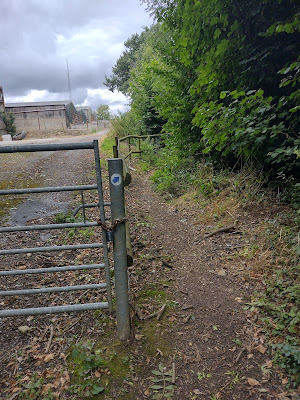 |
| The footpath we missed |
A enormous field on our left offered fantastic unobscured views over to Hardy's Monument way distant on the horizon. The farmer was urgently bringing in baled straw before more rain fell. With that rain the landscape was cooled, subdued, lank, and with harvest well under way it felt more autumnal than July.
Fifteen minutes steady uphill plodding brought us to what would be our defined mistake.
On the OS map the footpath is shown gently curving past a building. On the ground the farm track split, left through a disused piggery, right toward what looked (through my binoculars) like a locked gate. We went left, through opened gates and traversed the side of the deserted piggery and joined a meters wide conservation margin alongside a field of beans. This conservation strip was very wet after the rain but alive with butterflies, mostly meadow brown and 'whites'. There was a footpath of sorts, but to be honest just the faintest hint of passing feet through the long grass. The views were stunning but something did not feel right. Maybe it is just because this a new reserve, there was no one around, it is an empty remote spot. Doggedly we plodded on.
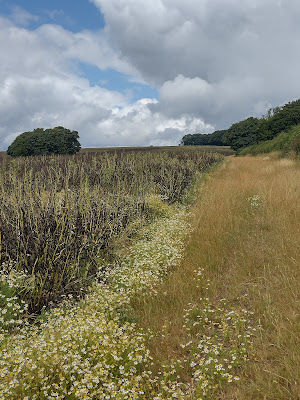 |
| The wide field margin on the wrong path |
The rain returned when we'd almost reached the top of the hill, luckily we were by some trees allowing us modest shelter. To our left the views were stunning across rolling farmland. To our right the horseshoe of Lyscombe curved away like a scimitar. Between Lyscombe and us sat proud as punch a brand new metal mesh fence complete with barbed wire on top. The rain eased, but something did not feel right. Doggedly we plodded on.
I could see where I thought we should be on the OS map, but this small woodland was in the wrong place. Let me rephrase that, the woodland knew exactly where it was, I didn't. Reaching another barbed wire fence blocking our route I knew somewhere, somehow, on the thirty minute trudge up the hill we'd missed a footpath leading off that long farm track. I don't think we were the first visitors to have made that error either as just along the barbed wire fence hands unseen had cut the middle two strands of barbed wire and bent them back. We scrambled through, there was a footpath sign but I knew we were on the wrong path.
Nothing for it, we retraced our steps back down the hill for ten minutes to the aforementioned metal mesh fence by the wood. Could we climb over it? Neither of us are good at climbing fences and while that thought came into my head a couple walked by on the opposite side, the only people we saw that day.
Explaining our predicament the lady said "Yes, we are on the footpath up to the view point - there is a footpath by the piggery, it veers off to the right next to a padlocked gate". We'd missed it, I'd seen the locked gate so we walked on via the left-hand track. To add to our despair she added "there used to be a gate where you are standing before this metal mesh fence was put up" before adding cheerily, but with a hint of why are they over there? "there's a lovely bench up the hill if you can ever get back over onto this footpath".
We thanked them and left them to their leisurely walk back downhill to presumably a warm drink and cake in the car. Dejected we took walked downhill on the opposite, the wrong, side of the fence. Moisture from the wet grass began invading our boots, Mrs Wessex Reiver hobbling due to a previous injury (I'd stood on her foot as we'd scrambled through the barbed wire fence), the metal mesh fence, happily excluding us from our destination, our constant companion. Tensions were high, enthusiasm low.
However half way down the hill as my dejection mounted, I noticed a gate on the other side of a hedge. It was open. Miraculously the mesh fence had also ended. Could we get through the hedge maybe? Yes, a bit of a squeeze but we were through. Our spirits lifted, finally after nearly an hour we were on the right footpath.
 |
| The correct footpath up the hill |
And what a difference. Much as we'd enjoyed the bean field this was more what I'd thought the walk would offer us, up a grassy ridge, trees, wildlife and far reaching views down into the valley below. We were now on our own, almost. There were butterflies everywhere, mostly meadow brown, hundreds of them, a few gatekeeper, speckled wood and large white, unidentified day flying moths too. Dragonflies zoomed erratically overhead and at our feet the grass shimmered with the explosive movement of crickets and grasshoppers jumping hither and yon. Not much birdlife other than a jay letting us know of its disapproval, but it is July, the silent season. That did not matter, we were in heaven.
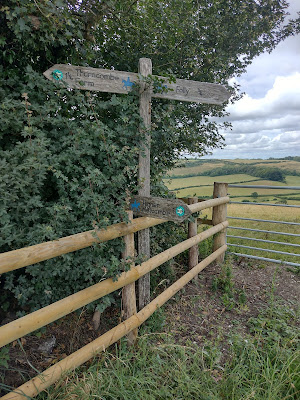 |
| Not quite there yet.... |
 |
| ... but what a view. |
We'd reached (almost) the top of the ridge, the OS map showing a nearby trig point of 244 meters, around 800 feet in old money. New metal access gates delineated a meeting of footpaths, the fingerpost showing Thorncombe, Folly, Higher Melcombe. I wandered through and looked at the view north towards the Blackmoor Vale, an area I know so well. In the mid distance the evocatively named Ball Hill, did they play cricket on that slope I wondered? To my right Nettlecombe Tout itself hiding from sight a landmark known as Dorset Gap. We'd made it, well almost. Another ten minutes walk was required before the now infamous bench loomed out the tall grass like a monument to the weary traveller. And what a wonderful bench offering a stunning view looking south across Lyscombe Bottom and on to the Dorset coastline and Purbeck, well worth the hour and a half walking to get here. We sat here for fifteen minutes in total natural silence. What a place.
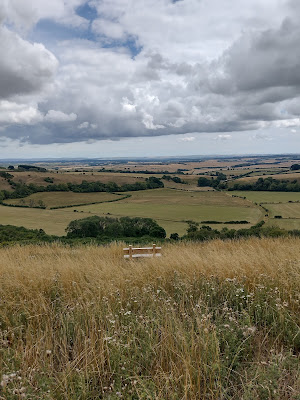 |
| We made it... |
Purchased in 2024 Lyscombe is a new reserve for the Dorset Wildlife Trust and at 335 hectares one of the largest purchases it has ever made. But I'm so glad they did (and erected the bench). Wildlife wise it is already wonderful but much more can be done. Dorset Wildlife Trust are doing an exceptional thing, by doing almost nothing. Of course management is happening. By reducing grazing and managing the reserve primarily for wildlife slowly the farmed landscape will become a natural habitat for many more species. Current management thinking is to do nothing too dramatic just give the wildlife a chance to return under its own steam now the pressure of farming for profit is released. And I applaud that soft touch approach, reading later that barn owls have already returned on their own wing as it were.
It's given me an idea too. I've been a member of the DWT for many years but mainly (due to work commitments) I've only visited a handful of their 42 nature reserves and 4 wildlife centres. Now I am retired, time hangs on me like an eager puppy wanting to be outside again. This visit, and while walking for two and a half hours and around five miles in total, gave me time to think about a new project. Over the next few years could I visit all 42 reserves and 4 wildlife centres? I'll not set a timescale, mainly as Mrs Wessex Reiver has her own hatching plans, which I'm reliably informed I'm included in, walking long distance routes. Maybe then I'll count this visit to Lyscombe as the first and at the moment half finished of these 42 visits. It is a big reserve and I've areas yet to explore, so I will definitely return.
Though maybe a refresher in map reading would be advisable first.


