A

A
Showing posts with label Radio 4. Show all posts

Wednesday, 29 January 2020

Now lend me your ears

Now lend me your ears. For the first time in years I've read a book. Bear with me, I do read books occasionally. This was a book which made me want to page turn at an unseemly rate (cover to cover consumed in a couple of days). But for reasons I'm unable to fathom out, it left me with a sense of bewilderment that of not really knowing what it was all about. 


Reading the dust cover of Under the Tump, I gleaned from the publishers prose the knowledge that this book is about finding community in the market town of Hay on Wye and how, as an outsider, Oliver Balch used his journalism skills to decipher that often impenetrable sense of place, many of us crave when arriving unannounced to pastures new. However despite the rapid page turning, probably 100 per sitting before nightly retiring, I felt empty. Why I wonder?  

Usually whilst skimming across some honed narrative, if a book fails to hook me like a dangling trout, I simply abandon it. Regularly I have half a dozen books half-finished after drifting off to a subsequent offering . Yet this book kept me turning the pages, I couldn’t stop, all the time while it failed to instil in me anything ground-breaking or new to say. That intrigues me. 

Neither geographical nor historical in purpose, both are covered in detail. Real life characters met along the way were detailed without overblown substance; whilst events passed by without too much fanfare. It was pacey. Balch adeptly used his journalistic technique to arrive at the point quickly, revisits his own perceptions of what and whom, leaving closure somewhat in the mind of the reader’s own interpretation. Clever writing. 

In the dim past I became a journeyman writer of natural history scripts for Radio 4, it is a similar technique to journalism - yet entirely different. For radio, the script has to allow the presenter to be both the peddler of the narrative, in an entertaining way, while sounding like the easy going orator and authority on that topic, as we absorb their every nuance. When we read off the page we self-adapt the words in print to our internal ear. A million individual ways to interpret how those words are being delivered. 

Writing scripts for the radio is a single entity. The person speaking is talking to you, the listener, one to one, personal and intimate. Nobody else.

If spoken word doggedly followed the journalistic chronological principles of Who? What? When? Where? Why? and How? possibly this would lead to merry mayhem with this eye-ear coordination and if lain uncorrected ultimately lead to the switching off of the radiogram or writing a letter of complaint from ‘Disgruntled of Much Wenlock’. 

Whether spoken or read, the beginning though is a hook, it's always a hook. Once impaled through the subconscious of the reader or listener, then other important details, other subservient information can be exposed. Not before, not never. 

I've just looked back at some of the scripts I bashed out for Tweet of the Day - World Birds. An example of how facts are delivered in different ways depending on the intended audience struck me. 

The bird in question is a horned screamer (Anhima cornuta), the narrator, Sir Michael Palin.

We're off, 90 seconds of radio is about to be unleashed before the Today Programme on Radio 4. Starting sedately, 6 seconds of natural soundbites filter towards the listener... the line is cast, will it?, could it?, hook the listener. Then oration feels a bite and reels in from the seventh second... 

"It sounds as if someone is using a giant plunger in the Venezuelan marshes. But these are the mating calls of the Horned Screamer.  They’re sounds that only another Horned Screamer could love, but then screamers are very odd birds."

40 words, 22 seconds of spoken word as a most pedestrian rate of 1.8 words per second - somewhat slower than the 'standard' rate of 3 words per second normally aimed for writing for the spoken word. 

In radio waffle isn’t allowed, we don't have time, the listener has a well-educated attention span, boredom is a cancer. Yet by the time this opening salvo ends, the listener is possibly unaware 25 seconds has elapsed, nearly a third of the programme. My words spoken by Michael Palin. I can never replicate his or any other presenters’ delivery on the page; each script though is adapted to the person, their voice and timbre. Michael Palin is a slower narrator than some, but he knows how to peddle the narrative, he knows  how to deliver without undue rush. It is radio gold. 

In a ham-fisted attempt to illustrate the difference, I've just looked up horned screamer within the Cornell Lab of Ornithology Neotropical Birds website. I give you the first 44 words of that entry below; have a go at speaking what you read?

"The characteristic spiny appendage on the top of the Horned Screamer's head could rightfully earn it the title of "unicorn of the avian world." This bizarre relative of ducks and swans is found along rivers and freshwater marshes in northern and central South America."

Initially this works as I read it, my brain reformulating it into a spoken word in my head, but the second sentence is a struggle. It probably is me (I struggled as a radio reporter) yet the salient facts are there in both;  

A strange bird from South America. 

That is really all there is to glean from both the journalist born book and the spoken word. In Under the Tump, I’ve mostly got down through the first layer of the Who? What? When? Where? Why? and How? of that corner of Wales. Further knowledge can if required be found elsewhere.  In the Cornell Lab entry for the horned screamer a short synopsis follows which further reading can increase our knowledge if required.  The radio script focus is on just a fact or two, delivered entertainment coupled with a little knowledge spinning around the mating behaviour of this odd bird, as the clock ticks towards the 6am pips on Radio 4. Before then an additional sound layering, that of giant plunger,  stage left.

Less is more. Radio gold.


Links: 

Tweet of the Day : https://www.bbc.co.uk/programmes/b04t0skg

Cornell Lab : https://neotropical.birds.cornell.edu/Species-Account/nb/species/horscr1/overview

Wednesday, 22 October 2014

October 22nd 2014 - Jackdaws again from 2012


Yesterday I posted about my quest to discover where 'my' jackdaws went in my area of Somerset. But that was not the first time that I'd done this. For the last 5 years I've been to and from a small part of deepest darkest Wiltshire, sandwiched between Hampshire and Berkshire; a land bedecked with the feeling of emptiness. Yet it is a landscape awash with abundant wildlife including corvids, huge drifts of which blow and tumble like black snow across the landscape, especially in the winter months. 


Today Jane a wildlife colleague of mine were discussing on-line my posting from yesterday. Why do jackdaw and rook flock together? Well it is a mystery, and as I said in 2012, I like a mystery, the natural world is all about mystery.

Research is on going, although the current thinking is two fold. Firstly rooks being the bigger of the two species are possibly acting as 'Big Brother' to the jackdaws; not in a reality TV sort of way you understand, more, looking after their smaller cousins.  Secondly, rooks posses sharp pointy bills with which they dig and probe the earth looking for worms and other invertebrates, something jackdaws couldn't do with any force. Thus the jackdaws could be following in the wake of the rook-like plough, much as seabirds will follow a tractor turning the furrow.

I like both theories. I like the fact that two species live and work as one unit. Not unique in nature, but something surprising. I have my own third theory. Given the intelligence of corvids, maybe, just maybe these two gregarious and flocking British corvids just like being with each other and are co-operating and communicating with each other in a way we'll never know. Whatever the reason, I'll keep watching and learning, and above all listening. For me, winter months mean bird spectacles, and like last night, tumbling black snow across a farmed landscape probably ranks above most things in my notebook.


Finally, to illustrate this posting, these two photos came from Jolle Jolles who is a jackdaw researcher at Cambridge University. The top image is us lot recording a living world on their work in 2011 for Radio 4, the latter is just one of the most evocative images I've ever seen of corvids. They're not my copyright nor for re-use elsewhere.

Friday, 23 December 2011

Twittering at Christmas

Well as the Winter Solstice has now past, it is time for new beginnings, so I've done just that and joined twitter. Not for personal reasons, but as a work tool. I've resisted for years having a twitter account but we're developing a new radio programme at work and looking to use tweet to get the message out. So I took the plunge. If you'd like to follow me it's @Wessex_Reiver


Speaking of work, we have a very important programme going out tonight at 20.00 hours on Radio 4. It's called Saving Species : Sustaining Life, link to it here...... Sustaining Life.


Finally it's nearly time for the NHU Bird Cup. Every year the fair people at my place of employ, run a bird cup, this year I'm on the committee, but we've handed the reins over to a younger more efficient organiser. This bird cup begins at 00.00 on Christmas Day and runs through to 23.59 on New Years Day. We've got 5 categories this year, Supreme Champion is up for grabs this year, which I'll have a go at but don't expect to win as usually over 100 species are needed to win.


I'll try and update what's happening each day.


Which leaves me wishing you all a Happy Christmas.

Monday, 29 November 2010

Winter Visitors

A bit of a catch up posting today.....

I wonder if I am the only person in the UK not blogging about the snow and the weather. Oh go on then. The snow in Northumberland is bad, friends of mine in the upper reaches of the Coquet Valley have nearly 3 feet outside their door. Luckily the man of the house works for the National Trust so has a 4x4 to get to work, but other than that nothing much is moving. There's a nice news clip from the BBC News here. Good to see Rothbury in the news again.

Actually this posting had been planned for last week before the snow arrived as I found myself in the Lake District, Windermere to be precise and Dumfries and Galloway for work. And while the weather was cold, it was just lovely frosty mornings and blue, blue skies. I drove south on Wednesday evening and by Thursday morning, the eastern side of the country was under a blanket of snow. I remember as a child the huge snowfalls an easterly wind brought into the north east.

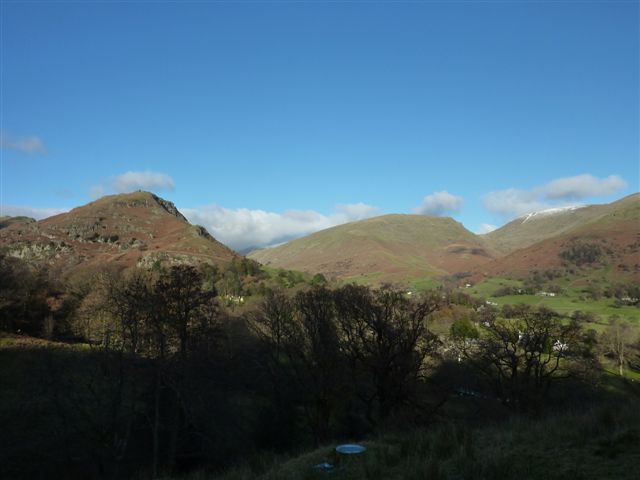
Back to my trip. There can be few better places than the Lakes on a cold and frosty winters afternoon. Last Wednesday having a few hours to spare before driving home (and to miss the chaos of rush hour traffic on the M6) I went for a very pleasant walk around Grasmere. Which is where these photos come from. Nothing too spectacular, just pleasant.


A couple of other views which caught my eye on the way.........


On the way to Grasmere I stopped off en route to walk around the Castlerigg Stone Circle near Keswick, which I last visited nearly 20 years ago.


View from the circle itself...

This was Wednesday last week, which saw me start that day off at Caerlaverock in Dumfries and Galloway. An early start was needed, as I was there to record a Living World on Barnacle Geese. this meant that at 6.30am on a cold, frosty and wonderfully moonlit morning, I found myself standing on the Solway merse (salt marsh) watching the dawn rise over the Lakeland Hills. And we waited and we waited and then, as if one bird decided to go, 2-3,000 barnacle geese flew over us, calling. What a fabulous sight, something I'll never forget. It was such a privilege to be allowed on the the WWT Caerlaverock site before dawn and be down there in the moonlight, just myself, the presenter and the man from the WWT, in the frosty silence.

Night time isn't ideal for a photo so I took this one above the afternoon before, when I did a recce. And then after the recording the geese themselves in the adjacent fields.


Caerlaverock is a special place as although a WWT site, it doesn't contain a collection of pinioned or research birds. So every bird on the reserve is a wild bird. The barnacle geese here are almost the entire Spitsbergen breeding population, so a lot of conservation effort goes into their winter welfare. But everything there is wild, including about 100 Whooper Swans, which a week or so before were in the arctic, but now make this area their home for the winter.


I love whooper swans. I remember years ago 2 or 3 arrived on the lakes at Cragside in Northumberland and watching them in this wild place, the estate being closed to the public for the winter, I could observe them unhindered. A true call of the wild in the winter.

Finally, this Sunday sees the final Living World of the year. On November 1st I travelled to Shropshire to record a raven roost. Ravens are another of the fascinating birds this Island should be proud to have living here. Big, superb flyers, steeped in folklore, and well just too clever for us.

En route to the roost sight, (which sadly I can't telly you where) we visited a raven nest. Ravens build a nest as big as an eagles, and this one was in a Scots pine, no taller than 30 or 40 feet. What is remarkable is that in Shropshire all bar a couple of raven nests are in trees and increasingly near lowland farmland. This much persecuted bird, is finally making a comeback into lowland Britain.

So make a date in your diary, Sunday December 5th at 06.35hrs on Radio 4 to listen to 2 raven experts from the Shropshire Raven Study Group extolling the excitement of these wonderful birds. The link to the programme is here. A shameless plug I know, but having seen the roost, and witnessed tumbling and pairing flight displays as early as November 1st, I want to share this experience with the blogging world.

Monday, 8 November 2010

The Gale, the Potter and the Waxwings

Well the winds that were promised have come and gone. Which is a shame as the glorious beech woods near Great Bedwyn were an absolute picture when I drove through them for the Saturday papers. So many a skeletal tree has been left this morning bare against a blue autumnal sky.

But all is not lost. As I walked in today, this Andy Goldsworthy-esk piece of natural artwork had developed in one of the rainwater ponds adjacent to the Catholic Cathedral in Bristol. I love it and yet again nature surprises me in the most unexpected places.

Speaking of unexpected things, a fellow blogger Sian, has posted on her blog "Life on a Small Island" a link to another blog where waxwings spent some time in the garden and the resulting photographs are absolutely stunning. See the photos here....!

And finally, my first programme in the current run of Radio 4's Living Worlds went out yesterday - there is still time to listen to it on the BBC i-Player. Click the link here.

Friday, 7 August 2009

A shameless plug

Just a quick note today, and for a shameless plug of David Attenborough's Life Stories. Last week we completed the final 5 (out of 20) episodes of these lovely 10 minute pieces on Radio 4. Something has happened in that these little programmes are being seen by both the industry and Sir David himself as a fabulous piece of Radio broadcasting.

So if you can, please tune in to BBC Radio 4 either 8.45 pm on a Friday evening or 8.45am on a Sunday morning, or on line by clicking this link - Life Stories. I'll guarantee you'll not be disappointed if you love the natural world - and by all means, spread the word.

And I'm sure you'll forgive this photo taken last week!!

Sunday, 14 June 2009

Au Revoir - temporarily

Self and Sprout the greyhound, Sand Bay this afternoon

Some of you who follow this blog may have noticed that I've not written anything for over a fortnight. I knew June was going to be a busy month, and so it is turning out to be; so little time to stop and stare, let alone write something worth reading.

So a decision:

For the next month or so, unless something monumental happens, I'll be off-blog as they say. I shall though return, bronzed (Isle of Man in the rain) fit (carrying cases and sound equipment to Isle of Man) and Adonis like........ maybe that's going a bit far.

And so until my return, please keep tuned into NHU Radio on Radio 4, Nature, Living World, A Guide to Waterbirds, and most importantly David Attenborough's Life Stories which I'm involved with. Go on have a listen, you will be amazed how good they are.

Until July then I wish you adieu........... must fly!!


Wednesday, 13 May 2009

Herefordshire...... is a sound place

Every time I head off to Malvern for the Spring Gardening Show, I always say to myself, I must come back here and visit this area properly. Hereford, Worcester and Shropshire are a bit of a closed book to me, yet easily reachable for a day out.

Anyway yesterday, I had a chance to do just that, as I was out on my first location recording of Radio 4's Living World at a location in Hereford. And what a beautiful spot. The National Trust property we went to, Brockhampton, has ancient orchards, amongst many other charms. This is an area of Hereford I do not know. So the drive up was great, sun shining and the countryside just looked absolutely stunning. You know those few days which occur each season when everything is "just right"

Anyway we duly decamped, met up with the National Trust team, said our hello's and then I was sent off to a far and distant corner of an ancient orchard (containing relic agricultural machinery) to record some atmospheres. Which is obviously a euphemism, for "get the idiot out of the way, we have proper work to do" So off I went to frighten some wildlife with my Rycote microphone and Nagra recording kit.

In this image I'm recording the sound of a fence post. It didn't make much sound, but after 20 minutes I had enough material to return to the fold and say I'd finished. By the way one shouldn't hold the microphone, as they're very sensitive. This was pointed out to me yesterday!!

But what a cracking place this estate is. You'll have to listen to the programme to find out what was going on, so book mark the Living World Radio 4 site here. I think this programme is going out in June, but will let you know. But if any of you out there are into insects, I think you will like this one, Mistletoe Weevil and Noble Chafer to name but two stars of the show.


And finally I'm going to enter this in a wildlife photography competition. I think you will agree this is just a stunning photo of a Cardinal Beetle. The clarity and composition are second to none!!!!!!!!! (oh if you can't see it, it's behind that nettle leaf).

Thursday, 16 October 2008

Owls tomorrow and that's yer lot for 3 weeks

Just a brief snippet of stuff today.

Firstly, via the blog I thought it may be worth publicising this Afternoon Play, Friday 17th October on Radio 4, The Owls. Why am I advertising the afternoon play? well because it has been produced from the BBC's Natural History Unit.

A fictional story written and narrated by Paul Evans and based on an island legend about a brother and sister who were bound by a wish sworn on a barn owl feather, which in turn became a curse that proved fatal. Recorded on location in Scotland.

Go on, have a listen, I'd be interested in any feedback.

And then again, I'll not be here to read feedback for three weeks. Yes, the Boy Border is finally off to have his Summer Hols. Those of you of sharp mind and quick wit, will notice that summer has passed and we're heading into Winter. Let that not deter me venturing off with my bucket and spade into the gathering darkness.

And so until November 10th (unless I get access to the Internet while away), I shall leave you with this quality photo of Bristol's Eagle Owl, now known as Eddie.

I know it's amazing isn't it, it's all my own work!!!