A

A
Showing posts with label Late Winter. Show all posts

Saturday, 21 January 2023

Late Afternoon Walk To Check On The Crows

Time of day makes a huge difference to what is seen in the countryside. Earlier this week I wrote up on my hour or so walking and looking for corvids at lunchtime. Today I headed off on the same route though as the sun began to dip. My aim this time was to try and follow where the jackdaw head to at dusk. Their main jackdaw roost here is at Worlebury Woods about a mile away towards the sea. however a sizeable number of jackdaw head in the opposite direction at dusk and I've never managed to discover where they actually go. So with my work finished for the day half an hour before sunset I headed off into the cold. First corvid an obliging magpie.


As usual once I reached 'Rogers' farm, the rook were loafing about. Earlier in the week the pairs were on the grassland today however they were paired up and loafing about on 'artificial trees'. I noticed a couple of single birds, but on closer inspection most rook were sitting tête-à-tête so to speak, simply enjoying the last of the sun on what had been a bright sunny but bitterly cold day. 


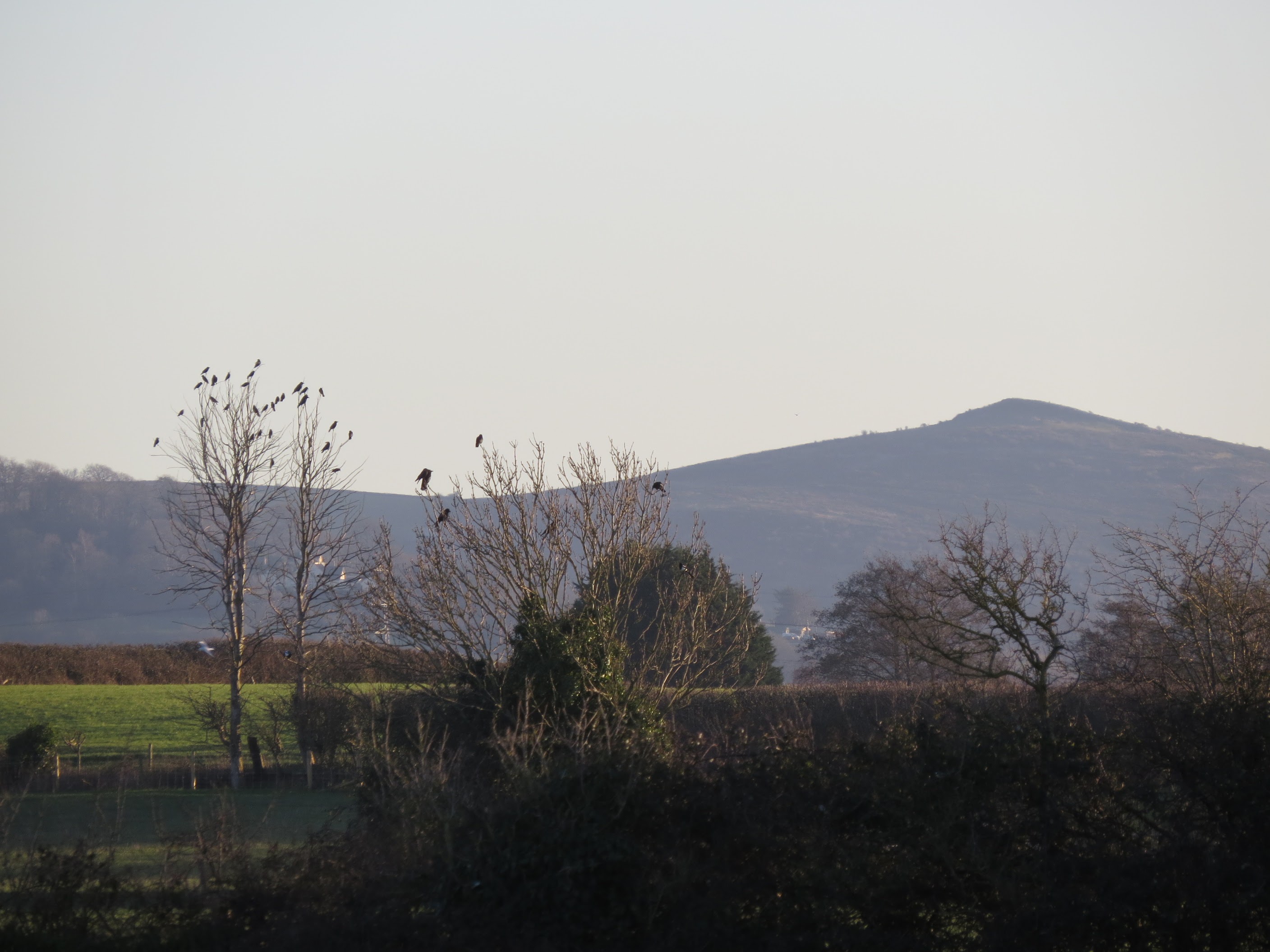
I could feel the temperature dropping with the sun and even at this late hour of the day, last night's frost remained gripped in shaded areas. The ground was hard. Difficult foraging conditions even for rook with their dagger like bill. If the ground is frozen even if they can stab through the surface, invertebrates will have retreated further down into the soil avoiding the frozen conditions. Luckily we don't get too many deep penetrating frosts here and the farm has many rhynes and waterways with exposed banks as emergency foraging areas. Just the other side of the farm more rook and jackdaw were arriving at favourite pre-roost trees, framed by the familiar bulk of Crook Peak on the Mendips in the distance.

There was a lot of activity in the countryside though this was of a fleeting and noisy kind. I could hear carrion crow, rook and jackdaw busily contact-calling as they flew to and fro but very few stayed put on the grassland for very long. And that is the time of day. The days foraging will be over and by 4pm in mid-January it is all about preparing for the long night ahead, social calling, interactions and resting before flying to the roost. I walked on, past the chainsaws buzzing at the dew pond, and onto the church in the village. Only two jackdaw there when I arrived, and only one obliging enough for a half decent image.


The sun was starting to set quickly now and I was beginning to feel the cold entering my bones. Cold sunny days have long fascinated me. Many is the time I'd look out of the house at the clear blue skies and think I'll head out for a few hours to watch wildlife. But really to observe wildlife involves being stationary for a long time and, even at these not that cold temperatures, a chill quickly will set in. Time to keep moving and wander back slowly in the hope the jackdaw will entertain me at around 4.30pm 


The low light was fabulous and by a newly installed footbridge I noticed half a dozen winter gnats flying, their delicate bodies picked up by the sun's rays. These probably were the males, buzzing about trying to attract a female, and are commonly seen in the winter months even on cold days as long as there is a nice sheltered area warmed by sunshine. A nice reminder life carries on all year. Other than the gnats and a mallard pair there wasn't much else about.


Further along the lane however a very obliging wren flicked and flitted through one of the lane hedges. I stood for ages watching this diminutive bird calling, each time its whole body would shake and shudder as it ushered that enormous song of theirs.


And while watching the wren, I noticed more rook coming in onto the favourite tree of theirs in the village. Light levels were really starting to fall now with the sky behind me turning a lovely salmon pink and blue colour. A light that signifies a cold night ahead for the wren then.


Those low level dusk hues are a photographer's dream and while this silhouette magpie is not making the most of the colours, I found the sepia background quite pleasing.  However although there were small groups of jackdaw milling about it was already 4.30pm and the main flocks had not materialised. Presumably they've taken a different flightpath today. I carried on walking until a feature I've been observing for a few years caught my eye, again.


If I'm honest, I've no idea what is making these tracks, but they've been here for years.  I'd love this to to be otter as the track goes from the River Banwell next to the barn top right, across the field, under the fence, down the ditch, before they disappear over the lane, before re-emerging opposite, down another ditch and into the river again. A sort of semi-circle from river bank to river bank avoiding the bridge which is mid point. But I'm certain it isn't otter. While otter do cross open areas as a shortcut, and I've seen many such otter tracks before, they would probably use the river or bank itself. And I've never seen spraint by the bridge. 

On closer inspection today there isn't any obvious footprints or tail marks either, in fact there's very little to go on at all.  It could be badger, though I can't find any hair on the fence or through the brambles on the opposite ditch, plus I don't know of a sett around here. Fox is a real possibility as this is very close to where the dead fox I spotted last week was, and there are a lot of foxes around here. Or even, and I wonder about this more and more, cat, as there is a large black cat often in the field hunting. What it needs is a trail-cam to solve the puzzle but as it is in a public area next to a lane I'm not sure the trail-cam would last very long. Food for thought, though thinking this through I'm going for fox without any evidence m'lud. 


In the five minutes I'd spent looking at this animal track I was beginning to get quite chilled. The jackdaw hadn't materialised either, though a number of redwing and long tailed tit were a pleasant diversion. I decided to head home happy in myself that the nature of this area of North Somerset continues to entertain me. Just being out on a cold frosty day is enough to lift the heart.


And then when I was almost home they appeared as if shapeshifters in the gathering dusk. The call came first of course, that jak - jackty- jak as they maintain social bonds in flight. Alerted to their arrival I managed a couple of quick images of groups of maybe a dozen or more birds flying quite high right over me in fairly quick succession. I checked my watch, 4.38pm. Of course, the days are lengthening and sunset is later by around 2 minutes a day now, so their 4.30pm passing the house on Tuesday was eight minutes later today. Lovely to observe as they sped overhead but I still don't know where they go from here. That's for yet another day of watching and waiting. 

I can't wait, but I must remember time of day does make a difference to what is seen in the countryside.


Tuesday, 17 January 2023

Lunchtime Walk To Check On The Crows

A beautiful day. 

Here in Somerset we had thirty days of rain from the 17th of December until this weekend. It has been truly grim. But all that has finally changed. As with the rest of the country a northerly airflow has developed and ushered in much colder but thankfully brighter weather. Last nights frost was hard but here we've been spared any snowfall. Simply a crisp and beautiful day dawned.

Working from the home office these last two days I've been distracted by the corvid activity hereabouts. Jackdaw continue to use our garden as a flightpath, as they have done for years, flying in the morning and evening at eye level between our bedroom window and the fir tree at the bottom of the garden. I try and grab images of these birds as they noisily shoot by at almost hand-grabbing distance but the result is always a blur. One day, and a faster camera. 

Yesterday at dusk I noticed a jackdaw flock of around 100 birds heading to roost flying over the back field, very low and hedge hopping, presumably a peregrine or other such raptor was hassling out of sight. Safety in numbers for the smaller jackdaw, the larger rooks and carrion crow carried on as normal with their flightpaths at some height in small groups or pairs.

Today though lunch beckoned and I fancied a walk to see what's happening to the rooks up by the village. It is still very early in the breeding season, but I fancied a bit of a reconnaissance before the main event unfolds in February. I had about an hour for lunch and as it is about a half hour walk to the trees I keep an eye on in the village where rooks come each year and rebuild their rookery, I had bags of time. 


Although I live in a modern estate, I overlook unspoilt countryside. It is also very flat around here, we're on the Somerset Moors, on a flat headland jutting out into the Bristol Channel. At around 3 meters above sea level the area is hedges, isolated trees with farming mostly sheep and cattle on permanent grassland. Perfect for corvids and views. The view above is from the Chinese Take-Away not 200 meters from the house - it has to be one of the best such views anywhere while awaiting the prawn crackers, lovely sunsets in the summer. 


The first corvid I spotted was this carrion crow. I still can't work out what it has in its bill (maybe a Chinese cracker), but whatever it was this bird swooped down from a height, grabbed it and was off.


Ebdon Bow is the first place I meet on the walk after about 5 minute, a couple of farms along the banks of the River Banwell. Sometimes along the river you can see a kingfisher or heron. Today though nothing other than a pair of mallard. This is a tidal river and today it was full, the tide was obviously in. On my return journey the levels had dropped and the river ran fast and true back out to sea a mile away. Despite this being mid day it was still cold, frost lay untouched wherever the sun had failed to reach. One sad sight however was a dead fox by the bridge itself. Being the good member I am I reported the sighting to the Mammal Society on their sightings app as a road kill, but as the fox was covered in frost it had been there a while so hard to be 100% sure it was a fatality.  


Turning left at the T junction and past 'Rogers' farm, first view of the village and the first birds. A party of redwing with a few pied wagtail were gorging themselves by some cattle troughs in the field. winter thrushes are always wary, the best image I got was rubbish really. But looking across I could see my quarry in the fields and the trees. And very vocal they were too.


Wick St Lawrence is no more than a hamlet, but I've called it home since 1998. And in all those years I've kept an eye on the rooks and jackdaws. Some years are good, thirty or more rook nests, a raven nest one year, and jackdaw omnipresent.  Some years less so. I fear this year may be a lean year. While on the surface the village looks the same year in year out, there has been a lot of development recently. Trees grubbed out, old buildings converted into homes and just a general tidying up of unsightly areas.


An example of this caught my eye at one of the newer rookery sites on a bend in the lane. Last year there were half a dozen nests here in what it has to be said are not very tall willows. On today's walk, half of those trees have now gone. I'll try and find out what's happening, but this dew-pond which was impenetrable to all but a few moorhen has been opened up. My guess is that now Roger's son has taken over running the farm and converted it from dairy to beef and sheep he's opening it up for drinking water. To be fair it's not a clear fell, with some nice marginal slopes having been scraped out and a willow pollarded (those trees that have been removed looked quite rotten), but for the rooks, they've lost three taller trees leaving just two standing. I think the work has been done well so I'll keep an open mind and see what effect all this has on the overall numbers of rook in the village.


Just beyond this pond work, and nearer the village, the number of rook were increasing in the fields. In taller trees by the village they were loafing about on and around nests. I'd spotted rook on nests in Devon in late December, and again a week later alongside the M5. Whether these birds I watched today have eggs already in the nest I don't know. It is still a little early even for these early nesters. However it's obvious the nests there are substantial and well cared for after the winter winds. 


In the field in front rooks were very much paired up. Courting couples were dotted about, relaxing in the sun and even taking part in a little allopreening to strengthen the pair-bond. I watched a dozen or so rook pairs for a while. Each close to its partner, oblivious to my voyeurism, in beautiful condition too. Such a good sight to see. It's still very much winter so I only hope we don't get strong winds in February and March as we did last year which blew many of the nests out of the trees just at the wrong time.


Just a little way further on I arrived at my destination, a not that large pair of trees which for a decade now have provided the hub of the half a dozen rookeries of Wick St Lawrence. It is an odd place to build a nest site but it must work. Adjacent to a number of houses the tree canopy leans over the road where milk tankers, tractors and daily commuters trundle by. But they seem to like it and as I walked towards them there was a lot of activity from two or three dozen birds both in the tree and flying around.


However when I got to the trees they all flew off leaving just a bare branch landscape. Until November last years nests clung on to the upper branches, wind and rain since then have taken their toll and not a single nest remains. It is like this most years, these trees sway too much in the stronger winds. Come nesting time though a dozen or more nests will festoon these branches. Given the activity in and around the trees I'd expect rebuilding to begin soon, I'll notice when this begins as I drive underneath on my way to work. But for now though, simply a place for Corvus frugilegus to rest and relax in the sunshine.


I'd now been messing about looking at these crows for forty minutes, I was behind schedule and I needed to get back home and back to work. There is always a cross to bear. No time then to go and look at the jackdaw in the church tower. A trio of quick long lens images then of my favourite corvids. I'll return soon and have a proper look at what they're upto, but they are nicely paired up I see.


The return walk was quicker, but not uneventful. A pair of raven shot over me cronking madly, a species that is daily now here. And a great spotted woodpecker made passing use of a GPO telegraph pole as I still think of them. No drumming or calling from him today but a wonderful example of a right place at the right time encounter.


Finally I found myself almost back at the Chinese Take-Away when a small flock of starling made use of a couple of poplars planted decades ago in what had been the farm yard. We don't get the big murmurations of starling here but most winters we'll see at least one flock of 500+ wheeling and zooming over the house en-route to somewhere. 


That ended my walk with a flourish, just over an hour in the end and I have to say, it was not a bad  lunchtime walk at all.

Sunday, 30 January 2011

Waterperry Gardens

After yesterday's bitterly cold and gloomy day, today dawned fair of face. Cold yes, a heavy frost, yes, but blue skies and sunshine. Lovely. I had a choice for entertainment this morning. Install a built in oven (well replace a like for like) or go out. Given the weather we went out.

First of all to get the blood circulating we went for a perambulation around the field at the back of the house. This is the first real walk I've been able to do since being ill over Christmas, and I thoroughly enjoyed it. However it may have been sunny, but that wind whipping off the fields nearly cut us in two. I took this photo to remind myself, and any of you who remember, the last time I walked up this treeline, back in December, when it was way way below zero and all what white with hoar frost. A link to that blog posting here:

Blood now pumping with abandon, we set off for Waterperry Gardens just outside Oxford. Now I have to admit, this garden had passed me by. I had stumbled across it reading the English Garden magazine last week. Julie knew of it, and said it had a good reputation, but had never been. So armed with a 2 for 1 Gardener's World voucher and some breadsticks as emergency rations (we know how to party) I pointed the car east and headed through Hungerford, up the A34 and bypassing Oxford (Red kite flying over the by-pass) breezed into the carpark just over an hour later. Time for a coffee and a cheese scone.

I knew going this weekend we'd be really early for the snowdrops, as they have snowdrop weekends in a fortnight, but there's something lovely about mooching around a garden in winter. It's quiet for one thing, and the bare bones of the garden are laid out for all to see. If a garden is worth visiting in the depths of winter, it will be a cracker later in the season. On this my first visit, I was impressed. I have to say, and Julie said the same, this is a lovely garden, and well worth a visit. It was laid out in the 1930s by a Beatrix Havergall as a school of horticulture for ladies, but apart from that I'll not waffle on about the background as the website can do this better than I ever can.

No; I shall let the photos below (oh dear quite a few) do the talking with a caption or two as they unfurl the wonderful few hours we spent in the rolling Oxfordshire countryside. It fair put a spring in our step, so much so Julie bought me 2 pots of snowdrops grown from the garden. These can be added to snowdrops she bought me last year from a visit to Lacock in Wiltshire.

In the garden centre this strange looking chap is as good a place as any to begin the visit (I mean the one below)


Still a week or so from opening properly, but lovely to see.

These "snowflakes" Leucojum vernum were just coming into flower too. These are quite difficult to establish (almost impossible if not in the green) but I have foolishly given myself a task to grow some at home. To that end I've ordered 3 bulbs for a princely sum from a specialist in Somerset. They're due to arrive any day soon. I can't wait.

Winter aconites were a welcome splash of yellow

But I still love my snowdrops. Nothing in my mind speaks of a positive year ahead as the emergence of these hardy bulbs.

One side of the garden is bordered by the River Thame

But let's return to snowdrops for a final time.....

But the garden is so much more. This is the entrance to the yew henge. Mind you that obelisk looks as though it had a good night last night.

It contained a friend too, sunning itself in the now warm (for January) sunshine

Inside the "henge" it is quite structured and formal. I love these obelisks against the clipped yew. In a few months they'll be obliterated by verdant foliage, but now they stand proud in the watery sun.

Viewed from a distance it is hard to believe this was January 30th. The strong structure of the garden made every nook and cranny worth a second look ....

... such as through this yew window

And being a quiet time of year with no one else around, wildlife came and played, like this chaffinch foraging in and out of this conifer.

Just a short walk from the yew henge is this, well in my mind anyway, a wonderful mix of formal topiary and unkempt. I love it.

I wonder what is through the gate?

The most glorious and tranquil garden room. This is, as its composition may suggest, the Formal Garden. I was bowled over by it. The clipped box, a central parterre, the statue, and at the end 2 heavily clipped beech trees. Fabulous.

I couldn't find out anything about this column. I wonder if it is a very recent addition. On the opposite side is Arabic script. But the sentiments match the garden, peace and tranquility to all.

This view just encapsulated to the two of us, symmetry of garden design, the curve of the heather, the perpendicular of the conifers, and beyond the linear of the hedge.

Just a flight of fancy at the Waterlily Canal

This photo was taken from the Alpine Garden but I loved the presumably accidental reference to the skeletal tree in winter by the skeletal espalier trained fruit trees in winter.

Oops sorry more snowdrops I'm afraid, this time in amongst Cornus spp

Just perfect on a winter's day: bold structures to enhance the passage of the winter months

Last photo, of the Classical Herbaceous Border. I took this because of something Julie said. What she loves about gardening, and after all it's her profession, is that the border above is pretty much empty of any activity. Just the odd shoot poking through. But as Julie said, below the surface of the soil, there is activity, and soon that activity will bust through and give yet another dazzling display in the warmer months. Gardening is about cycles, the yearly and seasonal cycle and that's what makes it so exciting at this time of the year, it's like being at the start of a big adventure. Roll on the spring.

Anyway just to finish the day off, we got home and it was still light. Wonderful. One job I had to do was decant half of the industrial-sized quantity of peanuts I'd bought off the Internet. We'll have birds who can't fly at this rate. Anyway Molly is preparing herself by the looks of it for these non flying birds. But best of all Julie did some gardening for the first time this year at home and at 5.20pm the evening sky was still light enough to see. February next week.