A

A
Showing posts with label Birdwatching. Show all posts

Sunday, 10 March 2024

Bittern by the SEO's


There is a lot to be said for going that little bit further, further away from the madding crowd. As happens every year March arrives and the urge in me to get outside more and more comes along. Especially so after the endless relentless wet weather this winter has been less than conducive to outdoor pursuits. However as the forecast for Friday looked fair of face, I booked myself a day of annual leave. The aim was to go and do some sound recording while also birdwatching. The reality was somewhat different.

Due to serious traffic problems on the M5 my planned early departure dissolved into gridlock chaos meaning my plan then became an 11am start. Not ideal, but the sun was shining. My aim was to visit the Catcott Complex, where a hide that is very rarely used as it involves a bit of a walk, has the peace and quiet I needed to set up some recording equipment. 

What I had not bargained for was the recent arrival of a male hen harrier at Catcott (there has been a female here all winter). Walking to the hide we passed a few 4x4 vehicles parked on the track up to the hide. I began to worry as no one should really be up here in vehicles. I was greeted at the gate to the hide by a man in full camouflage fatigues standing outside. Next to the entrance of the hide a collection of equipment trolleys were neatly arranged. I really worried now. As I walked up the path the other chap walked back into the hide and shut the door in front of me. That sort of behaviour never stops me and I opened the door. The hide was full to the gunnels of camouflaged clad photographers who all looked round at me as though I'd stood in something unpleasant. In all the 20+ years I've been coming to this hide I have never ever met anyone else inside. Of course I could have barged in between them but wanting to do some sound recording that'd have been pointless. I turned tail and exited.

That curtailment however provided the catalyst for what was to become a much better day, though I'll maybe gloss over the sound equipment debacle in any detail. That reason being the microphone kit I wanted to test, a shotgun microphone and a figure of eight surround sound microphone combination, known as an M&S set up, requires something called phantom power. In other words the microphones are powered by the field recorder batteries, rather than having their own internal batteries. Normally I would use something like a Narga recorder which has eight AA batteries. Today though I wanted to test the quite capable hand-held Zoom H5 recorder. This affordable kit copes well with a parabolic set up and the batteries will last a good eight hours. However as I was to discover today, using an M&S configuration drained both of the recorders AA batteries in ten minutes. And guess who forgot to bring replacement batteries which he'd left at home. Shall we move on?

I mentioned to Mrs Wessex Reiver who was with me that from this hide there's a nice track into the less well visited part of the reserve, let's wander up there. Not long into this walk a male tawny owl hooted, not unheard of in daytime, possibly a disturbed owl, or it had seen us and was voicing its displeasure. This came from a little copse by the track which produced a chiffchaff calling, also calling were wren, dunnock, blue tit and long tailed tit. [Ed. If only you'd brought some batteries to power the sound recording equipment with you].

There were quite a few gnats and bees hovering about too in the now warm sunshine. March does surprise like this, cold mornings can become very pleasant days though not warm enough today to get brimstones in the air. The noisy chattering of fieldfares rising from a clump of trees caught me off guard as we approached, a flock of about thirty, reminding me that winter has only recently released its grip. I think I heard a redwing with them but only saw the flash of feldgrau grey as they wheeled out, up and over the trees. They'll be gone from this landscape soon, leaving our shores as the first summer migrants arrive. Some already have. I heard later in the day that wheatear are now in Devon and previously read that sand martins have been along the south coast for a week. In the fields each side of the track the regular resident birds were around, robins were plentiful, a number of corvids hopped about, groups of magpie, some rook, and a few carrion crow. No raven overhead today which is unusual though a small party of jackdaw jak-jak'd as they passed over. This was turning into a proper nature ramble.

Eventually we made it to a dead end. I believe one day soon this track, or maybe another one nearby will be opened up further as there is a plan to create a 20km, or is it 20 mile? circular walk around the entire Avalon Marsh Super-NNR. I can see the real advantage of such a circular walk, though I also enjoy dead ends as no one passes through without reason. We stood in a gateway, taking time to look over the fields where Mrs Wessex Reiver had spotted some roe deer. I then heard a piping call. Peep-Peep, Peep-Peep. Kingfisher. Not just one kingfisher but a male and female flying at speed and in unison along a ditch, then out over the fields in a wide arc to then return to the far end of the ditch and fly fast and low over the water towards us, before the male alighted on a branch. I lost the female after that. A spectacular encounter we'd have missed if we'd been sitting in the hide. The male then flew off through some trees but not long after a Peep-Peep alerted us to the fact he was now behind us, perched on a branch over another ditch. He then flew off and despite our best efforts to see them again neither birds returned. Those efforts though were rewarded by a beautiful male sparrowhawk flying leisurely by just a few yards from us, quietly scanning the treeline for unsuspecting prey. Standing still and remaining quiet really does bring dividends even in an unremarkable landscape. I didn't manage any photographs of any of these encounters, but that is of little importance and the image below is simply a reminder of how an unremarkable looking habitat can offer so much. 

After that excitement we retraced our steps and headed off towards the 'tower hide'. I like this hide as, as its name suggests, it is high up, maybe 10 metres? It is a bit of a slog along boggy paths to get here but well worth the effort as it looks down over the reeds and because it's a bit of an effort to reach here it is a quiet part of the reserve. We had the hide to ourselves for a good half an hour, a half hour that yielded a marsh harrier flying by at our elevated head height. That spooked a flock of teal to noisily erupt from the reeds. I do like teal, they may be common but their plumage is stunning. A couple of Canada geese, a pair of mute swan, mallard, coot and a great white egret were here too. Then Mrs Wessex Reiver called out, what's that flying towards us? Lifting the binocular revealed a bittern, flying lazily across open water towards us, then past us, then away from us before dropping into the reeds some distance off. In the strong sunshine we had fantastic views from this elevated position for a good twenty seconds if not more. In flight the stippled browns and blacks look like striped lines of colour, which of course is why they blend in amongst the reeds so well. I've seen bitterns flying many times but that was a good one and for Mrs Wessex Reiver this was a first. She was thrilled.


View from the tower hide, where the bittern flew top right to bottom left 

Retracing our steps as we walked back past the track up to the first hide where a ragtag line of camouflaged men were walking back to their 4x4's, pulling behind them trolleys bristling with equipment. I wonder if they'd had as much success photographing a male hen harrier, that may or of course may not have appeared, as we had with our encounters.

I'll come onto a conversation about this topic of photographers later. 

Following Friday's glorious weather and even better encounters, on Saturday we went to the Steart Marsh complex. Rain was in the air, though not falling with any real effort. Steart is a strange place for me as I come here and rarely see very much and given the weather I wasn't hopefully today either. However the place was virtually empty, just how I like it. Upon arrival Mrs Wessex Reiver headed off for a five mile walk and I readied myself to visit the three main, and very upmarket, hides here. If nothing else I'd avoid the rain and the brisk wind. The Mendip hide was my first stop which produced absolutely nothing. There was a magpie by the entrance, but from the huge picture window looking over a vast salt marsh, not a bird stirred, though coltsfoot was already in flower outside. I had a cup of coffee and a biscuit.


Quite posh the hides here...

Ten minutes walk away is the Parrett hide which, as you may surmise, looks out over the river Parrett, a main drain out from the Somerset Levels into Bridgwater Bay. It was low tide exposing huge areas of mud showing a smattering of Canada geese, redshank, what looked like gadwall, but they were a long long way off plus a single curlew plodging through the mud. The biggest high tide of the year was due the next day that will overtop the Parrett and flood the whole site, as it is designed to do through an engineered breach. Today though the river was still sea-bound and very low. A lovely male  stonechat was singing as I exited the hide, a female close by listening. Stonechats, a favourite bird of mine,  are best known for their chak-chak alarm call but their song is a melody of soft whistles and single notes, almost like a dunnock but softer. I've probably only heard this a half a dozen times. 


View from the Parrett hide on a dull day, at low tide

Next stop the half mile walk to the Quantock hide. I could hear the teal and wigeon as I approached, though I decided not to enter the hide but instead look out from the screens. Quite a few redshank, shoveler, shelduck, mallard, little egret, and of course the aforementioned ducks. On one of the shingle islands a pair of greater black backed gulls, their backs looking almost jet black in this light, were resting. I'd like to know, are they are nesting here?  These really are huge birds when you compare them to say teal. I like them but they can wreak real havoc in a nesting colony. I then noticed some pied wagtail noisily flying about in tight circles over another island, males chasing females, males chasing males, I couldn't rightly tell. I was hoping they would stop and do some courtship display on the ground as I've never seen what some observers refer to as a wagtail dance.  However after a few minutes of frenetic activity they flew off towards the far fields where up on the ridge a very noisy rookery was also in full swing. I scanned the rookery and counted at least fifty nests. There was a lot of activity, individuals flying to nests with twigs, pairs of rook shadow-flying overhead, groups of rook just flying about enjoying the wind and despite the rookery being a good half a mile away their raucous calls filled the landscape. There was one odd sight though as I scanned the trees, a great white egret flying past the rookery, who'd have thought that twenty years ago this would be an everyday sight in Somerset.

My final highlight of the visit occurred was while ambling back to the car park. To my left I heard a commotion, a flock of linnet noisily flew overhead and a group of teal flew rapidly in all directions. I could see something light brown flying with purpose, half obscured behind a hedge so I stopped to try and see what is was. What it was, was a short eared owl. I had the binoculars on this bird immediately, what a stunning view of this top predator. As it flew towards me it casually looked left and right with those piercing eyes, and with a gentle flap and glide it flew towards me and then out of sight. There has been an influx of short eared owls into Britain this winter, especially along the North Sea Coast. Smaller numbers have overwintered here in Somerset but to see one in mid March is, while not unusual, a little late in the season. But what a lovely surprise ending to the day and as I got back to the car park I popped into the estate office. 

Yes they knew about the Short Eared Owl, though they are no longer publicising rare or unusual sightings, as WWT who manage the site have been having trouble here with a minority of photographers who disregard blocked off tracks or gateways and sometimes are found in restricted parts of the reserve looking for that perfect image. I'm glad though I popped into the office as I had a long chat about the reserve and its management and more importantly I learnt that WWT have taken over the management of the entire Bridgwater Bay NNR from Natural England.  And that has to be a very good thing.


Short Eared Owl landscape - well in this part of Somerset at least!

How fortunes have changed for many species in recent decades, some losers like the turtle dove, but we often forget the winners. That flypast of the bittern on Friday was a point of note, as I can remember when they were extremely rare, as can the writer Richard Jefferies in his 1879 book Wild Life in a Southern Country..

"Once, some five-and-twenty years ago, a sportsman startled a great bird out of the spot where the streams join, and shot it, thinking it was a heron. But seeing that it was no common heron, he had it examined, and it was found to be a bittern, and as such was carefully preserved. It was the last visit of bitterns to the place; even then they were so rare as not to be recognised: now the progress of agriculture has entirely banished them."

Through tireless work by the many agencies developing the Somerset Super-NNR now covering an area from Glastonbury to the coast we can see hen harrier, marsh harrier, bittern, great white egret, and short eared owls with relative ease once again. And that has to be a good thing. I just need to bring some batteries with me next time.

Sunday, 3 March 2024

The Song of the Cirl Bunting

 Not that long ago, most lowland farms south of a line from the Humber across to Blackpool would have healthy populations of cirl bunting feeding on spilt grain and chaff. Then as agriculture cleaned up it's act, literally, and as the land became industrialised, the decline in farmland seed-eating species has been meteoric, and the cirl bunting range contracted to an unviable, in the long term, population in Devon. A poster bird for this decline, the turtle dove, is a species we'll probably lose as a breeding species in Britain soon, but the cirl bunting, with it fantastically exotic species name of Emberiza cirlus, a species naturally at the very northern extent of it's range, is returning from the brink, thanks to decades long conservation efforts. And I've now seen these birds return to Somerset.  


I had to look it up. It has been fourteen years since my one and only sighting of a cirl bunting. Back then, on a very snowy day in winter 2010 I headed down the scarily snowbound M5 to Labrador Bay in Devon to record a piece with the RSPB for the Radio 4 series Saving Species. Thankfully when I arrived there there hadn't been any snow falling in this warm part of Devon and better still the cirl buntings appeared at the windswept and steep project management site. On that day the issue as always with sound recording for the BBC was that I was concentrating on capturing the interviews rather than out for a day birdwatching. At the time I did make a mental note to return to Labrador Bay. I've never been back.

Today however I set off for a closer destination Stolford Beach, forty minutes by car.


How I found myself here involved reading a newly discovered blog to me, so new I only discovered it at lunchtime. The blog writer, Jeff had spent a day in Somerset on Saturday the 2nd of March and in his write up he mentioned seeing cirl buntings which have overwintered at this Bristol Channel site. The weather was perfect and I'd been meaning to visit Stolford Beach this summer anyway after reading it is a butterfly hotspot. No butterflies probably on the wing in March, a little too cold for brimstone, therefore if nothing else I'd treat this as a pleasant reconnaissance, a walk in the sun and if I saw a cirl bunting that would be perfect.  Out on the Bristol Channel the tide was out, with a number of shelduck on the mudflats. This part of the Bristol Channel is known as Bridgwater Bay and is internationally important for shelduck, and other waders such as curlew which were calling out there too.


Stolford Beach is a stones throw from the largest engineering site in Europe, Hinkley Point. I'd not realised how close this nuclear site was until arriving and looking west saw it looming into the sky just a couple of fields away. However look the other way and the landscape feels wild and remote despite the proximity of thousands of workers. I'd come here today only to see the cirl buntings and on arrival didn't really know where to go but a photograph accompanying the description on Jeff's blog showed a pond and a track. To the east there was indeed a pond in the distance, I walked along the path which runs a-top the sea wall. Within five minutes I noticed what looked like millet on the track. Again the blog had mentioned supplementary feeding was taking place. Hopefully then this was the right location and not a horror moment from a passing family spilling their granola.


A number of birds were moving each side of the path, chaffinch, blue tit, house sparrow, wren, robin, starling, meadow pipit and above them all a skylark high up in full beautiful clear song. What a fabulous place, why have I not been here before?  But as yet, no cirl bunting. 

Mrs Wessex_Reiver who'd accompanied me headed off for a walk along the coast path leaving me watching and listening. I'm no expert with birdsong, but after years recording bird calls, I can recognise the more common ones. Cupping my hands around my ears to produce a sound listening receiver I swivelled myself left then right. A chaffinch pink-pink, a blue tit angry chatter, meadow pipits twittering over the field, and the fluty tinkling of goldfinch, out on the mud a curlew again and some cawing corvids. But no cirl bunting. Their call is similar to its relative the yellowhammer, but without the bread, cheese or flourish. I tried again, yes, there,  back in the direction from where I'd come, definitely a cirl bunting call. But where was it? 


A good couple of hundred meters away a bird flew to a hawthorn and perched... before calling. Despite this bird being a long way off, through the binoculars the yellow striped head gave it away, a male cirl bunting. I shot off a quick record photo thinking at least there's proof if it flies off, and then I tried to walk slowly back towards the shrub for a better view. As I approached the bird dropped down into the main part of the shrub and for the next ten minutes it played cat and mouse with me as it was visible but always a little obscured by the tangle of branches. Looking through the binoculars though really showed that from behind these could be easily mistaken for a sparrow, reed bunting, even maybe a dunnock if on the ground, given their chestnut brown, black and grey back, though with a noticeable cleaner definition. From the front though the male is a riot of lime-green-yellow with dark stand-and-deliver highwayman stipes across the head.


Eventually after about ten minutes this male flew off and I was left on my own, alone but elated. I never thought for one minute I'd be lucky enough to find this stunning looking bird without any local help, though of course I had a good idea from Jeff's blog. 


Turning around to catch up with Mrs Wessex_Reiver, now well out of sight, there were some birds feeding on the grain on the path almost where I'd  stopped to listen earlier. No, it can't be, it was. An easy to distinguish male and a drabber female nearer to me, who were joined at various times by a robin, chaffinches and house sparrow. I was way too far away to get any closer to them without spooking them into flight so I contented myself to watch through the binoculars, both the birds feeding on the path and regularly scanning the gloriously untamed field they all flew in from, to the right of me.


While scanning this field I noticed a different bird fly into a thicket of brambles, whereupon checking what this was, it was another male. Difficult to spot, virtually impossible to photograph as it was in shade and I had the camera lens pointing directly towards the sun. It is thought there are four cirl bunting here, they arrived naturally but I guess the supplementary feeding, from whoever is doing that, is helping them stay. Will they breed here, only time will tell? However it is a quiet corner of Somerset and if there is enough seed it's highly possible. The habitat is right for breeding, however more stubble fields nearby would be needed to sustain any meaningful population.


Eventually after a number of minutes watching this male he flew back towards the sea wall and into a shrub behind me, the one on the left. I was now only fifty meters away or so and able to get good views, well slightly obscured but decent views for a good five minutes until that is a dog walker walked past the shrub and the cirl bunting was gone. I'd spent a good half hour or more in their company and they didn't disappoint.  


I really enjoyed today. A spontaneous decision made at lunchtime while sitting in the garden wondering what to do in the afternoon, and everything worked out famously. The weather was perfect, the location is somewhere I'm definitely coming back to in the summer looking for butterflies (Wall, Small Heath, Small Copper, Common Blue and Brown Argus are possible along the coast path I've read), and the cirl bunting were easy to see. I hope they stay. 

References:

Jeff Goodridge blogging site (Somerset Day March 2024)

https://thefinancialbirder2.blogspot.com/2024/03/an-amazing-day-in-somerset.html?sc=1709492370750#c8858072077053806649

Saving Species 2010 - Radio 4 involving the cirl bunting 

https://www.bbc.co.uk/programmes/b00t1xt1


Saturday, 24 February 2024

B...is for....

It was a chance phone call yesterday that saw me down at the RSPB's Greylake Reserve in Somerset this morning. That call from my friend and erstwhile colleague Brett Westwood involved a well overdue and quite long gossipy catch up, which ended with a discussion over the Baikal teal which has been at Greylake all winter. This bird should be in East Asia but somehow made its way to Britain possibly two years ago, given a handful of sightings across a number of areas in southern Britain, of what is thought to be the same individual. This bird has now been accepted as a bone fide British record by the BOC and as such is now added to the official list of British birds.  Brett mentioned he's keen to see this vagrant from the Far East, however living in the Midlands it's a long drive down, and it wasn't visible when he led a birding walk to Greylake recently. I said I'd have a look over the weekend and report back to him.

I woke up to heavy rain on Saturday morning despite the forecast promising sunshine. Should I go, or stay indoors and sulk? In the end I went. It's about twenty miles to Greylake and I arrived around 11am just as the sun began to break through. My heart sank however as the car park was packed, I managed to squeeze into the last space with a feeling of dread. Images of camouflaged middle-aged men with huge lenses fixed to cameras, tripods be-topped with telescopes and the general chaos of twitchers came to mind.  However I was here, there was nothing for it, I headed towards the hide and viewing screen.

My fears were borne out. I couldn't get anywhere near the viewing screen for what looked like a traffic jam of green shopping trollies loaded with paraphernalia. I tried to get near but a dozen birdwatchers were well dug-in and definitely not moving any time soon. Massive scopes pointed outward through the gaps, cameras too, various bits of equipment littered the floor, flasks and sandwiches in evidence, and, the owners glued to their phones oblivious of what was happening on the reserve.


Failing to push my way to a viewing place, I turned tail and headed to the nearby hide itself. That was a little better, still burgeoning with birdwatchers but I managed to find a suitable corner to peer out of. I looked around, not one birdwatcher was actually watching birds, they were all either in huddles around a scope chatting (and moaning there was nothing to see) or on their phones looking for something, from which the constant pinging would suggest they had found. Do birdwatchers not watch birds through binoculars these days?

I don't mind any of this at all but they do tend to stay in one place for hours hoping for that elusive photograph, in doing so preventing the casual visitor access to their inner sanctum. I'm big enough and ugly enough to barge in but it is intimidating I feel for those less robust.

I settled down. Beautiful views of snipe just outside the hide, Greylake is a good reserve for these lovely waders. Beyond the snipe hundreds of teal, wigeon and mallard, some shoveler, a lot more snipe and a handful of other birds such as moorhen and gadwall. A good number of lapwing too with their lovely call regularly piercing the landscape. Beyond the main scrape great white egret, little egret and grey heron plus the usual smattering of corvids perched on fence posts. It's been a while since I've visited Greylake and the one thing a birdwatcher must do here is scan the pylons which march across the wetland. No perched peregrine this time but a lovely kestrel right on the top in the sun.


It was at this point that a conversation struck up between my nemesis birdwatchers over how few birds there are to see from these hides these days? One bemoaned that "[at Greylake] it's the same birds I see every time I come, it's the same at Catcott, it's just wigeon, more bl##dy wigeon everywhere". I refrained from adding to their discussion and so having had enough of all this I got up and left the hide to escape the conversation bemoaning common species. 

As I exited the hide however a 'chip chip' sound caught my ears. Bearded tit, or moustached reedling as the phenomenal birdwatcher and photographer Carl Bovis referred to them a few years back. Given the males sport a moustache rather than a beard, I like that name, better than bearded reedling. Now, I've learnt a technique when watching these beautiful birds, as they are ventriloquists. That call never seems to come from anywhere near the bird and so what you do is watch for a reed stem in the surrounding area to begin wobbling and then look down to about a foot or so above the water. There, if luck is with you, you'll find the bird, as it creeps along in a direct line foraging from reed to reed. I followed this one for a good ten minutes but it never gave me a good enough view for a photograph. Interestingly not one birdwatcher passing me, as they exited or entered the hide,  asked what I was doing peering intently into the reedbed. Eventually the bearded tit flew off, in doing so startling a Cettis warbler into its exploding song.

While watching this activity my ears picked up that the air was being filled with what I can only describe as 'snap, crackle and pop' to use a well known rice based cereal slogan. It took me a while to tune in before I realised it was individual reed stems either drying out in the sun or expanding in the sun and as they did they popped. I've not heard this before but as a sound recordist it fascinated me. I should imagine however if I turned up with a microphone to capture it, all would be silent.


After this immersion into that reedbed soundscape I fancied a walk, therefore retracing my steps I joined the waymarked reedbed-walk where once again I heard the 'chip chip' of bearded tit, this time however they were invisible. In this part of the reserve people too were invisible, just one chap out looking for grey heron. 


The twenty minute walk terminated in a willow screen which offered some cover from the few birds visible out here, great white egret, four greylag geese, mute swan and a marsh harrier. At my feet however a pond skater caught my eye. The sun was warming the water in a ditch by the viewing screen where I then noticed a swarm of winter crane-fly scudding over the water surface. There are around ten species of Trichoceridae flying in the winter in the UK, they're poorly recorded so there may be many more species yet to be discovered in the landscape. Some observers call them simply winter gnats, I'm amongst that body of observers, lacking the knowledge to identify down to species level. It then struck me that despite the aforementioned conversation possibly still going on at length in the hide, Greylake was providing a number of interesting things to see. 


Many years ago when the social media platform Twitter was gaining popularity I organised a 'Tweet-Up' of like minded natural history buffs. We spent a day on the Somerset Levels, including coming to Greylake where a superb entomologist Richard grubbed around in the undergrowth and in doing so discovered a number of species not known on the site at that time, including a freshwater snail which if my memory serves me well, was new to Somerset. These were good events to be part of, and those species we recorded were submitted to the relevant biological records office. Citizen science in action. It's sad these events fell by the wayside after a few years,  not least as today I'd have enjoyed having someone as phenomenally knowledgeable as Richard alongside me to put a species name to my 'winter gnats'.

I'd been here now for three hours and whilst enjoying being out in the fresh air and sunshine, it was time to call it a day. However on my way back to the car park once again I heard the 'chip chip' of a moustached reedling. This time I took some time following the wobbling reeds as they shimmered along a ditch, and after a dozen or so images of empty reed stems and nothing else, I was finally rewarded with a photograph of the male reedling as it appeared, all too briefly, into the open. This was the icing on the cake for me watching this bird, a species now becoming established in Somerset albeit still with small localised populations.


I had one final B to add to my list of B's I'd collected today, Balkai teal (reason for visit, absent), Birdwatchers (many), Bearded tit (lovely) and finally Beetle. This green ground beetle was crawling across my rucksack as I packed it up. I tried to key it out as a Harpalus affinis, the right size and shape, but this species is one of dry sites, a wetland seems a little too moist a habitat for it.  Then I thought maybe Carabus spp. but they are much larger. Once again my lack of knowledge is letting me down with beetle identification. 

There's so much to learn, or in my case, forget, but I'll not forget this wonderful visit to Greylake. As for the Baikal teal, well it was on the reserve today, though not somewhere the public had access to.

Sunday, 26 November 2023

The Unpredictable Draw of Nature

 As I prepared to upload the images for this posting a large flock of jackdaws has flown noisily past the back of the house. It happens every year. Every day during the winter months in the morning the daws flock noisily from their roost past our house at a very low level, so low I am at daw-level watching them from the bedroom window. Then in the afternoon they return in the reverse direction although they fly much higher over the fields at the back of the house heading to their roost, a roost that I've never actually discovered but suspect it's about 8 miles away in the woods near Clevedon.


I find winter a beautiful season, a season which if I'm truthful is the one time of the year when I have more of a craving to be outdoors observing nature than during the rest of the year.  Possibly this is to do with absorbing as much daylight as possible during these short autumnal days as they morph into the very dark days before Christmas. Or maybe it is the arrival of large winter flocks of birds to find food and shelter here away from their northern breeding grounds. Sometimes it is the sunlight light levels bursting through a crystal clear atmosphere such as I observed yesterday illuminating these reed feathers at the RSPB's Ham Wall nature reserve.


We'd arrived at Ham Wall to watch the starlings come into roost. In preference I tend to avoid visits these hot spots of nature watching at weekends as there are too many people about to observe more than the regular incumbents.  I made an exception yesterday. After the first frost of the season had blanketed the countryside in an iced dusting, the clear blue sky and surprisingly warm sunshine for the noted 5 degree temperature suggested a good day to see a starling murmuration over at the Avalon Marshes. We'd been there recently and watched a good number of starlings fly in around ten days ago but it had been a very blustery day and the starlings were quick to settle with little of their famed aerial display taking place. I hoped then that the calm but cold weather on this visit might produce a fine murmuration display.

At this time of the year the starlings come in to roost from around 4 o'clock. We arrived at the car park at 2.30pm and it was almost full, high-viz clad carpark operatives waved us to park sideways on in the carpark - they were expecting it to be busy.  It was. Sometimes though the atmosphere of hundreds of people milling about makes for the experience. We began with beverages, Mrs Wessex-Reiver having a hot chocolate and I a filter coffee. We stood by a picnic table, taking in the atmosphere, when we were joined by a chatty lady who like us visits here regularly, but had just come today for a quick visit, though not to see the starlings. During the conversation as we sipped our drinks she and her husband mentioned a huge heronry near High Ham in Mid-Somerset which I'd not heard of before, a mental note was then made to visit there in the spring.

Saying our adieus we wandered off into the reserve, and as we did so a lady in front stopped and asked if we'd been here before. She and her husband had come from Oxford especially to see the starlings coming into roost. The Avalon Marshes cover a huge area and I can well understand someone on their first visit thinking "Where do we go". We had a good chat, I pointed out nothing is guaranteed as the birds can change where they roost each day,  but I suggested she would be best to stay by Viewing Platform 1 just ahead of where we were talking and she'd be okay, not least as nearer the time the RSPB send staff along there to help people understand this marvellous piece of co-ordinated behaviour. Chatty conversation number two over, we wandered further into the reserve towards where the starlings had come in to roost ten days ago. I spied a vacant bench with a view over the reedbed, and I made myself at home here, joined by a very obliging pair of male robins who devoured the little bits of bread Mrs Wessex-Reiver had with her.

With 45 minutes before the show began Mrs Wessex-Reiver headed off for a walk while I faffed about with my camera lens which looked a little dirty. Lost in my endeavours I heard "This chap looks like he knows what he's doing, shall we stay here?"  I looked up and a family of four plus dog were surrounding me. It turned out they were staying for the weekend in Somerton as the son had bought his father a 'starling weekend' for his father's birthday earlier in the year. They'd never been to Somerset before and thus had no idea what to do, so for the second time in half an hour I passed on what paltry knowledge I could muster. They were a nice family simply having a lovely time somewhere they'd looked forward to visiting for years. The draw of nature watching is strong. As we chatted a crowd began to develop around us so by the time the starlings arrived my once clear view over the reeds had become one of bobble hats, prams, children on shoulders and dogs looking bemused.


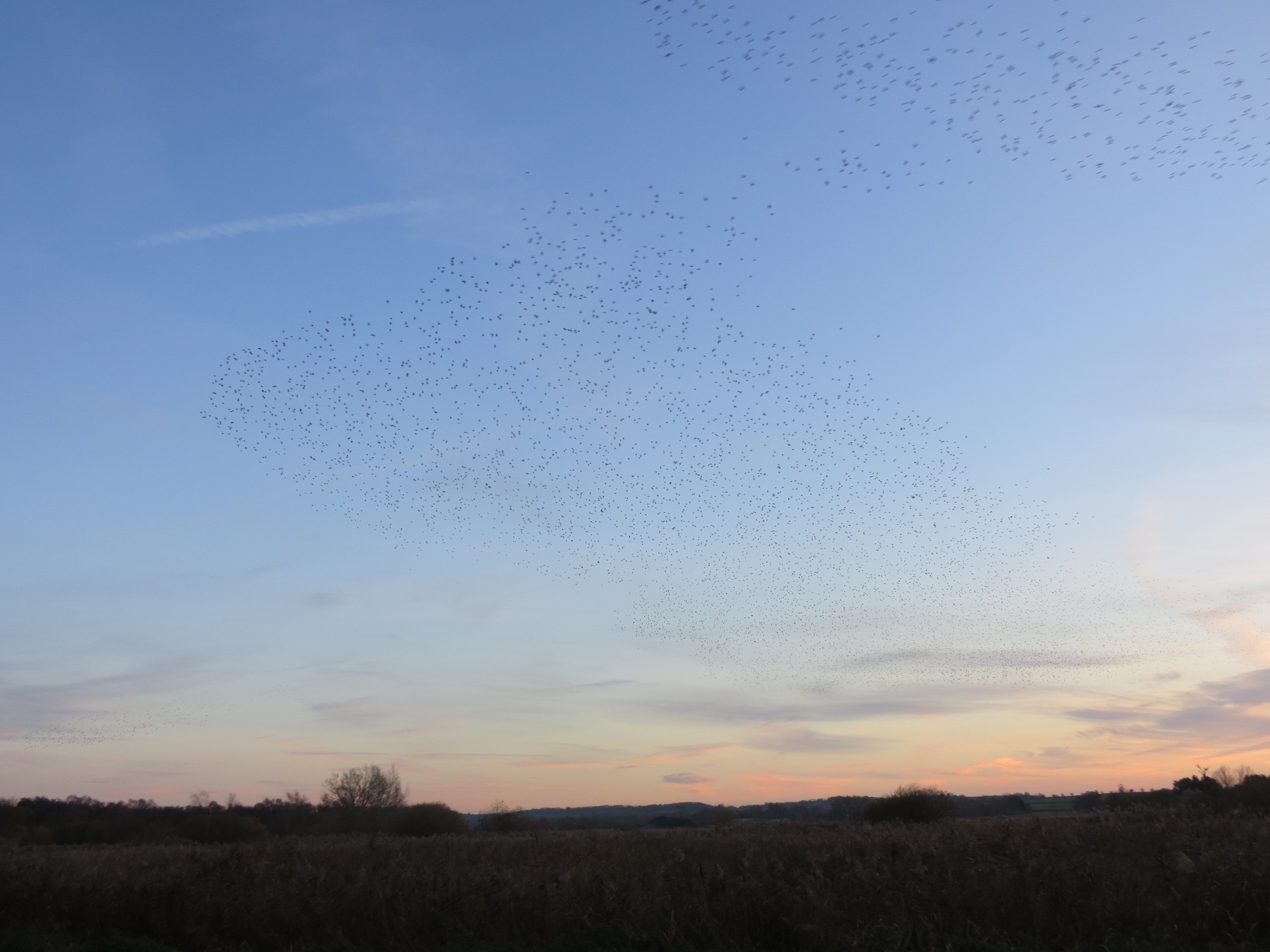
Thankfully for my new found friends the starlings gave a reasonable performance overhead. Not huge numbers of birds but a dozen or so largish flocks milling about in the sky, not murmurating exactly but very pleasant to watch as they drifted about and then into the reeds. Thinking that was the performance over we said our goodbyes and Mrs Wessex-Reiver and I began to wander slowly back to the carpark. We'd only gone a few hundred meters when we noticed a huge flock to our right in a different part of the reedbed. Sometimes the flocks of starlings converge into a single mass of activity, this evening however the various groups had formed and then split into roosting in three different areas of the reedbed. This often happens. This flock in front of us were very restless and were rising and falling into the reeds en masse. My new friends caught up with us and they saw and heard the commotion well. The chap's wife was mesmerised by what was happening and when I mentioned the noise of the wingbeats she couldn't believe it. Afterwards she thanked me for helping them have such a wonderful time.  I pointed out it was the birds not me bringing joy, but I can understand having some local knowledge maybe helped their experience.    


By now it was getting fairly dark so we sauntered further on to Viewing Platform 1 where we joined hundreds of people milling about, families, people on bicycles, couples, individuals unwrapping sandwiches and pouring tea from a flask, it was like a mass wildlife party, everyone enjoying the last of the light with the still restless starlings bobbing up and down in the reeds a few hundred meters away providing the entertainment. We watched this all for bit then I suggested to Mrs Wessex-Reiver we could walk out in the opposite direction onto the viewing platform at the end of the boardwalk and see what might be happening there. And I'm glad we did.

The noise from this third group of starlings deciding to roost here was astonishing. That noise came from the chattering of thousands of birds trying to settle for the night coupled with whoosh-wingbeats of those who couldn't find the right spot and were then agitatedly flying about between the reeds to find a new desirable piece of real estate. So low were some of these starling groups flying, and at quite a speed, that their passing was breaking the water surface and causing ripples and wavelets to form. By now the light was fading fast, seeing individual birds was impossible, it was simply a blur of activity. That didn't dampen the enthusiasm of the large number of people crammed into the viewing platform, no one was moving. It was now 4.45pm. 


Forty five minutes of entertainment by nature just doing what it does every day. As we walked back I noticed moonlight reflected on one of the pools. A moment of stillness in a landscape still chaotic with both visitors and nature on the move. Approaching the main path through the reserve those visitors were still ten deep still watching the starlings doing their thing. That's such a lovely thing to see as I suggest most people there were very much like the people we chatted to,  day visitors, some visiting for the first time, others regulars but maybe not hardened birdwatchers, families out for a bit of exercise, friends meeting up. Simply people coming out on a Saturday evening to watch nature's own unpredictable version of Strictly Come Dancing. 

Sunday, 5 November 2023

A Very Wet Newport Wetlands

A streak of mad spontaneity seems to grip our family, and myself in particular. 


I woke yesterday to a dawn of half light and full rain. Not just rain but a deluge, though there was no wind which was something to celebrate at least. I lay there wondering what to do while the rat-a-tat-tat of raindrops committing kamikaze death falls against the window confirmed in my mind it was a perfect day to be outdoors. But where? By due process of elimination, too muddy, too exposed, too near Bristol, too far, the RSPB's Newport Wetlands was fixed upon. 


We can almost see the wetlands from the back of our house in Somerset. As the raindrops fly it is 12 miles over the Bristol Channel, as the car drives it is exactly 38 miles. We, Mrs Wessex-Reiver and I, arrived just after 10am in rain. The forecast however was of an improving picture by noon. The carpark was quite full which surprised me but as this was my first visit here maybe this is normal on a wet Saturday morning.

"There's a fungi workshop happening in the woodland this morning, that's why the carpark is busy" the meet and greet lady sheltering under a sodden gazebo informed us. "It's quiet in the reserve there's no one else here but you two" she added, giving us one of those old-fashioned looks as if to say bless, these old people are game for anything.  We chatted for a while, explaining it was my first visit even though I've known of this place for decades. Predictably the conversation ended with an announcement that we'll pop into the café first while it is so wet.


From the café a capacious picture window revealed a sizeable pond devoid of any living creatures, until that is, as the rain eased from torrential to heavy a moorhen broke cover and swam into some reeds ( photographic evidence centre of image). My first tick of the visit. As we're the three camouflaged gentleman having a coffee. Obviously proper birdwatchers in that clothing they did however look suspiciously dry, and seemed to know the café staff, who outnumbered us five customers. It was going well. 

Eventually we'd read every RSPB events leaflet on the tables, perused all the Christmas cards, fondled the novelty gifts and examined every second hand book. Running out of excuses, even though it was still raining, we'd best at least show willing and actually go outside. Immediately we became lost. Somehow we'd wandered into the educational area, which was huge. Thinking we needed to walk through this to gain access to the reserve we came to a dead end at the pond dipping platform, which was apt on a day like today. On a sunny day this would be lovely, today it was a blanket of squashy sodden emptiness.


Retracing our steps we found a different path which seemed to head off into some woodland, it did, and from which we emerged at the entrance to the reserve itself. It's all quite easy once you know. By now the rainfall was intensifying, the hard path was more lake with stepping-stone islands and we were the only two people for miles around other than two dog walkers whose hi-viz full body wet weather gear allowed for only an eye slit and a muffled 'morning' as they splashed past. But we are British, it's just a bit of rain, onwards. 


Onwards brought us to a viewing platform. The view was of an empty lake and the Newport Power Station. This trip was becoming brilliant, like some art-noir film, I was fully expecting Michael Caine to appear traipsing about in a gabardine mac carrying a sawn off shotgun. But before we left this vantage point a mallard appeared. Tick two then. 

We'd been told to head for the lighthouse "it's beautiful over there". It possibly is, but by the time we'd reached this (over a quite scary inflatable pontoon set-up complete with danger of drowning symbols), the clouds were so dark we needed a torch. BUT - out from the gloom the glorious bubbling call of a curlew lifted our spirits. Not one either, a couple of calls at different locations. We'd reached the Bristol Channel.


I'd hoped we'd see Clevedon or Portishead across the water but the weather meant even seeing the edge of the marsh 50m away was a challenge. Emptying the small pond that had formed in the eye piece of my binoculars I scanned the coast. Redshank and curlew, shelduck, mallard, lots of them, and numerous grey things in the marsh vegetation, godwits maybe? To be honest they were so hunkered down, and with the rain running down my neck, I gave up trying to identify them and we decided to keep walking past a very wet stonechat perched on a reed.


I have to say bleak though it was, being the only two people on this bit of coastline in seriously bad weather was brilliant. What an atmosphere it created. Stark man-made industrialisation dominated the skyline behind us, turn 180 degrees and the sound of the waves lapping the shore coupled with the bubbling call of the curlew uplifted our spirits to the point where we forgot it was raining.  I loved it and I know Mrs Wessex-Reiver loved it too as she stood for a good ten minutes taking it all in, either that or hypothermia was setting in. I on the other hand noticed something astonishing...blue sky.


Lord preserve us, finally the rain was easing. After an hour of being deluged it was almost as if a curtain was slowly being drawn across the sky to reveal that much anticipated better and drier day forecast was behind it. And as always happens with the sun coming out the birds appear. More stonechat, reed bunting, starling, redwing, fieldfare and on the water cormorant, mute swan, little grebe, tufted duck and so on. Robins began to sing in competition with numerous unseen wren blasting out their calls. There was even a rainbow.


By now we were on the path back to the visitor centre and seemed to wander into some lovely woodland, a surprise for a coastal wetland site. Here we met a very friendly robin who Mrs Wessex-Reiver fed some bara birth cake we had left over from the café. Above us a flotilla of long-tail tits flipped through the branches chattering sonorously and then away. Then emerging from this woodland we walked through some very red-berried scrubby areas with fields to our right and above our heads the Aeolian drone of a now strengthening wind blowing through the high-voltage cables slung between two rows of pylons. This is not a pretty site but it is packed with interest, not least as I'd seen, rather than heard,  my first redwing and fieldfare of the season.


After just under two and a half miles we found ourselves back at the visitor centre - predictably in brilliant sunshine. By now sane people were arriving to presumably have a pleasant wander about in warm sunny conditions while waiting for the starling murmuration to begin - from 4.10pm on the board said. The café was filling up so we grabbed a table for a well earned lunch before driving home blinded by the intensity of the sun beating down from a cloudless sky.

But I loved this first visit to Newport Wetlands, first but by no means the last. And after a tot-up I realised I'd seen quite a few birds after all. Not bad for a wet day.

Blue tit, great tit, woodpigeon, moorhen, rook, carrion crow, magpie, robin, curlew, mallard, cormorant, ducks on the estuary miles away,  tufted duck, reed bunting, stone chat, herring gull, black headed gull, little grebe, mute swan redwing and fieldfare both seen, chiffchaff, wren, cettis warbler, jay, blackbird, starling, those waders unidentified, pheasant, long-tailed tit and house sparrow.

Wednesday, 18 October 2023

Storm Babet Birdwatching at RSPB Arne


There has to be a certain level of insanity in my DNA to come birdwatching at the RSPB's Arne reserve during Storm Babet. Especially as we'd been there the day before in sunshine, though it had been a tad windy. Today however we arrived as the rain lashed down and the roar of the wind through the trees was deafening.

We'd come today as we're in Dorset on a mini break at Studland. With the weather being so bad we'd spent the morning lounging about in the hotel gazing out the window discussing what to do today. Eventually the need to go outside drove us first to Swanage, which was being lashed by sea foam and flooding meaning the sea road was closed. Turning tail we headed to Arne, for a wet walk at least. 

Having been met by Gayle at the entrance, I succumbed to the thumb screws and we have re-joined the RSPB as joint members. I used to be a member for years but as I subscribed to many conservation agencies a few years ago I let it lapse. The question did go though my mind today, "why didn't I join yesterday?" after paying my £10 admission. Then I'd have had two free visits.  Anyway it's all in a good cause. Today I joined and got in for free. It was nice chatting to Gayle, I think she enjoyed the custom as due to the inclement weather there were maybe only a dozen cars here. Yesterday it was so busy we'd parked in the overflow carpark. We chatted for ages with the rain thundering down around us. There'd been a guided walk in the morning when a hen harrier and Dartford warbler had been seen despite the weather.

I've been to Arne many times, both for work and for pleasure, but not for about ten years. Mrs Wessex-Reiver had only been to Arne once before (with me) before yesterday when it was so cold we only stayed an hour but she had seen avocet for the first time on that visit. Yesterday's species she was keen to see were the sika.

After a coffee, to see if the torrential rain would relent, there was nothing for it. We ventured out. Actually to begin with it wasn't too dreadful as we walked towards the new Middlebere hide, though apart from a few great tits and a grey squirrel we didn't see another living thing. Which was perfect. It's beautiful here and in the inclement weather it felt quite wild, until vestiges of Poole loomed out from the distant murk. After a mile we reached the new hide.


It's an impressive hide but not a design I have come across before, fully open to the shoreline with tiered seating going back three levels. In normal circumstances this hide would provide perfect shelter, today however the sheeting rain blew into the hide as a result over half of the tiered seating was sodden and soaked. The rain was also keeping the birds at bay. In half an hour we saw a few redshank and oystercatcher, curlew were calling somewhere, a few black tailed godwits flying about, a few flying formations of 6-10 teal and nine Brent geese. And that was it. Everything else with any sense remained hidden. While we were there Babet began to really wreak her power. The wind strengthened and the rain resembled a celestial power shower, it was coming down in a deluge. And we had to move out of this shelter.


Moving to the back of the hide I disturbed a female stonechat which looked soaked. It was the only bird in our line of sight. We sat for a while hoping the rain may ease but it didn't and we just had to brave it and head out into the waterfall. By the time we reached the relative calm of the woods we were properly soaked, thank gawd for good waterproofs.


Walking on after catching our breath, the track back to the visitor centre had become a temporary river since we'd walked along it less than an hour before, quite impressive for an area of free flowing sandy soil.


Such a contrast to yesterday when we came in sunshine. On that visit it was blowing a hoolie but we walked for over two hours in a circular amble to and from the Shipstal hide.  En-route we stumbled across a sika group, female and fawn first, stag later with a couple of other females distant. Mrs Wessex-Reiver had really wanted to see sika close and this didn't disappoint as they were at most 10 meters away and quite unfazed by our presence. It afforded a good view of the stag and their frowning face. Mrs Wessex-Reiver was surprised how small these deer are. 

At the hide yesterday all the birds were way out into the harbour mostly sheltering from the wind. There were eight spoonbills, a lot of redshank, lapwing, godwits, lapwing and oystercatcher but to be honest they were so far away I couldn't really see that well. Closer were some little and great egret and a small murmuration of starling. And on the way back from the hide a kestrel.


Thus these two visits in not too ideal weather came to an end. I have to say walking around today in the rain of Storm Babet was a lovely experience. The trick of course is abandoning all hope of serious birdwatching and just enjoy being out there.  When we arrived I was told a rare vagrant was at Arne, at Shipstal beach, a Forster's tern from North America. Well I have to say when I scanned the beach there wasn't a single bird to be seen. It and all the other birds had probably flown to Poole to get out the wind, if it had any sense. 

By the time we arrived back at the carpark there were only two vehicles remaining, one being ours. We chatted to Gayle and her colleague who were impressed we'd gone into the reserve during the storm, and not more than 30 visitors had passed through the entrance. That's why we'd enjoyed it so much, just us, Storm Babet and a wild landscape to explore. Perfect.