A

A
Showing posts with label Butterflies. Show all posts

Thursday, 24 July 2025

Lyscombe Nature Reserve : Embryo Project Idea

 "I think we should return to the car, that looks seriously wet"


Those words passed my lips less than a minute after leaving the car. We, that is Mrs Wessex Reiver and myself, had travelled down to visit a Dorset Wildlife Trust site which had been newly added to its portfolio, Lyscombe, around ten miles north east of Dorchester.

May 2025 : The Chapel

I first visited this site in May on a very hot and surprisingly windy day. On that occasion I had left my OS map at home and naively relied on the satellite navigation on my phone. Betty, as I call the disconnected voice who normally aides my wanderings so beautifully, fell silent on that day when the mobile connection helpfully disconnected about five miles out. Despite being in Southern England this is a remote location, and after a number of fruitless wanderings and about turns along narrow lanes near the hamlet of Plush, lanes admittedly offering breath-taking views over huge fields in this rolling chalk and flint landscape, I finally found the small car-park and set off in blistering heat along what it turned out was the wrong track. Actually it was the right track but not for the direction I wished to walk up to the ridge of the horse-shoe of Lyscombe Hill. That first walk found me descending into the valley floor (Lyscombe Bottom) and exploring the ancient chapel there. It felt remote, a silent untouched landscape, one I instantly fell in love with. I was less enamoured by the searing heat and I decided to return and explore the 'horse shoe bowl' when the weather was less intense. 

An enormous field at the start of the walk

It has been a hot and dry year so far, the driest spring for a century or more, drought restrictions littering England, soil so dry the cracks are large enough to push a boiled egg into, if that was ever an meteorological option. The landscape has looked parched and weary for weeks. Imagine then our surprise at the squally rain barreling in from the west to greet our arrival. Welcome for the countryside yes, but a shock to the system now acclimatised to dry weather as the norm.  It was much too warm for waterproofs. Scuttling back to the car we sat watching the landscape disappear behind an opaque wash of the rainfall's brushstroke. It will just be a high temperature shower, it will pass quickly. Half an hour later we set off once more. This time up the correct track and with my OS map.

The footpath we missed

A enormous field on our left offered fantastic unobscured views over to Hardy's Monument way distant on the horizon. The farmer was urgently bringing in baled straw before more rain fell. With that rain the landscape was cooled, subdued, lank, and with harvest well under way it felt more autumnal than July. 

Fifteen minutes steady uphill plodding brought us to what would be our defined mistake. 

On the OS map the footpath is shown gently curving past a building. On the ground the farm track split, left through a disused piggery, right toward what looked (through my binoculars) like a locked gate. We went left, through opened gates and traversed the side of the deserted piggery and joined a meters wide conservation margin alongside a field of beans. This conservation strip was very wet after the rain but alive with butterflies, mostly meadow brown and 'whites'. There was a footpath of sorts, but to be honest just the faintest hint of passing feet through the long grass. The views were stunning but something did not feel right. Maybe it is just because this a new reserve, there was no one around, it is an empty remote spot.  Doggedly we plodded on.

The wide field margin on the wrong path

The rain returned when we'd almost reached the top of the hill, luckily we were by some trees allowing us modest shelter. To our left the views were stunning across rolling farmland. To our right the horseshoe of Lyscombe curved away like a scimitar. Between Lyscombe and us sat proud as punch a brand new metal mesh fence complete with barbed wire on top. The rain eased, but something did not feel right. Doggedly we plodded on. 

I could see where I thought we should be on the OS map, but this small woodland was in the wrong place. Let me rephrase that, the woodland knew exactly where it was, I didn't. Reaching another barbed wire fence blocking our route I knew somewhere, somehow, on the thirty minute trudge up the hill we'd missed a footpath leading off that long farm track. I don't think we were the first visitors to have made that error either as just along the barbed wire fence hands unseen had cut the middle two strands of barbed wire and bent them back. We scrambled through, there was a footpath sign but I knew we were on the wrong path. 

Nothing for it, we retraced our steps back down the hill for ten minutes to the aforementioned metal mesh fence by the wood. Could we climb over it? Neither of us are good at climbing fences and while that thought came into my head a couple walked by on the opposite side, the only people we saw that day. 

Explaining our predicament the lady said "Yes, we are on the footpath up to the view point - there is a footpath by the piggery, it veers off to the right next to a padlocked gate". We'd missed it, I'd seen the locked gate so we walked on via the left-hand track. To add to our despair she added "there used to be a gate where you are standing before this metal mesh fence was put up" before adding cheerily, but with a hint of why are they over there? "there's a lovely bench up the hill if you can ever get back over onto this footpath".

We thanked them and left them to their leisurely walk back downhill to presumably a warm drink and cake in the car. Dejected we took walked downhill on the opposite, the wrong, side of the fence. Moisture from the wet grass began invading our boots, Mrs Wessex Reiver hobbling due to a previous injury (I'd stood on her foot as we'd scrambled through the barbed wire fence), the metal mesh fence, happily excluding us from our destination, our constant companion. Tensions were high, enthusiasm low.

However half way down the hill as my dejection mounted, I noticed a gate on the other side of a hedge. It was open. Miraculously the mesh fence had also ended. Could we get through the hedge maybe? Yes, a bit of a squeeze but we were through. Our spirits lifted, finally after nearly an hour we were on the right footpath.

The correct footpath up the hill

And what a difference. Much as we'd enjoyed the bean field this was more what I'd thought the walk would offer us, up a grassy ridge, trees, wildlife and far reaching views down into the valley below. We were now on our own, almost. There were butterflies everywhere, mostly meadow brown, hundreds of them, a few gatekeeper, speckled wood and large white, unidentified day flying moths too. Dragonflies zoomed erratically overhead and at our feet the grass shimmered with the explosive movement of crickets and grasshoppers jumping hither and yon. Not much birdlife other than a jay letting us know of its disapproval, but it is July, the silent season. That did not matter, we were in heaven.

Not quite there yet....

... but what a view.

We'd reached (almost) the top of the ridge, the OS map showing a nearby trig point of 244 meters, around 800 feet in old money. New metal access gates delineated a meeting of footpaths, the fingerpost showing Thorncombe, Folly, Higher Melcombe. I wandered through and looked at the view north towards the Blackmoor Vale, an area I know so well. In the mid distance the evocatively named Ball Hill, did they play cricket on that slope I wondered? To my right Nettlecombe Tout itself hiding from sight a landmark known as Dorset Gap. We'd made it, well almost. Another ten minutes walk was required before the now infamous bench loomed out the tall grass like a monument to the weary traveller. And what a wonderful bench offering a stunning view looking south across Lyscombe Bottom and on to the Dorset coastline and Purbeck, well worth the hour and a half walking to get here. We sat here for fifteen minutes in total natural silence. What a place.

We made it...

Purchased in 2024 Lyscombe is a new reserve for the Dorset Wildlife Trust and at 335 hectares one of the largest purchases it has ever made. But I'm so glad they did (and erected the bench). Wildlife wise it is already wonderful but much more can be done. Dorset Wildlife Trust are doing an exceptional thing, by doing almost nothing. Of course management is happening. By reducing grazing and managing the reserve primarily for wildlife slowly the farmed landscape will become a natural habitat for many more species. Current management thinking is to do nothing too dramatic just give the wildlife a chance to return under its own steam now the pressure of farming for profit is released. And I applaud that soft touch approach, reading later that barn owls have already returned on their own wing as it were. 

It's given me an idea too. I've been a member of the DWT for many years but mainly (due to work commitments) I've only visited a handful of their 42 nature reserves and 4 wildlife centres. Now I am retired, time hangs on me like an eager puppy wanting to be outside again. This visit, and while walking for two and a half hours and around five miles in total, gave me time to think about a new project. Over the next few years could I visit all 42 reserves and 4 wildlife centres? I'll not set a timescale, mainly as Mrs Wessex Reiver has her own hatching plans, which I'm reliably informed I'm included in, walking long distance routes. Maybe then I'll count this visit to Lyscombe as the first and at the moment half finished of these 42 visits. It is a big reserve and I've areas yet to explore, so I will definitely return.

Though maybe a refresher in map reading would be advisable first.

Sunday, 4 May 2025

No Blues, But Plenty Two's

It was on a warm, indeed very warm May Day when I found myself wandering a precipitous hillside in north Dorset. This spring has been most interesting weather wise. Following an unexceptional if mild winter, in southern England at least, we have had a long spell of dry weather, which recently moved up a gear and became quite warm. Anecdotally the average emergent signs of spring are showing around a week ahead. The house martins arrived early April, along with willow warbler, days later I had my first cuckoo and pied flycatcher and I heard my first swift over the house on April 29th  - usually they arrive around the 5th of May. And so, despite it only being May 1st I had already noticed reports of mid-May emerging butterflies on the wing. I got into the car.


An hour and a half after leaving home I arrived at my chosen site near Shaftesbury. It was 10.30am and 19oC on the car thermometer. During the drive over I mulled over the two butterfly species I especially wished to see, marsh fritillary (Euphydryas aurinia) and Glanville fritillary (Melitaea cinxia). Having been to this site before I knew where to look, but knowing where to look is a different proposition to actually finding what I'd be looking for. However I needn't have worried. The walk down the track immediately provided lepidopteran interest, accompanied by an incessant skylark song soundscape.


There were a number of brimstone pairs on the wing, close bonding flights with the male following the female as close as could be. I noticed at least half a dozen during my three hours on the hill. Small heath were everywhere, and in unexpected places. Even along the track dingy and less numerous grizzled skipper were patrolling along with spotted wood and small white flitting in and out of the hedge line, though only one red admiral today. I'd only walked a couple of hundred metres along the track, but now I needed to get onto the chalk hill proper.


Emerging through the hedge the view which always takes my breath away awaited me. Here on the bottom of the slope is a small, but functioning marsh fritillary population. I had the hill to myself other than the skylark song, now joined by a blackcap. 


A cinnabar was a nice find however it was while unsuccessfully trying to take a photograph of a small heath that a marsh fritillary flew slowly by. By flying what I really mean is wafting by, wings horizontal as they glide and flap low over the hill. I find this mesmerising. They are simply patrolling their territory, seeing off any intruders (small heath were given a serious telling off), but somehow that slow lazy flight reminds me of a jazz performer, super cool, unflustered and captivating, but like the words within a jazz lyric, the marsh fritillary means business. As I made my way along the slope a number of fights developed both with other marsh fritillary and other intruders. Spiralling up the pair, sometimes a trio, would twist and turn in rapid flight until it was over when the jazzlike victor would return to his super cool glide and flap quartering of the chalk grassland accompanied by the blackcap backing vocals. I was intruding.

It was getting very warm now so I decided to sit for a while at an area I'd found successful in previous years. This area looks no different to other parts of the hill, a few stunted hawthorn and a sizeable sheltered grassy area, but it is where marsh fritillary have, in the past, stopped and positioned themselves on a prominent plant. As they did on cue.


On this visit plantain and birds-foot trefoil seemed to be the preferred perching plant. I'd not been sitting for long when they appeared and offered a perfect pose for a few images. I don't own one of those huge lenses everyone seems to carry these days. When I'm out I travel light, water, a sandwich, binoculars and my trusty Canon SX50 bridge camera with a very good x 100 optical lens. At ten years old, like me, it is getting on now but it still produces the images I need. Binoculars are also a must while butterfly watching. Putting my camera away I watched the antics of the marsh fritillary through the power of a 12 x 42. So much more can be seen through binoculars, allowing a really in-depth visualisation of the butterfly and it's behaviour. Being this exposed on a chalk hillside however was warming me up a little too well. Time to move, back along the slope to the track where the Glanville awaited I hoped.


I just stumbled down onto the track (it is steep coming down the rickety steps) when I noticed  this pristine newly emerged marsh fritillary. So motionless was it that I thought it had died. The faintest flicker of its wings confirmed all was well. Clinging to the leaf, pumping its wings with blood it allowed me to really focus on the underwing. It all made me think, why so intricate a pattern, which while variable is unique to each species? Underwings are works of art, the combination of light and dark, spots and lines a clever use of the lepidopteran palette to attract a mate.


Interestingly while this marsh fritillary was on the bankside of the track, where the Glanville fritillary are, on the hill earlier I'd noticed a couple of Glanville's floating about. There is a tall raggedy hedge between these two areas, butterfly passage between this boundary is occurring, though the Glanville has somewhat exacting needs.

Initially I didn't see any Glanville's on the wing (actually they were a couple at the base of the hedge). I did however notice a copulating pair. I've never seen this before, not least as Glanville's are rare and not really meant to be here, being an un-licenced introduction it is believed around ten years ago. The most recent Butterfly Conservation report, 2024, states 'the introduced colony appears to be flourishing with several seen including a pair copulating'. Well in 2025 they're definitely copulating. 


Male and female Glanville look the same, however from my own observation the male is subtly 'sharper'. By that I mean the colour is a little brighter. boundary lines a little darker. Thus, if I'm correct, in these images the male is on the right. And of course there's another give away....


Settling down I spent some quality time with this pair. They were reasonably active, circling this hawthorn sapling, slowly it has to be said. Copulation wasn't continuous either. They'd separate and reorganise position before starting again, the male following the female nearly always in a clockwise direction. This pair had already been in embrace when I first saw them and for the next fifteen minutes or so they continued allowing me to really watch what was happening and take a few, well rather a lot of images.


Female left, male right


Male above


Male above


Female with wings open


Suddenly it was all over. One final embrace and then the female dropped to the ground, followed a few seconds later by the male. Which was when the fascinating behaviour occurred. The female clumsily wandered through the vegetation, followed a hairs breadth away by the male. As I watched the female came up to ribwort plantain and (I think, as she was partly obscured) began egg laying with the male watching on. This activity was on a very steep slope and I didn't want to disturb them, or damage the habitat by scrambling up to be closer, I was watching as close as I dared. Maybe I should have checked the underside of the leaf later for confirmation of egg laying, but I didn't as I'm one who prefers to stand back a little to let nature do it's thing unmolested. It is also why I find it frustrating when people wander through habitats, flattening the vegetation, in order to get that perfect image. The needs of the species we are observing should always come first.


Given though this pair were mating, then presumably egg laying on their host plant, ribwort plantain, I can give a good guess as to the outcome. This population of Glanville fritillaries in Dorset may be an un-licenced release, but it seems they're very much flourishing and on this precipitous bankside by a track, with plantains everywhere the future looks bright.

I met a trio of butterfly watchers coming down the track as I headed back to the car. They were interested to know if I'd seen any 'blues' today. They made me think, no not a single blue butterfly. This site is host to holly, small, common and Adonis blue. Despite the warm spring then it is still a little too early for the blues, but the twos are most definitely out in force.

Monday, 17 July 2023

During Wind And Rain - Watching Butterflies

To badly paraphrase that well known lepidopterist Jane Austen “It is a truth universally acknowledged, that a Northern man in possession of a good guide book, must be in want of a butterfly.”

I read somewhere that the reason butterfly watching was so popular in the Victorian era was partly due to the lazy hot days of summer when the well clad gentleman in linen knickerbockers (or occasionally a lady in fetching taffeta) would roam the sweet vernal grass meadows near the homestead, swishing a butterfly net with abandon while dreaming of cricket, and a return home on the Penny Farthing to an afternoon tea on the terrace, maybe with the vicar. How things have changed.

July 2023 has arrived. I look out of the window. Strong winds and grey skies with rain so heavy you could launch a boat in the resulting flood. Not ideal weather for butterfly watching then? Well, yes it is, in some ways it is perfect. 

Hodder's Combe - where the sunlit butterflies begin

As I am that Northern man of Austen's  my target butterfly for this July has been the silver washed fritillary. Before dear reader you continue with this narrative I may as well confess to having failed spectacularly to see a single silver washed fritillary all year. Stop now if your only interest is polarised in Argynnis paphia. You will read no account here of this parfumier valentino of the woodland glade. However if I may entice you further, could a white admiral and maybe a large skipper pique your interest to continue?

I drove down the M5 in Somerset, en-route to Hodder's Combe in the Quantocks. The rain was so heavy that even on the fastest setting the deluge came down quicker than the windscreen wipers could wipe the rain away. Driving half blind we crawled along a flooded motorway where, as I passed by Sedgemoor Services at steady 30mph, I thought to myself "why on earth am I doing this?" The simple answer was the weather forecast suggested rain until noon followed by glorious sunshine for the rest of the day. Given butterflies have to feed and tend to fly only when it is sunny, my thought was they'll rest up in this rain but as soon as the sun emerges they'll be on the wing. I was right, and the butterflies came in good numbers.


Comma : Can you see me?

After a three quarters of an hour walk up the Combe, during which the rain finally stopped though it remained cloudy, I was now in position. I waited no longer than five minutes, not another living soul about, it was so peaceful. The sun emerged from behind the clouds and the butterflies began flying all around me. First the meadow browns who appeared as if by magic, ten maybe twenty of them flying haphazardly with their weak flappy flight. Followed then by a number of large white strongly flying in a purposeful way and then half a dozen comma, again out on the wing enjoying the sun. As the sun intensified out came half a dozen red admiral and gatekeeper, a trio of large skipper and a single common blue flitted and flapped between all this activity heading towards a large mound of bramble. I followed and noted this large bramble patch was a meeting place for the species. As happens when watching butterflies if the sun disappeared even for a short while all the activity would end and those butterflies I'd been watching seconds earlier would simply disappear as if by silent command. When the sun returned, this activity would resume. I became absorbed by this, a special moment to be in and amongst all this activity and behaviour by insects just getting on with their life while simply ignoring my presence. A wistful thought that if I were not there they'd be doing this activity anyway. The World revolves.

I did make an interesting observation though, the role bracken (Pteridium) played in all of this emergence and disappearance. Bracken is much maligned for its invasive and tick laden properties. My observations however showed how beneficial brackens' open domed growth habit is to butterflies, to species who would not normally be associated with this fern. Many individuals landed on the highest sunniest bracken fronds and rested, wings open, stationary, simultaneously warming up and drying out before heading off and out of sight. Every species I saw there on that visit used bracken as a resting site to a greater or lesser extent, often resting there with motionless wings for minutes at a time. There is a risk to all this of course as while they are so conspicuous butterflies are more visible to predation but the benefit of being out in the open while adjacent to dense vegetation they could quickly disappear into must outweigh the risk.  In all I spent two hours here exploring what this place had to offer. Sadly the silver washed fritillary did not show though they are here and I'd recently read that brown hairstreak have been discovered here. I'll leave these species for the next time, it was after 4pm now, activity was tailing off, time I headed home.


Comma


Gatekeeper


Normal meadow brown above and a dark form male with sex bands visible below


Female large white. A little like woodpigeons which because they are common and deemed a pest are very much overlooked, though both bird and butterfly I think are stunning.


Large skipper


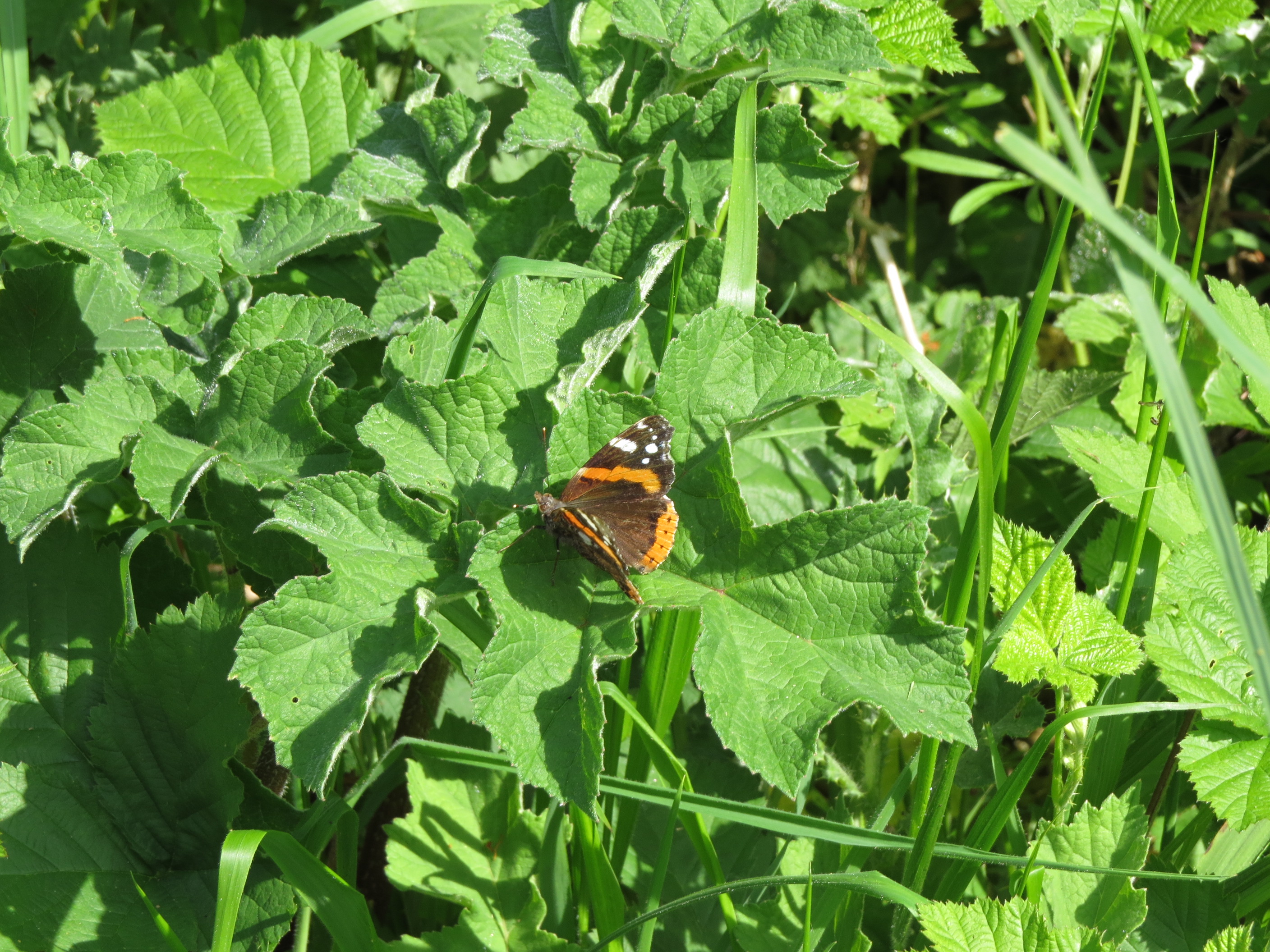
Red admiral above and below.


Female small white on a nettle above and on herb robert below.


That was during the week and so following my failure to see silver washed fritillary on the following Saturday I headed into the woodland area of Shapwick Heath NNR after recent reports of silver washed fritillary flying. 

This time I was taking a real punt given the weather had turned decidedly autumnal in feel, cool, torrential rain showers but now accompanied by 40-50 mph gusting winds. This weather was so out of season the Saturday Market in the nearby city of Wells, where I'd gone to first thing, had  been cancelled. Undeterred my revised plan was to venture into the most sheltered rides of the oak woodland at Shapwick and just observe what if anything appeared as and when the frequent rain showers were replaced with sunshine. 


Shapwick Heath NNR - white admiral country.

I could not have had a better afternoon. In a similar way to Hodder's Combe if the sun disappeared then the butterflies disappeared. But, when the sun did emerge the rides erupted with life. Not just butterflies but tens or even hundreds of dragonflies and damselflies, hover flies and a myriad of insects I couldn't identify. I could identify unfortunately the hundreds of mosquitoes that also flew in the sunshine, I was covered in them and their bites. A real downside here, not pleasant at all and I still bear the scars.

While frequently distracted by other insects I kept focussed on butterflies whose abundance was enhanced by energetic activity by the many species now on the wing in the strong sunlight, before it all fell quiet again as the rain returned as it often did. I was getting used to this weather related cycle. 


A very obliging brimstone which despite its bright colour blended beautifully into these oak leaves.


A beautiful but pestilent deer-fly Chrysops spp. but not sure of the exact species.


Beautifully marked gatekeeper underside (above) and a different but equally lovely gatekeeper upper wings (below). The gatekeepers were everywhere, more plentiful than meadow brown.


Peacocks were everywhere too, such oddly out of place markings in the English countryside, almost tropical in looks.


Ruddy Darter (first thought common darter but I dismissed this or maybe it is)


This southern hawker clung motionless to this honeysuckle branch for fifteen minutes or more. At first I thought it might have been dead but then on my last visit it wasn't there. There were a lot of hawker species about, a few did that spectacular thing of flying right up very close to my face and then after hovering for a while looking at me, decided I wasn't any threat - nor prey - and buzzed off.  Fascinating behaviour and I'd love to know what they see and are observing.


I'm not seeing many speckled woods at the moment. This one was one of the few found resting on a fern.


Now we're getting to the white admirals. In this cooler weather they were flying really well but unsurprisingly a slower flight and much less fidgety than when I'd last seen them a couple of weeks earlier. I'm not sure whether it was just the weather but they were also much lower down perching around head height or gliding for short distances low along the track which is a behaviour many lepidopterists look for. The image below was more typical on this visit, horizontally straight wings on a bramble looking inconspicuous. Despite the quite wild wind in the high canopy down at ground level it was almost motionless. I'd made the correct choice to come here today, the butterflies were within easy sight and once again I had the site all to myself due presumably to the weather. During one of the more prolonged wet spells I stood quietly listening to the pitter-patter of raindrops. It's a sound I've loved since childhood.


All in all what these two visits to observe butterflies in poor weather has taught me is don't remain indoors bemoaning the inclement summer, head out and see what happens. I'd do that when winter birdwatching, so why not in the summer?  Would I have noticed the butterfly species using bracken as a sunning and drying perch if the weather had not been so changeable? Would the eruption of species simultaneously timing their flights with the sun's emergence have been witnessed if I'd stayed at home? I suspect not and it made for a fantastic immersive experience on both occasions. But I'll leave you with this female blackbird.


I was walking along a boardwalk back to my car when this female appeared. I stopped and she stopped then, after checking me over, she ignored me and hopped a few feet at a time towards me. I stood motionless watching her for what seemed an age. Then when she was around 12 feet from me she dived into the trackside and speared the fattest slug I've seen for a while, a slug much too heavy for her to fly away with.  Transfixed I watched her kill and repeatedly peck the slug for some time until having eaten a large part of it she finally managed to lift the slug remains and fly off, albeit under some difficulty. Whereto she went I have no idea as the torrential rain returned as she flew off, so I the happy wildlife watcher of these two days simply shrugged, pulled my coat a little tighter around me and walked off accompanied by the roar of thousands of raindrops crashing against leaves in the tree canopy. I was alone with my thoughts surrounded by nature at its finest.