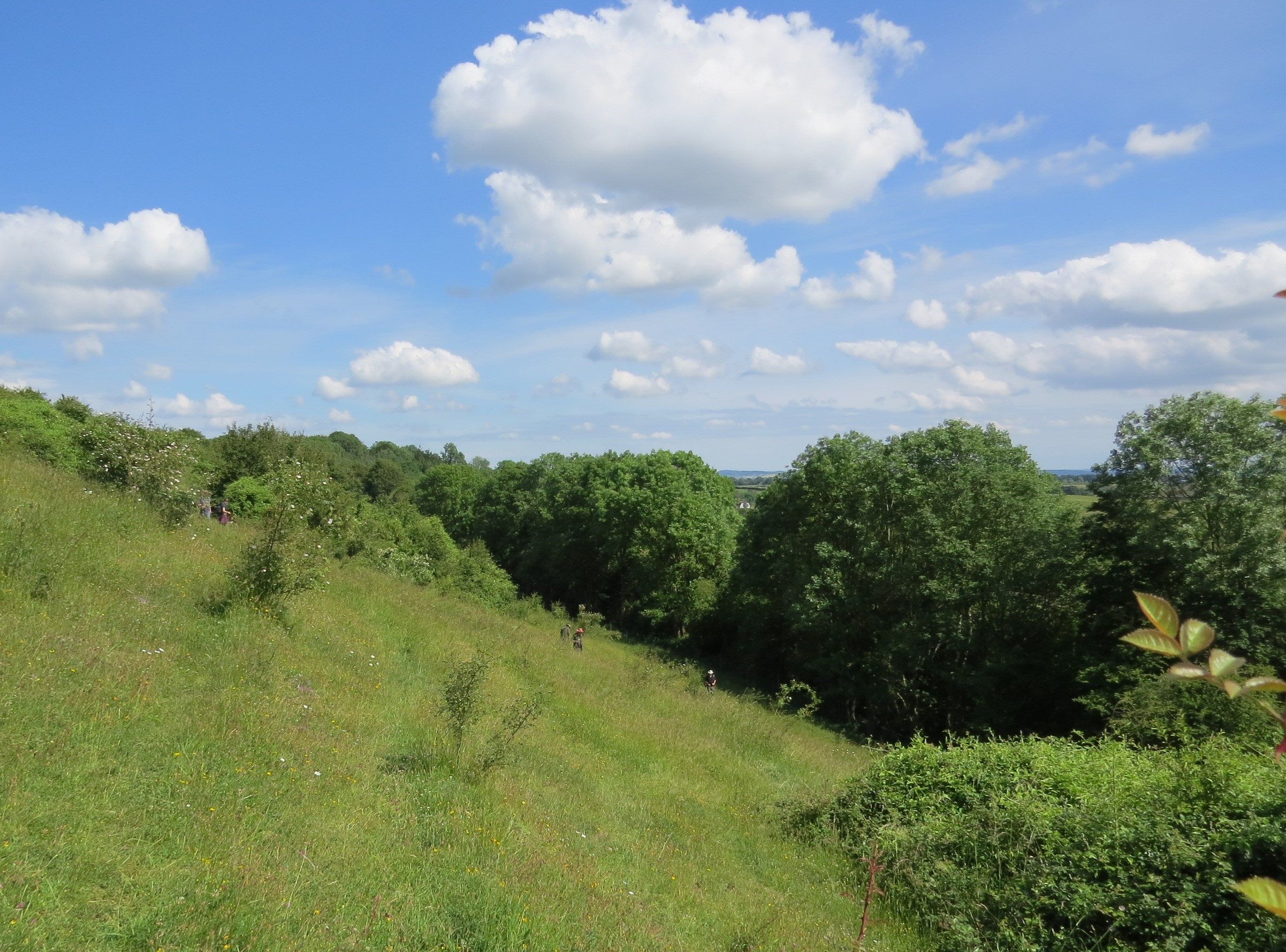
Despite the forecast suggesting an increasing risk of thunderstorms and thick heavy cloud I decided on the spur of the moment to head down to a butterfly reintroduction site in south Somerset. My quest today was to see if the large blue [Phengaris arion] butterfly was on the wing - I was not disappointed.
Since 2008 an eclectic ad hoc forage into British natural history, the rural scene, and countryside related topics. Three decades working in broadcasting and now retired. Selective posts revised and published on Substack - https://andrewdawes.substack.com/ Contact me : quicksilvercountry @ gmail.com
A
Showing posts with label large blue butterfly. Show all posts
Sunday, 11 June 2023
Large Blue Is On The Wing
I last visited this site two years ago when after a sizzling few hours of frustratingly seeing but being unable to photograph large blues, I realised later when at home that I had actually managed to take a photograph of a motley specimen after all. Two years ago it was quite late in their flight season, today however I hoped to be there at the beginning of the season. Looking on-line I had only seen a couple of sightings posted.
As luck would have it when I arrived it was spotting with rain and quite cool, certainly different to the last few weeks of hot dry sunshine. But that lack of rain shows on the ground as everything here was baked hard, cracks you can get fingers down in the thin soil, and more worrying many of the ants' nests that are crucial to the survival of the large blue looked like they'd been broken open and robbed by presumably badger, green woodpecker, or maybe even foxes. There were intact ants' mounds around but a quick scan revealed at least half of the mounds were broken apart or damaged. One even had a fresh badger tunnel dug into it.
It was noticeable on first walking onto the reserve that it looked like it had gone back a little since my last visit, with quite a noticeable increase in scrub. The once prominent signs directing people to the site have gone too, did they attract too many visitors? When the large blue were first introduced here the site was kept secret. The then recently installed horse gallops half way up the hill have also been abandoned by the looks of it which is a good thing I'd suggest, as what was mown turf and artificial gallop material on my last visit is now quite overgrown. Not good for the large blue, but reverting to wild for more generalist species, like this small heath, which intrigued me. It was stationed on some sheep's fleece for ages. I'm assuming the fleece lanolin is providing minerals of some form, but I can't recall seeing butterflies on fleece before - I've probably not looked to be honest.
The main path pushing further into the ancient downland area is now overgrown meaning I had to divert downhill a little where I spied a very familiar object. Either this is for a training day or a transect is about to happen.
Having pushed through the scrub, snagging myself a few times on the dog roses now growing everywhere, my first large butterfly of the day was one or two meadow brown, which proved frustratingly hard to get a decent image of.
It was while trying to snap a better image of the meadow brown that a blue butterfly flew past at speed at knee height, a common blue by the lighter colour of it, large blue do look sooty blue on the wing. It was gone before I really registered it, with just my mental filing system dismissing large blue. Spots of rain were still falling and while those species I was now seeing were proving fascinating I did wonder if I'd come too early, on a day with the wrong weather, to see my target species.
Planning to walk on a little along this forty degree slope, I looked down to check my footing and there, right next to my shoe, a large blue.
I only had time for a very quick record photograph before this beauty rose and flew off to join what I think were three maybe four large blue quartering the exact same place I 'd seen them two years ago. I now had got my eye in. The cooler conditions were making them less mobile than I feared they may be which allowed for a number of close encounters, (though not too close for this protected species).
To be honest it was near impossible to know how many were in front of me. Definitely four, but I'd struggle to say more in this first area as they were being both very mobile and quite sedentary once they settled. Those resting on thyme with wings open were really easy to spot, that dark Wedgewood blue really does punch out from the short downland vegetation.
Once I'd fired off a dozen or so images I relaxed and just watched them going about their business without me looking through the viewfinder. This is the closest I've been to newly emerged large blue and I can appreciate, though don't condone, why Victorian naturalists craved this species for their collections. Newly emerged as these were they are absolutely stunning, a thing of beauty.
This female is egg laying on thyme
Within half an hour I'd seen more large blue butterflies than in my entire lifetime. As I sat for a while just taking this all in I began to wonder how these now-naturalised 20-30th generation differ from Swedish stock they originated from. Maybe they don't.
However insect evolution can be rapid due to quick birth-develop-adult-breed-die generations. Yes these blues in Somerset are not from a British stock, but they are the same species as the ones brought over from Scandinavia, yet have these now English emerging adults begun to adapt at all, adapting to survive on a dry south facing slope in Somerset? Is the interaction with the ants identical? It's a thought.
I'd read this week that although large blue colonies are faring well across the UK, this site having previously been the best place in Britain in terms of large blue abundance, has suffered a little. Although there is still a healthy population here, a succession of less favourable winters, wet and cold springs and prolonged periods of drought have reduced numbers significantly. Though, as someone who studied statistical analysis in conservation for my degree all those years ago I ask myself is any of this change statistically significant?
Is it a worry given what I saw today of the desiccated and smashed ant-hills and the concrete hard baked soil? The number of butterflies on the wing today was good, I found more on my way back in another area, counting five at least, three spiralling on the wing. But without some much needed rain, will the ants, the host flowers and the area itself be productive enough to sustain this fragile butterfly at the north-western edge of it's range? I'll leave that question hanging there while I revisit this image of a remarkable and stunning species brought back from extinction.
Monday, 28 June 2021
In Search of the Large Blue Butterfly.
The afternoon was hot. One of those mid summer days when the light is intense and without a gentle breeze, the air would be suffering and humid. I was heading towards the Somerset Wildlife Trust's Green Down Reserve. But first a steep climb up a stone track, taking breath to admire the dog rose in flower and then over and across a railway bridge and into the lower slopes of Green Down, a new reserve to me, near the village of Charlton Mackrell.
Way back a decade or so ago one evening I went to the famous, in butterfly terms, Daneway Banks Reserve up in Gloucestershire to watch large blue butterfly (Phengaris arion) larvae being released onto the site. I was there for work, recording an interview with the team there (sadly never broadcast). It was August, too late for the adults to be on the wing and while it was fantastic to see the larvae being released, I made a mental note then to either come back to Daneway, or at another reintroduction site see our rarest butterfly free flying for myself. Ten years later I found myself standing on a very steep limestone grassland slope, on a June afternoon. Expectation was high.
The large blue butterfly was always a localised southern species of butterfly, which I'd read (much like the Duke of Burgundy butterfly) surprises on first encounter in how small it is. Large in this case being the largest blue butterfly in Britain, though in reality it's virtually the same size as a common blue. Struggling to keep going in the UK, by 1979 the large blue was declared extinct. Why this happened became a research discovery, principally by Dr Jeremy Thomas who unravelled its complicated life cycle involving Myrmica red ants, wild thyme (Thymus polytrichus) to feed on, sometimes wild marjoram (Origanum vulgare) to lay eggs on and warm, predominantly south facing well-drained unimproved, limestone preferred grasslands. No wonder it was a rare butterfly.
The first thing that I noted when entering this reserve was the absolute profusion of plants; and tell-tale signs of red ant mounds. Due to its topography, these 40+ degree steep slopes have never been improved for agriculture. Aside from a railway line as the southern boundary of the reserve, and the recently installed horse gallops splitting the higher and lower parts of the reserve in two, the site has remained a lightly grazed calcareous grassland for centuries. Everything was here, it made sense then to have this site as a re-introduction habitat for the large blue.
There is always a slight sense of jeopardy when visiting a new area to observe wildlife. Without a seasoned local guide we (my wife Julie and I) simply entered the gate and walked blindly along a visible but indistinct path through nettles and long grass. Soon though the nettles fell behind us and we were enclosed by the sweet smell of a summer wildflower grassland. Soft rose scents drifted by as we slowly walked along the thankfully flat path following the contours of the reserves 15 acres, making this a short half mile walk to the other end. Not a large site by any means but wonderful in the sun hearing chiffchaff, whitethroat, skylark and willow warbler provide a rhythm as the myriad of crickets and grasshopper at our feet provided the chorus.
Despite this abundance of wildlife and of course the presence of the large blue (Green Down was noted in 2016 as holding the largest British population of large blue butterflies with over 153,000 eggs laid that year) we more or less had the reserve to ourselves. Maybe half a dozen other keen lepidopterists and us. We'd only gone a few paces into the 'good stuff' when I spied a labyrinth spider (Agelena labyrinthica) web, complete with its creator. This is one of those moments where I know what I'm seeing although I've never seen it before. Reading around natural history allows flotsam of fact to seep into the little grey cells and remain there awaiting its time to emerge. I could vaguely remember reading about these large labyrinth webs used by this spider to trap and feed on grasshoppers and crickets. As you could imagine to catch and especially hold onto such athletic and bulky insects isn't for the feint hearted arachnid and Agelena excels by building a strong sturdy trap that can’t be destroyed too easily. That's what I remembered from my memory, reading up about this spider later on I discovered "Agelenidae cobwebs are so strong and thickly woven that in the 16th century, monks in the Austrian Alps began layering them together to create tiny canvases for religious miniatures"
That was a nice find but only a few paces further on, Julie who was walking ahead of me called out, and there flying away from us, a large blue butterfly. The reserve has both common and large blue butterflies, but the colour and markings of the one we'd seen were unmistakable. Yet another moment of theoretical recognition. What was less enjoyable was that in the gentle breeze the butterfly disappeared quickly out of sight over a shrub in seconds. Was that to be it?
The large blue butterfly was reintroduced to Green Down in 1992 and for many years the reserve was closed to the public to allow the butterflies to gain a hold. Just a few miles to the north is Collard Hill, a much better known and since 2002 a well visited reintroduction site owned by the National Trust. But now Green Down is open to visitors, though like many fragile habitats I'd worry if it became too well known.
So far just the one sighting, therefore as we'd been on the reserve about half an hour when we thought we'd stop for a while and just watch and wait. No sooner had we done this than another large blue flew towards us, and yet again up over a shrub and out of sight. That's two, or was it the first one returning upon itself?
Coming towards us was a fellow butterfly watcher and after a brief conversation he confirmed what I'd already observed, namely that today the butterflies were highly mobile, never resting. I've seen marbled white butterflies many times across Wessex and they always pose for a photograph, but today these would just not keep still. Taking images was proving a challenge, a frustration and annoying. I packed my camera away and we slowly followed this chap along the path as he retraced his steps. When we finally caught up with him he was on his hands and knees trying to photograph, yes, a large blue butterfly. However each time he got to within a few feet of it, it flew a few feet away. We had the best view as the butterfly flew bit by bit towards us and I got some nice views in my binoculars when it was only a few feet away. Watching him struggle to capture that perfect image I just thought there's no point in trying, my camera remained deep within my backpack.
While he was scrabbling about and failing to capture the perfect pose, a couple more large blue butterflies flew by which was amazing to see. They were also very mobile, never remaining on the ground for more than a second or two. Eventually this chap who I discovered was local and knew the site well also noted the flight period was about three weeks late due to the cold spring this year. He eventually gave up on trying to photograph this flighty individual and wandered off up the hill and like the butterflies, out of sight. Though before he left, he did show me a lovely image captured on his mobile phone and taken only half an hour before of the large blue with wings open. Perfect. I was happy, I'd seen them flying, I'd seen a nice image and that's why I'd come. Mission accomplished.
We were now on our own in the reserve. I took my camera out of my rucksack and for the next half an hour or so Julie sat and watched me messing about photographing anything that would stay still long enough, quite tricky with a long lens. I tried to capture some of the other butterflies around. Common blue, marbled white, meadow brown, but failed on the grasshoppers and couldn't be bothered to walk down a steep slope to where I heard a number of grizzled skipper were. Even the many pyramidal orchids were difficult - as unlike other visitors here today I wasn't prepared to trample all over the site just to get an image. Code is - leave the habitat undisturbed for the wildlife.
The large blue was first discovered (although it was possibly always here) in Britain in the 1790's and has always been considered a rarity. That rarity and the Victorian craze for collecting butterflies probably did the fatal damage blow to the survival of the indigenous large blue. During the 19th century lepidopterists became obsessed with having this species in their collections and over time located new colonies near Dover, on the Marlborough Downs and in Winchester in Wiltshire, Somerset, the Cotswold hills, south Devon, Buckinghamshire, and Northamptonshire. Becoming a trophy species, caught large blue's were often sold for substantial money. This pressure from collectors had a devastating effect and most colonies were cleaned out by collectors and by the 1950 only around 30 sites remained. Needing grasslands with short turf, the spread of myxomatosis in rabbit populations became the straw that broke the butterflies back. Grasslands became under-grazed due to a lack of rabbits, shrubs quickly grew and the microclimate became too cool to support the red ant. Post war agricultural improvements didn't help and by the 1970's only three colonies remained. By the end of that decade, it was game over.
After about an hour and a half of wandering about in the intense sun I decided to call it a day. By now it was around 4.30 pm, Julie had already gone back to the car for some shade and the number of butterflies flying was reducing, despite the still warm sunshine. I'd seen half a dozen large blue butterflies on the wing although I'd failed to capture an image, but that didn't matter.
Except I had. Going through the images once I was back home, I saw this battered tatty blue butterfly. At the time when I'd taken the image the butterfly was 20 feet away and I thought it was a common blue, but looking at the underwing it is undoubtedly a large blue. Accidentally I had captured an image of what I'd come to see. Happy Days indeed.
Links:
More on large blue life cycle https://butterfly-conservation.org/sites/default/files/large_blue-psf.pdf
Cobweb canvasses. https://www.atlasobscura.com/articles/the-lost-art-of-painting-on-cobweb-canvases
Subscribe to:
Posts (Atom)