A

A
Showing posts with label Somerset Levels. Show all posts

Friday, 10 January 2025

Embargoed Beavers

 I'm not sure where to begin with this. Maybe a photograph of me out birdwatching one day will provide enough impetus for everyone to run in horror and move onto the most important part of the story. Beavers!!


For reasons that become apparent I can't say where all this action took place, and of course is still taking place. However now the news has been released from Natural England onto Social Media I can say this is somewhere on the vast Somerset Levels 'Super' Reserve. That's all you're getting I'm afraid. But for over a week now I've kept the news to myself. After-all wildlife comes before Social-Media.

It all began between Christmas and New Year. I was idly out birdwatching with no real plan and then it was while having a break for a coffee from my flask that something strange on an island just ahead of me caught my eye. Branches at the water line were nibbled, and then scanning this island through my binoculars I noticed a couple of trees showing distinct 'Beaver Engineering'. Really? There are no beavers in this part of Somerset, the nearest known established population miles away on the River Frome and a smaller population on the River Brue. I looked again. There was no doubt about it, freshly nibbled branches at the waters edge and those two trees showing a lot of gnawing, with one leaning at a rakish angle. Back home I emailed Natural England.


A flurry of e-mails then took up much of the next few days until on Friday evening when I received a telephone call from the Senior Reserves Manager (Somerset) for Natural England. We chatted and the conversation ended with an invite 'could I meet him and someone from Somerset Wildlife Trust at the site at 1pm the following day, Saturday?' 

I only need one invite.

It transpired that the report I'd put in was not the first they'd had, it was the second but the first from a member of the public. A few days before my report a volunteer for Natural England out doing survey work had alerted the team and they'd put trail cameras up. On the day I was invited back to the site the plan was to look for other evidence and also check the cameras for any activity for the first time.


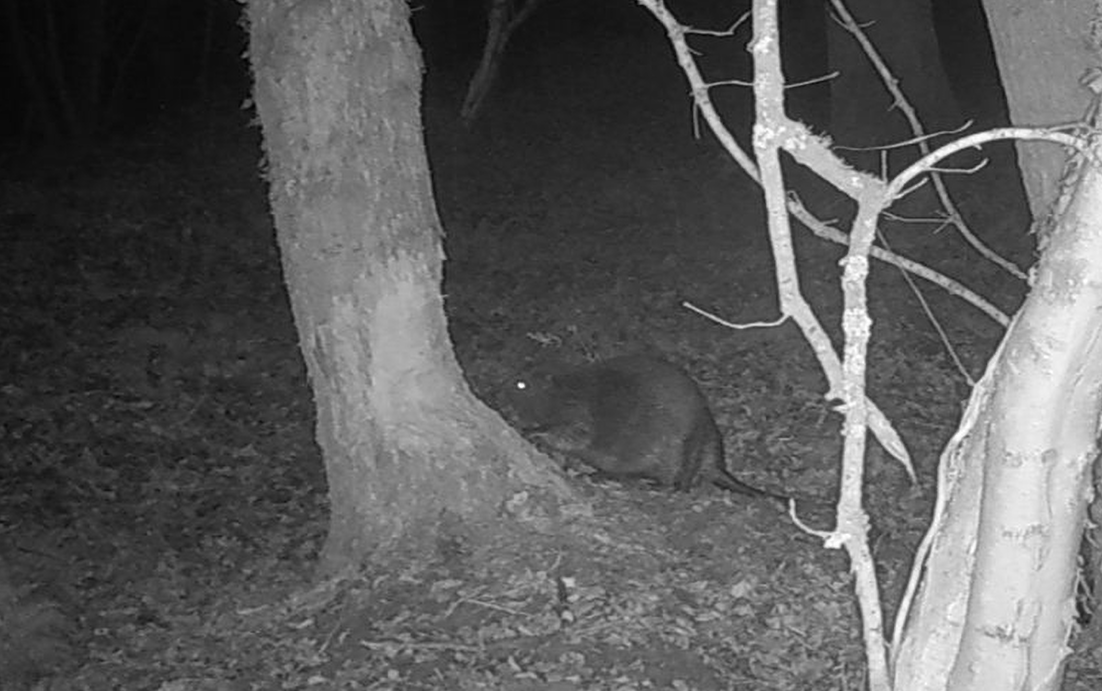
At the allotted time I was scooped up in a vehicle and after a short drive myself and Phil from Natural England and Lucy from Somerset Wildlife trust set off into wet woodland well off the public path. Evidence of beaver activity wasn't that hard to miss, with the nibbling of bark a sign they're relaxed enough to be feeding at the site. What I wasn't ready for was the sight that greeted me where the trail cameras had been placed.


Oh my! That oak tree has received some engineering. And that is interesting, it seemed as we wandered about looking for evidence that these beavers are preferentially targeting oak, specifically mature oaks that have been here since this was peat cutting territory. An ecological conundrum then. These oak are hugely valuable to the diversity of species found here, however if the beaver fell them, great for the beavers less great for the other species. It's a minor point but one I found fascinating. As was the amount of engineering which had gone on in a short time, maybe a week to 10 days?


I put my binoculars at one tree just to show the scale, and height, of this activity. On their hind legs beavers can reach almost a meter high, they are after all the second largest rodent on the planet. But it is only when you see this in reality that you realise what they can do, and how extensive the gnawing is. Ultimately this engineering is very beneficial to a habitat. Very few mature trees are clear felled. Many fall with a living hinge to re-grow horizontally as it were, the trunk providing new and different habitats for many species. Mice and mustelids such as stoats and weasels love these aquatic bridges for example, allowing safe and dry crossing across water. Birds like owls or sparrowhawks perch here and plan their next strike, likewise kingfisher using these as a perfect perch to drop into the water below. Increased shadow and cover provided by the felled trees brings with it safe refuge for fish and other aquatic species, which then brings in otter who both feed and rest up in these shady areas. All in all having beavers in a habitat is good.


The three of us spent a lot of time discussion where these beavers have come from. Quickly dismissed was a legal introduction, they happen elsewhere under strict licence, and definitely not here. An illegal re-introduction? That is a possibility but this was also discounted as where they are is not easy to get to by vehicle and would someone carry beavers over a large distance. What seems more likely is a natural expansion, and arrival. I was informed that a few miles away is a fishing lake and for a year or so there has been evidence of beaver living there. But being a private business there's not been a lot of information about their activity. Potentially however they could be the source of these animals. The same individuals or possibly young moving territories. The jury is out. What seems almost certain is the arrival of beaver here is a natural process of territorial expansion rather than human-assisted.


I spent around an hour at the site with Phil and Lucy. The more we looked for evidence the more we found. I particularly like the image below showing the effect of the two huge gnawing teeth beavers have, somehow shows the power of these animals. What we did not find was any evidence of lodges or dams, and that's not to be unexpected. If these are new arrivals, as they are it will take a while for their exploration activity to become structured into holding territories and sustained habitat. There was one loose structure that looked interesting, I'll keep an eye on that.


And that's where we left it, a discussion as to whether I'd be interested in both keeping an eye on this site and looking elsewhere for evidence under Natural England supervision. I've said yes, but at the moment I've not had time to go back there. It is all however very exciting.

A few hours later while once I was back home I received an email from Phil. He'd gone through the Trail-Cam footage and there without a shadow of a doubt a beaver gnawing the very same oak tree in the image above on December 30th. That said, the Trail-Cam only confirms what was plainly evident on the ground, the beavers are back here on the Somerset Levels after hundreds of years.


Saturday, 27 January 2024

Spring is not quite here, close though...

 There is always a sense of great excitement in me at this time of the year. I'm like a child sometimes. Yes it is still winter, yet spring is very much beating it's own emergent path towards winters closing door. After weeks of rain followed by a lovely but very cold spell, today felt almost no coat weather. I said almost.


I was on the Avalon Marshes area of the Somerset Levels, Shapwick Heath to be precise. I've not been here for months, and today Mrs Wessex_Reiver and I had not started out in the morning to come here. It just happened by chance, and as that chance would have it I didn't' have any binoculars with me. More on that later.

Following an errand in Weston super Mare we decided on the spur of the moment to visit Shapwick. After the obligatory drink and snack at the Hub, it was simply lovely having a walk along the central path, the former route of the railway line which once carried peat dug hereabouts to the rest of the country. A bit of fresh air and some gentle exercise. There were some visitors about but for once it was fairly quiet. Not having my binoculars with me meant I had to use my other sense, hearing. First up a few fieldfare were raucously chak-kak-ak-ing in a nearby shrubbery, silhouetted against the sky but unmistakable with that call. As I listened a song thrush beyond gently repeated its phrasing adding a songster's lead vocal to the fieldfare's rhythm. A nice start.


Other sounds emanated as we walked along. The ubiquitous mallard quacked away, or at least the females did, a flotilla of Canada goose honked as they flew over. Great tit called, not the classic teacher call, but the two note contact call, repeated before falling silent. Not everything made a sound, over the reeds at some distance a male marsh harrier quartered silently, its blue-grey wings flashing its presence to a number of duck species who rapidly rose and fled as it arrived. A great white egret stood silently at the edge of a pool. I find this amazing as it is now almost impossible to visit the Somerset Levels without seeing at least one great white egret or a marsh harrier within a few minutes. In truth on the walk back an hour later, three marsh harriers were together in one eye line. Having no plan for the day, my destination was Mere hide, simply because after 30 minutes walking I needed a sit down. I said goodbye to Mrs Wessex_Reiver who went for a longer walk. Crossing a bridge, the approach to this hide is through a small wet woodland, from which two jays erupted with their harsh call and flew over my head. I do love jays. In many ways the expectation of wildlife watching can overshadow the reality, and today Mere hide lived up to its reputation, for me at least, for having absolutely nothing to see, well not upon first entering it.


I was lucky as a family and then a couple were exiting the hide as I arrived, presumably they'd seen me coming. I always do this, but on arriving at the door of a hide I open it very slowly, gingerly even, as if a demonised phantom was within waiting to scare me. I love hides, they have a unique atmosphere but they are mysterious. One never knows who, or what will be found when the door is opened. Fling open that door with a loud crash followed by a 'Hello I'm Here' boomed out in a thundering voice and the volley of  'SHH, SHH, SHH's' from camouflaged middle aged men will return to you like machine gun fire, at which point you are trapped. Which leaves a dilemma, do you find a seat and carry on as if no one has noticed your entrance, or turnaround and exit the hide quickly. 

The one aspect of hides I find quite bothersome is when I'm seated quietly in there and someone comes barging in and immediately asks "anything worth seeing?". My immediate thought is to suggest some rare vagrant in a nearby tree and then enjoy the chaos as the they unpack all their gear in readiness to take that award winning photograph of the greater striped zebra-sparrow. It happened today, a couple who were visiting the Levels for the very first time, before they'd even come through the door said, "anything interesting". I wish I'd said I was from the north and not being able to afford binoculars I was counting the number of reed stems which I found helped my mental problems while I am on day release. I didn't, just mumbled something about it being quiet, and actually they were a charming couple (complete with campervan from Exeter). But why don't people just come in and sit quietly and look out the hide windows for themselves. Tribal acceptance I suppose. Sometimes visiting a hide is hilarious.

I once entered a hide on the Catcott complex nearby. With me was my friend Rob, we were on a between Christmas and New Year escape the indoors day and had walked here from Shapwick hoping for a quiet few moments scanning the wetlands. Not to be, as I opened the door we were greeted with a sea of late middle aged ladies surrounding a bemused gentleman in a fedora hat. "Come in, come in, there's not much room, but you can sit on our knees though" one lady said with a giggle, with another adding "we don't bite.....much". My friend and I found a space no larger than a postage stamp and squeezed in between our new friends, who I'm sure reduced the space as we settled. "Would you like a wine gum" one said. We took up the wine gum offer, fearing refusal may find us kidnapped and turned into domestic slaves, never to be seen again outside. We needn't have worried as in the end we had a riotous time. It turned out they were a ladies nature and birdwatching group from somewhere near London on a girls mid-winter weekend in Somerset complete with binoculars. Once they found out we knew what some of the birds were, the questions came thick and fast. "what's that duck there?" "Is that a pigeon?". The fedora hat wearer feeling somewhat miffed and ostracised I suspect said loudly "Ladies there's a garganey over there...". Given this was mid winter Rob and I sprang into action, "really? where?"... "there" fedora said pointing to a gadwall. We didn't say anything to avoid a possible lynching and death by wine gum, but ever since then Rob and I have called gadwalls, GargGadanywalls. 

Today however as I peered around the hide door the building was empty, save for the new logbook. Hide logbooks are another fabulous item of birdwatching culture. If well used, they invariably contain within their pages at least one, if not all of the following; 

a) a three page seriously compiled list of all birds seen, including taxonomic grouping, recorded during a three hour visit, signed and dated by someone called Kevin, self proclaimed ornithologist and RSPB love-child
b) a note in capitals that someone has pinched the pen - AGAIN, with the writer having to resort to his or her own pen to write this complaint
b) the word DUCK, TIGER or COW written in three inch letters, often in green ink, often with a drawing of something which may resemble the said animal, but the jury is out
c) or some lovelorn teenagers, outpouring of passion complete with words of Anglo Saxon origin relating to hoped for recreational activities later that evening

I love logbooks, though sadly this one was reasonably new, and sensible, with just a few species listed as having been seen today. Sadly no cows or teenage lust. I settled down then to gaze across the reedbeds and listen.


To my amazement I could hear many invisible species, and without the aid of my binoculars saw a number too. A couple of marsh harriers were simple, a cormorant too. In the distance some ducks alighted, by their size and flight teal were among them, and wigeon confirmed by their whistling calls once they'd resettled. Then as I sat I heard the unmistakable drumming of a great spotted woodpecker, that's a first this year. Then the squeal of a water rail. Not having binoculars was sharpening my hearing, a coot called somewhere, to my right a wren's song erupted, more quack quack from a passing flock of mallard. 

It was while listening that I noticed movement at the bottom of the reed in front of the hide. Two birds, one following the other skulking at the base of the reeds but in the open. Brownish grey nondescript plumage, pale grey underneath and looking quite 'warblery' if that's a word. I couldn't be 100% sure but immediately I thought Cetti's warbler - I've not seen one for years, although I have heard them many many times, they're fiendishly difficult to see. Quickly checking the ID via my phone somewhat confirmed my suspicions, but by the time I'd looked this up, the birds had disappeared back into the reedbed and as they never called absolute confirmation remains sadly elusive. I'll mark this as probable, possible, well I think maybe so. 

The remainder of the listening and watching took place to the right hand side of the hide within some wet woodland. Blackbird, blue and great tit, wren again, a chaffinch 'pinking' away somewhere and flitting along delicate branches high in the trees what I'm assuming were chiffchaffs, if only I had my binoculars to see these a little closer. A grey squirrel wafted about on the ground and a moorhen messed about in a water filled ditch which was nice to see, a much overlooked bird. 

Not too many species, but sitting there quietly watching and listening was a real joy. The sound of the breeze through the reeds was especially evocative.  


Retracing my steps the only additions were a long tailed tit, a male stonechat, a few starling, rook and carrion crow, a grey heron and somewhere over in the far distance a bittern was clearing its throat and ushered out two half hearted 'ho_oo_ops'. I've often heard them boom here at the end of January but it is in February that they'll really begin, when if you visit the Levels they are everywhere to be heard, a real success story.

So spring has not quite arrived, but all the signs are gathering, not least this thrown-out-of-the-nest starling egg I spied on my neighbour's path when I got home. Not long now.

Sunday, 6 February 2022

Seek, Hide, Reveal

February is here and I'd been given a get out of jail free card on Saturday as Julie was in Bristol attending a soil management for horticulturists day course. The world lay before me. 

I had had this germ of an idea when visiting Shapwick Nature Reserve the previous Sunday. On that day we'd arrived at 7am, an hour before sunrise and were almost immediately rewarded by 2 bitterns calling quite close by. However the temperature had dropped overnight which made sitting for long periods observing wildlife in minus 2 conditions, less than pleasant. I resolved to return when milder conditions allowed, which was sooner than I planned when Saturday 5th February dawned fair of face. My rudimentary plan was to visit all three hides at the Catcott complex, sit for an hour in each and await to observe whatever showed up. 


The Catcott Lows Reserve was the very first area on the Somerset Levels to become a dedicated reserve way back in 1968 after Somerset Wildlife Trust bought it. Over time more land was added and now a larger Catcott Complex is sometimes described as a miniature version of the huge Avalon Marshes area.

Catcott is a mix of seasonally flooded wet grassland, former peat works now flooded, lowland heath, wet carr woodland and a number of droves and rhynes, or ditches. Although it isn't strictly on my doorstep it's a very regular haunt of mine after hearing a grasshopper warbler in the mid 1990's for the one and only time. It was here I headed for a five hour observational day.


Three hides to visit, the well named Bird Hide was my first destination. Accessible along an older drove road the hide itself juts out into the wet grassland, with a long border of woodland just behind it running out to the east. It is one of those hides where if you just popped in for a quick look, not much would happen. I though planned a long haul sit and wait...and it brought dividends. 


Almost immediately I spied a great white egret.  They have been a remarkable success story here, so much so that in the last three or 4 years it has become almost impossible to visit the Avalon Marshes and not see at least one. And to think when I first visited the Somerset Levels in the early 1990's to have seen a great white egret would have been a national event. Likewise the marsh harrier which I'll come to later. I took time to simply observe how the egret foraged. Like many other egrets and herons it made slow deliberate steps along the water's edge. Both feet just in the water, paddling the mud as it crept forwards, much as gulls do on a grassy field, or blackbirds in the garden. The paddling disturbs the mud and encourages invertebrates to come to the surface or disturb prey. What the egret does do I noticed is sway its neck and head a few degrees to the left or right while keeping its body absolutely motionless, presumably to gain a better view of what it is about to pounce on with that formidable dagger like bill. I'll have to watch grey herons anew as I don't think they do this, they remain motionless before they strike. Patience is a virtue for this large member of the heron family as in over 20 minutes only two strikes brought success, first a frog and the other a small fish.


While keeping an eye on the egret, I also looked out for anything else happening. I noticed another great white egret flying to my right way over towards Glastonbury Tor. As soon as it landed, the egret I had been watching flew off towards this newcomer. At first I thought this was a flight and chase off, but the egret I'd been watching flew in a wide arc and then behind the other bird, which then flew up and the pair flew back towards me. Watching these flying in unison was remarkable and something I've not seen before. Possibly a breeding pair within or establishing their area to breed in? Great white egrets only began breeding here in 2012, but last year, 2021, 10 nests were found and over 30 chicks fledged. I think they're here to stay, and provide a wonderful addition to the local fauna.


However while watching the egrets through my binoculars I caught the briefest of glimpses of a marsh harrier being mobbed by a carrion crow way off in the distance. Like the egrets, the arrival (or correctly the return) of marsh harriers to Somerset has been recent and remarkable given the bird was Britain's rarest raptor in the 1970's. These days they are visible with every visit, numbers annually bolstered after regular and successful breeding here every year since 2009. Although the harriers were a very long way off, through my binoculars I could now see there were two harriers and a carrion crow. The lower harrier was flying up high then dropping down with the other harrier flying in circles around the first's flight path. I was watching skydancing. This wasn't the full-on skydancing, not least as the carrion crow wasn't enjoying their presence in its territory and kept disrupting the flight rolls. However this was a form of aerial display practiced by the three harrier species in Britain. Usually marsh harriers are slow level flyers quartering the reedbeds, but time and again the lower bird, the male, flew up high then dropped down to maybe half height before flying up again. Although the higher bird would fly close to the other harrier, at no point did the two birds make contact in the air. A little research afterwards suggested what I had seen was the pre-dancing phase, pre-pair bonding if you will. I spent a good five minutes watching this performance before, presumably fed up with the crow's incessant intervening, the two harriers flew off and out of sight. 


It was back to the egrets then, one of whom had come to the nearside edge of a small island. Casually observing the egret, my eye caught, way over in the distance, a raptor flying along the tree line before perching into a tree. A peregrine. They're very common here, usually seen dashing across the large duck flocks trying to pick off teal or maybe a snipe which are common here. This one though landed in this tree and never moved at all. The woodland edge near the hide was pretty quiet, just a few magpies noisily chasing each other, a female pheasant and a couple of roe deer. I'd been in the hide over an hour, so feeling stiff with the sitting I decided to move off to the Tower Hide and leave the egret to its fishing.


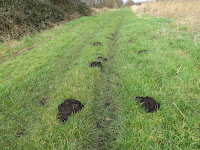
It is about 1 and a half kilometres to the Tower Hide along one of the many droves which crisscross the Complex.  I'd only walked a few minutes when a huge dog fox ambled towards me a fair way off. I only had a short while to watch this very foxy coloured individual ambling along a reed bed without a care in the world before he dropped through a hedge and away. I say he, because of its size. Further on a fox scat was atop a mole hill. Like many mammals their marking is often on a raised or prominent part of a landscape. Given this drove was only a few centimetres above the water table, a mole hill would provide a perfect high point to advertise your presence.


But seeing this made me think about the moles on the reserve. Do they have webbed feet? The only 'high ground' in the Reserve are these droves, which can not be more than 30cm above mean water mark all year, much less in winter, yet there are many molehills. I wonder how many of the tunnels become waterlogged, and how often. I've read that at times of big floods hundreds of drowned moles (and rodents) can be found at the edge of the floodwaters, providing rich pickings for corvids and buzzards. It is a precarious life living underground in a wetland.
 

It isn't too difficult to understand why the Tower Hide is so named.  Approached along a narrow footpath between reeds much taller than me, this high observation hide somewhat startlingly looms out of the landscape. I come to Catcott regularly but rarely come to this hide, the reason being that each time I visit I can find very little to observe. And today it didn't disappoint. Ostensibly I'd come here to have a lunch break, and in the hour I spent here I saw a single carrion crow, a blue tit and heard a little grebe usher its strange high pitched babbling call they make. I did though have my lunch and was joined in the hide by a lovely couple from Cardiff. It was while talking to them a wasp fell out of the roofspace and onto the bench next to me, quite alive.


This couple had come from Cardiff earlier this morning to spend some time getting to know the Levels. As often happens when sitting in a hide the first conversation tends to be ' Are there any birds to see?' Being honest I said 'absolutely nothing'. Thereafter we spent about half an hour chatting about reserves they visit in south Wales, how they'd never heard of a black redstart, and how they'd be off to North Norfolk in a few weeks to catch the last of the winter flocks there. All this while I had my lunch. That latter conversation brought a pang of envy as it's years since I've birdwatched in Norfolk. Thirty years ago I spent every dawn and dusk during a week's holiday at the Cley reserve trying to (and failing to) hear a bittern. Back then bitterns were really rare and I was desperate to hear one. Now in Somerset between February and June they are a relatively common sound on the spring airwaves. Another remarkable success story alongside the great white egret and marsh harrier.


Eventually this lovely couple decided to head off, and I suggested they maybe wander towards the Lows Hide where a glossy ibis had been resident for weeks. They left and I spent a while longer on my own in the hide. The weather was beginning to change, a breeze picking up which rattled the roof sheets now and again. I could see rain heading towards me and wondered if the change may show an otter before I left. Despite where I was, I felt quite isolated in this high hide, a nice experience. I've heard otters are often seen from this high vantage point, not today, and I have to say while with every visit the bird life is somewhat lacking, the identification guides in the hide are probably a more sure way to add a tick on your birding list.


The walk back took me though Catcott Heath - which was a real change from the emptiness of the Tower Hide. Here on the heath hundreds of small birds flitted to and fro from the bits of wet woodland and scrub. Most were chaffinches and I thought how long it has been since I've seen such a large mixed bird flock moving through a woodland edge, in this case joining the chaffinches mostly long tailed, blue and great tits, plus a number of blackbirds.


Between the Heath and a drove road were these dragonfly beds I'd spotted a few weeks before.  It's the wrong time of the year of course for any dragonflies on the wing, but I made a mental note to return and see what emerges in those long summer days. Today however the wind was beginning to be a nuisance, trees were creaking and swaying, with uncoordinated raindrops being blown my way. Time to get to the final hide on my visit, where I'd parked the car. 


When I had arrived here at 11am, the car park was absolutely crammed with birdwatchers and 4x4 vehicles, I got the last space. At 3pm it was deserted apart from my car, well almost. The lovely couple from Cardiff were walking back to their car. "Seen the glossy ibis?" I said. "Just flown off" said the husband, before bursting into laughter. They'd not see the ibis after 30 minutes so were calling it a day to head back to the Principality. I wished them Bon Voyage and entered the hide. Little did I know what was to follow.


I like this hide, it's a regular stop for me, and a place where I've seen some remarkable events. Barn owls flying so close they could be touched, a remarkable drop of thousands of swallows covering every available perch like black snow, and of course the grasshopper warbler I heard all those years ago. Oh and the time my friend Rob and I entered the hide which was crammed floor to ceiling with a WI birdwatcher group who offered us wine gums and to sit on our knees to make space.  Mostly though coming here in winter I'd expect to see a lot of wigeon, teal, lapwing, a few pintails and snipe. On this visit I saw all of these although the snipe was really well hidden (bottom right image above). And there's a reason that image is included in this account.


The snipe could be found towards the far left of this view, almost impossible to see but, seeing it made up for the lack of the glossy ibis. I'd been in the hide about half an hour when a family group arrived, two women and a little girl. One lady had come here especially to see the glossy ibis having seen it reported on social media. She looked crestfallen when having asked me 'is the ibis here' I had to reply in the negative, 'certainly not while I've been here'. I added that I'd heard from another birdwatcher earlier in the day that the ibis may have moved to Westhay, a reserve a few miles to the north, but that was just hearsay. The lady, Rachel, resigned herself to not seeing the ibis and the newly arrived trio carried on watching the ducks with the little girl. It's lovely hearing children get so excited seeing 'a duck'  - it doesn't matter what it is. The little girl was very interested, when a fox was seen at the far end of the reserve. I only hope she continues being excited by wildlife as she grows older. Another 15 or 20 minutes had passed and I was beginning to think of calling it a day, it was about a quarter to 4. One last look then, could I get a better view of the snipe. Looking at the same place the snipe had been, another bird appeared in view, though heavily obscured. I thought to myself, that's not a snipe, it's the glossy ibis.


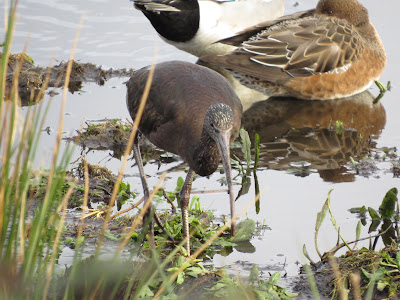
Calling this out to Rachel, the excitement resonated around the hide, though by now the ibis had disappeared from view. Was I seeing things? No there it was again with the little girl saying  - is it a heron. A master of understated joy. I've seen glossy ibis a few times before but this afternoon I had an unrivalled view for over half an hour just meters from me, allowing time to observe the feeding behaviour of this bird. Unlike the egret, the ibis spent virtually all of its time probing deep down between the stems of grasses and reeds with its long bill. It is a smaller bird than you would imagine, more akin to a little egret in size than a grey heron, but having that long bill and long legs it has different proportions. This individual I'd think is a non breeding adult (maybe a juvenile) with the white mottling on it's head and neck and more sombre colouring. Which is interesting for the next stage of this bird's increasing presence in Britain. The Somerset Levels have become a hot spot for water bird firsts, not least breeding successes with little bittern and night heron. Ibis' are here every winter now and there are currently 3 maybe 4 glossy ibis in Somerset this winter, is that enough to set up a breeding attempt? Since 2014 a few failed attempts have taken place in other parts of Britain, will 2022 be a success for Somerset?


Seeing the glossy ibis was my success during a very enjoyable day at the Catcott Complex. Sitting for hours, watching, waiting and observing brought huge rewards, the large chaffinch flock, the skydancing harrier, the fox, egret feeding behaviour. And with our views of the glossy ibis Rachel was overjoyed to see it with her family in tow. I like that fact. There were just 4 of us in the hide. We weren't packed together like sardines, no huge cameras, no camouflaged birdwatchers bristling with scopes, kit and bleeping rare bird pagers. Just me, two ladies and a little girl. Of course we all watch birds in our own different ways, for me it's meeting nice people and generally spending a long quiet day on my own, simply watching what happens.

I only wish the lovely couple from Cardiff had been with us too to see the ibis. That would have added another dimension to what was a thoroughly wonderful day  


Monday, 17 January 2022

Avalon Marshes Complex - A winter's walk.

It has been 6 months or so since my last blog post. Back then, in June, it was a scorching hot sunny day and I was to be found looking for large blue butterflies at a mid-Somerset location. It's not that since then I've been stuck indoors, but life has taken a strange turn and sped up considerably. The winter is here and it was high time to re-connect with my blog, posting what is the simplest of an image-driven walk.

We've reached mid January 2022 and I've taken a few days off to have a late Festive break having worked over Christmas. To be honest this morning's walk was simply that, a walk, a chance to get out into the countryside, some exercise and to spend what turned out to be over five hours tramping across the magnificent Avalon Marshes complex, with my wife.   Birdlife was abundant but not exceptional, so much better then to just let the images do the talking. Here we go then... the walk began at Canada Drive on the Shapwick Complex.


Here in Somerset we've had week upon week of dull grey days but this morning a really heavy frost was revealed by clear blue skies and a burst of strong sunshine. The sunshine was actually quite warm, not least as there was not a breath of wind. Underfoot however the distinct crunch of frozen ground broke the silence even after the surface frost had melted. Winter is such a wonderful time to walk, the views open out, there's a chill in the air, and what bird song there is travels far, which today was predominantly from blue and great tits, the latter with their 'teacher teacher' calls, and a number of ravens, cronking their dominance of the airways above me.


Evidence of spring, while still some way off, was emerging, with iris and arum starting to push through the leaf litter.


In this strong light some sublime images were to be had if only we stop and take time to look more intently, such as this back-lit fern on a rhyne edge. Just gorgeous.


I love bare winter trees, and this oak shows why. I tried to take some photographs of long tailed tits flitting through the branches, which became a wasted endeavour, but the realisation this tree is in itself beautiful from underneath wasn't.


Further up the Canada Drive, the strong low sunlight created these wonderful regimented shadow-lines, created from the fence line and trees on the left.  The closer we look the better the connection with nature can be.


Eventually I made it to the Canada Hide itself. This hide is brand new, replacing the one that sank into the peat and became unsafe. It is one of my favourite parts of Shapwick, simply because it is somewhere the hoards of visitors rarely come to. And today I was pretty much on my own, Julie having gone off for a longer walk, and only one other person to be seen for about for 20 minutes. Perfect.


And once inside, with some really swish sash windows to open, the view was what can only be described as 'blue'. A deep calming blue.


There was birdlife there, just a long way off, mute swans, coot, tufted duck, shoveller, gadwall and cormorants the most abundant.


Walking back from the hide a distinct mist drifted across the path highlighted by the sunshine, almost smoky in appearance it added wonderfully to the sense of isolation as I walked.


The joy of light on a mossy log - just as simple as that. 


Further on this track lies the Hawk And Owl Trust reserve, which is where Julie had walked to. I didn't follow, simply spending some time here listening to a great spotted woodpecker calling kik-kik as it flew through the branches. A couple passed me and we had a little chat, they'd heard 'drumming' over at the Westhay Reserve earlier in the morning. I had my hopes raised, however in all the time I was out I never heard any drumming.... spring isn't far away though if woodpecker drumming is being heard.


This reflection in the wet woodland really was that blue - magical, and opposite this decaying trunk had been well peppered with woodpecker holes.


The colours of this ivy just appealed to me.


Retracing my steps I then plunged into the Shapwick Nature Reserve. This image sums up what I love about this site. It's a fairly new path, one of many now connecting the numerous reserves. It feels wonderfully isolated, but the large pipe along the floor reminds any traveller that this entire Complex is man made and man managed. Without the pumping and water management to maintain wildlife, it would drain and be simply wet meadow and woodland, or simply dry out and revert to agricultural land. 


Most of the birds I wanted to photograph were so far away that even for my camera's 200 x lens, most images were just blurred dots. This coot at the Decoy Pool however got close enough to provide a half decent image. Coots are cool.


The view from the Decoy Hide over to Glastonbury Tor never changes winter or summer, different birds of course each season, and dragonflies a-plenty in the summer, but basically it is a time capsule landscape and I never tire of it. Otters are regular here, but never when I visit. One day maybe.


Great crested grebes were around, but still too early for their lovely courtship dance. No booming bitterns either today.


Towards dusk in the final half an hour before sunset we stopped at the Westhay Reserve. Many people visit Ham Wall about 3 miles away for the starling murmurations. This year however the starlings have kept everyone on their toes and have split into three groups regularly... roosting at Ham Wall, Shapwick and Westhay. But not today, not at Westhay, and that didn't matter. The light as the sun set and lit the reeds was compensation enough for me.


4.25pm and the sun was almost down..... and.... if I turned 180 degrees.....


... the Wolf Moon, the first full moon of the year was just rising to the east.


I mentioned this at the top of this post. It is simply, sometimes, the act of being outside that provides the great joy we all attempt to gain from a connected experience outdoors. Today I wasn't interested in finding rare birds, or seeing as many different species as possible, but simply enjoyed walking around, observing and enjoying this quite wonderful, and man made landscape. Humans can create beauty, if they only think about what's needed to reverse some of the ills of civilisation. Rewilding these industrial landscapes from exhausted peat workings, and in doing so creating one of the biggest wetlands in the UK, needs celebrating, mostly as I sit on a log and do absolutely nothing.