A

A
Showing posts with label Nature. Show all posts

Saturday, 30 September 2023

Interesting Times : Loss and Renewal

The tree has been felled. What do I think?  


Like millions around the world I was alerted to breaking news last Thursday at breakfast time. The iconic sycamore tree at Sycamore Gap on Hadrian's Wall had been felled. At that time mis-information suggested it had simply blown over during Storm Arwen. But even I, a man who'd not held a chainsaw in anger for 30 years, could see this felling was at the hands of a much lesser force, Mankind.  

Like many I was angry, more angry than I could have possibly imagined.  I was upset, it really troubled me that this had happened. Who could be so crass as to have done this to a beautiful landmark. My best friend was on holiday in southern Spain. He lives literally on top of Hadrian's Wall, it runs underneath the kitchen of his converted Chapel, only a stone's throw from Sycamore Gap. I texted him. His replied was immediate and simple "Eh????". Exactly my reaction on hearing this. I couldn't believe what I was reading.

Quite a bit of that reading was hilarious as journalists who had no idea about this tree sprang into action. One copy in the on-line edition of the Daily Mirror had the headline,  "Beautiful 300 year old tree planted between 1840 and 1860 felled by vandals". Even with my mathematical incompetence I think they had the dates wrong. It was soon changed. The BBC Website ran a headline for a few minutes "Medieval tree visited by Robin Hood felled near Hadrian's Wall". Obviously that journalist's only fact gleaned from the press releases that speed around broadcast media's newsrooms was that Kevin Costner in the 1991 film Prince of Thieves travelled from Dover to Sycamore Gap on foot in one day.  Some copy was even more bizarre. The New York Times initially ran with Sycamore Tree felled near Scotland. I read on, realising how isolated the American press is. Northumberland was mentioned in the third paragraph and apparently Hadrian's Wall is a short drive from Scotland's beautiful capital home of whisky and Robbie Burn's. Of course American's only know about Scotland, so in modern terms it was simply click bait.

But all this smoke and mirrors aside, there is a real sense of anger prevailing over this felling of a single tree. I completely understand this sentiment, for many the tree stood for something, whether that was personal, aesthetic, natural history, a symbol that represented the north east or simply a focal point for a lovely photograph. But why was I so angry? I'd never been there.


Northumberland is a beautiful county and littered across this landscape are magnificent sycamore trees such as those I photographed above near Matfen in mid Northumberland a few years ago. Every farmstead, field and village has mature sycamores as a permanent symbol living in and of the landscape. Most, like the one now lying on it's side, are 200-300 years old. They are majestic and I love them, as they remind me of being a child, lazy sunny summer days when I'd be out for a wander near Rothbury and often found myself resting with my back on the trunk of a sycamore while I drank my ginger beer or ate a massive gobstopper. However I'd never been to 'the' sycamore at Sycamore Gap, a name which is itself fairly modern, as it was allegedly just made up by a Lawrence Hewer when an Ordnance Survey team visited and wanted to know what the feature was called. 

I'd driven past the Gap many times while on the 'Military Road', in the same way that many motorists on the A303 pass Stonehenge but don't stop but admire the view. I'd even stopped the car once when my Canadian cousins were visiting on their whistle stop tour of Britain so we could take a quick photo out of the car window. But although I've walked sections of Hadrian's Wall, I'd never got to the tree. And that is what interests me in two ways. Firstly it was a difficult place to reach even in daylight, so how on earth was a hefty chainsaw carried over there in complete darkness? It really is dark up there. But secondly, why did the loss of a tree I only knew of from a distance affect me?

I think answering that latter point is easy. As we age, loss becomes a larger part in our lives as our own mortality comes over the horizon, and trees themselves are meant to be permanent - we don't lose them - but if we do it matters. 

Take the image below, the oak on the right of this hedge line is known as Julie's tree.
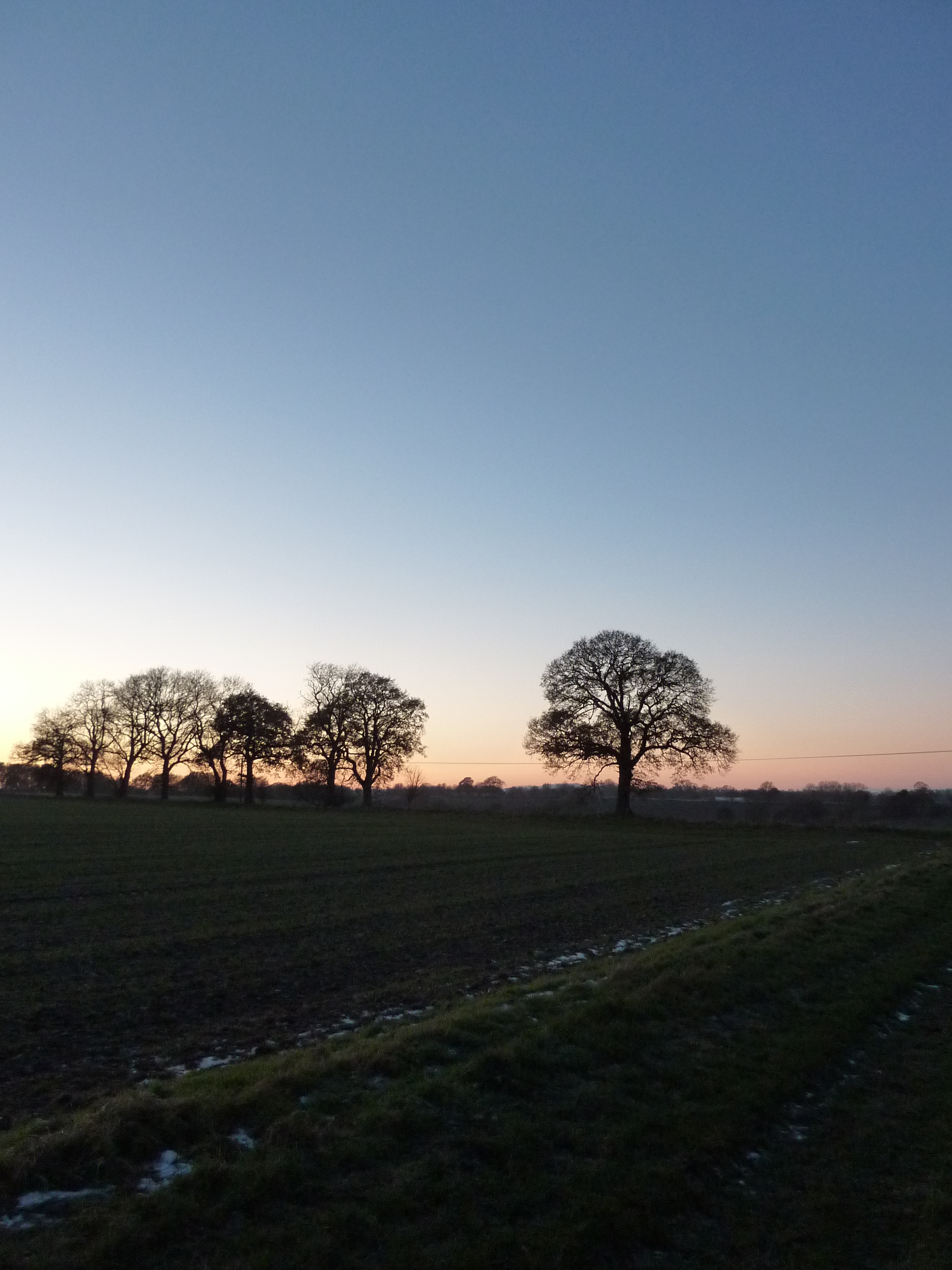

Nobody calls it Julie's tree apart from my wife, the very same Julie and myself. This was a landscape I got to know when we first met, the wide rolling landscapes that surrounded her village in Wiltshire. We walked up here on one of my first visits and while almost identical to every other tree for miles around this tree, (along with another in the village that was fenced off and we couldn't visit anymore), became "our" tree. And that is the answer. Permanence in the landscape grabs hold of the soul and never escapes. Julie moved to Somerset in 2014 and since then we've not been back to 'our' tree. I hope it still stands and hope it is well, but in my mind it is a permanent symbol of a happy time for both of us in Wiltshire.

The image of me at the top of this post is of Blindburn at the head of the Coquet Valley in Northumberland. I love it up here but have absolutely no connection to it other than it means something to me as a casual visitor. But I feel protective towards it. Oddly though, my wife owns a house further down the valley at Harbottle which we have no spiritual connection to. Julie may own it but it is occupied by a long term tenant and his family, a local family with children which is a wonderful addition for the village. But as we don't live there, that full blown spiritual connection will be focussed on those children growing up in this wonderful part of the world, not me. But I still have some connection.

Academic careers have been made analysing what it is to have a memory, what it means to experience spirituality or a Spirit of Place, that historical record of a time and a place that means something in that precise moment of time to an individual when we are there, alive and living. In a similar vein the below image of me as a volunteer warden at the National Trust's property of Cragside in Northumberland in the 1980s is another example. I didn't perform paid work there, I never lived on the estate, but for about six years, I spent every weekend there doing something I absolutely loved, being out in nature, learning how wardens (now rangers) operate and meeting the public. I forged fantastic long term friendships there, but then I moved south and I've only returned a couple of times as a visitor. But if anything catastrophic happened to Cragside, as happened to the sycamore at Sycamore Gap, I'd be devastated. 


The wanton destruction of the sycamore on Hadrian's Wall was an abominable act.  Why someone thought it was a good idea to illegally fell a beautiful tree is not something I think anyone will find out soon. But it's gone. Many people are suggesting what happens next. An Anthony Gormley sculpture in its place. I personally hope this doesn't happen. A wooden sculpture of the tree made from the trunk. Maybe, but can this be in a museum or arts centre. I worry the site may become a bizarre shrine to something that was once loved but has gone, eradicated and will never ever come back. Nature carries on if we let it, but what replaces it will never be what was there.

There was an excellent comment by Gary Bartlett I read, who perfectly summarised my thoughts on what may happen to one option.  The National Trust and many others are suggesting the coppicing of the stump will preserve the tree. I don't know Gary, but he writes......

" It's a nice thought.... But let's be realistic. I first met this particular tree in 1990 when surveying the trees on sections of Hadrians wall. This Sycamore was in it's unadulterated natural form, three centuries in the making. It had a twin stem which added to it's aesthetic appeal.

Sycamore will respond to hard pruning but a coppice or a pollard never take on the appearance of the natural form... You can go to Sherwood forest and see 700yr old oaks that haven't been pollarded for well over a hundred years... And they still bear the signatures of the woodman's saw. There is a reasonable possibility that this tree will soon throw multiple shoots up from the stump - it will have the appearance of a scruffy thicket for a few years. With careful selection of maybe 2 or 3 dominant stems (& their protection from further vandalism); a new tree may be crafted... After 10yrs of nurture, a new multi-stem tree with a natural habit may be visibly appreciated & in 40 to 50 years it may have the appearance of a reasonably mature tree. It will be 80+ years before it has anything like the stature of what was lost & another 50yrs beyond that until it has any sense of grandeur. In the meantime, the tree will be vulnerable to pathogens - especially fungal.

It is exposed to fairly strong winds - and sucker shoots in maple species are prone to tearing out at their union with the stump or stub. This structural weakness will be ever present for the first 20-30yrs at least. Sycamore don't tend to send up daughter plants / clones away from the stump like many Prunus or Poplus species will... So new shoots will be limited to the stump - which will in time decay from the centre... There is a risk that the shock of losing the main stem might kill the tree (at this age), so regeneration is not guaranteed.

Planting a replacement will be challenging as the site is a scheduled ancient monument - so a planting site would need to be identified for a new tree - agreed by Historic England / English Heritage and the National Trust (whichever have jurisdiction on this section of Hadrian's wall). An archaeological dig would likely be required before a new tree could be planted.

The tree that has been lost will never be replicated - it was unique.

Northumberland has many tens of thousands of Sycamore trees; many of which are older, taller, broader and arguably more magnificent than this one (I urge you to seek them out - they will warm your soul).

But this tree was the iconic "Sycamore Gap" tree... It cannot be replaced by a tribute act. 
This tree seems to have become a metaphor for man's relationship with all trees... From the Amazonian rain forests, to trees being felled for access to building sites or new infrastructure. It's loss feels like the assassination of Martin Luther King or Kennedy... Senseless."

Gary Bartlett ended his piece with these words on the desire to coppice.

[I admire the optimism.... ]... Unfortunately few of us will be around to discuss this by the time this tree may become anything reminiscent of the original."

Other people will have many other views and that is how it should be. But for me now some forty eight hours into the story, this is how I'm increasingly feeling. The anger I felt at that tree's destruction has softened. I'll now never visit the tree, but, and this is important, if it had been such an important part of my life, I'd have made the effort to visit it while it still stood. Now, my mind is focused on change and the future. Let the fallen tree decay at it's own rate into the landscape, help dead wood invertebrates and plants thrive for a few decades in this most treeless of landscapes. Plant something new, maybe not in the same place, but nearby. The loss felt by my generation by this criminal act could benefit generations to come. I remember visiting Kew Gardens while on a botanical course in February 1988, just months after the October 1987 storm had ripped through the gardens. Many much loved trees from their specimen area had fallen. It was while on a walk around the site, then still closed off to the public, with Kew's arboriculturalist that he said something I've never forgotten. 


"[sic] Arriving at Kew on the morning after the storm he cried and cried for the lost trees there, many of whom he thought of as family. But then as the weeks passed he realised this was a moment to embrace change and plan for the future." 

Looking at Kew Gardens now it's almost impossible to imagine the damage caused on that October night. My hope then is the same fate befalls the toppling of this sycamore. Over the months and years we'll see change at Sycamore Gap. We as a society must and can look forward. What can we do as a society to make the landscape better for children being born in 200 years time? We have benefited from a tree being planted in the 18th Century maturing in the age of Social Media. Much like the trees below in the field next to the aforementioned friend's house only a stone's throw from Sycamore Gap which I photographed while on a walk before breakfast last November. They're just trees, no one except the odd walker will notice them. They stand there quietly removed from the consciousness of collective society. Would anyone miss these unknown trees if they were felled one night? I doubt it, and that is a most sobering thought. 


Wednesday, 12 April 2023

Quantock Easter 2 of 3 : Somerset Wildlife Trust's Holford Kelting Nature Reserve

Less than 48 hours had passed since we had enjoyed romping up and down Hodder's Combe in the Quantocks, before we found ourselves back in this lovely part of the World on Easter Monday, poised like mountain goats for a second walk. Actually this walk was followed by a third walk later in the day, details on that in the next post.

Roll back a day or so. After returning home on Easter Saturday I found myself flicking through a walking guide of the area when I stumbled across the name Holford Kelting, which as it turns out is a Somerset Wildlife Trust nature reserve. 5 hectares of a steep sided valley in the Holford Glen.

Strange name I thought. I looked up Kelting - not much on-line but it is either a)  a surname of Germanic origin meaning field or place by a field, or more likely in my imagination b)  the ability when two (or more) people are able to communicate via Telepathy. The mind boggles, I've led a sheltered life, I had to visit.


By 11am we were off walking through the lanes of Holford Village and into the Glen itself. In all the years I've visited this area, I have never walked in this direction. Today, even with the car park full, no one else walked in this direction either it seemed. It was bliss. Soon we walked through a gate and into another world as we descended on a steep path through the most wonderful woodland. The woodland floor was awash with ferns, celandine, wood anemone and wild garlic. Mosses covered the buttress trunks of trees. Overhead woodland birds called. It was magical and we were not even in the Nature Reserve, this was just the aperitif. My notes I'd jotted down said - walk half a mile into the woodland and then enter the reserve, taking care on the steep sides which may be slippy if wet. Duly noted. 


We kept walking, the path became steeply descending and we were in heaven walking into somewhere new where way down below we could hear the unseen river gushing and cascading through the understory. It is a long time since I've seen a woodland floor this covered in spring flowers - primroses, violets, and wonderful carpets of anemone rising up the valley side.  And that was just what we could see while walking.


All the while I was looking for a sign or notice that we were at the reserve. We'd now been walking about twenty minutes and nothing was obvious by the time we came to a gate into a field. We went through and suddenly the landscape opened out. To our right and ahead of us a huge grass field littered with celandines. To our left a tree line crowning the lip of a steep valley. Maybe there's a gate into this valley further into the field. 


This was magical, aside from a large flock of jackdaws noisily flying around some mature beech trees, we were the only other moving thing. No sheep, no cattle, just the jackdaws and us. The once well defined path up to the gate now became barely visible in the field. We were actually on a bridleway as seen by recent horse shoe indentations in the sward. But everywhere there were celandines and ad hoc clumps of primrose.


Mid field a really fresh badger set was being worked, it looked like the winter bedding had been evicted for a new spring mattress. 


Eventually though we came to another gate. Mrs Wessex-Reiver checked her fitness app. We'd walked 0.8 miles. Where on earth was this entrance to the nature reserve then? We had not passed anything obvious at all. That said it didn't matter as we were thoroughly enjoying this walk into an unknown land, and ahead lay what looked like a wonderful piece of ancient woodland. I half expected to find Baldmoney, Cloudberry, Dodder or Sneezewort guarding this gate and their woodland home to BB's Little Grey Men. We stood by the gate for a while listening to the silence other than the chorus of the natural world. We then ventured in.


And what a woodland. The first flowers of wild garlic were just emerging, their scent was subtle but in a few weeks it will be overpowering. Aside from the pathway not an inch of land remained bare earth. What had been we thought wonderful woodland at the start of our walk, was now surpassed by this hidden gem of modest size.


Five more minutes walking and we reached another gate. We'd done 0.94 miles. As we'd missed the entrance to the reserve we needed to turn back, but before that we spent a few minutes enjoying the view towards Kilve and the Bristol Channel a mile or two further on. A new hedge and gates have been installed in this field which was interesting and I'm still not sure why there and then continuing up the hill, the distance between hedges slowly becoming narrower. Overhead a buzzard mewed while being noisily mobbed by a carrion crow. More jackdaws, the yaffle of a green woodpecker and a few other woodland birds completed the soundscape.


Reluctantly we turned and retraced our steps back through that magical woodland copse, through the gate and once more onto the wide fields rolling down the ridge to the tree line standing sentry to the valley below. 


I kept looking as we walked but the fence on top of the valley lip contained no obvious entry points, until that is when we reached the felled tree. Next to this I saw a small wooden stile which we'd missed on the way out. But this can't be the entrance, it was covered in brambles and no obvious pathway lead from it.   It felt right that the reserve was below us, we just didn't know how to get into it. Oh well we've had a lovely walk and on our next visit we can try again with better directions.


And then, just as we went through a five bar gate and re-entered the first piece of woodland we'd walked through I saw what looked like a path, one I'd not observed on the way through. A rarely used path indeed which ignited memories of exploring woodland as a child. I looked at Mrs Wessex-Reiver and said "shall we" and she nodded - and so we headed down this leaf strewn path as if descending into a primeval forest no human has entered before. It wasn't easy, with the leaf cover it was slippy in places but not obvious until our legs slid from under us. Hidden branches provided a trip hazard and fallen trees a head injury opportunity. But this was great, I was eight again and exploring the landscape of Rothbury in Northumberland. If this is the reserve entrance, the reserve itself must be superb.


And boy were we not disappointed. Suddenly the path emerged at the river we'd heard earlier. A rubble strewn shallow river which threw me back all those years to making dams and looking for caddis on the underside of stones. Water flowed over the pebbly bottom providing a chorus of liquid music into the otherwise silent valley. We stood at the water's edge, just taking it in, silent not talking. This is exactly what a river should be, meandering, semi blocked by fallen trees, little pools, shallow rapids, swirling eddies, chaotic.


And this is what being in the natural world is all about, nature quietly doing its thing and we as observers leave it well alone, and that was why we never went any further into the reserve, our path ended at the river which meanders to the sea, just as it should. 


I can't recall how long we spent there, it felt like hours but probably a quarter of an hour.  A mental note was made to return with a picnic and just sit and do absolutely nothing, nothing other than sit and watch the croziers unfurl from the many ferns down in the valley floor, or watch the sunlight dancing off the surface of the water. Of course like Brigadoon we may never find this place again, but I'll know where it is, it felt like home, and we will be back.


Sunday, 17 April 2016

Abandon hope all who enter here

Nature can both enrich and destroy.


Today it's capacity for failure has been aptly demonstrated by the abandonment of the blackbird nest I wrote of recently. Two weeks ago I sat in the garden enthralled by to-ing and fro-ing of the female blackbird building a nest in the garden. Two weeks ago the promise of new life into this corner of Somerset was all around us. Today after not seeing any activity in the garden or around the nest by either the male or female blackbird I checked it with my camera on a pole - 5 beautifully marked eggs but no bird. I gently felt the eggs, stone cold and they plus the nest were soaking wet after the frost we had last night. Having not seen the female around the nest for 4 days now, I fear that's that. There will be no new life in this corner of the West Country this year.

In a way I'm not surprised, just saddened. On Tuesday, the last day I saw the female an unknown black cat had come into the garden and was looking up at the nest hidden in a clematis. It then walked along the fence the clematis is attached to and peered in before leaving the garden following my protestations. But I have often seen this and another cat in the garden by the bird feeder. Was she killed by a cat maybe? I can't say the cat had anything to do with the abandonment but the female blackbird was especially tame and would hop around the garden while we worked in it. She'd happily fly into the nest too seemingly unaware we existed. Too trusting possibly?
 
We also have regular visits by magpies and carrion crows, in fact a crow has just arrived on the shed as I write this, all sleek and glossy, a killer king in a black mantle? Maybe but often they would rob the nest of eggs, rather than attack the parents. The eggs are still there, cold as stone, jewels hiding their macabre story of abandonment. We do have a regular sparrowhawk too, but there is no evidence of blackbird remains. Why then the nest was abandoned? I just don't know.

I've long loved nests and eggs. Since a child that joy of discovering a nest and peering carefully inside to see perfectly formed spheres of creation. In many ways finding nests in the winter is just as thrilling. I remember discovering a long tail tit nest in a dense blackthorn hedge in the middle of a snowy walk in December. That beautifully crafted tennis ball dome stood out as a reminder of warmer days which felt a lifetime ago. Gently pushing my finger inside the dome I could feel the soft interior, which possibly housed ten or 12 pompoms of life all squeezed in tightly vying for space as the warm spring sun warmed within.  

Rooks nests out of season fascinate me too, they look so precarious on the outer branches of trees, just a ragtag and bobtail structure of sticks swaying in a winter storm; but no matter the weather they remain relatively undamaged all through the year often to be repaired and used again in the following March. Even in the height of nesting season, winds can whip the trees into a flagellating frenzy but the nests remain; although in severe gales at this time of the year young can be hurled to their death below. The illustration below from The Collins Guide to Nests and Eggs I have mentioned before fascinated me as a child as it simply illustrates the differences. Rooks, social and build on the very edge of the tree, which is of course why the nests are stable as the branches are a vertical foundation structure to the nests. Carrion crows build lower down, singly and usually in the more stable Y or fork of the branch - their nests being more of a platform. And magpies. I love magpie nests one of the few instantly recognisable nests with it's mezzanine floor above the main nest to protect eggs and young.


The complexity of nest building in the birds world is fascinating, and all from a beak and a bit of avian design flair. Not all birds build nests of course, the cuckoo just pops by like a difficult older sibling while you're out, raids your nest, leaves a present you didn't really want and disappears until next year. The guillemot and many other seabirds just lays an egg on a rock, the egg itself is the wonder, designed to roll around not off the cliff face. But as with the unhelpful term seagulls to describe anything white and flying along the coast, the term nest fails to enthral the casual observer.
 
Rightly nests and eggs are protected by law from destruction, harm or wilful disturbance during the breeding season, I only checked this nest being certain it had been abandoned and after days of discrete distance observation. But later in the year when rebirth has been completed on that country walk, if you find a nest, stop and take a closer look at the miracle of its building, it's form, structure, shape and function is unique. As is every species' nest.
 
All is maybe not lost. As I sat here writing this memorial to avian abandonment a dark shape caught my eye. It is a female blackbird carrying nesting material from the garden and over the wall into a shrubby area next to the lane. In the time it has taken me to write this she's been back and forth half a dozen times. The male blackbird is perched on a shrub beside where this female is flying in and out of. To be honest this female looks darker than the one nesting in the garden who had a distinctive pale ruff across her chest. Is this male blackbird one with female blackbird 2? Only one thing for it, to stop writing this, make myself comfortable and as all naturalists do, sit quietly and observe.
 
Observation is what enriches our understanding of nature, and, maybe there will be new life in this corner of the West Country this year after all.

Wednesday, 29 October 2014

October 29th 2014 - Before dawn

 
I woke well before dawn today, before 5am if truth were to be told. It had been raining hard during the night. The rhythmic drip drip drip from the broken gutter above the bedroom window (which after 4 years I've yet to replace) always a tell-tale sound before even an eye is opened. I lay on top of the bed looking at an unseen ceiling, total darkness filled the room. Drip drip drip went the rain released from the gutter, my mind had focussed on this sound, returning to sleep would be nigh impossible. Something stirred in me like episodes of  unstructured but interconnected whirlpools; ideas, emotions, thoughts all collided with the physical sensory ink-dark environment my body now lay within. I got up.
 
Being English of course the first thing I did was to make a nice cup of tea, before switching all the lights off in the house, ventured onto the seating area in the garden.
 
There is a window, a moment, after heavy rain and especially in darkness when I am consumed by a sensory overload. Something stirs in me, possibly harking back to primeval DNA and a heightened sense of the environment. I find it fascinating that I can, should that I had the skills, trace DNA and carbon back through time. I had ancestors living and breathing as Neolithic people walked the earth. Who was my ancestor when Jesus preached? The Battle of Hastings happened, my great great times 20 grandfather would have been breathing too, who was he? Since childhood I've longed to know more about my ancestors. Not their names, or facts, but what made them human beings and how much of them is now lodged within me. There is a direct link, yet that link is as broken as the gutter attached to my home. I know it's there, I just can't reach it.
 
Steam rose from my mug of tea. I knew this as energy saving streetlights in the lane behind the house, timed to come on at 5am had begun to glow. Steam rising like an ochre ghost into the still air. Otherwise I sat in absolute darkness. No wind, the temperature mild my skin bristling to the morning air; a steady drip of exhausted raindrops, having succumbed to gravitational pull, falling from overhead trees. I listened, while watching the lights turn from the faintest blood orange to their resplendent sulphurous aura. Watching that glow increase without any real thought, my attention was drawn to a blackbird as it tik tik tik'd in the hedge across the lane, soon to be joined by a second in an adjacent garden. I sat, eyes slowly adjusting to the change in illumination grappling with the blackness of the day in a battle the rising sun in a couple of hours time would ultimately win.
 
 
Silence. I listened to my heartbeat, the sound my body made drinking my tea, all the while listening to that occasional tik tik tik in an otherwise silent world. Silence and the ability to envelope oneself in silence is important. I allows processes deep within our soul to become heightened. Today however that silence was rudely and abruptly broken by the staccato shrill of a robin on the wall. His modesty is put to one side while he exclaims his territorial possession. "I am here, I'm awake, this is my territory, enter at your peril". I could see his silhouette on the wall, tail cocked as he bobbed about whilst producing a cascade of liquid refreshment.  A crow 'cawwed' in the field, a pheasant too. A wren began it's powerful chattering. The world was waking, and I was privileged to be part of that process, my presence is but a heartbeat in a lifetime of process.
 

My eyes adjusted, my attention became drawn to raindrops on the washing line. Like linear glow worms, or sparkling diamonds, their ability to cling on to a thin wire fascinated me. The resulting photographs seem, much like my thoughts today,  to represent a connection between places. Like a fibre optic cable this humble washing line has become an instillation. It's utilitarian use far exceeded as it carried my creative thoughts along in a linear manner. I could, and should, have fetched a tripod. Do this properly Andrew or not at all, was a mantra drilled into me by my parents. Today however was about being slapdash. About being spontaneous. A handheld camera to captured the moment. That heartbeat moment, joy at being in dark surroundings, and alive with the illuminocity of life. Clarity was not important, creativity was.

 
And so I experimented - 10 second exposures and hurling the camera around like a madman. I like these images. They represent my way of thinking. Sort of chaotic, sort of structured, but always unfocussed. I respond to the moment well, not for me the process of endless planning.

 
It is almost light now as I write this. Passing moments, that is what these images actually represent. A brief part of my day, a part of the day that is no more. Outside before the world really began to wake up I let my inner senses, my inner mind take over my thoughts and this is what it made me do. It pleases me.