A

A
Showing posts with label Rookery. Show all posts

Friday, 21 March 2025

The Spring Equinox Rooks

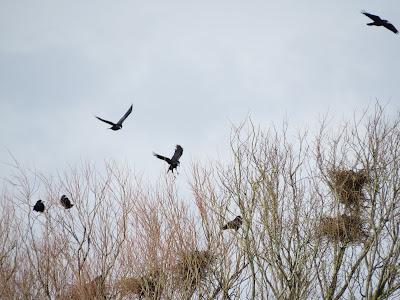
 In a non scientific way I have counted the rook nests in the village for a number of years now. In previous years my count took place in late February or early March, after which a couple more nests invariably appeared. This year I delayed my count slightly and waited until the spring equinox, not just because it was the warmest day so far in 2025, but also the first day of my retirement. Until this moment I'd been too busy finishing my career, and work, at the BBC.


The afternoon was warm. The thermometer in the greenhouse nudged 40oC, outside it was around half this, not bad for the 20th of March. With little wind and visually perfect blue skies I set off walking the half mile or so to the village to make my count.


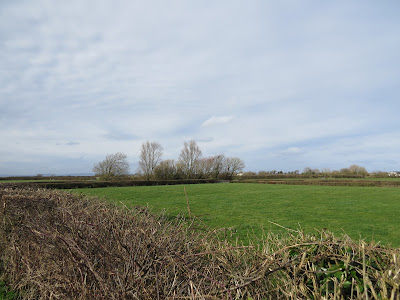
First the site I refer to as the bend in the lane. This is interesting. In previous years there have been one or two nests in the far right tree. This year there are nine spreading across all four trees, themselves around a quarter of a mile from the main rookery. Why the expansion here I can't say, but I hope this is a sign of a healthy population expanding their territory.  


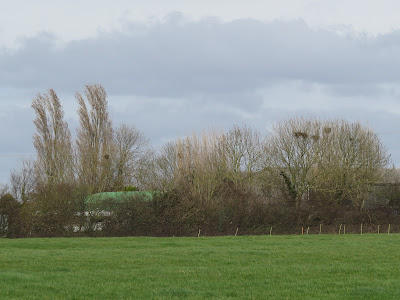
Walking further towards the village, the two core trees as I like to think of them, on the left have, as in previous years, hosted the bulk of the nests in the village, nineteen in total this year in the main tree and five in an adjacent one. The trees to the left (and below) at Cypress Farm, have increased nest numbers too, with nine this year, quite interesting to see poplars being used.


I spent a little time near to and under the main core trees. I've mentioned this before but it never ceases to surprise me that they nest over the lane, now covered with sticks. They're safe in the trees of course but this is a busy commuter short cut from Weston Super Mare to a major road, plus a busy agricultural area with thunderous tractors passing through. Not a quiet spot then but as it is host every year to the core rookery structures, they must like this spot.


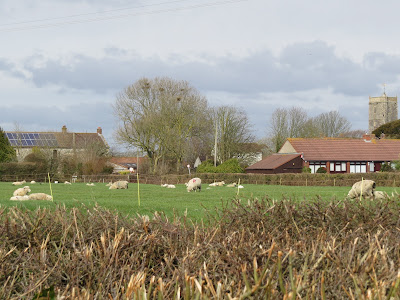
Not far from the core area, three nests have appeared in what I can loosely term a new site by the holiday cottages, only a sticks-throw from the core. Three nests here, but room for more.


That's a good total then, 9 on the bend, 9 at Cypress Farm, 19 plus 5 in the two core trees and 3 at the holiday cottage = 45 if my sums are correct. That's two more nests than in 2024. 

Not a bad way to spend the first day of my retirement, messing about in warm sunshine watching the behaviour of rooks in the village.


Saturday, 30 March 2024

Rocking Rooks


Earlier in the week I finally managed to do my annual rooks-on-the-nest count in the village. I've done this for a few years now, just in and around the actual village itself. I could expand the range of nest sites I might look at as in recent years a number of new rookeries have developed within a 2-3 mile radius. I did a quick drive-by count of those recently and there are 7 new rookeries in the area, all on fairly young trees by roads, rather than traditional mature copse and woodland trees. While it is interesting to speculate why this population boom is happening, food supply (more sheep farming on grassland, fewer cattle farms), climate change, lack of persecution etcetera, remaining faithful to my original site allows for a little consistency. Though none of what I do is scientifically rigorous. I'm just interested.


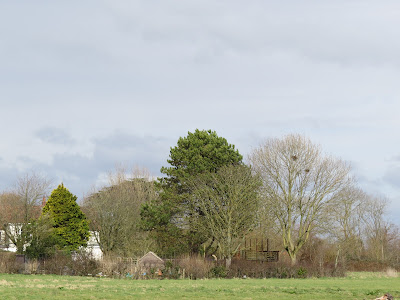
The above image gives the best view of most of the nests. During the wet and windy winter just coming to an end every nest from 2023 was trashed. By January not one nest remained, I can therefore be virtually certain all those nests I observed this week were 2024 active nests. In total I noted active nests in six different trees. Three nests are on the lane into the village, with a carrion crow nest nearby, a further nine were in two sets of trees on the village outskirts, and a set of three nests were on the farm trees about half a mile away, making 15 nests in total away from the main site. 


That main site consists of two trees holding the bulk of the nests, 23 in total. These two trees have been at the centre of rook activity for a number of years.  New for this year an adjacent tree was hosting five nests, I've not seen nests here before. In total then 43 active nests within the village or no further than half a mile away. That figure, in common with my casual observation of the surrounding wider area, is up slightly, in most years the figure is around the mid to high thirties. I used to do a count of actual birds based on two birds to a nest. Recently though I was chatting to a corvid observer who uses 2.8 birds per nest, with the 0.8 taking into account non breeding individuals remaining within the spatial cohesion of the colony during the breeding season. With that in mind, the village of Wick St Lawrence has, by my Heath Robinson efforts,  a rook population of 43 nests x 2.8 = 120.4 rooks. I may round it down to 120, that 0.4 of a bird is maybe a statistical outlier...or not very well and missing 0.6 of it's body. Eric the half rook if you will.

Given the wider circle of rookeries outside of the village and a quick count as I drove past I'd estimate within a three mile circle there could be a population of 250-300 rooks. 


As an aside, in my home I now have a pair of jackdaws nesting in the roof space of my home (lack of maintenance has a benefit). The noise they create building a nest in the void is astonishing. No doubt I'll write about these in a future post. 

Monday, 3 April 2023

Revisiting The Rookeries of Wick St Lawrence

It has been under a month since I last did a count of the rook activity in the village, March the 14th to be precise, and much has changed. Some winners and oddly a strange loss.

Finally the weather in this part of Somerset has improved. We've had rain, more rain than I'd like to see again during spring. I think this may be the first year I've not experienced one of those dry early March days when there is dust billowing along the lanes, which for me is one of the signs of spring arriving, dry roads and dust on the car.  But we're in April now and after a Biblical deluge on Saturday morning it seems we're set fair for a few dry days. Perfect then for a pre supper amble to catch up on the rooks in the village on a Sunday evening.


A month is a long time in the natural world. On my last visit as I came home from work, it was around 6.30pm, bleak and almost dark. By my next visit last night at roughly the same time of day now the clocks have changed the sun was strong and the landscape was beginning to emerge - which is a good thing given that rooks begin to nest with an eye on their eggs hatching as the trees come into leaf (for a little protection for the young) while the ground is still moist but warming up nicely thus provisioning more invertebrates for the hungry chicks. 

Those chicks stay in the nest for about 30 days. Interestingly at the beginning of their life the male is the only provider of food, the female remains on the nest only getting involved once the chicks are around two weeks of age. It is all a little taxing for the adults as they can exhibit asynchronous hatching, in other words the eggs laid can be delayed somewhat and hatch at different times. This can mean that from the first egg hatching to the final fledging from the nest can take six or seven weeks. Exhausting for the adults who don't themselves feed well at this time and often lose a good percentage of their body condition. That's why this time of the year and into early summer the weather is important. A hot dry spring with baked earth is not good for rooks as the young fledge, or any other ground feeder for that matter. Hopefully then 2023 will be a good year if this cycle of damp wet days continues as the days lengthen. But I digress, the real issue as I walked the lane was to count the nests.


I'd noticed while driving through the village that a number of new nests had appeared since my last visit. The three which were formerly at the pond corner, now numbered six - three in one tree, two in another and a singleton, though I'm not sure that the lone nest on the far left is active.  Possibly a dummy run nest which is common. 


The three nests on the right, and below were very much active which is good to see given the extensive tree work that happened here in January to open up the dew-pond, which is beginning to come to life after the dredging and chopping back. 


Standing guard in the warm sunlight above.


A single new nest has also appeared in trees by the old school building. This line of trees was once the main hub for the rookery in the village, then around ten years ago they stopped coming here. Disturbance probably, there's a resident herring gull pair here now, but for whatever reason they're back this year, or at least one nest is.


However more worrying is that the nests which were occupied in early March at this location above have disappeared. Did they naturally go or, as I hope has not happened, have they been removed? This location was where nests had remained from last season, and I noticed there is a ladder against one of the trees, trees which border a Farmstay touring caravan site which has recently changed hands. I'm going to be generous and say the rooks have literally 'upped sticks' and moved across the road, as there has been a more than doubling of nests here since my last visit.


On that last visit there were twelve nests in a single tree. On this latest visit that tree had nineteen nests. The trees either side of that had five and four nests respectively.  That's twenty eight nests. Which is not unsurprising as when doing a rough bird count on my last visit there were as many non-nesters as nesters based on the birds present and who flew off when I approached. Those non-nesters have presumably then caught up with delayed nesting activity. 


It was while taking these images that a family, with dog in tow, emerged from the caravan touring site and asked what I was doing. Newly arrived here for their Easter holidays they were interested to know I kept an eye on the rooks in the village. As like the rook I'm a resident myself, I forget sometimes I live in a tourist area.


Hard to count all of the nineteen nests in this image so one of a single bird and nest then.


It does make me wonder why this tree below has always been a favourite for the rook. It isn't particularly tall, not in a favourable location (to us humans) being right next to the road and a house, but the rook love it. They nest here every year and roost here in the winter. What that does show however is that an inconspicuous looking tree if  it were to be felled, could have catastrophic effect on this rook population. And that is always a risk of management taking place without local knowledge. This tree is not just a tree, it hosts a community. 


It was all looking promising then, six (or 5) nests by the pond, one nest by the old school, and twenty eight by the village, 35 nests, that is a minimum of seventy rook plus associated non-breeders. However all was not finished yet. Retracing my steps back home after a lovely forty five minutes bobbling about watching the rooks I noticed back at the farm by the River Banwell that there were some more nests. I'd not noticed these on the way out as they were behind me. These nests are around a quarter of a mile from the main site in the village, in trees by the farm buildings.


There is often winter activity here but I can't recall seeing nests, or maybe never noticed them. The question then in my mind is  - are these birds from the same social group as those in the village simply finding more suitable trees to nest in. Or given these nests are somewhat separate are these a social outlier, maybe newly paired birds beginning a new rookery some distance off from the main rookery, albeit of only three nests. I can't get any closer to these nests from the lane but may have a wander over there soon if I'm allowed by Roger the farmer.


So the count - where have I got to on the 2nd of April with the rooks of Wick St Lawrence?

6 x nests by pond (or 5 if one is inactive)
1 x nest by old school
28 x nests in the village itself
3 x nests by the farm a quarter of a mile distant

I make that thirty eight nests in the village, making the population here at least 76 individuals. Which is even higher than I'd got to during my last visit in mid March, then by estimating breeding and non breeding individuals I'd got to around sixty birds.


I'll leave the rooks of Wick St Lawrence alone now for the season, as I'm pretty sure the number of nests won't increase now. That's a good total of nests for the area, as while rook are not in serious threat nationally they are in a slow decline, like much of lowland farmland birdlife is. We need to let nature have a few raggedly and unkept places to live in - and spill a little more grain at harvest - and leave those trees standing. But that is for another day, especially if it stays warm, with a little rain, but mainly sunny in this corner of the West Country.

Tuesday, 14 March 2023

The Rookeries of St Lawrence

Back at the end of January I wrote of the rook community at Wick St Lawrence, my local area. Back then the rooks were loafing about but aside from a couple of old nests which were being utilised, the bulk of the rookery activity had not begun.  Last evening though, as sunsets are definitely occurring later, I stopped on my way home to check what is going on.

Plus, as I realised later, the blurred images due to the low light bring (in my view) an enhanced atmosphere to the images I took. 


It was close to 6.30pm by the time I'd arrived home after my commute. The light remained but wasn't that great. However it was a preferred time for counting nests and birds as they were coming in to settle for the evening, allowing for a more accurate count of the population.  At this time of the year we are at the cusp of massed winter roosts ending and socially cohesive communal rookeries developing. An interesting book from the 1930s by G. K. Yeates [2] first looked into this in depth, though some of his observations were discussed and revised soon after publication by one J. P. Burkitt in his short article on young rook at a rookery [1]. Yet it was Yeates who mentioned that mid March is a cusp time between winter roosts ending and the rookery roosts forming, which he estimated to be about a week before the first eggs lain. Certainly down here I'd suggest this happens two or 3 weeks earlier - late February?


All the nests are around the boundary of a large grass field. The first image above of three nests was especially welcome as this area had been heavily modified over the winter months. Luckily a couple of standing trees were left and three nests were in use. To my right, the trees by the field edge had six nests, though the exact number is hard to observe in that image. A quick count then, nine nests so far, meaning a minimum of 18 birds, assuming 2 birds to a nest. I didn't count the hangers on, more specifically, non-breeding, young, unpaired singletons or late nesting rook


Turning then to the main rookery area of trees hard by the road entering the village itself, a total of 12 nests were visible in the one tree. Remarkable that only two weeks ago not a single nest was here. Therefore a rough estimate, 24 rooks here plus the 18 from the other trees, 42 birds minimum. However there were a lot more birds loafing about in these trees and in other parts of the village. As I walked closer they fidgeted and squabbled, the noise was quite deafening. Below the trees on the lane was a matrix of sticks dropped, or fallen from the nursery structures above. I tried to count the birds as I walked and, while nearly impossible there were certainly more than 24 in this one spot. 


Then as I walked under the nests the formerly agitated and fidgety birds who'd been watching me approach now arose from the branches en-masse in an almighty crescendo of noise the moment I stopped walking. That is quite usual for corvids, and other wildlife. They observe an approach and as long as there's nothing to worry about they'll hold their station but chatter away. However once movement stops immediately there's an eruption of birds calling loudly, both harsh caws of alarm and communication and the softer whistling contact calls rook make.  Many of the birds wheeled just above the branches and then very soon began to return onto their nests, though a good number left the area completely, floating away like wood smoke in the blustery wind. I quickly withdrew and retraced my steps a little thus allowing the nesting birds to regain their former position as soon as possible.


That lift-off allowed me a rough calculation of individuals in this one assemblage and I would estimate around 40, so heading towards double the nesting pairs of 24. And in doing that rough calculation, shall we say an additional 40% non breeding birds in the community, then adding those here and the others in the trees I'd suggest somewhere over 60 birds in this small rookery encircling this large grass field. Not far away, less than a mile across the fields, is another rookery at Hewish of a similar size. Whether there is cross communication between these two rookeries I don't know but it wouldn't surprise me with these sociable crows.


Walking back to the car I noticed that twenty nine rook (counted from the image) were making use of the power lines crossing the field that the rook nests border. Most of these individuals were those who had flown off from the main rookery area, but not all, and probably these were a mixture of non-breeding individuals and maybe males waiting to return to the rookery. Moments after the image was taken they erupted again en-masse and headed back to their respective sub-groups in the trees, leaving me to take all I'd seen in and assess this wonderful end to the daily commute from work, counting rooks.
References

BURKITT, J. P - British Birds April 1935. Volume 28 Issue 11. NOTES ON THE ROOK:
With special reference to the proportion of young in flocks, and the change over from winter roosts to the rookery.

YEATES, G.K. The Life of the Rook. Philip Allan 1934
Saturday, 12 March 2022

The Rooks Of Wick St Lawrence

I've just looked it up. I last did a rook nest count around the village on March 20th 2016. You can read about it here if you so wish. Rooks 2016

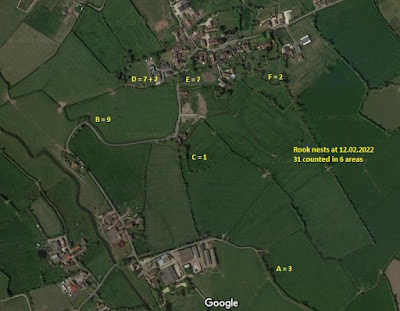
Back in 2016 I counted 33 nests around the village, predominantly within three distinct concentrations, one by the Village Hall [C in the map], one as you entered the village [E on the map] and one as you left by Cedar Farm [F on the map].  Today I headed off to count them again, and this time there were 31 nests. However they are now spread loosely around and away from the village. Only the trees on the entrance to the village [E] still holding nests in number. 

Rooks are often site faithful, with some large rookeries being occupied for centuries. There is not the extensive spread of trees here so numbers would always be low, but for reasons I can't explain they've spread out into new areas, often in quite low trees. So what's happened? Well I'm not sure, maybe its something and nothing, simply just a change. 

Location of rook nests in the village (after posting noted date incorrect should read 12.03.2022)

Wick St Lawrence is a tiny hamlet really only 8 miles from Weston Super Mare. Over the six years since 2016 a number of farm buildings have been converted to housing, but pretty much the village is as it was. Certainly this area is perfect for foraging with damp grassland of sheep and cattle farming making up the bulk of the farmland here on what is the northern areas of the Somerset Levels and Moors. It is low lying land, quite exposed but perfect for foraging, lots of tasty worms and other invertebrates then.


The biggest change in those 6 years is the lone nest in the trees next to the Village Hall. In 2016 there were a number of nests but as in the image above, today just that single nest. From memory I think there were no nests here last year. These are actually the tallest trees so maybe Wick St Lawrence rooks don't have a head for heights. What I find amazing though is that every single nest that had survived from last year around the village was blown out of trees after Storm Eunice. That was little over a month ago, and since then 31 nests have been fashioned, life goes on. Its to hope then that we don't get any more gales and the rooks can get on with raising young in peace. So here is my record of the rook count 2022.


A on the map = 3 nests in trees by Byfield Farm, a lot of activity there there today with jackdaws joining in.

B on the map. 9 nests here, the most in one place. This is a brand new location for nests and as hopefully the images shows these are not tall trees and right by the road. The rooks though were very active here, with at least one female on the nest.


The site B is very much on its own in terms of tree cover. Barn owl love this area too.


C on the map. As mentioned above these trees are next to the Village Hall and used to be a regular area for rook to nest in. Just this lone nest in 2022.


Trees around Cypress Farm - D on the map - also held 9 rook nests, but two of these to the left were actually quite a way distant. This is again a newish area for rook to nest in.


Above and below the only site that has remained constant in terms of activity - E on the map. What isn't obvious is that the trees where the rook nest are overhanging the lane, which itself is peppered with sticks which have fallen out, as I've encountered a few times over the years as they've bounced off the car while I was driving to and from home. Not a very peaceful site then with cars and tractors thundering underneath, but the rooks don't seem to mind.


Finally below - F on the map - just 2 nests by Cedar Farm. This used to be a hotspot for rook nests for a number of years, and a couple of years back a raven nest in the conifer. Just two then in 2022. The house, no longer part of the farm, was sold a couple of years ago and the new owners have cleared a lot of the garden. Not sure this has made any difference in the reduction in the number of nests, but could be a factor.


It is intriguing seeing the change over the years. On one hand the level of activity is about the same as in 2016, 33 nests then, 31 this year. The dispersal of the nests into smaller groups and in areas where the trees are quite small is quite interesting too. It seems to me that rook behaviour is changing, and certainly they seem less wary of humans now they are not shot at or persecuted as of the olden days. As many people will have noticed drive along a motorway and where there are trees, often quite young, you'll see nests, especially in and around service stations.  A few years ago research took place at Membury Services on the M4, as the rooks there seem to be changing their behaviour based on human activity - not least raiding the waste bins.

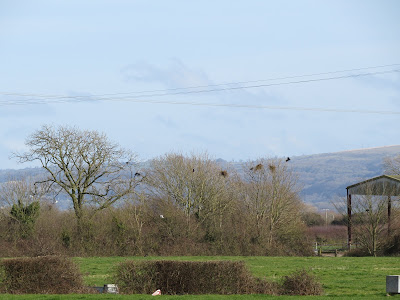
It is fascinating trying to work out what's going on. The image below is a good example of what intrigues me. This is the landscape beyond site B all the way to the Bristol Channel about a mile away. Nice wet long term grasslands, normally full of cattle and today hosting a lot of corvids feeding. In the middle distance are a number of tall trees both in the hedgerows and around farms, but not a single rook nest that I could see. 

I'll leave that as a question then - I'm sure the landscape could hold more rook territories and there is enough food, so I wonder why they don't also move over there? Maybe 30 pairs is all the landscape can hold for reasons that escape me. Interesting!


Sunday, 20 March 2016

Corvid Cornucopia

It's been a cold grey old weekend, ideal for staying indoors and watching the rugby yesterday. Today however I began to develop cabin fever, just as the clouds parted. Blue sky began to eradicate the grey blanket and sunshine filled the early evening sky. Thus just as the clock struck 4pm I headed over to the village for an hour.

 
I've been meaning to do this for a week or so as the rooks are in full nest building mode now. They're moving about the village this year, not sure if they've been disturbed or just fancy a change, but some quite young trees are being colonised quite rapidly. Driving through every day to work I've watched five nests occur in trees over the road in just a week and a couple of singles now occupy outlying trees, like sentries to the main garrison. I have a soft spot for all corvids and in those brief minutes as I cycled around the village, camera and binoculars swinging precariously, I managed to spy a good number of rook and jackdaw, carrion crow, 6 magpies together in a flock and a raven, which took me by surprise. We don't get many jays in this part of Somerset as most trees are ash and sycamore on the wet moor grassland but no matter, I was in my element.

 
There have been two rookeries around the village for years, about half a mile apart. One by the village hall (above and below) and one by Cedar Farm. A lot of activity today, jostling, calling, flying in with twigs, back out again to plunder,  with about half and half rook and jackdaws in the trees. I was surprised to see so many jackdaw pairs in amongst the rook nests but they offer mutual protection and as the jackdaws aren't nesting yet, why go elsewhere. Conserve your energy.

 
There were ten nests here and it was lovely to see the jackdaws noisily wheeling over the rookery too.
 
 
Just a few hundred yards away the new nests are being built and as I stopped my bike underneath the trees which can only be 20 years old, they noisily chastised me for disturbing them.

 
I cycled on into the village and passing Cedar Farm I hear a strange guttural sound, almost like someone is being strangled call. I recognised it instantly over the rooks relentless caw cawings... a raven. I watched a pair of ravens repeatedly barrel rolling last weekend over a copse at Tyntesfield and can therefore only assume they are nesting more frequently all around this area now. Ravens were always present in winter as they loafed about the coast a couple of miles away but in spring usually disappeared to the Mendips or South Wales both about 15 miles away as the raven flies.  Anyway this one was in the huge cedar that stands guard over the farm. As I listened the more familiar cronk cronk emerged from the dense foliage and it was off over the fields - just time for a quick record shot before it headed over to the coast. I heard it again ten minutes or so later but didn't see it. That cedar would be a perfect nest platform for the raven, whose nest is absolutely huge. My fingers are crossed.

 
Cedar farm is to the left of this image and the rookery, if that's the right term for a succession of nests that straggle out over three trees in the hedge line to the right (one of which as seen in the second image below)


What a lovely way to spend an hour on the Sunday of the Spring Equinox. In total I counted 33 rook nests. Back home I quickly sketched a map to show their location. The two single nests intrigue me as they are both about a quarter of a mile from any other nests. Outliers? young birds unsure of their position in the flock? I hope they do okay as one in particular had a carrion crow observing it. It's safety in numbers now that spring has arrived.