A

A
Showing posts with label Woods. Show all posts

Tuesday, 15 September 2026

A Falling Emotion : Simply Rain


A wet Northumberland National Park, viewed from our house in Harbottle.

I walked through the woods. Above, the high canopy drenched by September rain, below, little fell on me, though underfoot the soil quietly yielded to my step, a sensation I'd not experienced for many a month. These woods were redolent, an atomised perfume of emerald moss, of burnt sienna earth, of invisible mycelium. I wandered without purpose or direction until arrested in my reverie; there on the floor, glistening as if a shining beacon, a tree stump enveloped by coral fungus irradiating the most luxurious of orange in the half light.

That encounter was during an impromptu walk in East Harptree woods in the Mendip Hills in Somerset, having arranged to meet a friend for what was described as an amble with cake and a coffee. It has been so far well documented that 2026 has been the warmest, and possibly the driest, summer for decades. After over three months of dry weather here in the South West, the arrival of rain a few weeks ago was both unfamiliar and welcome. Soil remained iron-hard after those initial showers, but here, last weekend, high up on the Mendip ridge, after a few unsettled days, the soil was finally beginning to compress under my weight. Subtle, welcome and above all something to celebrate.

The change has been rapid. For months, I, along with most of the population of England and Wales, woke to strong sunlight, warm mornings, hot afternoons, nighttime too warm to sleep, with the prospect of the same tomorrow, the next day, and the next. And then, it rained. Referencing my diary, I noted 'It rained overnight. Don't get too excited as it was just enough to moisten a postage stamp.' It was the 18th of August. A few half-hearted showers arrived over the following days, but persistent rain only began on August 27th. 'It poured overnight. That is the second night running that we have had heavy rain, yet by morning you'd be fooled into thinking no rain had fallen, save a tell-tale dampness on the lawn'. Therefore, walking woods in the Mendip's during the steady rain of Sunday, September 13th, was a delicious novelty.

It was a meeting of literary minds which prompted me to mull over what rain actually means to me. I attended an Edward Thomas Fellowship walk two Sundays ago, bizarrely, in terms of my present thoughts, taking place on a gloriously warm and clear blue sky day. Thomas wrote a number of pieces about rain. One, simply titled Rain, poignantly contemplates mortality during WW1. However, in 1914 he wrote After Rain, recalling a sunrise illuminating a rain-drenched Hampshire hanger in winter; the poem begins,

The rain of a night and a day and a night
Stops at the light
Of this pale choked day. The peering sun
Sees what has been done.

I absolutely understand this sense of ending and beginning only too well. Love it or hate it, rain has that ability to reflect the mood, to enhance the scene. I've experienced that emotional uplift rain has given me since childhood. There is often a clarity created over a landscape when rain finally ends and, if lucky, the sun emerges, a sentiment Thomas brings to the end of the poem:

And on each twig of every tree in the dell
Uncountable
Crystals both dark and bright of the the rain
That begins again.

For me, with the all too logical background of a science graduate, rainfall is merely the rules of chemistry. I know it is simply two chemicals combining to produce water, add a little meteorology, the evapotranspiration and the water cycle of schooldays, but then therein lies the unfathomable kaleidoscope of emotional connection which has captivated me since childhood. It is the sound above all else which I enjoy, or is it the sight? Samuel Taylor Coleridge captured what I am trying to say in one of his notebooks. On October 21st 1803 he wrote:

    'Friday Morning. – A drisling Rain. Heavy masses of shapeless Vapour upon the mountains [O the perpetual Forms of Borrodale!] yet it is no unbroken Tale of dull Sadness...  a gleam of softest light, that brought out the rich hues of the late Autumn… the Birds are singing in the tender Rain as if it were the Rain of April, & the decaying Foliage were Flowers & Blossoms.'

A Romantic Poet view of rain indeed. Yet, how many times have I myself observed 'Heavy masses of shapeless Vapour upon the mountains'. Living for over three decades in Somerset, mountains are distant, but still, if I travel to an upland area, I am transfixed by those scudding clouds which caress the tops, often travelling quickly uphill through a gulley propelled by up-draught air. Technically, this is known as orographic lift, the clouds forming when moist air rises and the dew point is reached. But emotionally, these are fascinating connections to nature.

I experienced this only a few days ago on the Quantock Hills. Walking steadily upwards from the lower slopes, the views towards Exmoor were far-reaching and spectacular. Before long, gossamer clouds began to chase my route. Long before reaching the trig-point at the summit, I'd entered thick cloud, visibility reduced to a mere metre or two, everything, including me, coated in a fine confetti of mist. Hundreds of cobweb hammocks, now visible, glistened amongst yellow gorse flowers, strange disconnected sounds reached me, a raven, a stonechat. Neither seen. A distant steam train whistle shrilled its passage. Everyday life below, yet, on this ridge, I felt alone, abandoned, but intimately connected to this mass of vapour swirling quickly around me. Low cloud is, of course, not rain, not the rain we think of, the energy of condensation overruled by the pull of gravity.

Rain seemed to dominate my childhood. My mother bought a static caravan near Rothbury in Northumberland in 1971. Our very first night sleeping there was the eve of my seventh birthday, and we woke to rain. It rained a lot there. To this day, if I hear the percussion of rain on a metal roof, I'm instantly transported back to sleeping in our tin box. I was a self-contained only-child and allowed to free-roam the surrounding countryside. I would walk the banks of the river Coquet in all weathers, but it was the wet weather which excited my senses. Raindrops on grass could be flicked into the air as I passed. Few people ventured out during the rain, I was alone in nature, I was happy.

Much later, when at their lowest population ebb, I spent a couple of years surveying otter activity along the Coquet for the then Nature Conservancy Council. And, while I never saw the animal here, only signs (I had to travel to Skye for views of otter), memorable days were spent watching wildlife, often at dawn and dusk, often in rain. Here, without realising, I absorbed the knowledge of the sound of rain. Heavy rain on a sycamore leaf has a sound altogether different to heavy rain on the water. Light rain dampens the soundscape. Rainfall, scurrying wind chased across the landscape, has a sound altogether different to incessant drisling, as Coleridge called it. Summer rain is different, often subtler and short-lived, to winter rain with its harsh symphony and darkening sky. 

Summer rain can be cruel.  At fifteen, I spent my six-week school summer holiday working on a hill farm near Glanton in Northumberland. I was due to move there as a student the following June. It was a wet year and, try as we might, the hay crop could not be brought in dry. I can still hear the sound of mini-waterfalls cascading from the broken gutters of the barns, down into pools of water below. Everywhere was wet, yet, in an odd way, I loved it, possibly as, at that age, this was simply one big adventurous step in my chosen career, and not the anguish of a farmer surveying a ruined hay crop. And still, nearly fifty years later, I enjoy rain. 

Only this week, unable to sleep, did I sit in the conservatory at night listening to the sound made by rain falling in the garden. Hopefully, the hedgehog discovered that same day asleep in our compost heap, woke to rain and a smorgasbord of slugs that night.

I enjoy walking in it too. A few years ago, I took myself for a Sunday walk along a lane during heavy rain, well protected by my favourite Barbour coat and hat. A Land Rover pulled up, one of the local farmers offering me a lift to 'get out of this horrendous rain'. I declined his offer, stating I was enjoying the experience. I well remember his quizzical look as he closed the door and drove off into the murk. Penny for his thoughts?

But what of rainstorms? These high-energy fleeting moments of deluge are fascinating to watch, to experience, to read about. I've long admired Thomas Hardy. His description of the Wessex hinterland resonated with me as a teenager, and it has never left me. Hardy provided the perfect metaphor of the destructive powers of a summer storm in the heart of his heroine in his book Far From the Madding Crowd. Firstly, as steadfast unrequited Gabriel Oak noticed, a storm approached unprotected ricks during Bathsheba's wedding night. 'He was disturbed in his meditation by a grating noise from the coach-house. It was the vane on the roof turning round, and this change in the wind was the signal for a disastrous rain.' Oak having thus saved the harvest causes Bathsheba to reflect on her choice of husband. Later, that same husband, Sargent Troy, having rejected Bathsheba, despairs over the destruction of his true-love, Fanny Robins' grave, by rainwater falling seventy feet from the church tower. 'The persistent torrent from the gurgoyle's jaws directed all its vengeance into the grave. The rich tawny mould was stirred into motion, and boiled like chocolate. The water accumulated and washed deeper down, and the roar of the pool thus formed spread into the night as the head and chief among other noises of the kind created by the deluging rain.'

Summer thunderstorms seem less present in Somerset than of late. I so enjoy that feeling of tempestuous wind, noticed by Gabriel Oak, which often chaotically precedes the deluge, which when it arrives can be deafening, and if falling on parched summer earth accompanied by a unique aroma I struggle to describe, earth mixed with the scent of new lain tarmacadam almost suffices. One of the people I met at the Edward Thomas walk was Roz Brady. I've been reading some of her exquisitely crafted nature writing on her website. She writes outdoors and beautifully describes in Pudsham Meadow through the Seasons – A Wild Writing year (1), a storm blowing over Widecombe... winnowing summer's growth and ushering in a landscape of winter. 

All of which reminds me that while I have been writing this, I can hear steady rain falling once again. Writing about rain is one thing, but while it lasts, like Thomas, like Hardy, like Coleridge, like Roz Brady, I need to get out there and experience... Rain!


Dorset, January 2026


(1) : Roz Brady website : www.rozbrady.com

Wednesday, 14 December 2011

The Quiet Woods

Last weekend Julie was at Lydney Park in the Forest of Dene for an Equine Psychotherapy workshop, which apparently from all accounts was fantastic. Anyway I thought as I don't know that area very well, I'll offer to drive Julie there and back each day and that will give me 4 hours a day to amuse myself, with a spot of walking-cum-birdwatching.


Safely dispatched on Saturday I headed off to a place called Tidenham Chase. I've had to look up some facts and figures, but this area of Gloucestershire sandwiched between the River Severn, and Chepstow in Wales was a real gem of a find. It had a real feel of isolation, yet as the crow flies, just 15 miles from Bristol.

Parking the car I headed into the woods which have recorded woodcock, nightjar, crossbills and other classic boreal avians. Today though, and as is oft the case in mid winter woodlands the birdlife was sparse and hard to see.

I didn't mind, the day was sunny, mild (for December) and I was just enjoying the walk, when all of a sudden I came across these free range pigs. This is how pigs should be kept, not indoors. The gentle snuffling and grunts told me they were happy pigs, if a little dirty.

There is something magical about being in a silent wood in mid-winter. There is a heady presence of silence everywhere, mainly as the birds are mostly silent at this time of the year. Yet this silence is just a smoke screen for life carrying as normal, if we just look a little harder, such as these flies, grabbing as much warmth from the suns rays as it is possible to do in mid December.


The views up here across the River Severn to "mainland Gloucestershire" were stunning, and if you are wondering that's Berkley Nuclear Reactor on the distant shoreline.

Tidenham Chase seems to actually be an amalgam of smaller woodland areas. This area, as was most of the Forest of Dene, was a mining region, so there is much evidence of past exploitation of the coal reserves underground. At an adjoining woodland called Parson's Allotments, I stumbled across this monument.


And try as I might I can not find out what this monument is about. The inscription said VP 1837-97 (or was it 1867, it had some damage to it). Was VP the Parson of the woods name? I'd be interested to know more.


I did see some wildlife of course. This buzzard idly flew up from the woodland floor and sat looking at me. Which helped me enormously as while watching the buzzard, I noticed a small number of marsh tits flitting about, 3 or 4, but on looking at one of them, one had a very sooty black head, was this a willow tit? It's so hard to tell them apart without song. The marsh tit's did call, but not this sooty black chap, so I can't be certain but my hunch was 3 marsh and a single willow. Quite possible as around these 4 birds were half a dozen blue and great tit. Mixed tit flocks are a very familiar sight in the winter, although long tailed tits, of which I saw many by the pigs, do not seem to be as sociable.
This active hole was also a nice find, woodpecker possibly, but given the damage to the tree around the hole itself it is more probably being used by grey squirrels as a winter site, but again maybe little owl, other birds, even bats, if abandoned.


And so I wound my way back to the car after a glorious 3 hour ramble in December sunshine; it wasn't spectacular, just a pleasant walk in silence.


Sadly the next day, Sunday, brooded dull and the threat of rain in the air. Again Julie safely installed in her Yurt, I headed inland this time to the area around Nagshead, the RSPB site. To begin with I decided to have a wander about the area before visiting the reserve. I have to admit something here, in that I just headed off without really having a clue where I was. Even carrying a map was pointless as I didn't really know where I'd started from. But that didn't matter I was following old forestry tracks so couldn't really get lost.


This hole intrigued me. Ashamedly I've done the classic faux pas of not scaling this. It was about 4-5mm across and on a sandy substrate. I wonder if it is an oil beetle chamber, or mining bee, though a bit late in the season for them. I asked a few colleagues and they're a bit stumped too. Any ideas out there?


No mistaking this jay. I'm a huge fan of all corvids, and jays just fascinate me. But (my incompetence not their ability) I've never ever managed to get a descent photo of one. They're off faster than I can get the camera ready.

A lot of lichen can be found in the Forset of Dene, such as this fairly common Ramalina spp. The forest semed to be good for lichen, presumably due to the ancientness of the area's woodland, and of course being on the west, slightly damper conditions. The forest's longevity is partly due to it's proximity between Wales and England, so, as with many border areas, they weren't developed. Also the low-impact mining which carried on here needed timber for the mine shafts, so there continued a continuity of tree cover rather than clearance for agriculture. You can read more about ancient woodlands and their epiphytes here.

Plenty of squirrel dreys around here too, sadly not the reds, and another interesting sight of some cracking Stereum spp. fungi on stacked logs, which was good to see being left here in a Forestry Commission plantation.


I finally made it to the RSPB's Nagshead reserve just as the rain began to become more frequent. But I was here and decided for one last push and so tramping again through silent woods, I reached the hide, in excitement of possibly seeing mandarin ducks. Absolutely nothing, not a single bird within 100 yards.


But on the way back a nice collection of sulphur tuft fungi on a tree stump. So again the woods may be silent with birdsong, but if we look, there's a lot to see.


So that was it, two days exploring a part of the UK I'm not at all familiar with. It is very hard work birdwatching in woodlands in mid-winter, I probably saw 20 species in 2 days, including some lovely nuthatch on the Sunday. But that's not the point. It's all about getting out there and looking for other signs of life. There are birds there, but they're silent and often hidden. But look closely and we can see lichen, moss, fungi, as well as signs and tracks. And on this last point I shall end this posting.


The Forest of Dene is well known as being home to reintroduced wild boar. While getting myself completely lost in the forest on Sunday, I stumbled across a wild boar area. Optimistically, I'm sure I heard a single grunt from a distance, but in reality I didn't see a boar. I'd love to and think they're a fantastic addition to the UK countryside. But in the area I stumbled across there were many many signs of very recent activity.


Wild boar slot (quite similar to some deer)


a chewing post, and of course the uprooting they do along wide tracks.


To see these it's best to be out there in the dawn or dusk, so I may just have to ask Julie to go and book herself onto another course in the not too distant future...........!!

Monday, 25 April 2011

2 Easter bluebell woods and a walk to the church

What a fabulous Easter weekend. I only had Saturday and Sunday off as the wheels of industry continue to turn in the working world I inhabit. But two days is more than long enough to demolish an Easter egg or two.


Time allowed over the weekend, apart from eating Easter eggs, gardening and sleeping, to visit 2 bluebell woods in Wiltshire. The first was a private woodland I actually stumbled across near Ramsbury in the East of the county on Good Friday. Driving along a single track road, I literally stopped in my tracks as a flash of blue emanated from the trees. It is so much more thrilling to find something unexpected as I drove around the lanes.


This woodland was a mix of coppiced hazel, ash and other native species and riddled with badger setts so I will not give the exact location away. The woods themselves were about 2 miles long but only a few hundred meters wide as they skirted the ridge of the hill. Just stunning seeing the bluebells in the evening sunshine.


Then on Saturday evening Julie and I went to West Woods just outside Marlborough. Actually we had a little bit of a drive out as it had been such a hot afternoon, pootling about the glorious Wiltshire countryside in the cooler evening was a treat. Given I had seen the wonderful bluebell wood above the day before, I had mixed feelings when Julie suggested we go to West Woods as I'm often disappointed going to well known wildlife spots, in my experience they never quite live up to expectations.


On Saturday evening I was proved absolutely wrong with that thought. These beech woods not 4 miles from Marlborough has a dozen or more cars parked in the carpark. I thought, humm, there'll be a few bluebells and an awful lot people. But no, so vast were the woods that even though there were a lot of people there, it felt like we were alone.


And they were stunning. I've visited a lot of bluebell woods over my time but I have to say this is by far the best one I have visited in 30 years of wildlife watching. It was hard to know what to photograph, where or how, given that there was just a sea of blue, as all the bluebells were in perfect condition all at the same time.


One nice find by Julie was this dor beetle geotrupes stercorarius scuttling along the path. These are fun little beetles who do good work hovering up all that manure left by other animals. I never used to be interested in insect or creepy crawlies until recent years and now the more I found out about their fascinating life cycles and adaptions to their environment, the more I'm fascinated by them. Just wish I knew more about them.


So lets head back into the sunlit West Woods, one more time....


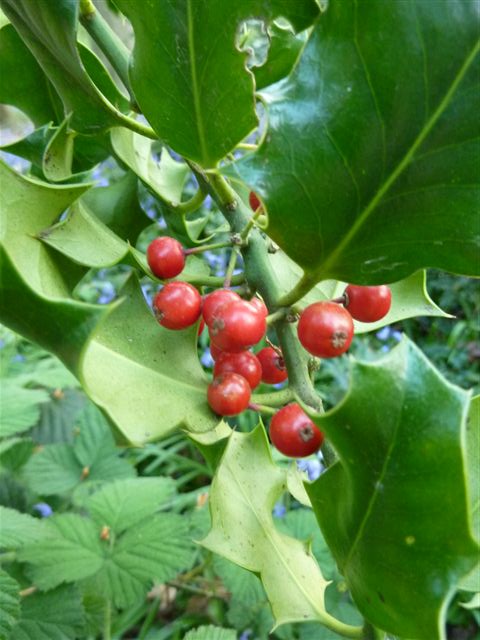
....but not before this most peculiar bit of wildlife spotting, a holly in full berry mode. Now what I want to know is why is it in berry in late April? The berries were fresh too, not dried and remnants from the winter, they looked very fresh indeed.


Just so atmospheric


On the way back home I took Julie to see the woods I'd visited on Good Friday. I'm glad we went that way as we stumbled across 3 red kites. In fact in one small area of Ramsbury, as we stood next to the car, we saw 3 the kites, 1 buzzard, 2 muntjac, a brown hare, 3 grey partridge and a magpie. Can't be bad.


And neither was the sunset...!!


Earlier on Saturday I'd popped over to Ham Hill near the Hampshire border to see if any Duke of Burgundy butterflies were about.


The reserve has changed dramatically since I last visited a few weeks ago. Partly I guess because of the hot dry weather recently but it was alive with insects. Masses upon masses of St Mark's flies, and many brimstone and orange tip butterflies. Sadly no Duke of Burgundy butterflies this visit. But a lovely Dark-bordered Bee-fly, Bombylius major, diverted my attention for a while.


This tiny linear reserve is well known for its wild flowers, with this germander speedwell Veronica chamaedrys showing well against the cow slips.


As was this newly emerging common twayblade, Listera ovata below.


...and the masses of willow down blowing in the hot breeze. Was this really only April 23rd? Felt a lot more like July up there on the chalk downland.


Finally for this posting, yesterday evening when it became cooler, Julie and I had a gentle stroll up to the village church in East Grafton. It was a super evening and lovely to be out for just half an hour as the shadows lenghtened.


Inside the church was an Easter garden made on the Saturday by the village children. I thought this was absolutely charming.


And so Easter Sunday drew a-close and we wandered back round the village green to take in the air, the many thatched cottages and then home for a well earned shandy while watching Julie's favourite film, Seabiscuit.


I know where I'll be on May 7th!!!!!


Tuesday, 16 November 2010

Day Flying Bats at Wilton Brail

Having a week off in November isn't something I'd planned but so far it is a great way to prevent the onset of those winter blues. On Sunday a friend and I headed off to the Somerset Levels in less than exciting weather but seeing 50+ Snipe at the RSPB's Greylake reserve is a sight I'll never forget.

But today I woke to deep blue skies, some mist, but a severe frost, in deepest Wiltshire. This area of Wiltshire just south of Savernake Forest is a bit of a cold spot. Leaving the house at 8am this morning to take Molly the cat to the vets, the temperature gauge on the car glowed a bracing minus 3. Cold enough for me thank you. Molly didn't look too chuffed either.

After the vets Julie and I did a few chores and a coffee in the Polly Tea rooms in Marlborough, before Julie went to work leaving me to fill in a few hours before Molly had to be collected.

So I headed off to Wilton Brail. This is a piece of open access woodland between home and Great Bedwyn. By now the sun was up and there was some heat in those rays, meaning the frost of the morning had gone, well except where the sun didn't reach.

Leaving the car by the road I walked up the track. A few birds were floating about, including a strange looking bird flitting between the tree tops in the above photograph. It's flight was odd and fluttery, like that of a bat. I got the binoculars out and lo and behold it was indeed a bat. This was about 12.30 pm and quite remarkable. I did attempt a photo but failed completely, so positive identification was problematic, but my money is on a Noctule. It is late in the season for this species to be flying, even if I ignored the fact it was flying mid day, the size, flight pattern and habitat all point that way. I just wish I'd had a better view. Exciting though.

That excitement over I continued the walk. The weather could not have been better. Clear blue skies, no wind and with a strong sun, ample photo opportunities to try and capture the light through the trees.

The view back towards Bedwyn Brail on the hill, where the plaintiff drone of a chainsaw emanated.

Photographs never do justice to an atmospheric image in real life.

Anyway I eventually reached an area where a ride had been opened up. I walked this route in September and it was dark and brooding. But today with a 10 meter ride having been opened recently the sunlight flooded in. As I walked I heard the familiar jangling call of common crossbills flying overhead, 7 in all. Not that surprising as Savernake Forest just a few miles away has a resident population. Also flying nearby calling was a raven.

I like this walk. The woods aren't too sizable but it is quite varied. The photograph below was taken with my back towards a field. A short hop and skip over that field and I'd be at the Kennet and Avon canal. A circular route therefore could be woodland, fields, canals and back through woodland. I may post this one day.

And being on the northern edge of the wood, frost remained where the sun didn't shine.

All too soon I had to retrace my steps and back to the car for a 5 minute drive home and a welcome cup of tea. Julie then returned, we picked up Molly from the vets and all is well. So as holidays go it may not be a World trip, but very relaxing and in today's glorious weather, very, very enjoyable. I'm enjoying myself.

And briefly to finish this posting a link to the latest Living World I produced, Native Hedgerows. Rob Walton was the contributor and with the presenter Lionel Kelleway provided a wonderful programme. This went out on Sunday, but was then also featured on Radio 4's Pick of the Week, which was very exciting. Well it was for me, because it was picked by a presenter as a highlight of the weeks radio.

Link to Living World Hedgerows here

Link to Sunday's Pick of the Week here (link may go soon)