A

A
Showing posts with label Wiltshire. Show all posts

Saturday, 27 June 2015

Time Gentlemen Please

I have it here;  bookended on the page between timbrology (an outdated word for stamp collecting) and timenoguy (a rope stretched from place to place in a ship).

“concept arising from change experienced and observed: a quantity measured by angle through which earth turns on its axis : a moment at which, or stretch of duration in which, things happen : season: due, appointed, usual time : hour of death or parturition…”

And it continues in that vein for two more pages. I’m talking of course about time. That theoretical concept of movement;  we look back to a time with fondness, rush to be present at a point in time, and look forward to a moment in time with excitement.

My thoughts on time gathered pace yesterday. I believe it is because of the effect Wiltshire has on me. It makes me think and feel in an altogether different way than anywhere else I know. I slow down. Time stands still somehow.

I began ruminating on the process of time after arriving at the Waggon and Horses pub in Beckhampton. This ancient public house in the Avebury hinterland, hard by Silbury Hill was, and remains so, a favourite pub of ours. And, in addition, the inspiration for the famous coaching inn scene in Charles Dickens’s ,The Posthumous Papers of the Pickwick Club (also known as The Pickwick Papers).

"Tom cast a hasty glance at the upper part of the house as he threw the reins to the hostler, and stuck the whip in the box. It was a strange old place, built of a kind of shingle, inlaid, as it were, with cross-beams, with gabled-topped windows projecting completely over the pathway, and a low door with a dark porch, and a couple of steep steps leading down into the house, instead of the modern fashion of half a dozen shallow ones leading up to it. It was a comfortable-looking place though, for there was a strong cheerful light in the bar-window, which shed a bright ray across the road, and even lighted up the hedge on the other side; and there was a red flickering light in the opposite window, one moment but faintly discernible, and the next gleaming strongly through the drawn curtains, which intimated that a rousing fire was blazing within. Marking these little evidences with the eye of an experienced traveller, Tom dismounted with as much agility as his half-frozen limbs would permit, and entered the house"

The book continues on to report groaning table of fine vitals in this comfortable coaching inn, whereupon the characters of the novel meet and exchange a bonhomie story or two before the inevitable disaster strikes.

And bonhomie it remains.

I was due to attend a Trustees meeting at the Richard Jefferies Museum near Swindon. Finding I had a couple of hours to spare, time enough to visit the Waggon and Horses for a light luncheon before the main event.
The bar was quite empty for a Friday lunchtime. A couple of middle aged men in working attire reading the papers, pint glasses in hand;  an elderly chap on a table by himself surrounded by a selection of post vitals crockery, a pair of ladies in deep conversation in the window seat, gin and tonics in hand, and a characterful dog cum engaging ragged mat called Katy who was causing consternation to her owner perched on a bar stool, by wandering about getting her lead entangled in table and chair legs.

Low beams, dark wood, old paintings of stagecoaches, wooden floors, every time I enter this favourite hostility it feels like a timeless place to rest the traveller’s bones.

“I last came here in 1947 when I was stationed at Larkhill just after the war”

I’d just sat down with my pint of Wadsworth’s bitter when the old gentleman hidden from view behind the settle announced to the two paper reading gentlemen opposite this point in time.

“It’s changed a lot since those days, yes, I last had a pint in this pub in 1947 – great days, I was stationed at RAF Larkhill, me and the boys would come down on the Garry and spend the night here, no breathalysing in those days, how we got home I’ve no idea. I’m 87 you know but I still drive. I was stationed at Larkhill you know, it’s a long long time ago, a whole lifetime ago. This place has changed so much since then”

The newsprint pair joined in this conversation and as it wheeled around I half listened, to their conversation. All of which was reminiscing of the good old days, things were never as good again, more especially from the octogenarian how much this place had changed since his last visit, a lifetime ago.

It abruptly ended when a lady arrived and remonstrated with the Larkhill wanderer;

“There you are, I’ve been sitting in the car for ages, I thought you’d gone there”

One only has to guess why the lady, presumably Mrs Larkhill was in the car, or why Mr L had not joined her there. But all was well and they left out the very same door Charles Dickens would have entered close to two centuries ago en-route to Bath, when presumably like me he observed the goings on at this ancient pub and then put pen to paper.  My guess is should Charles Dickens have returned in 1947 (unlikely considering his demise in 1870, but stick with me) he too would have struck up a conversation bemoaning how much the place had changed since his last visit.

Time has that effect on life, and on the generations, and therefore time distorts.

There is an environmental discipline which has many names, such as baseline shift,  but the term generational amnesia is one that is growing in popularity. Origins of this recent idea are vague but in 1995 a marine biologist Daniel Pauly used the term ‘shifting baselines’. This attempts to define the way in which each generation develops a set point in time (a base line if you like) when they are accustomed to the way their countryside and environment looks and feels. This for that generation is the norm from which everything else is judged, what went before was possibly better (greater biodiversity in nature terms), everything which has happened since their developmental stage shows how much the environment has degraded over time. In other words time distant clouds exact knowledge and function in history. It was different back then.

Of course it was, time moves on.

This generational amnesia also applies to life in general. We all look back with fondness to our childhood and formative adult years. Experiences were new and exciting. That first tree climbed, our first kiss, the first car, first holiday without parents. All markers in the passage of time.  Inevitability in one’s lifetime.

I feel blessed myself that memories of my early years remain razor sharp, it’s only what I did this week that fails in my 51 year old brain.

The scent of wet grass, the bubbling sound the river coquet made over riverbed pebbles, my parents endless house parties, playing with friends in a disused market garden, my father in his art studio seeming always covered in glitter, mother always in the garden or talking to people as I wished to keep walking, glorious pre-school breakfasts on the beach, endless summer days and day trips in the car to the Lake District, Yorkshire or Scotland. Pleasurable events and should I suffer from generational amnesia then this was the norm. Life was always picnics, sunshine and happiness.

It wasn’t of course.  I remember the dull drudgery of November Sundays where boredom literally clawed at my soul. I can still remember one such afternoon, dark, cold and miserable and in the distance an ice cream van’s optimistic jingle attempted to lure people into the grey forbidding streets of the Colliery Village a few miles away (where we from our village never dared to go).  Village life as an only child could be excruciatingly tedious.  Mastering the ability to ride a bicycle alleviated some of this as I could travel far and wide, well at least as far as the coast 3 miles away to have an ice cream. 


Ninety six thousand one hundred miles and one tenth it read. A six digit confirmation of this rusting decayed artefact as it travelled through time.

Having arrived at the Museum I was eager to see the changes and I have to say astonishing improvements in the last 6 months. The Jefferies Museum in 2015 is definitely not one that has stood still recently; it has changed quite a bit, time has not stood still here. Dr Mike Pringle the Museum Curator and Hilda the Education Officer have worked tirelessly to rescue this fading gem, and as volunteers for little financial reward.

One of these changes is the arrival of a miniature railway to the back of the Museum. Swindon Borough Council is building this at their Coate Water Country Park, the boundary of which abuts the Museum grounds.  Negotiations are now complete and a station, or more correctly a halt, will be created at the Museum, allowing visitors to arrive by train. Something Mike is sure Richard Jefferies himself would have approved of.  The Museum is actually the farmhouse where he was born and where his formative years were spent. These formative years rooted Jefferies in a love of the pastoral countryside around this part of Wiltshire, something he wrote fondly of as an adult having moved away for work and living near London.

What marks Jefferies out from many countryside writers is that he did not dwell on the past as if in a golden hued aspic, he embraced change and lived very much in the time, that time being the expansion of Victorian engineering, quest for knowledge and societal development. He looked forward too, to a time he would never see, in such works as his 1885 novel After London an early example of "post-apocalyptic fiction": following an unspecified catastrophe, England is depopulated and the land reverts to nature. What few survivors remain, return to a quasi-medieval way of life. Many now say this is the time this may happen as we degrade the environment beyond its ability to recover.


Likewise the rusting speedometer I discovered in the Museum grounds had befallen an unspecified catastrophe and was slowly reverting to nature. It had been unearthed as part of the general clearing of the Museum area which over decades has become a dumping ground for all manner of detritus. And there it lay having travelled, within a vehicle of course, for 96100.1 miles.

I have absolutely no idea what car or vehicle this came from, this however is part of the history of time I love. Rusting and decayed, no longer able to work, yet this can inform us of so much of the passage of time, should we let our imagination run wild.

In a time not too distant past, a brand new vehicle would have rolled out of a garage showroom. Mileage 00001. The new owner excited at his or her gleaming purchase, maybe children excitedly in the back seats looking around in wonder at the shiny new seats and bright metalwork.  The adventure begins.

As in life, there would have been a honeymoon period. Everything was new and exciting, it all worked beautifully, it went on holiday, to picnics, to the workplace. As this mileometer travelled over hill or dale, what did it see I wonder? Gazed at continuously by its owner, a relationship and bond would have developed. It would have informed of the passage of time, 500 miles, 1000 miles, endlessly it’s numbers crept up as time after time it served the owner well.  I love this car.

Yet time took its toll. Eventually irritating hiccups developed into annoying breakdowns and in time the milometer became unloved, a reminder that age was increasingly making this vehicle unreliable.  At 96000 miles this car was a wreck, hiccup, was that the last breath, destined to become nothing but scrap. Its gleaming hedonistic days of 00001miles but a distant memory, a new generation of faster, more powerful vehicles now criss-crossed the roads.  I’d love one of these new cars, this pile of rust is not worth keeping any more.

Outdated and unloved at 96099 miles it still ran, but only just.  Barely connect to an engine and body it like a dying swan performed its last mile, the engine revs dropped, the wheels stopped moving and with a final click of the ignition key it stopped. Time had caught up with it and with the engine cooling silenced forever. It was a good innings 96100.1 miles.

The world never stands still.  Had the vehicle this belonged to survived battered but intact maybe in an old barn, a new generation would have discovered it and now it would be a much loved object again. Restored as a classic car, it would be paraded and feted with maybe children excitedly looking around in the back in wonderment at how something ‘so old’ could have such shiny and bright metalwork.

“Dad this is a lovely old car, can we have a car like this?”

“Not today son – but I remember my grandfather having one – ahh happy days going on summer picnics in the back, they just don’t make cars like they used to in the old days son, these were proper cars,  had such characters, wonderful memories, I wish he’d kept his, would be worth a fortune now”

Tempest fugit forgets the oil leaks and dodgy breaks, handling of an ocean liner, thin tyres with no grip, headlamps with the candlepower of a firefly, wipers that never worked, no heaters, picnics in rain soaked cars, or the 0-60 speed of 2 hours!

You see, time changes everything quite a bit, for every generation.

Now where did I put my watch…

Wednesday, 24 June 2015

June and the Midsummer Solstice

For many the summer solstice is seen as a time to celebrate the arrival of the longest day.


Certainly as I arrived at Avebury Stone Circle in Wiltshire on the evening of June the 20th, I realised a lot of people wanted to celebrate the setting of the midsummer sun. Planning is everything and on that warm June evening, my planning had been what many would describe as, deplorable. After a dummy run for anywhere to park up and walk back to the stones, followed by another vain return route attempt to circumnavigate every blocked parking space or route we would normally use to visit Avebury, all attempts to celebrate with the thousands of people there were abandoned, we headed for the Pewsey Downs.

This was going to be a busy weekend and so it proved. Having woken in Somerset, we had a full morning planned to clip six, yes 6 box parterre of a client of Julie’s. In Wiltshire.

And not just a part of Wiltshire say near to Bath, but a part of Wiltshire less than a gnats crotchet from the Berkshire border; turn right before Hungerford, shimmy back and we’d be there. In fact very close to where Julie lived until a year ago.

Duly arriving at 10.30 am we set to. Shears flashing like egg whisks across the Buxus hedging we toiled for a goodly while. I found myself facing the man’s hedge, sizeable mushrooms of greenery and a hedge around a small patio, the steps to which were flanked with yew – also to be trimmed into submission. Julie meanwhile remained at the front shaping the 12 inch high parterre box hedging containing a cornucopia of mauves and pale pastel plants, literally dripping with buzzywussies.


Noises off alerted me to the grounds man who seeing me (for the first time) struggling with my shears suggested I use the strimmer. I’ll go and fetch it, returning in a few minutes later with a leviathan 24 inch petrol hedge trimmer. Man’s tools for man’s work I thought.

 
Man's tools for man's work!

After an hour wielding that beast over all of the garden, I felt more mouse than man. It did a splendid job but boy they are heavy – and noisy. Common sense, something I’m not entirely sure I have, would have suggested ear defenders and maybe a shoulder harness. But no, this man from the north strode on manfully sweating buckets, smoke billowing from the exhaust, all the while adding to Wiltshire composting mountain without a care in the world.

Julie has earlier booked us to have lunch with friends of hers at 2pm. These lovely people were once gardening clients, but now she is considered their 5th daughter as they looked after her when Julie was going through a rough patch a few years ago. This meant that at 1.30pm a portly gentleman could be seen stripping, less Poldark, more needing the dark to remove a box flagellated shirt for his pristine luncheon attire.

Crayfish salad pushed across the larynx it was time for a nap, and just 4pm. Overnight accommodation was at friends of Julie's who own an equestrian business with a B&B room. It seems odd staying just a mile from where Julie used to live, but it is lovely there. And now is a base to pootle about back in Wiltshire. A nap was had prostrate on the lawn listening to swallows and martins swooshing by.

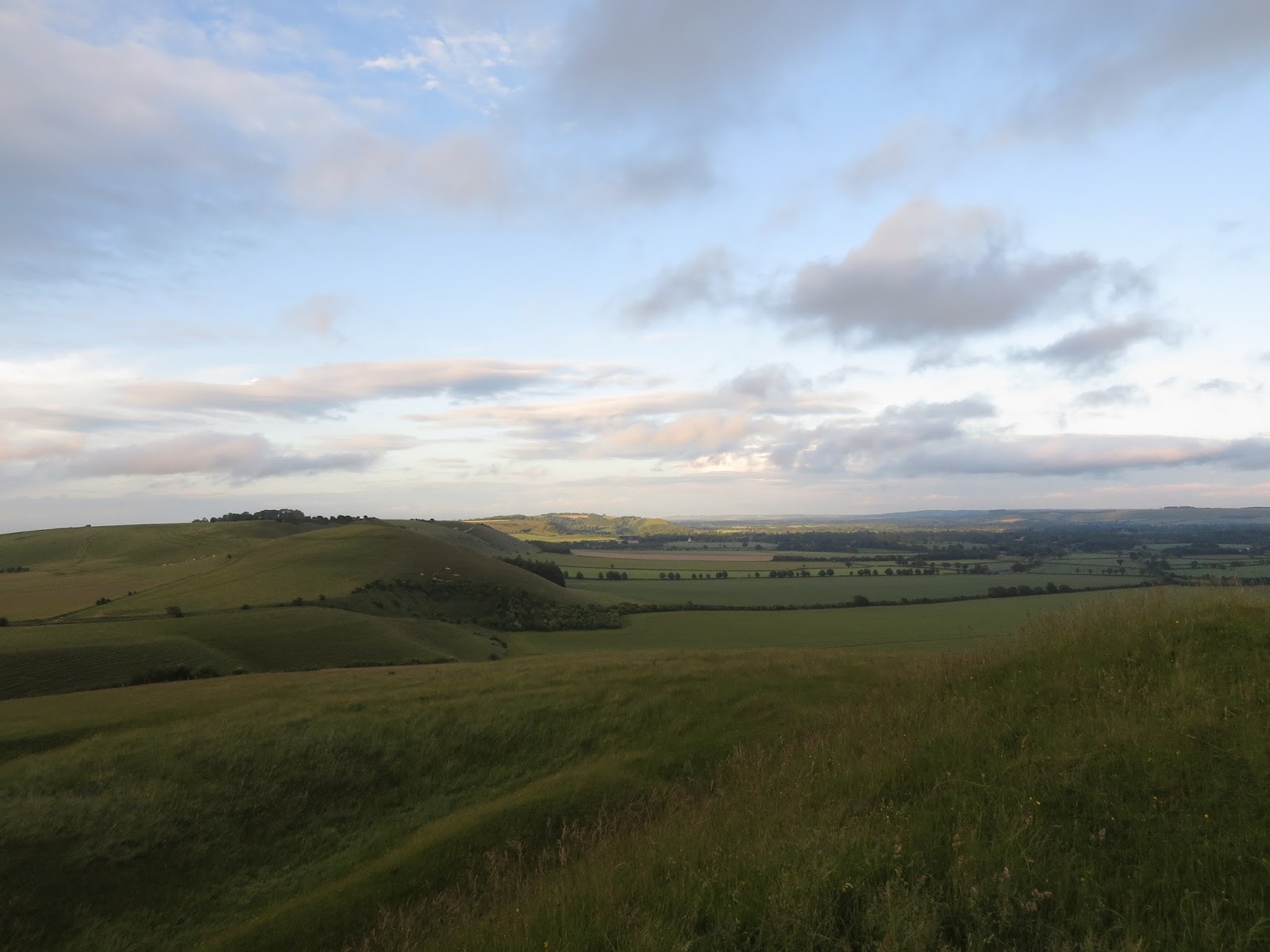
Which brought me to being up on the Pewsey Downs to celebrate the Solstice. It is lovely up there. We walked up to Adams Grave Long Barrow, a steeply enjoyable climb to 262 m above level sea. And what a view, back down the vale of Pewsey and along the chalk ridge towards the Giants Grave above the hamlet of Oare to the east.

 
Knapp Hill from walk up to Adams Grave


Knapp Hill and the Vale of Pewsey

The wind was howling up here, with low clouds scudding across the sun and sky. Dramatic, brooding and just what we needed for the Solstice. A handful of people and being at one with nature. We were surrounded by skylark, some just singing while perched onto the grass, due to the wind. The wind up there dominated our time watching the sun set. I asked Julie to cup her hands round her ears and listen to the wind pulsating across the tall grass producing a sound like a rapier being flashed through the air. Slash, slash slash silence, slash, silence, whoosh, slash... It's a sound that will stay with me for a long time, man and the elements in an audible harmony.

 
Remembering the rapier grasses

 
View from Adam's Grave


Giant's Grave hill bathed in the last of the sunlight

All too soon we retraced our steps back down the hill, past the skylarks still singing and at the car park watched a mêlée of young bullocks being very frisky in the field. Perfect.

 
As the sun sets over the Pewsey Vale

Sunday; after waking at 4.20am to see the sun rise over the farm (and take a wobbly record shot to boot), we mosied back along the M4 to meet up with friends in Thornbury near Bristol. Another super luncheon was partaken of followed by a walk along the 'small' Avon river near Tortworth. I had been duped into visiting Tortworth with the promise of a strawberry cream tea. Plus our original plan was to haul ourselves up May Hill, an activity curtailed by one of the party injuring a foot the week before. 

Nonetheless, what I enjoyed was a lovely walk along a river, including a minor detour to visit the 800+ year old Tortworth chestnut, before for a few moments just being able to sit by the river and watch the world go by, marvel at the sunlight on the water, listen to the breeze through the trees, lose myself in the day and the year very slowly moving, taking hours to complete minutes, much like it used to do as a began exploring the natural world as a child, when a whole day seemed a lifetime in length.


A juvenile dipper piping up the river ended that weekend wonderfully, that and sitting watching a Vulcan bomber fly by almost to the minute of the Solstice at 5.30pm. These long June days are so special, we must embrace every moment we have to enjoy them, for soon the days will shorten, mists and mellow fruitfulness are knocking at the door. The Wheel of the Year that is so important to me.

Thursday, 6 November 2014

November 5th 2014 - Jefferies' Mulberry Tree


The writer, commentator and inspirational thinker Richard Jefferies is a bedrock for anyone who is attuned to 'Spirit of Place' nature writing and environmentalism. So it was that yesterday as a Trustee of the recently formed Richard Jefferies Museum Trust, I attended a Sustainability Self-Assessment Framework meeting. Distilling down the jargon, this process allowed the Trustees and Management team to realistically assess where the Museum has come in the first 12 months of its phoenix like rebirth, assess our structure and process thus allowing a recognised and agreed benchmark to work towards in the future.


Expertly chaired by Liz (a Museums Development Officer for the South West Museums Sustainability Programme) this was the second meeting and as a Trustee I found this thoroughly insightful and stimulating. It is hard to think that only a couple of years ago the Museum was threatened with closure, the property would likely have been sold off and that would have been the end of road for Jefferies' birthplace. Two days of discussion really has put down the seeds of sustainable development which following peer to peer review can provide a solid foundation as the Museum moves forward.

I'd taken 2 days annual leave to attend this meeting and although we pushed ourselves hard, we allowed ourselves half an hour for lunch. As the Museum is currently closed for the winter, I wandered into the garden and sat by The Mulberry Tree, now shedding its leaves rapidly as the November chill gathers around its fissured trunk.


This is not just any mulberry tree, but a mulberry tree thought to be close to 180 years old and planted by Richard Jefferies father, James Luckett Jefferies. James inherited the 40 acre farm in 1825 and my imagination as I sat there wandered through the thought that maybe the tree could have been planted as a 10th anniversary of their time here; possibly a celebration to a successful few years as farmers. But that is pure speculation on my part. What is known is that by the time Richard Jefferies himself was a child, the tree would have been around 20 to 30 years old and presumably bearing fruit, something it still does today.


I sat quietly having lunch, watching the odd leaf listlessly fall onto the lawn as only leaves can do in November. It then struck me that although I am seeing a part of the landscape Jefferies himself saw and intimately knew, in reality I am not seeing what he saw, but a relic of that image. Jefferies the child would have seen a young tree, full of vigour, life, energy maturing slowly as he too matured as a young man forming and gathering his ideas on nature and the countryside. Today I looked upon Jefferies’ tree, its remaining heart shaped leaves citrus shimmering in a weak November sun, but it is a tree in its more mature phase. It is beautiful yes, but battered and bruised by its endurance over a long life. Yet for me it provides a direct link to that ‘Spirit of Place’ Jefferies' writing encapsulates.

Mulberry trees are prone to fall over or lose limbs as they grow to maturity. And Jefferies’ mulberry is no exception. In the morning of September 23rd 2007, gales blew across Central England and the tree split in two, losing a main branch. Whilst sad aesthetically, this is natural in many species of tree as they mature and will not affect their lifespan. Indeed mulberry trees often fall over onto the ground and sucker. That fallen branch lying across the lawn in 2007, had it not been cleared away but left in situ, would undoubtedly have suckered from where it touched the earth, thereby rejuvenating and strengthening its presence by 'walking' youthful like across a garden landscape. Many trees do this, the common lime especially.

What is known is that Jefferies regularly sat under this tree during his time here, and unusually (as he was not known to be a prolific poet) composed a poem entitled The Tree Of Life, which when it was published on November 8th 1890 (three years after his death) went under the title of The Mulberry Tree.


Image courtesy of Rebecca Welshman - @Jefferiesauthor
I gazed upon the tree before me, like Jefferies undoubtedly did, lost in thought that like Jefferies writing, like the concept of Spirit of Place, through time, as the years go by, ghosts of those who trod lightly echo within the imagination. Their presence seeps into our very body and soul to create a moment, a moment that in the blink of an eye, is gone. Rising, I trod lightly myself around the tree gathering leaves for no other reason than it felt the right thing to do, to gather a part of Jefferies' to take away with me and to gaze upon over time. As I write, I have those leaves beside me; a physical reminder of a moment in thought.
THE MULBERRY TREE

Oh, mulberry tree, oh mulberry tree
Dear are thy spreading boughs to me.
Beneath their cool and friendly shade
My earliest childhood laughed and played.
Or, lips all stained with rich red fruit
Slept in the long grass at thy root.

Oh mulberry tree, oh mulberry tree !
The yellow moonlight shone on thee.
A few low words - a gentle sigh,
A tear within the upturned eye.
“I love—my fate to thee resign"—
A nameless thrill, and she was mine.

The mid-day sun in splendour blazed,
And all who stood around me praised.
The deed was done, the fame went round,
My brows with laurel leaves were crowned
My first—my proudest victory
Beneath thy boughs, oh mulberry tree.

The tears of Heaven were falling fast,
Mourning the memory of the past.
I knelt beneath the broken limb
In rain and night, and wept for him.
I saw the tomb - the planks laid there,
To slide the coffin to its lair,
"Ashes to ashes", this the end,
My first, my last - my only friend!

The morning stars grew pale and few,
In chilly draughts the east wind blew,
Lifting the black and frost-strewn leaves
In rustling eddies to the eaves.
Deceived no more with life's vain lies,
And all things equal in mine eyes,
I wait still near the mulberry tree
The dawning of eternity.


Whoe'er shall pluck the mulberry tree,
Bitter and sweet its fruit shall be;
Such - joy and misery still at strife -
The berries of the Tree of Life

Sunday, 20 November 2011

Birdwatching across 2 weekends

I'm enjoying this. Having slightly, and I emphasise slightly, less on at work at the moment I have time now to go out watching wildlife, though I have to confess to having planned to post last Saturday's birdwatching all week, but completely failed to do so. But better late than never I suppose.


So two brief postings. First an afternoon spent last Saturday walking from East Grafton up onto Wexcombe Down in Wiltshire and back again. The glory of Julie's house being in the middle of nowhere is that the car isn't needed to head off into unspoilt countryside. This part of the Wiltshire / Hampshire / West Berkshire border lands is unspoilt and pretty much unknown, certainly in birding terms very few people venture here, so it is like having my own back garden. So after a lovely relaxing lunch at the Cross Keys in Great Bedwyn, Julie settled down to watch the racing at Cheltenham and I headed off into the hills. Don't get too excited by the photos to follow, you'll see what I mean soon.


First encounter was an obliging pale buzzard on a fence post (honestly there is one there, in the middle)


And the fields around here are covered in mushrooms this year, I think that's because they've been spreading mushroom compost recently.


This is a shooting area so always lots of pheasants and partridge


As well as brown hare.... okay the photos are getting silly, so I've added arrows to them to help spot what I'd seen. This was actually about a quarter of a mile away.


And as everyone knows this November is mild, so here's two hovers on an umbellifer, not sure of the species of hovers.


And this is how far I'd walked up onto the Downs, arrow denotes the hamlet of East Grafton.


But by the time I'd returned I'd seen;


Blue tit 10+, Red kite 1, Buzzard 3, Pheasant numerous, Linnet 20+, Raven 1 + 2 (1 heard), Wood pigeon 100+, Blackbird 6, Red Legged Partridge 3, brown hare 2, Chaffinch 200+, Wren 1, Great Tit 2, Fieldfare 150+ more flying in as dusk gathered, long tailed tit 5+, Skylark 20+, Carrion Crow 20+, Robin 1, Kestrel 1, Greenfinch 1, Golden plover 35-40 overhead, Jay 1 and finally 2 Greater Black Backed Gull overhead which is very unusual for this area.


So all in all a very good 2 hours on the chalk downs. Mind you when I got home, Molly wasn't impressed with the brown hare, she'd seen one anyway (one of my wire sculptures in case you are wondering).


Let us now cast ourselves forward 8 days. It is Sunday November 20th. Still mild and at 8am I found myself at RSPB Greylake in the misty gloom. Julie has put herself forward to be a BTO Wetland Birds Surveyor and was meeting a more experienced surveyor to get herself familiar with what to do. I was going along for the ride (well actually as we had to leave the house at 7am, I was chauffeur and breakfast maker, Julie is not by any means a morning person). So the two of them went off and I, with 3 hours to spare, pootled off on my own to see what was happening.


I've been coming to Greylake ever since it was bought by the RSPB and it's good to see it develop. This is the first time I've been around some of the new walks around the back of the reed beds, which was a good place to put up snipe.


I then ventured into the hide and joined 2 other chaps, who were amused by the strange fauna in the restricted area of the reserve, namely Julie (on right) and her BTO mentor. It was good they were wandering about the restricted area, as they put up a lot of waders for us to see. You can't beat a nice bit of disturbance to get a good birdcount.


But we were soon distracted by another exciting view, a great white egret emerged as if by magic right in front of the hide. No need for arrows with this photo or the one below.


But I definitely need 2 arrows for this next photo taken hand held through my scope... I know, I know, you are astonished at the technical accomplishment. Oh and incase you're wondering, it is 2 peregrines in a dead tree half a mile away. Maybe enlarge the photo for, just for fun and a better look.


And now you know, the enlarged view is just as bad! I But at least these shovler are recognisable.


Bad though these photos are the tally was good, and so as in all good competitions, in ascending order......


.... willow tit 1, great white egret 1, pied wagtail, 1, grey heron 1, male kestrel 1, sub adult male sparrowhawk 1, buzzard 1, cormorant 2, little egret 2, wren, 2, cetti's warbler 2, water rail 2, snipe 3, linnet 3, peregrine 3, chaffinch 10+, shovler 10+, mute swan 15+, golden plover 19 flying over (apparently there were about 500 in the restricted areas), carrion crow 20+, starling 50+, mallard 50+, wigeon and teal combined 1500 +, lapwing flying overhead 2000+


That last lapwing flock was astonishing. I'd seen drifting flocks of 20, 30 but we were back at the car and about to leave when this huge flock circled overhead. Despite the great white egret being scarce, I still love to see so many lapwings.


Ohh yes by the way sorry about not being able to leave comments, I keep being logged out when I post, think its because I'm on Explorer 9 or something, if anyone has any suggestions how to rectify this, let me know (and the blog formatting is double spacing too and doesn't seem to want to change)

Sunday, 14 August 2011

And the harvest comes in

This afternoon Julie and I went for a walk around the lanes and fields of her village. A glorious afternoon walk of about 5 miles made all the better for being adjacent to a field as the combines came in. I love watching combines, takes me back 30 years to when I used to work in the fields at this time, both as a schoolboy and later as an agricultural journeyman.


Wilton Windmill from East Grafton

I didn't have my camera with me but the following images were taken on my Blackberry. I'd never used the black and white or sepia settings before, not bad for a mobile phone. Shame I hadn't my camera though as these would have made super subjects for black and white images.


Up the hill they go


Disgorging their work ready for the mill


Apart from the fact these are modern combines, black and white works for farming shots I feel, makes them seem timeless.


The same in sepia


And 2 colour ones, just for the record.

Wish I could drive one of these, looks like fun.......!!

Monday, 25 April 2011

2 Easter bluebell woods and a walk to the church

What a fabulous Easter weekend. I only had Saturday and Sunday off as the wheels of industry continue to turn in the working world I inhabit. But two days is more than long enough to demolish an Easter egg or two.


Time allowed over the weekend, apart from eating Easter eggs, gardening and sleeping, to visit 2 bluebell woods in Wiltshire. The first was a private woodland I actually stumbled across near Ramsbury in the East of the county on Good Friday. Driving along a single track road, I literally stopped in my tracks as a flash of blue emanated from the trees. It is so much more thrilling to find something unexpected as I drove around the lanes.


This woodland was a mix of coppiced hazel, ash and other native species and riddled with badger setts so I will not give the exact location away. The woods themselves were about 2 miles long but only a few hundred meters wide as they skirted the ridge of the hill. Just stunning seeing the bluebells in the evening sunshine.


Then on Saturday evening Julie and I went to West Woods just outside Marlborough. Actually we had a little bit of a drive out as it had been such a hot afternoon, pootling about the glorious Wiltshire countryside in the cooler evening was a treat. Given I had seen the wonderful bluebell wood above the day before, I had mixed feelings when Julie suggested we go to West Woods as I'm often disappointed going to well known wildlife spots, in my experience they never quite live up to expectations.


On Saturday evening I was proved absolutely wrong with that thought. These beech woods not 4 miles from Marlborough has a dozen or more cars parked in the carpark. I thought, humm, there'll be a few bluebells and an awful lot people. But no, so vast were the woods that even though there were a lot of people there, it felt like we were alone.


And they were stunning. I've visited a lot of bluebell woods over my time but I have to say this is by far the best one I have visited in 30 years of wildlife watching. It was hard to know what to photograph, where or how, given that there was just a sea of blue, as all the bluebells were in perfect condition all at the same time.


One nice find by Julie was this dor beetle geotrupes stercorarius scuttling along the path. These are fun little beetles who do good work hovering up all that manure left by other animals. I never used to be interested in insect or creepy crawlies until recent years and now the more I found out about their fascinating life cycles and adaptions to their environment, the more I'm fascinated by them. Just wish I knew more about them.


So lets head back into the sunlit West Woods, one more time....


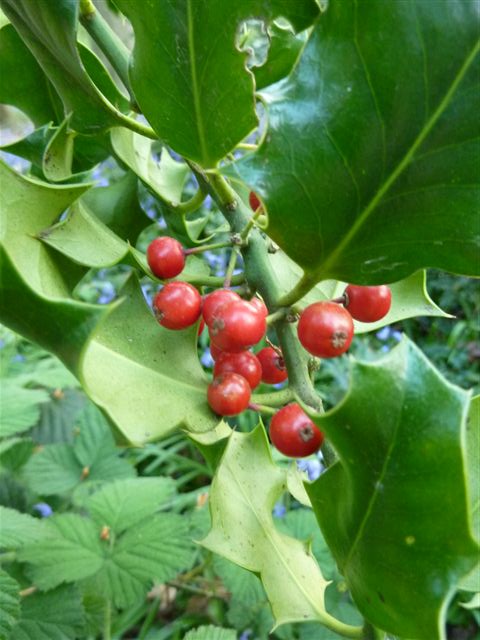
....but not before this most peculiar bit of wildlife spotting, a holly in full berry mode. Now what I want to know is why is it in berry in late April? The berries were fresh too, not dried and remnants from the winter, they looked very fresh indeed.


Just so atmospheric


On the way back home I took Julie to see the woods I'd visited on Good Friday. I'm glad we went that way as we stumbled across 3 red kites. In fact in one small area of Ramsbury, as we stood next to the car, we saw 3 the kites, 1 buzzard, 2 muntjac, a brown hare, 3 grey partridge and a magpie. Can't be bad.


And neither was the sunset...!!


Earlier on Saturday I'd popped over to Ham Hill near the Hampshire border to see if any Duke of Burgundy butterflies were about.


The reserve has changed dramatically since I last visited a few weeks ago. Partly I guess because of the hot dry weather recently but it was alive with insects. Masses upon masses of St Mark's flies, and many brimstone and orange tip butterflies. Sadly no Duke of Burgundy butterflies this visit. But a lovely Dark-bordered Bee-fly, Bombylius major, diverted my attention for a while.


This tiny linear reserve is well known for its wild flowers, with this germander speedwell Veronica chamaedrys showing well against the cow slips.


As was this newly emerging common twayblade, Listera ovata below.


...and the masses of willow down blowing in the hot breeze. Was this really only April 23rd? Felt a lot more like July up there on the chalk downland.


Finally for this posting, yesterday evening when it became cooler, Julie and I had a gentle stroll up to the village church in East Grafton. It was a super evening and lovely to be out for just half an hour as the shadows lenghtened.


Inside the church was an Easter garden made on the Saturday by the village children. I thought this was absolutely charming.


And so Easter Sunday drew a-close and we wandered back round the village green to take in the air, the many thatched cottages and then home for a well earned shandy while watching Julie's favourite film, Seabiscuit.


I know where I'll be on May 7th!!!!!