A

A
Showing posts with label birds. Show all posts

Saturday, 27 January 2024

Spring is not quite here, close though...

 There is always a sense of great excitement in me at this time of the year. I'm like a child sometimes. Yes it is still winter, yet spring is very much beating it's own emergent path towards winters closing door. After weeks of rain followed by a lovely but very cold spell, today felt almost no coat weather. I said almost.


I was on the Avalon Marshes area of the Somerset Levels, Shapwick Heath to be precise. I've not been here for months, and today Mrs Wessex_Reiver and I had not started out in the morning to come here. It just happened by chance, and as that chance would have it I didn't' have any binoculars with me. More on that later.

Following an errand in Weston super Mare we decided on the spur of the moment to visit Shapwick. After the obligatory drink and snack at the Hub, it was simply lovely having a walk along the central path, the former route of the railway line which once carried peat dug hereabouts to the rest of the country. A bit of fresh air and some gentle exercise. There were some visitors about but for once it was fairly quiet. Not having my binoculars with me meant I had to use my other sense, hearing. First up a few fieldfare were raucously chak-kak-ak-ing in a nearby shrubbery, silhouetted against the sky but unmistakable with that call. As I listened a song thrush beyond gently repeated its phrasing adding a songster's lead vocal to the fieldfare's rhythm. A nice start.


Other sounds emanated as we walked along. The ubiquitous mallard quacked away, or at least the females did, a flotilla of Canada goose honked as they flew over. Great tit called, not the classic teacher call, but the two note contact call, repeated before falling silent. Not everything made a sound, over the reeds at some distance a male marsh harrier quartered silently, its blue-grey wings flashing its presence to a number of duck species who rapidly rose and fled as it arrived. A great white egret stood silently at the edge of a pool. I find this amazing as it is now almost impossible to visit the Somerset Levels without seeing at least one great white egret or a marsh harrier within a few minutes. In truth on the walk back an hour later, three marsh harriers were together in one eye line. Having no plan for the day, my destination was Mere hide, simply because after 30 minutes walking I needed a sit down. I said goodbye to Mrs Wessex_Reiver who went for a longer walk. Crossing a bridge, the approach to this hide is through a small wet woodland, from which two jays erupted with their harsh call and flew over my head. I do love jays. In many ways the expectation of wildlife watching can overshadow the reality, and today Mere hide lived up to its reputation, for me at least, for having absolutely nothing to see, well not upon first entering it.


I was lucky as a family and then a couple were exiting the hide as I arrived, presumably they'd seen me coming. I always do this, but on arriving at the door of a hide I open it very slowly, gingerly even, as if a demonised phantom was within waiting to scare me. I love hides, they have a unique atmosphere but they are mysterious. One never knows who, or what will be found when the door is opened. Fling open that door with a loud crash followed by a 'Hello I'm Here' boomed out in a thundering voice and the volley of  'SHH, SHH, SHH's' from camouflaged middle aged men will return to you like machine gun fire, at which point you are trapped. Which leaves a dilemma, do you find a seat and carry on as if no one has noticed your entrance, or turnaround and exit the hide quickly. 

The one aspect of hides I find quite bothersome is when I'm seated quietly in there and someone comes barging in and immediately asks "anything worth seeing?". My immediate thought is to suggest some rare vagrant in a nearby tree and then enjoy the chaos as the they unpack all their gear in readiness to take that award winning photograph of the greater striped zebra-sparrow. It happened today, a couple who were visiting the Levels for the very first time, before they'd even come through the door said, "anything interesting". I wish I'd said I was from the north and not being able to afford binoculars I was counting the number of reed stems which I found helped my mental problems while I am on day release. I didn't, just mumbled something about it being quiet, and actually they were a charming couple (complete with campervan from Exeter). But why don't people just come in and sit quietly and look out the hide windows for themselves. Tribal acceptance I suppose. Sometimes visiting a hide is hilarious.

I once entered a hide on the Catcott complex nearby. With me was my friend Rob, we were on a between Christmas and New Year escape the indoors day and had walked here from Shapwick hoping for a quiet few moments scanning the wetlands. Not to be, as I opened the door we were greeted with a sea of late middle aged ladies surrounding a bemused gentleman in a fedora hat. "Come in, come in, there's not much room, but you can sit on our knees though" one lady said with a giggle, with another adding "we don't bite.....much". My friend and I found a space no larger than a postage stamp and squeezed in between our new friends, who I'm sure reduced the space as we settled. "Would you like a wine gum" one said. We took up the wine gum offer, fearing refusal may find us kidnapped and turned into domestic slaves, never to be seen again outside. We needn't have worried as in the end we had a riotous time. It turned out they were a ladies nature and birdwatching group from somewhere near London on a girls mid-winter weekend in Somerset complete with binoculars. Once they found out we knew what some of the birds were, the questions came thick and fast. "what's that duck there?" "Is that a pigeon?". The fedora hat wearer feeling somewhat miffed and ostracised I suspect said loudly "Ladies there's a garganey over there...". Given this was mid winter Rob and I sprang into action, "really? where?"... "there" fedora said pointing to a gadwall. We didn't say anything to avoid a possible lynching and death by wine gum, but ever since then Rob and I have called gadwalls, GargGadanywalls. 

Today however as I peered around the hide door the building was empty, save for the new logbook. Hide logbooks are another fabulous item of birdwatching culture. If well used, they invariably contain within their pages at least one, if not all of the following; 

a) a three page seriously compiled list of all birds seen, including taxonomic grouping, recorded during a three hour visit, signed and dated by someone called Kevin, self proclaimed ornithologist and RSPB love-child
b) a note in capitals that someone has pinched the pen - AGAIN, with the writer having to resort to his or her own pen to write this complaint
b) the word DUCK, TIGER or COW written in three inch letters, often in green ink, often with a drawing of something which may resemble the said animal, but the jury is out
c) or some lovelorn teenagers, outpouring of passion complete with words of Anglo Saxon origin relating to hoped for recreational activities later that evening

I love logbooks, though sadly this one was reasonably new, and sensible, with just a few species listed as having been seen today. Sadly no cows or teenage lust. I settled down then to gaze across the reedbeds and listen.


To my amazement I could hear many invisible species, and without the aid of my binoculars saw a number too. A couple of marsh harriers were simple, a cormorant too. In the distance some ducks alighted, by their size and flight teal were among them, and wigeon confirmed by their whistling calls once they'd resettled. Then as I sat I heard the unmistakable drumming of a great spotted woodpecker, that's a first this year. Then the squeal of a water rail. Not having binoculars was sharpening my hearing, a coot called somewhere, to my right a wren's song erupted, more quack quack from a passing flock of mallard. 

It was while listening that I noticed movement at the bottom of the reed in front of the hide. Two birds, one following the other skulking at the base of the reeds but in the open. Brownish grey nondescript plumage, pale grey underneath and looking quite 'warblery' if that's a word. I couldn't be 100% sure but immediately I thought Cetti's warbler - I've not seen one for years, although I have heard them many many times, they're fiendishly difficult to see. Quickly checking the ID via my phone somewhat confirmed my suspicions, but by the time I'd looked this up, the birds had disappeared back into the reedbed and as they never called absolute confirmation remains sadly elusive. I'll mark this as probable, possible, well I think maybe so. 

The remainder of the listening and watching took place to the right hand side of the hide within some wet woodland. Blackbird, blue and great tit, wren again, a chaffinch 'pinking' away somewhere and flitting along delicate branches high in the trees what I'm assuming were chiffchaffs, if only I had my binoculars to see these a little closer. A grey squirrel wafted about on the ground and a moorhen messed about in a water filled ditch which was nice to see, a much overlooked bird. 

Not too many species, but sitting there quietly watching and listening was a real joy. The sound of the breeze through the reeds was especially evocative.  


Retracing my steps the only additions were a long tailed tit, a male stonechat, a few starling, rook and carrion crow, a grey heron and somewhere over in the far distance a bittern was clearing its throat and ushered out two half hearted 'ho_oo_ops'. I've often heard them boom here at the end of January but it is in February that they'll really begin, when if you visit the Levels they are everywhere to be heard, a real success story.

So spring has not quite arrived, but all the signs are gathering, not least this thrown-out-of-the-nest starling egg I spied on my neighbour's path when I got home. Not long now.

Wednesday, 1 February 2023

Simple Pleasures From The Office Window

February is here at last, I can feel the days relaxing, just a little, as the sun gains strength and lengthens the daylength.  Like many people I'm trapped in front of a computer most days, however since the Covid pandemic I've been able to work at home for three days a week. Three days which usher in the most simple of pleasures, watching garden birds from the office window.


This male great tit [Parus major] is in fabulous breeding form. His colours really pop in the dull beige-ness of a late winters day, especially the wing coverts which now are an almost lime green against a slate grey. In the garden I only ever see a single pair of great tit, therefore I can assume these are a resident pair. Although our own cat Gingernut has absolutely no interest in birds, we have neighbourhood cats marauding with intent within the garden. This means most of my feeders are high in shrubs outside the garden wall to keep preying moggies well away. Similarly I don't have a nest box which would invite trouble, but neighbours do. Hopefully then come the late spring there will be a few juvenile great tit coming to the garden, as I love watching them quiver on the wall waiting to be fed. 


My office is located in what can be comically be called the third bedroom. You'd have to be very thin to use this as a bedroom. As an office however it is perfect, book shelves, my desk and what I ostensibly call my reading chair, a much loved Cintique arm chair that the cat sleeps on when not being used as a storage facility. However from the desk where I'm writing this I have a view out over the countryside or look down to the feeders, from where all these photographs were taken. Adhering to strict health and safety guidelines while working on a laptop my regular long distance views are mandatory to save my eyesight, though to be honest there are maybe more views than close work script writing on some days.


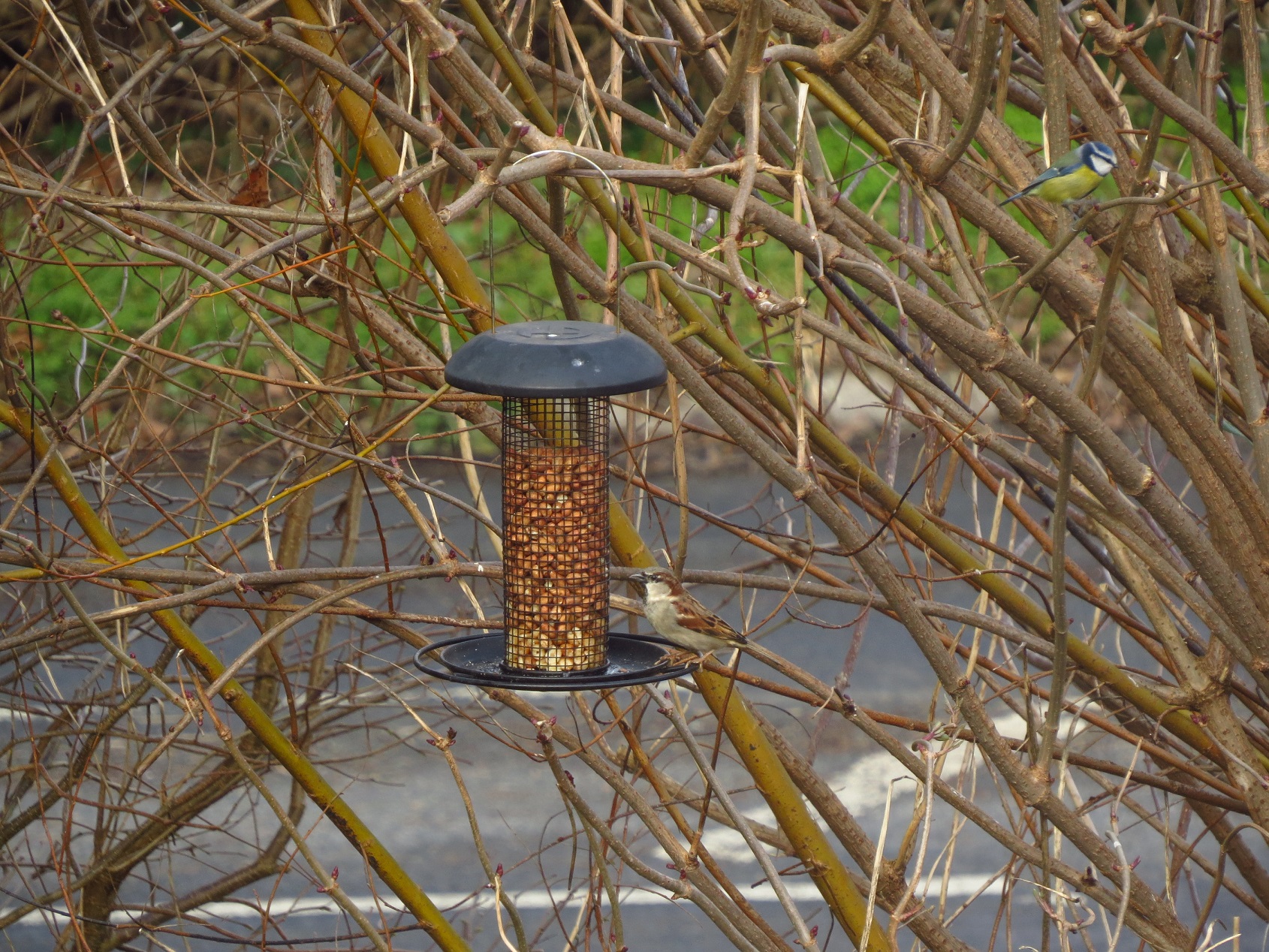
Exotic and rare birds are always a fascination, yet for me I obtain just the same pleasure watching the birds using my garden as a territory. I love watching the house sparrows [Passer domesticus] bicker and squabble at the feeders. They've been a little in decline recently. They roost and nest in the roof space not just in my house but in a few neighbouring properties.  Not so many years ago I could count forty or fifty sparrows in the garden. Today half a dozen or maybe a few more is the norm. It's worrying as house sparrow are a species which require a colony to maintain a threshold size to remain viable as a breeding group. Here in the northern parts of Somerset there are whole areas which do not have any house sparrow present, and so those areas with sparrows are isolated refugia populations. Although not present in February of course, house martin [Delichon urbicum] too have all but disappeared from this area, with 2019 being the last time they nested successfully on my house. Last year I counted only a handful flying overhead in the evening and no active nests in the street. 


While this male house sparrow is easily identified from the female, the blue tit [Cyanistes caeruleus]  patiently waiting top right could be either sex.  Identifying male and female individuals of some common species is a tough ask.  Great tit males have a broader chest stripe to that of the female, but blue tits are pretty much identical. The books say females are not as brightly coloured as the male. In the field though this is a pointless piece of information when you have a single bird on a feeder. We get a lot of goldfinch [Carduelis carduelis] in the garden and while the males and females can be identified with a decent view, mostly they fly off before that occurs. Same with long tailed tit [Aegithalos caudatus].


Another bird exhibiting more or less sexual monomorphism [as it is called where both sexes look identical, as opposed to sexual dimorphism where they look different] is the collared dove [Streptopelia decaocto]. Now technically the males and females only look different close up, with males having a 'pinker' colouration to the neck and upper body, the female a more grey-sandy colouration. In the two images below I think - note think - the female is the one below looking left, and the male the one below that is looking right. But I may be wrong.  My inability to be certain of which sex these are by no means diminishes the joy of watching these doves with their gorgeous ruby eye during my frequent screen breaks. The same goes for the other species coming into the garden today, a pair of male robin [Erithacus rubecula] vying for domination of a feeder, or the male and female blackbird [Turdus merula] duo, the male having a well defined yellow eye ring, which at this time of year may mean it is a European migrant rather than a resident. Even the five magpie [Pica pica] cackling their annoyance in the fir tree could be of either sex, and no silver was offered either.


None of what I've noted really matters, what does for me is taking time to properly study these very common species of bird from the comfort of a warm house. In other words, detailed observation. Of course putting feeders up encourages their arrival and use of the garden but that's part of the joy. That and really studying what happens a stones throw away. How blue tit will not come to the feeders if great tit are there. Female house sparrow also dominate the feeders to the almost exclusion of males, often the latter only nip in when the females have gone, or the stand off between two male robins, or the beautiful colouration of a great tit. These really are for me quite simple pleasures on the first day of February.

Sunday, 14 February 2021

Inside A Ring Of Peewits.

"It is not spring yet. Spring is being dreamed, and the dream is more wonderful and more blessed than ever was spring." 
A Flock of Peewits by Denys Watkins-Pitchford

Spring may be knocking on the door, but in recent days, as a result of a dominant high pressure system over Scandinavia, blistering easterly winds have buffeted Britain from the Continent. Add to this sub zero temperatures (Braemar in Scotland nudged minus 23oC) and, despite snowdrops peaking through the ground, a late blast of winter weather has enveloped the country. Most of the country has had a covering of snow, but here in Somerset despite the odd flurry we've remained snow free, the skies predominantly blue and the countryside bathed in sunshine. 

Working at home this week I've spent a lot of time looking out of the window while having the obligatory screen breaks. I've had a lot of birds come to the feeders, the colder weather always increases usage. A great spotted woodpecker was a highlight, but I love seeing the boisterous sparrows and starlings fighting over the fat balls. The resident great tits are looking fantastic in their fresh olive-blue plumage, seeing them next to blue tits on the same feeder, the size difference is obvious. I also have a resident male blackbird with no tail, which I've imaginatively called stumpy.  It is his garden and the interloper males are given short shrift if they dare to enter, post skirmish he'll tik-tik away on the shed roof in an avian triumph.

It's not just the garden where activity this week has increased. From the house I can look over two miles of small grassland fields to the National Trust's Sand Point and then the Bristol Channel beyond. Skeins of geese often use the Bristol Channel as a land-map, mute swans too, and in late afternoon gulls fly past going to roost on Flat Holm island. But it was while casually scanning this area with my binoculars  I noticed three sizeable flocks of lapwing wheeling over the Point. Each flock was maybe one to 2 hundred in number. After a few minutes the flocks merged and dropped out of sight. We're lucky here as lapwings in winter are quite numerous. A drive north up the M5 from Weston super Mare guarantees sightings of lapwings in the adjacent fields, and only a few miles away the Somerset Levels are a favoured location. But those birds seen over towards Woodspring Priory were in greater numbers than I'd seen for a long time. 

From home it is about a 2 mile walk to where I'd seen the flock, which seemed much longer in the biting wind whipping across the flat sea-blown fields around here. Only field hedges curtail these blasts which, as anyone who has stood motionless birdwatching in winter knows, I was inordinately thankful for.  At first I could not locate the lapwings. I counted about 30 mute swans, many many rooks, carrion crows and jackdaws in the fields and a solitary song thrush. Then rounding a corner I heard the first pee-wit call disappearing in the breeze, along with the birds. I'd spooked them unknowingly.


I wasn't unduly worried as lapwing are what I call a fidgety bird.  Individuals and groups will nervously fly up and down to the same spot while foraging or resting, sometimes the whole flock takes off for no reason only to return a few minutes later as if nothing had happened. But this flock was different.


Field guides will tell you that lapwing and golden plover flocks are common in winter. I've seen these many times. This flock though was something I haven't witnessed before, a mixed starling and lapwing flock. That may sound unremarkable, but what I seemed to have stumbled on was a co-operation flock. Despite the wind making it hard to focus the binoculars, I hunkered down to watch them drop back into the field.  What I observed was possibly a wonderful example of intraspecific anti-predator behaviour. Time and time again I observed the lapwings encircling the starling flock while they foraged on the grass. Not just in one field but a number around me. In the field nearest me there were maybe 200 starlings and 50 or so lapwing.  The flock would move as one organic force, lapwings leading at the front, with sentries posted to each side and the rear. And within this ring of peewits the entire flock of starlings moved as one with and at the same speed as the peewits as they foraged. The lapwings were foraging too, but at least half of them at any one time were alert, fidgety and calling what was wonderfully described by Charles Bayne "tcher-willooch-weet'. 
 
Then, and I observed this regularly, something unseen would spook the lapwings. The leading half a dozen to a dozen  would fly up in their lazy flap flap way, noisily calling. As they rose, behind them the entire starling flock alighted as one with them, the remaining lapwings following the starling chase. Being faster fliers, quickly after taking off the massed starling flock would fly past the lapwings in a fast moving murmuration, hedge hopping inches from the hedge top into a safer field, leaving the lapwings to bring up the rear as they flapped and glided back down to join them.  Once in the field previous positions would regroup. Starlings inner, lapwings outside, foraging would begin once more, with the leading edge of the feeding mass being the advance party of lapwing walking and foraging in a planned direction, followed by the starlings en-masse, with the lapwing sentries keeping watch. Time and again I'd observe lapwings take to the air, followed by the starlings and then the remaining lapwings. Not once did I see the starlings rise up first followed by the lapwings, always the lapwings first. It was beginning to get dark by the time I'd observed maybe a dozen take off and landings, and I was cold, with a walk back to warmth ahead of me. 

The following day I went back to the fields this time with a camera. If anything the wind was stronger than the day before, and that maybe accounted for the lower numbers of birds of each species in the fields, but they were there once more repeating that co-operation behaviour of lapwing sentries and starling feeders. In the course of an hour or so watching, not once, save for a lone buzzard, did I spot a sparrow hawk or other predator. The roller coaster flights of lapwings up, starlings up, starlings down, lapwings down seemingly caused by reason's unseen.  On this second visit the only difference to the lapwing behaviour was that lapwings from a field behind me flew back and forth to the fields containing foraging starlings and lapwings. Whether this was additional reinforcements or simply wandering about I didn't know. That field behind me also contained a large corvid flock, I counted over 30 carrion crow.

What I had witnessed intrigued me. Is this a common occurrence, this lapwing starling co-operation, or simply two species cooperating in winter during a cold spell. A search on the internet failed to come up with an answer, even going through research papers into interspecific flocking behaviour in winter. I decided to head into my library and spent a few hours reading through my natural history books.

What struck me in reading through these books was how often peewits or green plover as lapwings were known of old were mentioned, but how scant those references were of detailed information. It made me realise that many of these naturalists writing 50 or more years ago tuned into the beloved sound and flight of the lapwing, but it seemed that as peewits were more numerous than today these observers seemed not to register any behaviours. Hudson, Jefferies, BB, Moore, and Drabble all note the liquidity of the lapwings call, or the flap flap flight, but though only a limited selection of my own books, that was about it. 

Even that most poetic of naturalists Edward Thomas failed to provide what I'd wished for. Thomas, finding his life as a journalist unfulfilled, set out on an 8 day bicycle journey in the pursuit of self discovery and rejuvenation. Riding from Clapham in London to The Quantocks in Somerset around the Easter period between the 21st and 28th of March 1913. His book In Pursuit of Spring does reference peewits, but in passing while on Salisbury Plain 

"Next to the dead the most numerous things on the Plain are sheep, rooks, peewits and larks. The lark is most constant here  ....the pewit is equally characteristic. His Winter and twilight cry expresses for most men both the sadness and the wildness of these solitude"

Interestingly for me Richard Jefferies writing nearly 150 years ago in Wild Life In A Southern County questions why birds 'pack' as he calls it 

".. the packing of birds is very interesting, and no thoroughly satisfactory explanation of it, that I am aware of, has ever been discovered" 

He then goes on to discuss other species and of the peewit says " Peewits or lapwings not only pack in the winter, but may almost be said to pass the nesting time together" he goes on to discuss the lapwings avoidance behaviour by the nest in spring, but adds a beautiful description of the lapwing flight: 

"Then you have a good opportunity of observing the peculiar motion of their wings, which seem to strike simply downwards, and not also backwards, as in other birds; it is a quick jerking movement, the wing giving the impression of pausing for a tenth of a second at the finish of the stroke before it is lifted again"  

A lovely observance of the flight but not what I was after. I'd drawn a blank. The closest I got to answering my question and a naturalist describing their observance of lapwing behaviour was found in Sir John Craster's book Naturalist in Northumberland.

"[February 28th]... many more peewits are, this morning, going through their courtship antics, and I stand for some time watching and enjoying this very embodiment of the spirit of spring".... 

He later describes at length watching over 200 lapwing 'whiffle' in from the sky to join a few on the ground.

Maybe it is just my books, my limited knowledge, but I have found this whole process fascinating and it is why after over 50 years of observing wildlife there is still so much more for me to learn. Not least that the old term for lapwing can be spelt either pewit or peewit... I've gone for the latter except in quotes, after all it is the sound of a magical bird flap stop flapping the wing. 

I've not been to those fields for a couple of days but hopefully on my next visit the lapwing and starlings remain, and I'll continue to observe their antics. It certainly makes sense to combine forces, and observant eyes, to avoid predators during these winter months. Natural territorial hostility replaced by the need to simply survive. No doubt in a few weeks the lapwings will disperse, some flying a long way off. The starlings too, many back to Europe. The memory of this chance behavioural encounter  will stay with me a long while yet.

As an aside in the evening I asked Julie my wife if she would do a quick sketch of a lapwing to help illustrate my memory of this. An hour later I have the best Valentine's present a man could have.... It is not spring yet, but Spring is most definitely being dreamed.


References 

Bayne, Charles S. (1944). Exploring England. Collins, London

Thomas, Edward (2002). In Pursuit of Spring (first published 1914), Laurel. 

Jefferies, Richard (2011). Wild Life In A Southern County (first published 1879). Toller

Craster, John, Sir (1969). Naturalist In Northumberland

Quote "It is not spring yet" 

Thomas, Edward (2009). The South Country (first published 1909), Toller

Lapwing illustration by Denis Watkins-Pitchford from;

Warren, C. Henry (1940). England Is A Village, illustrated by Denis Watkins-Pitchford. Eyre and Spottiswood


Sunday, 15 January 2017

The Results - The Christmas Bird Challenge 2016


For those of you, and there were 10 of you who took part, the results of the 2016 Christmas Bird Challenge are in. And It was a fabulous selection of birding lists from across the United Kingdom. The reason I like this challenge is that it "forces" us all out into the Great Outdoors over the festive period.
 
Although there were two categories, most from a garden and overall highest species list, the real winners are all of you who took part. Maybe as you enjoyed it so much we should consider an Easter challenge when the migrants will be flooding in. But that's for another day.
 
And so without further a-do here are the winners and the competition lists from those of you who took part. WELL DONE!!!

Garden Lists :  Winner – Andrew Smith with a whopping 33

Overall Supreme Champion – Stewart Sexton with 90


Here are the results in no particular order - just when they came in.

Iris Bassett – 9 species from around the Bristol area.

Iris wrote "Ducks under the bridge in Pensford near church yard. Quite a few other very small birds, (don't know if chickens and a rooster count).". Ed comment. No Iris domestic chickens or budgies are definitely not allowed :-)

Starlings, Seagulls, Wood pigeons, Blackbirds, Pheasant, Robin, Owl - only heard one, not seen, Woodpecker.


Dr Simon Acey  - We got a total of 85 species – North East and North West. 

Simon a great birder since childhood said " Had an excellent week walking off Christmas excess. Highlight for us was excellent views of a water rail though missed the waxwings... Attached is our list from Dalton Piercy. Don't know if the Black Swan counts - it was in the wild at Saltholme. I think our total is therefore either 84 or 85 "

Ed comment. Sorry Simon I failed completely to download and read your list, but knowing how honest you NHS staff are, it's all okay :-)  Oh and yes a black swan, if it is living wild and not in a captive collection, is allowed.


Stewart Sexton – aka the Boulmer Birder from Northumberland  90

Stewart lives next to the best stretch of coast in Northumberland and has a fantastic blog, where he also posts some of his outstanding bird art. No list from Stewart, but his 90 stands on a nod and a handshake over Facebook !!

Stewart said "Hi Andrew well thats the week done and I finished on a nice clean 90 species. Highlights included Peregrine, Mediterranean Gull, several Kingfishers, Black tailed Godwit, Purple Sandpiper and Grey Plover. Obvious misses were Coot, Meadow Pipit, Skylark, Fieldfare plus many more. I didnt do any twitching or even visit any reserves, all seen just wandering around locally. All tbe best, Stewart. "

Well done Stewart a great win especially if having not visited any reserves.


Andrew Dawes – 80 – South West

A weird year for me doing this. I got to nearly 60 species by Boxing Day and then each day struggled to add more. But overjoyed with the otter on Chrstmas Day, as well as a greenfinch as I'd not seen one of these once ubiquitous finches for over a year.

Christmas Day in the garden - Robin, house sparrow (35+), starling, collared dove, wood pigeon, carrion crow, blackbird, magpie, herring gull, jackdaw, redwing, blue tit, black headed gull, dunnock, great tit. Out and about on the Somerset Levels - buzzard, long tailed tit, grey heron, little egret, pheasant, rook, goldcrest, goldfinch, chaffinch, moorhen, coot, cormorant, teal, OTTER, kingfisher, great crested grebe, wren, marsh harrier, greylag goose, pochard, jay, great spotted woodpecker, kestrel, stonechat, lapwing, widgeon, snipe (flushed from a few feet away - magical views), shoveller, bullfinch, great white egret, gadwall, reed bunting.

Remaining species from Boxing Day - Canada goose, pied wagtail, little grebe, tufted duck, Cetti's warbler, Raven, BITTERN (spotted by Julie in amongst the starlings at roost at Ham Wall),

Sand Bay 27th - my local patch. Curlew, oystercatcher, shelduck, dunlin meadow pipit, grey plover.

Topsham in Devon 28th - Day out with the nearest and dearest but I had to take my bins : Red breasted merganser, avocet, brent goose (bit far away over the mudflats to see if pale or not),bar tailed godwit, black tailed godwit, song thrush, redshank, water rail, goldeneye.

Cheddar reservoir 29th - scaup, common gull, lesser black backed gull, fieldfare (at last!!) grey wagtail, sparrowhawk, green woodpecker.

December 30th - absolutely nothing!

New Years Eve in Wiltshire - Red kite, greenfinch, corn bunting, coal tit and stock dove.

New Years Day - abysmal weather but had an hour at Catcott just to get out - pintail! Last bird of the year.

Ed Drewitt – 86 -  Around the south of England.

Ed is one of the top birders and wildlife experts in the UK and hosts wildlife holidays for organisations like Naturetrek - and what he doesn't know about peregrine feeding habits is not worth knowing. He and his wife Liz almost toppled Stewart.

Ed said " Hello Andrew, Happy New Year! I reached 86 bird species (88 if we combine Liz and me together). Highlights include four red-throated divers, hen harrier, corn buntings, thousands of knot and wonderful views of waders at high tide on the Isle of Sheppey, Bewick's swans, all the winter thrushes, barn owl, stonechat and nuthatch. Hope you had a good festive season - our birds have been busy in the garden. Best wishes Ed "


Julie Rana – 15 from the stables in Northumberland.

Great list Julie, good to know the horse fields are alive with birds, I hope this has sparked more interest - I know it has as you'll be doing the Garden Birdwatch soon with your son. Good luck with that.

Julie said " Bird race - Stable yard and winter field., Choppington, Northumberland. Buzzard, robin, chaffinch, blue tit, crow, common gull, starling, pheasant, jay, blackbird, collared dove, wood pigeon, racing pigeon, wren, partridge. xx "


Gill Brown – 49  in total from around North Somerset.

Gill is one of natures champions - a dormouse and otter expert and passionate about all wildlife in her local area and beyond. It is people like Gill who spend hours a week helping wildlife.

Gill said "Facebook managed to lose the message I sent with this! The best birding days were taken up with family but we did brave the rain yesterday and spent a rather dull afternoon on the Severn Estuary. Great fun though and I would definitely do it again. Thanks Andrew!"

Garden - 18
Blue tit, Great tit, Goldfinch, Blackbird, Wood Pigeon, Collared dove, House sparrow, Long tailed tit
Magpie, Black headed gull, Starling, Greater spotted woodpecker, Tawny owl, Robin, Wren, Carrion crow, Dunnock, Jackdaw

Out and About – 31

(Land Yeo Valley and Towerhouse Wood, Backwell Lake, Clevedon sea wall, Severn Beach, New Passage, Aust, Strawberry Line, The Causeway on Nailsea Moor)
Mute swan, Shoveller duck, Tufted duck, Mallard duck, Feral pigeon, Green woodpecker, Curlew
Reed bunting, Skylark, Shellduck, Stonechat, Lapwing, Oystercatcher, Greenfinch, Kingfisher, Herring gull, Moorhen, Buzzard, Meadow pipit, Raven, Pied Wagtail, Canada Goose, Redshank, Dunlin, Grey Heron, Coot, Little egret, Cormorant, Water rail, Rook, Song thrush.

Andrew Smith –  33 - North Yorkshire

Andrew's 33 from and around his garden is a great total - we did have a long FB discussion about the hooded crow (normally not seen in England) and having done some searching a couple of records were put in from Durham and North Yorkshire over Christmas too. So the 33 stands.... next time a photo Andrew - we'd love to see this in Yorks.

Andrew said " Have really enjoyed this - I feel privileged to have seen these all from my own house / garden "

1. Blackbird 2. Goldfinch 3. Great Tit 4. Blue Tit 5. Cole Tit 6. Crow 7. Hooded crow 8. jackdaw9. Collared Dove 10. House Sparrow 11. Tree / Hedge Sparrow 12. Gull 13. Pigeon 14. Wood Pigeon 15. Starling 16. Robin 17, Pheasant 18. Chaffinch 19.Fieldfare 20.geese (Barnacle) 21. Blackcap 22. Greater Spotted Woodpecker ( Male ) 23. Lapwing 24. Wren 25. Kestrel 26. Canada Goose 27. Black Headed Gull 28. Greenfinch 29. Grey wagtail 30. Mallard 31. Brambling 32. Tree creeper 33. Sparrow hawk


Richard Comont – 38 - Malverns and Cheshire

Richard is one of life's greats - and so young :-) A superb entomologist now bringing his unique way to Bumblebee Conservation. As a Dr PhD id have expected nothing less than Richards spread-sheet with both species and detailed information. If you ever get a chance to meet Richard at an event, you must. Great man.

Richard said " Hi Andrew, My sightings attached - 38 species in all, all from walking the dog on the Malverns plus a drive up to Cheshire.  Highlights were ravens, a pair of peregrines, and the first bullfinches I've seen in a long time! Cheers, Richard"

Collared Dove, Lesser Black-backed Gull, Black-headed Gull, Pheasant, Rock Dove, Starling, Lapwing, Grey Heron, Coot, Mallard, Mute Swan, Woodpigeon, Blue Tit, Jackdaw, Blackbird, Goldfinch, Fieldfare, Redwing, Chaffinch, House Sparrow, Canada Goose, Carrion Crow, Robin, Black-headed Gull, Tawny Owl, Raven, Song Thrush, Wren, Bullfinch, Green Woodpecker, Long-tailed Tit, Buzzard, Jay, Peregrine, Dunnock, Magpie.


Miranda Bell – 19  from Herefordshire

Miranda and her husband has just moved back to Hay on Wye after years in France and someone I met through blogging - having blogged about her wonderful wildlife rich garden in Brittany. However we've never met, but in 2017 plan to rectify this.

Miranda said " Hi Andrew  Hope you've both had a great Christmas...here are a list of birds seen in our garden here near Hay from 28 Dec – 1 Jan...not that impressive compared to others I’m sure. The highlight was the female Bullfinch – see so few of these now. Look forward to hearing how other people got on!"

Great tit,  Blue tit, Coal tit, Robin, Dunnock, Great Spotted Woodpecker, Buzzard, Chaffinch, Song thrush, Gold Crest, Bullfinch, Fieldfare, Starling, Blackbird, Long tailed tit, Crow, Wren, Magpie, Redwing

And last but by no means least....

Lyn Hunt – Dorset – 15 Garden

Lyn is another one of my blogging contacts and another I have not met although we used to frequent the same areas of Dorset.  Great to have your garden list Lyn, and on one day. Now here's a thought, you have 15 - how many at the end of 2017?

Lyn said " I saw 15 different varieties of birds in our garden on the 1st January, does that count?
Sparrows, Starlings, Dunnock, Blackbirds, Robin, Great Spotted Woodpecker, Blue Tit, Chaffinch, Goldfinch, Greenfinch, Carrion Crow, Wood Pigeon, Jackdaw, Nuthatch, Great Tit"


Thank you all for taking part - I hope you all enjoyed it, enjoyed working out what the birds were and above all enjoyed being out and about in nature. If I have missed anyone out, please do let me know and I'll rectify this.

Now where are my bins.............

Wednesday, 4 May 2011

Seawatching at Severn Beach

Yesterday evening after work I headed over to Severn Beach in South Gloucestershire following a call at lunchtime by Bristol naturalist Ed Drewitt that the evening before hundreds of terns, godwits and other waders had flooded the sky en-route to their breeding grounds further north.


We had all been reading for the last few days amazing reports of 1500 'commic' terns, 4-500 godwit flocks, whimbrel, dunlin and even 40 dotterel in summer plumage passing through. In recent days strong easterly winds had blown many migrants westwards, rather than following their usual route along the English Channel. This spring has been a fantastic time for sea watching up the River Severn. So after work, I joined Ed and another colleague and we sat down in the shingle awaiting the arrival of high tide, and the birds of course, while admiring the charming view of the massive Avonmouth industrial complex a few miles down the coast. Lovely. But the birds don't mind.


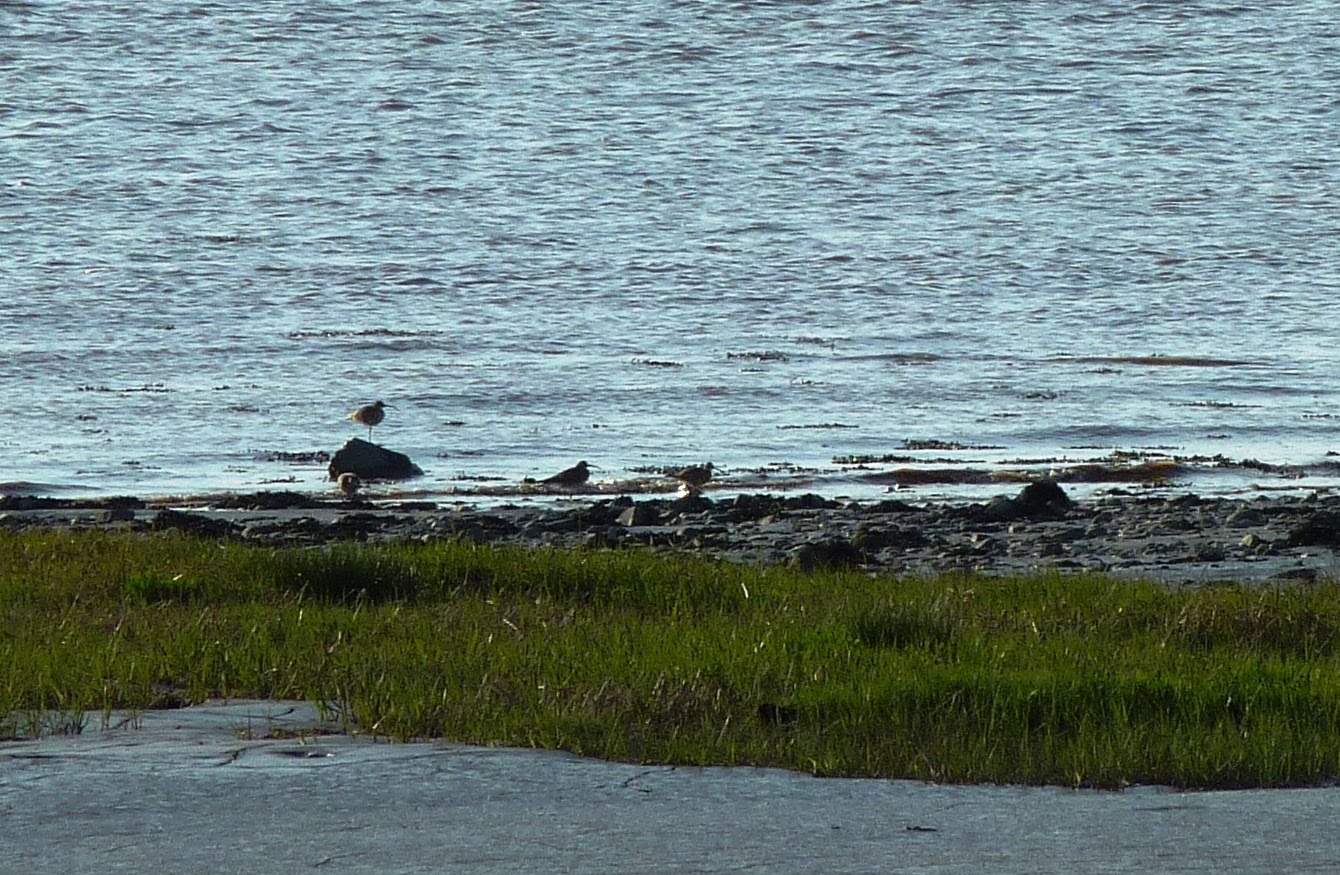
Soon the rising tide pushed up a smallish flock of bar tailed godwits who began feeding just in front of where we sat, joined by a lone knot (centre of picture). I've never seen these birds in summer plumage and they were stunning with their brick red bellies. What is amazing is that only 3 days or so these godwits would have been feeding in West Africa and in a few more days will be in the Arctic tundra. Bird migration is amazing.


We then had some whimbrel who warbled their wonderful flutey call as they restlessly skipped about in the rising water, followed by 12 black headed gulls on migration, quite a few swallows and house martins flying through, a sanderling, a couple of ringed plover and a few dunlin in their fantastic summer plumage with golden top and black bib belly.


But sadly nothing like the numbers Ed had experienced the evening before where the Severn Bridge, a well know barrier to bird migration had stopped 500 terns in their tracks and they then wheeled round to gain height right over Ed's head. We did however really enjoy the 2 hours out there on a glorious spring evening, such a nice thing to do after work, and we did have the godwits above fly low over our head calling.


And so as the sun set, the temperature dropped quickly. It was therefore time to go home from this wild feeling place, just on the outskirts of Bristol, and have a cup of tea.


I'll finish though with one amusing thought. As we sat there Ed's phone rang, another birder he knew was a mile or so down the coast and sending reports. Ed's phone rang a second time, another group of birders further north reporting sightings. Through binoculars we could see most of these birders from our vantage point, which added to the excitement having these updates from north and south of us. Mobile phone reports of those wild birds being very mobile themselves on migration.

Friday, 22 April 2011

Home Pleasures

I spend a lot of my working time visiting fantastic locations across the UK to see rare and fascinating wildlife, but this last couple of days as I've been working flat out and not getting home until 8pm. To relax therefore, in the evening, and morning for that matter, I've just been relaxing at home. And in doing so, appreciating the wildlife my garden has to offer. It may not be exotic, but we often overlook the common place and after all these are "my" birds.


I'm fortunate in that my house backs onto farmland which then becomes the North Somerset Levels before falling into the sea at Sand Bay on the Bristol Channel. From the spare bedroom window, where this view was taken, I can see the Black Mountains in Wales on a good day, but often foxes padding about the field.


But ever since moving here 2 years ago, I've loved the fact the house is actually a home to a myriad of birds. Although it is a modern house, in the eves as I write this posting there are at least 3 starling nests. How do I know this, well apart from seeing half eggshells on the path, or watching the adults zooming in and out, I can hear the chicks chirruping. In fact if I gently tap my bedroom ceiling off they start clammering for food. Don't try this at home, as the chicks use up energy chirruping so if the adults aren't feeding they'll not replace that effort.


Soon the house martins will be back. I have 2 old nests at the moment on the front of the house. Last year 3 broods fledged which was fabulous, if not a little messy on my window sills.


Back to the present then. Last night I sat outside for an hour as the night faded. Joining me was the resident collared dove who is becoming more sociable. There is a nest in the conifer just outside the garden, hopefully then there will be a family of dove-ttes in the garden soon.


Around the small pond a female blackbird hunted for titbits and all around the large number of sparrows here squabbled and chirruped. What is lovely of course is that just sitting and observing the familiar wildlife in the garden for an hour, makes me realise that I don't spend enough time these days just sitting, observing. Good field biologists will tell you, the only way to really understand and observe wildlife is to spend hours and hours just quietly watching behaviour. And by sitting quietly, wildlife always comes to you, there really is no need to go and find the wildlife in any situation, just sit still for a while and they'll all come closer.


An example of this is that yesterday morning I stood at the kitchen window for 20 minutes (while washing up) watching a blue tit pulling moss from the lawn, presumably to line the nest. Frustratingly although it returned 9 times to collect moss, each time I tried to take a photograph, it flew off. The resident sparrows were of course more obliging.


In the same area recently I watched a wren systematically picking off insects from the two climbing roses I have, fascinating to watch as it went up and down every branch. And this is what is fascinating about watching wildlife at home in the garden. We all think, oh yes there's a lot of birds in the garden, but how many of us actually watch what they're doing, how often, why and when? I know you bloggers will, but the general public probably miss a lot of free entertainment by not taking time to observe for prolonged periods.


Such as this morning. I made a cup of tea and sat for 30 minutes watching what was in or flying over my garden. House sparrows were in evidence of course (I always scan every bird looking for tree sparrows, which while very rare in this area are nonetheless here in single numbers - I'm still waiting, ever hopefull). Blackbird and starling, collared dove too. But then I noticed beyond the garden line with the aid of binoculars, herring gull, magpie, rook, carrion crow, buzzard, 3 goldfinch, a green finch and finally a swallow, first I've seen here this year


So this weekend, maybe instead of joining the massed crowds heading to the sea or spending a lot of money at an event, why not stay at home, unpack a deck chair, sit in the garden and just quietly watch, observe and see what is actually happening "at home". I know I will with my binoculars and camera close by.


Just a final notice as I know some of you like to listen. On Sunday 1st May my next radio programme will be airing, Living World on the birds of Islay, on the 8th is a programme about the daffodils of Dymock produced by a colleague, then 2 more from me, on the 15th will be oil beetles and the 22nd May, raft spider. This latter one I'm off to record on Wednesday in Shropshire, here's hoping the weather remains warm and settled. I can't wait.


HAPPY EASTER!

Monday, 2 August 2010

Chipping away at the weekend.

Well what can I say. Who is this fine figure of a man in fetching garb? Notice the chiseled good looks, the racing snake physique. Improvement will be impossible I'd say. The epitome of man in human form. But I digress. So dear reader, please relax for a while as further derring-doo into this wayward movement into sartorial elegance will be later in this posting.

Before that a plethora of activity on the birding and moth front. Saturday morning saw me with a few hours to fill, as Julie had gone to a walk plus pub lunch near Calne. So I popped into Hungerford, via the country lanes around this part of East Wiltshire.

I like this part of Wiltshire. Big dramatic skies over unspoilt agricultural land. A landscape which undulates as if with the breeze as it flows and ebbs over the chalk uplands and into the greensand lowlands below. Pastoral southern England at its finest. And on Saturday morning it was breezy and fresh, dramatic clouds scudded across azure blue skies in patterns of movement only nature can conjure up with so little effort, but so much emotion.

I'd hardly driven a mile of so when out of my eye, I spied 3 birds of prey using the wind as a thermal balance, near to Wilton Windmill. I knew instantly what they were but got out of the car to check anyway; three red kites. Sadly as I didn't have my camera with me, just my blackberry, no photos, even after watching them for over 10 minutes gliding and soaring around the aforementioned windmill. It was while watching these that a male bullfinch also popped into view. A good start to my shopping trip.

On the way back from Hungerford, another red kite hoved into view over these fields not far from the village of Great Bedwyn. I love watching red kites as their tail manoeuvres in the wind while they elegantly flap and glide on the updraft. My guess for what it is, is that this red kite was one of those seen earlier at Wilton a few miles away, but who can tell? While watching the kite, a male yellowhammer sang its "little bit of cheese" song from a hawthorn, a female kestrel hovered over the field, a chiffchaff and a large flock of blue, great and long tail tits flitted back and forth amongst the conservation headland and finally 3 linnets twet tewwet'd across my line of vision.

That was the afternoon. Later that same day, Julie returned from her exploits and I offered to create something interesting with a packet of vegetarian mince, a brambly apple and some custard. I make no apologies for the following photograph, save that it was taken along with much mirth by a blackberry wielding female. It's slightly blurred, as Wiltshire's answer to Heston Blumenthal could not remain still, so much to do, so little time to do it!! So I whizzed and hurtled spoons and whisks across the kitchen to produce a vegetarian lasagne, with wholemeal bechemel sauce, followed by apple and blackberry crumble, and sadly sans wine, as we'd drunk it all on Friday. Geordie men are renowned for their tough northern lifestyles, a lifestyle which would exclude any domestic activity, and a true Geordie would never be seen in the kitchen wearing an apron - sadly 17 years living down south have softened me to a remnant of my hard man image .... there is no going back now..... the shame of it all.....!!

Following the meal, we went for a little drivette. The sole reason of this was for me to show Julie the shortcut back to our house I'd taken on Friday evening, which resulted in an additional 8 miles being driven trying to save time (please no comments about men and map reading). But it was a lovely view though, both ways. The sun was far too bright for a picture the other way, so just this view, this time.

And as we came back towards the village, the sun set and one last photo on the blackberry. Readers may be interested to know I have now located my camera and so slightly better photos should follow on the blog from now on (the camera was in my work bag - had been there for 3 weeks and I couldn't find it!)

Later that night leaving the lights on in the house, we had a Silver Y, a Willow Beauty and a common wave inhibiting the smallest room in the house. Last week I tried an impromptu moth trap and trapped no moths at all. I think from now on I'll just leave the bathroom window open.

Sunday:

Okay, grab a chair and sit back. One of the things which took me to Hungerford was to go to the Antiques Arcade and whilst there I purchased 2 wood carving chisels. For a while now, since doing my stone carving course in November, I've wanted to get back to hand on arts and crafts. I've done a bit of woodwork in the past, mainly green-woodwork, and even demonstrated pole lathe turning at the Peat Moors Centre in Somerset a while back, but woodwork hasn't been part of my life for quite a while now.

The need for compost necessitated a trip to the garden centre and while there we perused a kitchen workshop, festooned with wooden objects including wooden bowls. Rashly I offered to make a bowl using a chunk of spalted beech I just happen to have had about my person. Spalting is the process of fungal attack of deadwood, producing "marbling" pigments in the wood. One can never predict what will be inside a piece of wood until it comes out in the woodworking process.

So here is the original piece of wood as collected from a forest. I'd sawn the bottom off so we had a nice squarish piece for Julie to carve herself. But the main body of the trunk lay undecided. Initially because of the two pointy bits, I had wanted to carve a free form sculpture, but a bowl it will become.

I set too with power saws and so on to cut the main shape, always the hardest part. A golden rule in all carving is let the shape of the wood, and the wood itself dictate the shape of the finished article.

And hey presto, a basic outline slowly emerged. It got a lot more messy after that, but eventually after a few hours I had managed to get the basic shape I wanted. Quite a long way to go, but I've set myself to the end of August to get it completed. I won't be using power tools from now on, so everything from here on in will be chiseling and hard graft. I'm hooked, not to mention developing muscles in places I didn't know muscles existed.

In case anyone is wondering, the smaller piece of wood with a candle in it is an off cut with 3 holes drilled into it. Just something for the outside table I knocked up. What I love about working with natural materials is that, such as in this piece of spalted beech, it began as a tiny sapling, grew, then somehow died. I've no idea how old it was, but probably older than me, and now, by creating something permanent, it will live on in another form. True regeneration of wood and woodlands.

I just hope I haven't set myself up for a massive fall with this carving of a bowl malarkey - watch this space.........!

Monday, 16 March 2009

Birds, Bees, Butterflies and every Corvid

Many bloggers have posted great stuff about the arrival of spring this weekend. At last it felt like we were getting rid of this long winter. Which explains of course why my head this morning looks like a ripe tomato..... I'll never learn, wear a hat in the spring sunshine.

What this glorious weather did do of course is bring out the wildlife en masse. I think it is the arrival of insects in the countryside which really starts to move the year on. Certainly there were a lot of Queen bumblers droning about yesterday. I also spied 3 different species of butterfly, 3 Brimstones, half a dozen Small Tortoiseshell and at one point one of these was next to a newly emerged from hibernation Peacock. Would have made a fabulous photograph if they hadn't flown off just as I got the camera ready.

There was also a lovely bit of behaviour with one of the Brimstones as a House Sparrow tried to catch it on the wing, watched this for a while until the Brimstone left uneaten to live another day.

Yesterday was glorious so a friend and I went on a nature ramble in Dorset. I'll not say exactly where as this involves a Badger site not far from houses. Save to say it was a "reet canny walk".......... off we go then!!

The walk began in a wide footpath with overgrown hedges. These were alive with birds doing what birds do in the spring, the lads showing off to the girls. Greenfinch, Blue Tit, Blackbird, Song Thrush, Great Tit and Robin were everywhere. As were one of my favourite birds the classic Little Brown Job, the Dunnock. Normally fairly secretive, they do sing from perches as this one was. In the same bush were 2 others having a bit of a flirtatious time with their constant wing flicking, which is why some older people call this a Shufflewing.

Walking through the village to the woods, many chimney pots had Jackdaws nest building. I watched this pair for ages, as they were collecting nesting materiel from the roof. Lovely bit of pair bonding going on while the male passed items to the female. In the distance is a Rookery and this is where I was heading


But en route spotted this very common moss, Bryum capillare on a wall

Into the Rookery by the church the noise was deafening. Also the Rooks were not that good at nest building; or as my companion said, they're dropping more than they're using. We watched these for about 10 minutes and isn't it just amazing how entertaining the Crow family are. I love crows and just feel uplifted watching their squabbling and messing about, especially this time of the year. I wonder if they minded me photographing their bottoms?

This part of the walk took us past an ancient stone wall, absolutely covered in plants. I think I'll do another posting one day about the value of stone walls for wildlife, but for the moment a photo of Navelwort, named after the dimple in the centre of each leaf. This one was producing it's strange flower spike. Like all members of the sedum family these fleshy leaves store water and help it survive periods of drought, which is why it's often found on old stone walls growing in very little soil.

Speaking of water, this area has a spring fed water trough, so an arty shot of cold, spring derived water on a warm spring day.

Just around the corner from this we were greeted with a carpet of yellow Lesser Celendines in flower. It just lifts the spirits seeing this blast of colour.

But eventually we got into an ancient woodland. Quite an interesting place really, as although classic mixed deciduous Ash and Hazel woodland, at some point it must have been enclosed as there are old stone walls running through it, quite a bit of Laurel at one end and now seems to be used by mountain bikers. Which was interesting, the path snaking through the wood was wide and full of jumps, but off the path the woodland was pretty much as it should be.

Quite a bit of it seems to be coppiced and this gave a wonderful mix of lower and upper story habitats, but open for ground loving plants, such as these Violets, which were present in both blue and white form, or the Dogs-Mercury below.

Bluebells were starting to come through, Aliums, and a whole host of other plants, emerging into the spring sunshine, such as these Wood Anemonies, not quite in flower, but just as beautiful in the green.

The woods were absolutely alive with birds, usual Great and Blue Tits everywhere, but a Great Spotted Woodpecker was calling, as were a pair of Jay's with their harsh call, though I never managed to get a good look at them. Which made me realise we'd now seen nearly every member of the Crow family on this walk, except Raven, Hooded Crow and Chough, and the latter two I'd not see in Dorset anyway...... more about this at the bottom of this posting.

I tried to get a decent photo of this Nuthatch, one of 2 on this tree, but it was a bit far away really. Oh well a record shot I suppose. They were calling continuously. One bird I didn't see was a Treecreeper which was slightly surprising, but we can't win them all.

I did however find a huge Badger Sett, with this entrance being very freshly dug out, or at least having a spring clean, so I know it's active and why I'm not saying where this walk was given the woods are also used by mountain bikers. Can't really see this in the photo but a lot of green vegetation was mixed into the spoil. It was while looking around the Badger domicile I spotted what I'm pretty certain is a common Carder-Bee, Bombus pascuorum. I should know this but there was something about it which made me think it wasn't.

We'd been out 2 hours now, so time to walk back home, which brought us back into the glorious sunshine, and past a lot of Mistletoe on fruit trees in a farm.

Finally back home we were relaxing with a cuppa in the garden, more Small Tortoiseshells there, when Baxter (who acts as tour guide on all our walks) heard a commotion overhead. Before even looking up, I knew what was going on as that deep Cronk Cronk was heard. 3 or 4 Carrion crow were hassling a Raven as it flew over the house. Quite a few Raven up on the ridges only a few miles as the crow flies from where I was. Brilliant, I couldn't recall seeing a Magpie today, but they're everywhere and often don't register, but that Raven meant that every Corvid possible in Dorset was seen in 3 hours, and a confirmed Magpie in the garden not long afterwards. Fantastic.

Certainly Baxter was very happy with his walk and spent the rest of the day relaxing in the garden. Well he only has little legs. There will be more from him later in the year, as he has his own blog now.