A

A

Friday, 25 November 2011

A thought for the Faroes

It's just been on the weather that last night a gust of wind hit the Faroe Islands at over 120mph, 126mph I recall being mentioned. That is astonishing. Not unknown in the UK of course but astonishing, nonetheless.


This was all because of a deepening low pressure tracking across the North Atlantic, dropping 50 millibars in 36 hours. But it's better explained here.....


My maternal grandfather was a Master Ticket Sea Captain, which meant amongst other things he could go into any port without a pilot on board, which didn't make him the most popular man at times, as that's how pilots made their money. He plied the seas across the world in his ships, often away from home for up to two years at a time, and he was even seconded to the Royal Navy in the Second World War as an Atlantic Convoy leader (and harrowing that was apparently, as he watched "his" ships go down one by one while trying to maintain the formation and liaise with the Navy support). Bizarrely, when my parents met, Captain Johnson as my mother's father was always known, said to my father, "Dawes, are you related to "Daddy"Dawes..." my father said, "yes he's my grandfather". Captain Johnson then said, finest sea captain and ship owner I've ever served under, and with that nipped upstairs and got his first ever seaman's ticket, issued at the age of 14 when ships in sail were still being used. And there, on that ticket, which we still have, was my paternal great grandfathers signature, signing off the first rung of my maternal grandfather's shipping career. Being brought up in the North East, it was either shipping or mining that ruled the economy. Both sides of my family were shipping; all my paternal grandfathers brothers were sea captains, except him, he stayed on shore, at Readheads Dock in South Shields along with his sisters husband who was managing director at that time. It was my father who broke the mold and became an artist. But the sea is still in me, but from a safe distance of course....


I wish I had known my mothers father better. He was Norwegian and sadly died when I was 6 and although I can remember him, only vaguely. So my knowledge of him is from my mother. He always said respect the sea, the sea is in charge, you are not. And that has come down to me. I'm both fascinated and intimidated by the sea, especially when it is rough. I remember being in a force 10 coming back from the Isle of Arran and the ferry we were on was like matchsticks on a whirlpool. Seeing waves crash right over the ferry was absolutely fascinating, but then one remembers, we're in a fancy tin bath....... I hope the plug is in !


But I digress, this is about wind... I've paraphrased this from a weather facts website, as it is just so fascinating. Or at least I think so.


There is not a linear relationship between wind speed and the damage that is produced. For example, a 150 mph wind would not do twice as much damage as a 75 mph but rather it would produce many times over the damage of the 75 mph wind. When considering wind power alone there is a cubic relationship between wind speed and the power produced by the wind.


For example, suppose the wind speed is 15 mph and produces 3,375 units of power (15^3). If the wind speed is doubled to 30 mph then the power produced by the wind would be 27,000 units (30^3). As the wind speed increases the power produced increases at a rapid rate.


Assuming the cubic relationship mirrors reality which is does not for all wind speeds and situations, if the wind is 100 mph the damage produced will be 1,000,000 units of damage (100^3). If the units of damage are double to 2,000,000 then the wind speed that produced this damaged can be found by taking the cube root of 2,000,000 which has a value of 126 mph.


Thus, the damage produced increases significantly as the wind speed increases, especially as it increases above hurricane force. The 126 mph wind does twice the damage as the 100 mph although the increase in wind speed is about a fourth greater.

Sunday, 20 November 2011

Birdwatching across 2 weekends

I'm enjoying this. Having slightly, and I emphasise slightly, less on at work at the moment I have time now to go out watching wildlife, though I have to confess to having planned to post last Saturday's birdwatching all week, but completely failed to do so. But better late than never I suppose.


So two brief postings. First an afternoon spent last Saturday walking from East Grafton up onto Wexcombe Down in Wiltshire and back again. The glory of Julie's house being in the middle of nowhere is that the car isn't needed to head off into unspoilt countryside. This part of the Wiltshire / Hampshire / West Berkshire border lands is unspoilt and pretty much unknown, certainly in birding terms very few people venture here, so it is like having my own back garden. So after a lovely relaxing lunch at the Cross Keys in Great Bedwyn, Julie settled down to watch the racing at Cheltenham and I headed off into the hills. Don't get too excited by the photos to follow, you'll see what I mean soon.


First encounter was an obliging pale buzzard on a fence post (honestly there is one there, in the middle)


And the fields around here are covered in mushrooms this year, I think that's because they've been spreading mushroom compost recently.


This is a shooting area so always lots of pheasants and partridge


As well as brown hare.... okay the photos are getting silly, so I've added arrows to them to help spot what I'd seen. This was actually about a quarter of a mile away.


And as everyone knows this November is mild, so here's two hovers on an umbellifer, not sure of the species of hovers.


And this is how far I'd walked up onto the Downs, arrow denotes the hamlet of East Grafton.


But by the time I'd returned I'd seen;


Blue tit 10+, Red kite 1, Buzzard 3, Pheasant numerous, Linnet 20+, Raven 1 + 2 (1 heard), Wood pigeon 100+, Blackbird 6, Red Legged Partridge 3, brown hare 2, Chaffinch 200+, Wren 1, Great Tit 2, Fieldfare 150+ more flying in as dusk gathered, long tailed tit 5+, Skylark 20+, Carrion Crow 20+, Robin 1, Kestrel 1, Greenfinch 1, Golden plover 35-40 overhead, Jay 1 and finally 2 Greater Black Backed Gull overhead which is very unusual for this area.


So all in all a very good 2 hours on the chalk downs. Mind you when I got home, Molly wasn't impressed with the brown hare, she'd seen one anyway (one of my wire sculptures in case you are wondering).


Let us now cast ourselves forward 8 days. It is Sunday November 20th. Still mild and at 8am I found myself at RSPB Greylake in the misty gloom. Julie has put herself forward to be a BTO Wetland Birds Surveyor and was meeting a more experienced surveyor to get herself familiar with what to do. I was going along for the ride (well actually as we had to leave the house at 7am, I was chauffeur and breakfast maker, Julie is not by any means a morning person). So the two of them went off and I, with 3 hours to spare, pootled off on my own to see what was happening.


I've been coming to Greylake ever since it was bought by the RSPB and it's good to see it develop. This is the first time I've been around some of the new walks around the back of the reed beds, which was a good place to put up snipe.


I then ventured into the hide and joined 2 other chaps, who were amused by the strange fauna in the restricted area of the reserve, namely Julie (on right) and her BTO mentor. It was good they were wandering about the restricted area, as they put up a lot of waders for us to see. You can't beat a nice bit of disturbance to get a good birdcount.


But we were soon distracted by another exciting view, a great white egret emerged as if by magic right in front of the hide. No need for arrows with this photo or the one below.


But I definitely need 2 arrows for this next photo taken hand held through my scope... I know, I know, you are astonished at the technical accomplishment. Oh and incase you're wondering, it is 2 peregrines in a dead tree half a mile away. Maybe enlarge the photo for, just for fun and a better look.


And now you know, the enlarged view is just as bad! I But at least these shovler are recognisable.


Bad though these photos are the tally was good, and so as in all good competitions, in ascending order......


.... willow tit 1, great white egret 1, pied wagtail, 1, grey heron 1, male kestrel 1, sub adult male sparrowhawk 1, buzzard 1, cormorant 2, little egret 2, wren, 2, cetti's warbler 2, water rail 2, snipe 3, linnet 3, peregrine 3, chaffinch 10+, shovler 10+, mute swan 15+, golden plover 19 flying over (apparently there were about 500 in the restricted areas), carrion crow 20+, starling 50+, mallard 50+, wigeon and teal combined 1500 +, lapwing flying overhead 2000+


That last lapwing flock was astonishing. I'd seen drifting flocks of 20, 30 but we were back at the car and about to leave when this huge flock circled overhead. Despite the great white egret being scarce, I still love to see so many lapwings.


Ohh yes by the way sorry about not being able to leave comments, I keep being logged out when I post, think its because I'm on Explorer 9 or something, if anyone has any suggestions how to rectify this, let me know (and the blog formatting is double spacing too and doesn't seem to want to change)

Tuesday, 8 November 2011

At last a weekend at home........

It's the first weekend in November 2011 and at last I've taken a breath, workload is reducing slightly and I'm taken stock, feel the embryonic energies of blogging coming back to the fold. When I began this blog 4 years or so ago, I had a completely different lifestyle, different job, different places to visit and well looking back it seems like a long time ago, especially as back in those days I seemed to have to a lot more time to go out and watch wildlife. But then again I now get paid to go out and watch wildlife, can't be bad, so I hear you say, "he doth protest too much"


So, now the mood has taken me, let me take you back to last weekend. It began with that dreadful crash on the M5 on Friday, not that far from where I live. I do a lot of driving now for my work, too much really, and what happened then really makes one stop and think of the fragility, the veneer our cosy modern life provides. What happened at Taunton really made me reassess.

So it was with a relish we woke on Saturday for a pre-planned visit to friends in Thornbury, in South Gloucestershire. The weather was fine, so we pootled off for a wonderful 3 hour walk/talk/amble along the Gloucester Canal at Purton (home of the original Bill Oddie programme on starling displays, more on that later).


Not long into our walk, we spied a rambling ivy across a stone wall. Bearing in mind this was November 5th it was covered in insects feeding on the nectar of these late season ivy flowers. A year or so back I made a Living World programme on the importance of Ivy in the winter and ever since then have been fascinated by how important this plant is to insects later in the year.


So important in fact I think a campaign should be started, "leave ivy alone" - keep it bushy, keep it messy, until April at least.


Onwards we strolled to take in the sights and sounds of the canal


Where soon we came across the undisputed highlight of the walk....


I do like gnomes. Maybe not as many as there are here, but every garden should have one. We're all much too sensible these days, and actually the original gnomes were there to bring good luck to the garden.


I'd never been this way before but had heard of the Purton Graveyard. A century or so back the Severn was a shipping highway but by the 1960's this shipping was in decline. As boats became obsolete they were rammed into the river bank to help stop river erosion from the huge tides the Severn experiences. Until recently these hulks were slowly rotting into the silt, but now these fascinating remnants of an industrial past are being preserved, with regular guided walks and information boards on each boat, when it was rammed into the riverbank and so on. Industrial archeology used to bore me rigid, but now, I love it. A sign of getting older I guess.


Not everything is about the boats though, as on the riverbank between a pair of boats this chickory was in flower, with quite a bit of it growing around this area.


This tower gives the names of all the boats lying here...


A concrete lighter


A plaque commemorating the destruction of the Wye Severn bridge when a barge hit a pillar and the whole lot came a-tumbling down.


Not the actual barge, but you get the idea


Amazing so much activity took place in what is now such a peaceful place.


Soon it was journeys end, the entrance to the Gloucester Canal, now blocked off at Sharpness with a lovely waterfall


And an interesting building, which is under threat apparently


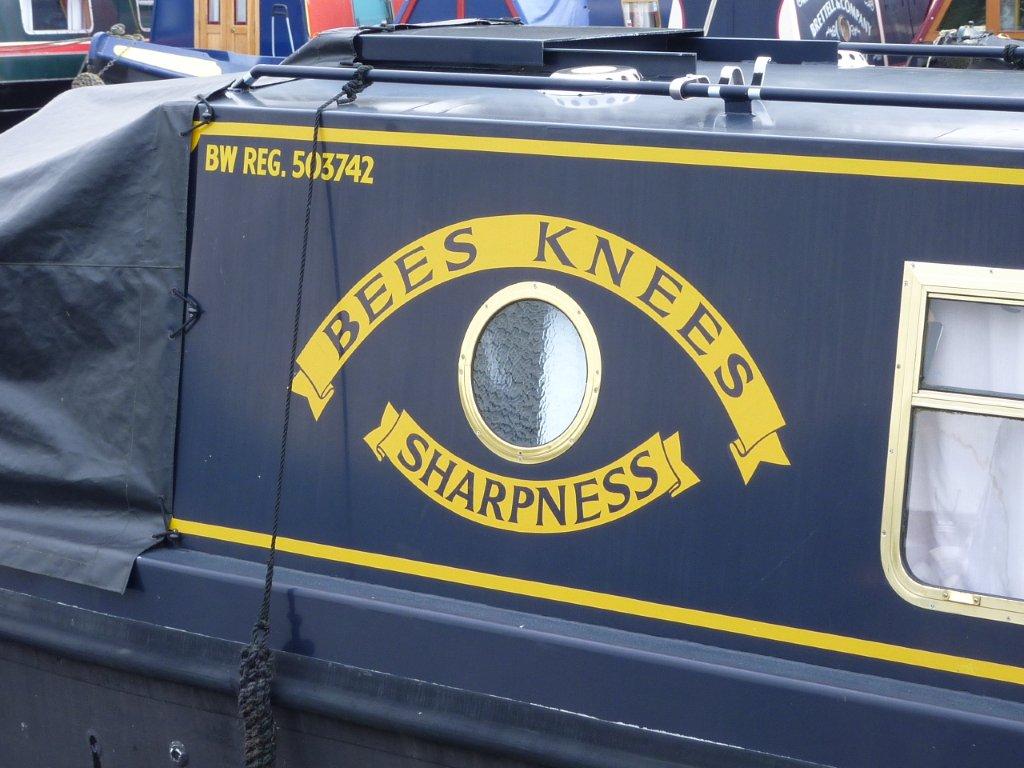
It had been a fascinating 'bees knees' of a stroll out to the end of the canal, but now it was time to return.


Which brought about the wildlife spectacle of the day, not one but three peregrines flying about the canal. Two birds were pseudo-food passing so presumably pairing up for next year. Amazing to see,especially thinking back that only a few decades ago, seeing a peregrine was a rarity and usually in very remote places. Good to see them making such a good comeback.


Nearly home now........ but it wasn't far from here we also saw a kingfisher.


That was Saturday, rounded off with a fantastic meal back at my friends and then home to see the fireworks.


Sunday dawned bright and fare. Which was good as it was destined to be make the Christmas cake day, as can be seen by the chef hard at work...... oh dear look at the state of that kitchen!!


It was all too much so we had to escape while the cake was in the oven. And escape we did, to the Somerset Levels, Canada Farm Lake to be exact, just a short drive from me.


Such a glorious late afternoon to be walking up the lane to the bird hide


And so we made ourselves comfortable in the hide and waited to see what happened.... such a wonderful and peaceful place.


We weren't expecting these but all of a sudden thousands of starlings emerged and flew right over our heads to Westhay a few miles away. This is the first winter starling flock I've seen this year and it was such a pleasure to witness it on our own, made more so by the surprise of their passing overhead. It's still early in the season for the big flocks of 1 million + birds , but a sure sign winter is on its way.


And while we waited for more to pass,we could just admire the view.


Again, again and again....


But all too soon it was getting too dark to see any more starlings so off we walked back to the car, observing this moon and sixpence view on the way back. Magical.


Lets leave the last word to the starlings though........


Saturday, 24 September 2011

21 Years Ago

Well well well....... back in the mists of the last Century I began my conservation-cum-wildlife career. In those days I was here there and everywhere in Durham and Northumberland learning my craft. But by 1990, as a lot of my work was voluntary, I'd realised I needed to get a degree to move on, and get paid for doing a job I love.


L-R John Middlemiss (Head warden), Dave Edwards (Warden), Damian Rana (Warden), Me (Volunteer), Julie Rana (wife of Damian and wardened at weekends)


Sorting out the office tonight I came across this photo. Not that I'd lost it, just I didn't know where it was these days. This photograph was my last day as "official" voluntary warden at Cragside in Northumberland, hence why we're all standing like lemons in front of a sign I'd quickly written at the end of the day. I was at Cragside last week and mentioned this photograph to Julie, strange then to see it again so soon after that conversation. Strange too to see the ramshackled uniforms. These were the days before corporate identity came to the fore. We just wore whatever we worked in.


I began there in 1986 and clocked up over 1500 hours of voluntary wardening experience there in the 4 years before this photograph was taken. Not a bad achievement considering I had a full time job too. I was also working as co-ordinator for the North Northumberland Otter Project, conducting various surveys for NGO's as well as Nature Conservancy, working for and on behalf of the National Trust's Northumbrian HQ of anything which needed doing in the Durham area, as at that time there was no NT staff down there, such as NT rep on members groups, involved with the Neptune 500 project, and heavily involved during for the hand over of Souter Lighthouse from Trinity House to the National Trust.


This latter work was fascinating as I was invited into the lighthouse by Trinity House 2 weeks before it was handed over and shown round to make notes for the National Trust's land agent, prior to being myself the NT rep on site after handover. What was lovely was that the keepers lit the lamp for me and I was allowed into the lamp room while the huge lens floated past me on a mercury bath. Something the public were banned from doing. But as I was representing the new owners, it was an absolute privilege to be in a lighthouse in those days when still an operational building run by 2 keepers. An experience no one will ever be able to get again now that lighthouses are unmanned and fully automated.


Although I kept going back to Cragside as a volunteer warden on an ad-hoc basis until 1994, it was never the same. So this photo marks both the end and the beginning of an era. It was the end of my time at Cragside, but six weeks later I started my Countryside Management degree at Newcastle. Graduating from there in 1993, I applied for and got a job with the BBC's Natural History Unit in Bristol, moved south and 18 years this November, I'm still there making wildlife programmes on the radio.


But seeing this photo brings it all back to me, that excitement of developing a career in wildlife conservation in my early twenties. If I had my time all over again, I'd do exactly the same. But where did I have the energy to do all of that work and have a full time job.....and where has the time gone!!


Great Days, great days indeed.

Sunday, 4 September 2011

The twilight of a summer sun

I guess the embryonic development of this post began in high summer, although for many years I have watched the phenomenon of sunsets and developing twilight from my house with never ending fascination.


Back in mid June I was up in Northumberland for work. After a busy day on the Farne Islands I took 3 colleagues up to Lindisfarne, to show them the Cradle of Christianity (or as they all thought culture ended at the Watford Gap - the Cradle of Culture). They were bowled over by the fantastic scenery of the Northumberland coast and the island itself. But after a rather terrific supper at the Manor House Hotel, we had to drive back to Bamburgh. The time, 20.45 hours.


As we drove down to the causeway, the view above literally stopped us in our tracks. And so the seeds of this post were sown. What is it about sunsets in particular which ignite something both artistic but also primeval in us all? We'll all happily watch a sunset develop for hours, while exploding into explosive irritation at being forced to stand in a queue for 1 minute. Is it that timelessness which makes sunsets so all absorbing to the viewer? Or maybe something else related to our hectic modern life. As you read this, I wonder what it is you yourself gain from watching a sunset?


Holy Island 20.55 hours


Two emotions ripple through me. Firstly I love the developing colours and cloud combinations a sunset brings to a sky. That ever changing kaleidoscope of colours often associated with vanishing clouds as the energy in the atmosphere subsides with the diminishing rays of the sun. but secondly it is that calm end of a day feeling that I love. The day draws to a close, I muse on the waking hours just passed and think ahead to the new day dawning. On many occasions I've sat in the garden with a nourishing glass of wine watching a sunset develop and fade, only to realise it was dark, so full of empty thought I'd been for that hour or so.


Budle Bay 21.15 hours


And so it was on that June evening with my work colleagues. We could have stood there for hours watching the sun set, but an early start the following day brought us back to earth, until that is we drove past Budle Bay, between Bamburgh and the A1. Yet again we were literally stopped in our tracks by the two images here.


Looking at these photographs in early September, I can recall every detail of this view. It also makes me realise that now, sunset is about 7.45pm. In Northumberland in mid June it was 21.45pm. Celestial motion stops for no man.


By the time the above and next two photographs below were taken on Bamburgh beach, it was well after 10pm. The colours intensified with the passing minutes. In all it had taken us nearly 2 hours to drive the 20 or so miles back to Bamburgh. The four of us were reluctant to head back to the hotel, and even at 11.30pm I looked out of the bedroom window and an orange glow still emanated from the north. I do miss the long day length Northumbrian summers.


So what is a sunset? Well I'm sure most of you know, but in essence as a ray of white sunlight travels through the atmosphere to be viewed by us, some of the spectrum of colours are scattered by particulates in the atmosphere. Blues and greens being of shorter wavelength than other colours scatter quite strongly and are in effect removed further from the visible light spectrum than say the warmer red colours. Along comes a sunset when the distance the white lite has to travel to your eye is longer than at mid day. The short wavelength blues and greens are scattered almost completely, leaving the warmer long wavelength warmer hues to dominate the sky. This warm red light is then further dissipated by clouds (which also have additional atmospheric effects) and dust particles allowing the intensity of the light to, well, intensify. It is these latter dust particles which generally make sunsets more dramatic and longer lasting than sunrises, as usually more dust is in the atmosphere in the evening than in the morning. and of course once the sun sets, what we are viewing then technically becomes a twilight.


Back to my sunset images from this summer.

I'm not sure whether it has been the unseasonal nature of this summer's weather but I feel I have witnessed some dramatic skies after what appeared to be inauspicious days.


From the house. July 1st 20.39 hrs


I've mentioned before that my house looks west towards the Black Mountains of Wales. To get to the horizon, in the middle distance is the estuarine Bristol Channel. Ever since moving down to Somerset, I've been aware of sunsets of staggering magnitude and proportions, often after a wet day. The light intensity in this part of the world is very strong, with the prevailing wind straight off the Atlantic. However the Channel itself is muddy in colour, I've often wondered therefore whether this brown sea adds something to the atmospheric colouration. After all the sea does reflect blue light back to the atmosphere, making the sky blue, or at least that's what my grandmother told me!!


From the house. 17th August 19.39hrs


Being on the west, sunrises of note are few and far between, however sometimes just before sunrise produces fantastic cloud formations for a few minutes, until like a magician with an illusionary trick, the clouds dissipate and the sun rises again.


It is as I've said, sunrises which fascinate me. and so the following photographs have all been taken from my house in the last month. I've added the date and time just for interest.


20th August 19.11 hours


20th August 19.12 hours


20th August 19.30 hours


20th August 19.37 hours


The next two photographs illustrate what is a regular occurrence here. This was August 26th. It had rained all day, not just any old rain, but a torrential downpour, which finally ended about 6.30 in the evening. I was in the office working away when all of a sudden a shaft of bright light illuminated the room, such brilliance after a wet, dark and quite frankly depressing August day.


26th August 19.41 hours


As often happened after a wet day, just before sunset the clouds seem to lift up from the horizon, just enough for the sun to almost say, well that's your lot for today, see you tomorrow. Which in turn provides some dramatic and as in this case Apocalyptic skies.


26th August 19.42 hours


This final raft of sunsets have been taken this week. I'm on holiday and this week at home with my parents visiting me. After a hard day chatting and catching up, what better way to relax than watch a sunset develop over the Bristol Channel.


30th August 18.55 hours


30th August 19.16 hours


30th August 19.19 hours


1st September 18.13 hours


1st September 18.43 hours


And so as we head into autumn and then winter we will of course experience more sunsets, but I do feel the summer of 2011 has been an exceptional sunset year, for me at least.


~~~~ POSTSCRIPT ~~~~~


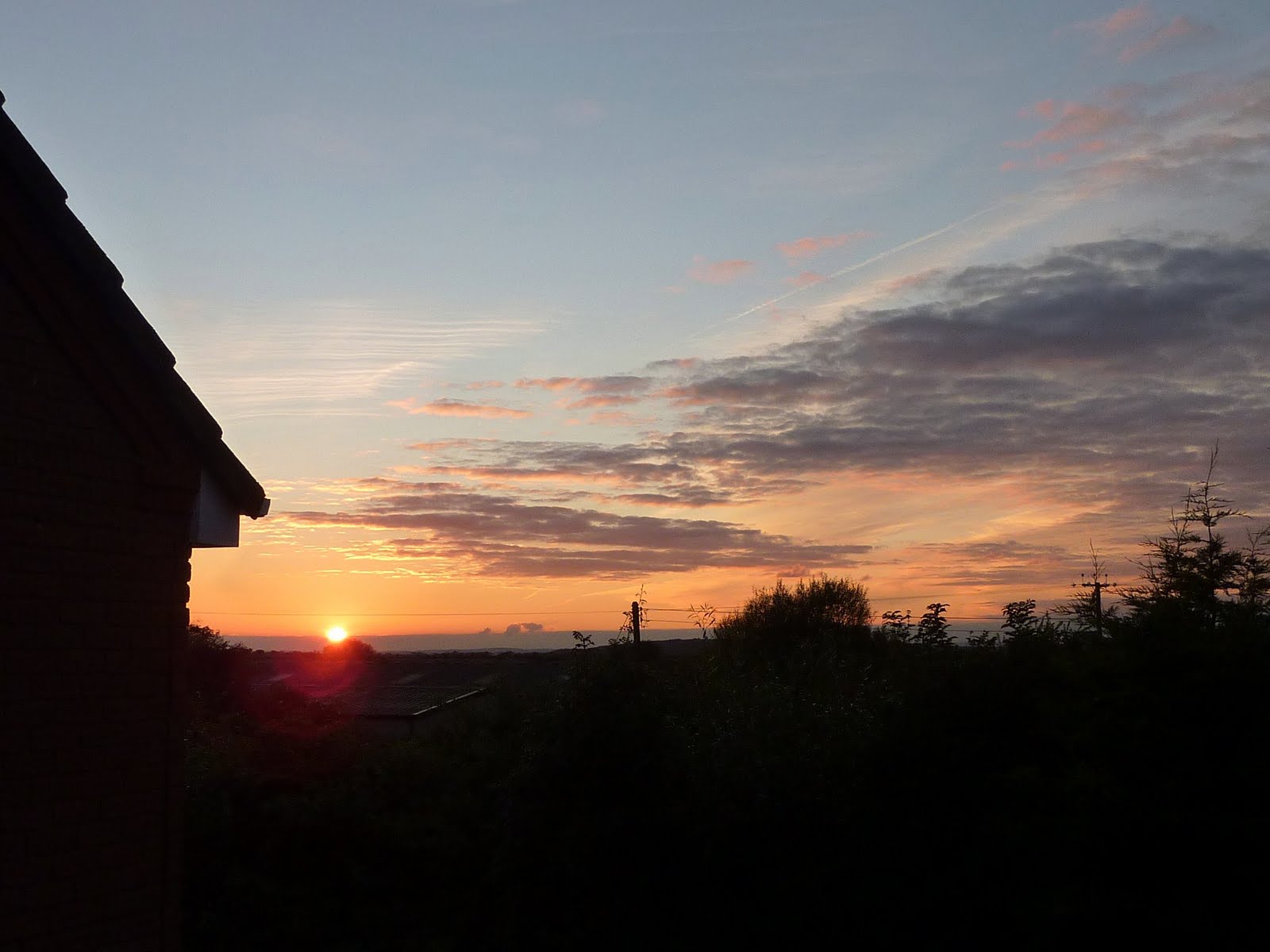
As if to prove my point in the above post, this afternoon it began to rain, torrential rain (why I came indoors to blog). But just now at 19.45 the clouds parted near the horizon as they often do in bad weather and this was the view out the back of the house just a few minutes ago, yet it was still raining on the house. Another magical sunset on a wet evening in September. So I'll let the photograph I've just taken below end the post..............


4th September 19.45 hours