A

A

Wednesday, 3 April 2013

Richard Jefferies Essay : The Dawn

Some of you will have been aware that this Easter, on Radio 4 there was a 3 part programme of mine called In Pursuit of Spring, an account of Edward Thomas's 1913 ride across southern England. But Thomas himself was influenced by many other writers, especially Richard Jefferies. Jefferies is hugely overlooked in nature writing these days, and I don't know why.

One of Jefferies best books in my mind is The Hills and the Vale, which is in essence is a collection of his essays. When recording the programme with Jefferies scholar, Rebecca Welshman of Exeter University brought along an original copy of this book. Time didn't allow me to look at it for long, but embedded in those pages is an essay called "the Dawn". By coincidence while doing some e-mail housecleaning I came across an e-mail I'd sent myself 3 years ago with a note "remember how good this is". And it is, this for me encapsulates what is important in all nature writing, observation, historical context and a sense the writer is beside you guiding your senses to the experience.

So here, below, is The Dawn in its entirety. Enjoy!


There came to my bedside this morning a visitant that has been present at the bedside of everyone who has lived for ten thousand years. In the darkness I was conscious of a faint light not visible if I looked deliberately to find it, but seen sideways, and where I was not gazing. It slipped from direct glance as a shadow may slip from a hand-grasp, but it was there floating in the atmosphere of the room. I could not say that it shone on the wall or lit the distant corner. Light is seen by reflection, but this light was visible of itself like a living thing, a visitant from the unknown. The dawn was in the chamber, and by degrees this intangible and slender existence would enlarge and deepen into day.

Ever since I used to rise early to bathe, or shoot, or see the sunrise, the habit has remained of waking at the same hour, so that I see the dawn morning after morning, though I may sleep again immediately. Sometimes the change of the seasons makes it broad sunlight, sometimes it is still dark; then again the faint grey light is there, and I know that the distant hills are becoming defined along the sky. But though so familiar, that spectral light in the silence has never lost its meaning, the violets are sweet year by year though never so many summers pass away; indeed, its meaning grows wider and more difficult as the time goes on. For think, this spectre of the light--light's double-ganger--has stood by the couch of every human being for thousands and thousands of years.

Sleeping or waking, happily dreaming, or wrenched with pain, whether they have noticed it or not, the finger of this light has pointed towards them. When they were building the pyramids, five thousand years ago, straight the arrow of light shot from the sun, lit their dusky forms, and glowed on the endless sand. Endless as that desert sand may be, innumerable in multitude its grains, there was and is a ray of light for each. A ray for every invisible atom that dances in the air--for the million million changing facets of the million ocean waves. Immense as these numbers may be, they are not incomprehensible. The priestess at Delphi in her moment of inspiration declared that she knew the number of the sands. Such number falls into insignificance before the mere thought of light, its speed, its quantity, its existence over space, and yet the idea of light is easy to the mind.

The mind is the priestess of the Delphic temple of our bodies, and sees and understands things for which language is imperfect, and notation deficient. There is a secret alphabet in it to every letter of which we unconsciously assign a value, just as the mathematician may represent a thousand by the letter A. In my own mind the idea of light is associated with the colour yellow, not the yellow of the painters, or of flowers, but a quick flash. This quick bright flash of palest yellow in the thousandth of an instant reminds me, or rather conveys in itself, the whole idea of light--the accumulated idea of study and thought. I suppose it to be a memory of looking at the sun--a quick glance at the sun leaves something such an impression on the retina. With that physical impression all the calculations that I have read, and all the ideas that have occurred to me, are bound up. It is the sign--the letter--the expression of light. To the builders of the pyramids came the arrow from the sun, tinting their dusky forms, and glowing in the sand. To me it comes white and spectral in the silence, a finger pointed, a voice saying, 'Even now you know nothing.' Five thousand years since they were fully persuaded that they understood the universe, the course of the stars, and the secrets of life and death. What did they know of the beam of light that shone on the sonorous lap of their statue Memnon?

The telescope, the microscope, and the prism have parted light and divided it, till it seems as if further discovery were impossible. This beam of light brings an account of the sun, clear as if written in actual letters, for example stating that certain minerals are as certainly there as they are here. But when in the silence I see the pale visitant at my bedside, and the mind rushes in one spring back to the builders of the pyramids who were equally sure with us, the thought will come to me that even now there may be messages in that beam undeciphered. With a turn of the heliograph, a mere turn of the wrist, a message is easily flashed twenty miles to the observer. You cannot tell what knowledge may not be pouring down in every ray; messages that are constant and perpetual, the same from age to age. These are physical messages.

There is beyond this just a possibility that beings in distant earths possessed of greater knowledge than ourselves may be able to transmit their thoughts along, or by the ray, as we do along wires. In the days to come, when a deeper insight shall have been gained into the motions and properties of those unseen agents we call forces, such as magnetism, electricity, gravitation, perhaps a method will be devised to use them for communication. If so, communication with distant earths is quite within reasonable hypothesis. At this hour it is not more impossible than the transmission of a message to the antipodes in a few minutes would have been to those who lived a century since. The inhabitants of distant earths may have endeavoured to communicate with us in this way for ought we know time after time. Such a message is possibly contained sometimes in the pale beam which comes to my bedside. That beam always impresses me with a profound, an intense and distressful sense of ignorance, of being outside the intelligence of the universe, as if there were a vast civilization in view and yet not entered. Mere villagers and rustics creeping about a sullen earth, we know nothing of the grandeur and intellectual brilliance of that civilization. This beam fills me with unutterable dissatisfaction. Discontent, restless longing, anger at the denseness of the perception, the stupidity with which we go round and round in the old groove till accident shows us a fresh field.

Consider, all that has been wrested from light has been gained by mere bits of glass. Mere bits of glass in curious shapes--poor feeble glass, quickly broken, made of flint, of the flint that mends the road. To this almost our highest conceptions are due. Could we employ the ocean as a lens we might tear truth from the sky. Could the greater intelligences that dwell on the planets and stars communicate with us, they might enable us to conquer the disease and misery which bear down the masses of the world. Perhaps they do not die. The pale visitor hints that the stars are not the outside and rim of the universe, any more than the edge of horizon is the circumference of our globe. Beyond the star-stratum, what? Mere boundless space. Mind says certainly not. What then? At present we cannot conceive a universe without a central solar orb for it to gather about and swing around. But that is only because hitherto our positive, physical knowledge has gone no farther. It can as yet only travel as far as this, as analogous beams of light.

Light comes from the uttermost bounds of our star system--to that rim we can extend a positive thought. Beyond, and around it, whether it is solid, or fluid, or ether, or whether, as is most probable, there exist things absolutely different to any that have come under eyesight yet is not known. May there not be light we cannot see? Gravitation is an unseen light; so too magnetism; electricity or its effect is sometimes visible, sometimes not. Besides these there may be more delicate forces not instrumentally demonstrable. A force, or a wave, or a motion--an unseen light--may at this moment be flowing in upon us from that unknown space without and beyond the stellar system. It may contain messages from thence as this pale visitant does from the sun. It may outstrip light in speed as light outstrips an arrow. The more delicate, the more ethereal, then the fuller and more varied the knowledge it holds.

There may be other things beside matter and motion, or force. All natural things known to us as yet may be referred to those two conditions: One, Force; Two, Matter. A third, a fourth, a fifth--no one can say how many conditions--may exist in the ultra-stellar space, beyond the most distant stars. Such a condition may even be about us now unsuspected. Something which is neither force nor matter is difficult to conceive; the mind cannot give it tangible shape even as a thought. Yet I think it more than doubtful if the entire universe, visible and invisible, is composed of these two. To me it seems almost demonstrable by rational induction that the entire universe must consist of more than two conditions. The grey dawn every morning warns me not to be certain that all is known. Analysis by the prism alone has quite doubled the knowledge that was previously available. In the light itself there may still exist as much more to be learnt, and then there may be other forces and other conditions to be first found out and next to tell their story. As at present known the whole system is so easy and simple, one body revolving round another, and so on; it is as easy to understand as the motion of a stone that has been thrown. This simplicity makes me misdoubt. Is it all? Space--immeasurable space--offers such possibilities that the mind is forced to the conclusion that it is not, that there must be more. I cannot think that the universe can be so very very easy as this.


Richard Jefferies's essay: Dawn

Tuesday, 26 March 2013

In Pursuit of Spring : Radio 4 this Easter

Just a quick posting to link to my last posting on countryside writers.

The Radio 4 series I produced with the National Trust's Matthew Oates as presenter now has its website live:

Website link to in Pursuit of Spring


3 transmissions, Good Friday and Easter Saturday at 15.30 and Easter Sunday at 14.45.

The programme will also be available in perpetuity on the BBC i-player

It is not yet spring..............

Thursday, 21 March 2013

The landscape of nature writers of old

Yesterday was a momentous day: I finally put down my editing mouse and said a sad farewell to an 8 month pilgrimage with one of the greatest prose writers of natural history England has ever seen,  Edward Thomas.


Of course I am talking rubbish, there is no way I can be on a pilgrimage with a man who died 47 years before I was born, but metaphorically I have been on my own long journey with this most eloquent of Countryside writers. Along the way, the road has been bumpy, the path slippy, and the destination seemed never to reach to me further than the horizon. That bumpy and slippery road is apt, as Edward Thomas had a lifetime's fascination with roads, paths and trackways gained from a years wandering The South Country as his 1909 book put it. But yesterday, my horizon came into view and the sun shone once again in the West.

Making a radio programme on a writer who is adored and loved by many is a daunting prospect. It is also one of huge compromises. How can I possibly say anything new, or worse still, misrepresent the facts. Compromise is the name of the game, and yes, while my name will be there as Producer of this programme on Radio 4, to get to my destination many ideas which were exciting at the development stage never made it to the Grand Finale. The team which surrounded me needed to hold me steady, calm the nerves and generally just be there quietly doing what's needed to stop me going off the rails. Principle in this team was Matthew Oates of the National Trust, who is the programmes presenter. A chance encounter with him in July 2012 while on a butterfly day at Cherhill Down in Wiltshire allowed us to discuss an Edward Thomas programme idea, to celebrate the centenary of Edward Thomas's last piece of prose writing, In Pursuit of Spring, published in 1914.

The year before, I failed to get commissioned an idea of mine to Radio 4 along the lines that 2013 could be seen as a momentous year for nature writing anniversaries. Some anniversaries were at best tenuous, but my idea for a 10 part 10 minute series which would whet the appetite of the listener by exploring a single point of time in the lives of some of the best nature writers we have ever seen; writers which to a new generation are mostly forgotten.

Sadly my idea fell by the commissioning wayside, but I still have that ambition to do this. Here I'd like to share those writers with you now, as they still excite me, not least as I am staring at a 250 year span of English nature writers. Can any other Country boast so long a nature lineage?


Gilbert White, Selbourne, Hampshire died 1793 – 220 years and inherited Wykes in 1763, 250 years

William Cobbett, Farnham, Surrey – Born 1763 - 250 years

Richard Jefferies, Coate near Swindon - The Story of My Heart (1883). 140 years

W.H. Hudson, died Worthing, Sussex (although born in Argentina) Adventures Among Birds (1913) – 100 years

H.J Massingham – Tree of Life (1943) – 90 Years

Henry Williamson – Tarka the Otter 1927 - 85 years

Arthur G. Street - Country Days: a series of broadcast talks‎ (1933) – 80 years

John Moore, Tewkesbury - The final volume in The Bensham Trilogy, The Blue field (1948) – 75 years

Denys Watkins - Pitchford (BB), Lamport, Northamptonshire - A Child Alone (1978) – 35 years

Ralph Wightman, Piddletrenthide, Dorset – Portrait of Dorset 1983 – 30 years


A sub plot of mine is that these writers were speaking to us from a different time, but their words echo along the timeline of history and are as fresh and as relevant to readers today as they were in their time. Thomas himself completing his cycle ride for In Pursuit of Spring over Easter 1913 laments the car traffic noise despoiling his rural idyll. Which asks the question, what would he think of today's traffic?

But there is possibly a more serious point here. Those writers were recording a changing landscape, sometimes unwittingly through observations of the here and now which to today's readers is astonishing for its richness and variety of wildlife. But also, like another writer Thomas Hardy who predominately set his books in 1840's Dorset, they were often harking back to a landscape either of their own memory, or gleaned from family and friends observations. The truth lies where I wonder? We all forget over time as our little grey cells fail to replace themselves quickly enough, but the written word, remains fresh and permanent.

There is another angle to this, something which Dr Sophie Lake an ecologist calls Generational Amnesia, whereby our baseline of how the countryside should look is being reset based on each generations experiences of how it looked as they experienced it for the first time. Today's child thinks cars and planes and the maelstrom of modern life is normal. 100 years ago, cars and planes were just beginning to breach the wall of silence in our countryside; therefore someone in their 80's in 1910 would possibly be horrified.

The countryside however looks pretty much the same as it did on Thomas's ride in 1913. But for how much longer? Today many of those landscapes are under greater threat than ever before. We are a small island and our land surface area is small, too small really to support a State planned population of 70 million. Something has to give, and today that giving seems to be some of the most uninteresting landscapes in the English landscape, or so planners think.

Richard Jefferies hailed from Coate near Swindon. In his day this was a tranquil backwater. From his parents farmhouse he would travel the fields of the area and walk up to the dizzying heights of the Marlborough Downs to see the view from Liddington Hill. One can almost do that today, indeed standing in the Richard Jefferies Museum garden if one ignores the roar of traffic heading into Swindon and turns around, Liddington Hill can still be seen. We couldn't walk there now easily as the M4 cuts off our route, but we can still see it. But not for much longer as a new housing estate is about to consume the landscape he knew, forever. Today many feel that Wiltshire landscape is a degraded pastiche of what was there in the 1880's

Or to paraphrase Wilde, To lose one landscape may be regarded as a misfortune; to lose another looks like carelessness.

Thomas Hardy's Dorset is increasingly under threat from development and in Berkshire the famous "Watership Down" will possibly go the same way as Newbury expands.

We cannot stop progress, I believe a lot of progress is for the better, people need to live somewhere. We use cars, travel and generally fill in the gaps between towns. But for me, I find it sad to think that when that view from Jefferies farmhouse has gone, it will be gone forever. In the future anyone who wishes to experience Jefferies mindset as he walked the few miles from Coate to Liddington, will only be able to dream of it through his writings.

None of these landscapes are exceptional in terms of their beauty. Few hold rare species or possess a view to take our breath away. They are just one of the many thousands of gently rolling areas of countryside, fields and hedges brimming with the nature of a managed English agricultural landscape. But as a piece of history for our nature writing ancestors those little corners of forever England are precious, really precious.

As such these landscapes should be looked after. Not preserved in aspic and left to rot in some "roses around the door" time long forgot, we must conserve at all costs way, but managed for today, used for whatever they need to be put to, but with the understand that those landscapes are as important as any ancient monument. Wordsworth wandered lonely as a cloud over the Lake District, would anyone suggest building 15,000 houses and a Shopping Mall on the slopes of Grasmere? Of course not! Coate is no different; it's just in Swindon, and that's all.


I'll leave you with an image of Kilve Beach in Somerset. Thomas ended his journey here in 1913, Wordsworth, Llewellyn Powys, Virginia Woolf and many other writers and poets have been drawn to this "ghostly coastline" of Coleridges, from which his poem The Ancient Mariner drew inspiration. On the day I recorded my radio programme there, as the sun set, I think I saw the ghost of Thomas talking to that Mariner. I wonder what they said?


Sunday, 10 March 2013

Edward Thomas and Burbage On-line

Burbage news is the local (to me at weekends) community initiative. It's a great little paper packed with information and news from this remote part of South East Wiltshire. For a few months I've written a nature article to the paper version, but they have just published an on-line version and on pages 8-9 after calls for articles I helped out with a short story, unrelated to nature.... a ghostly who-done-it.  Complex ending  a few have not understood, but that's the point. I hope you like it. 


I've not written much on the blog recently mainly due to a big work project I'm working on for broadcast over Easter this year. In 1913 Edward Thomas the poet and writer cycled from London to the Quantocks in 'pursuit of spring'. Why he did this journey is complex. Was he escaping winter, was he escaping himself, was he on a spiritual journey? Over the last few months I've got to know Edward Thomas well. He was undoubtedly melancholic, but also one of the greatest observers of wildlife and nature in our literacy heritage, after another major nature writer, Richard Jefferies, who was himself an inspiration to Edward Thomas.
 
I'll write more soon on this but our nature writing literacy heritage is being forgotten, I hope with this 3 part series to help re-balance this.
 
Before then here's a link to the Edward Thomas Fellowship


Thursday, 14 February 2013

A photo a day project

Just a short posting today. Since my last posting all manner of mad things have been happening to me and kept me from my promised blogging.

But to get me back to being match fit as they say, just want to promote a good friend of mine. We schooled together and then went our separate ways. I to nature and media, he to photography. But this year he is undertaking to post an image a day over the entire year. A great idea, and one I dip into, well daily as it happens.

So click on the link and maybe leave him a comment.....  A Photo a Day Project

Saturday, 19 January 2013

The silent city (grit free pleasure)


What I wanted to chat about in this posting was "The Silent City" No; not some post apocalyptic zombie film or the town of Mdina, but the west country city of Bristol.
 
 
Like most of the UK yesterday Bristol was covered in a thick layer of snow. Bristol City Council are renowned for their lack of gritting effort, which considering this is a very hilly city makes for some atrocious driving conditions. I'm sure this is a reflection of their desire to make this a car free city. I have no problem with that, as long as they grit the roads to allow the buses to run. Car free is admirable, and inability to get to work is lamentable. I once drove from Newcastle to Bristol in thick snow, every road on that 300 mile journey to the perimeter of the City was easily drivable. I then passed the South Gloucestershire boundary mark and within a few miles the whole place became gridlocked. Took me three hours to do the last mile to work. I'd have walked but I had a car crammed with kit so couldn't leave it.


However because of this lack of gritting yesterday it made me realise what cities could be like without the car, something as a child of the Sixties, I have never known. All the photographs for this comment were taken at 2pm when the roads were beginning to clear of snow, but even then they were empty of traffic. In the morning however because no roads were gritted, the City fell eerily silent. Trains were running, but all buses had been cancelled and all other transport had heeded the warnings to stay at home. My 40 minute walk from Bristol Temple Meads train station (and back when these images were taken) was absolutely fantastic.


Because there was no traffic, except the odd driver braving the roads, as I walked I could hear and feel the silence around me. Silence is something a big city can never experience these days. Usually walking to and from the station I am either enveloped in a carcinogenic fog or dodging endless traffic while trying to cross a road. It is often a harrowing experience. But not so on January 18th 2013.
 
As I walked I could hear birds singing. Above that children, and a few adults, chatting, laughing, playing snowball fights, building snowmen. Everywhere people walked, walked and walked, like a reenactment of an L.S.Lowry painting was being staged. We didn't worry about the traffic, there wasn't any. We just walked in the silence and that silence was deafening, but also so so therapeutic. This is what cities should be about!


The second photograph on this posting is Whitladies Road in Clifton at 2pm. Usually this is a slow moving carpark of traffic either heading into or out of the City. Not yesterday. It was eerily quiet. People walking could cross on a zebra crossing or at lights without a care in the world. It was so fantastic I felt like running along a road just because I could. As I stopped to compose these photographs I had a few people stop and say "isn't this lovely this snow is magical" or "isn't the city quiet". On a normal work day everyone is heads down shuffling to their appointed destination without a care of the environment they tread. Yesterday however the transformation was astonishing. We looked up, we heard and we saw.


Even on the train as I headed home again, which was delayed by 15 minutes because of the weather, people were chatting. One woman on hearing the train would be delayed just said "ohh well its the weather, what can you expect" and then struck up a conversation with a complete stranger about how beautiful Bristol looked today. He chipped in with an observation that he came from Taunton and he was the only one of his office to make it to work today. His colleagues all drove in to the office from Bristol and couldn't make it, so his manager had sent him home - presumably with a gold star and impending bonus for good behaviour.


The weather (and to a part Bristol Council's inability to cope) did a miraculous thing yesterday. It allowed the people to reclaim the City for people, just for a few hours. For millennia cities have been places of and places for people; gathering for commerce and employment cities grew into chaotic vibrant and above all human scale places to live. Vice and crime rubbed shoulders with commerce, culture and housing. The outer boundaries of our biggest cities was less than the distance a man could walk in half a day, as he needed to walk back in the evening. Indeed I have a book covering the history of stage coach travel. In 1800 Hyde Park Corner in London was just that, the corner of the street where one road split to Bath, the other South. Here market gardens and farms prospered feeding the Nations Capital.


Just fifty or 60 years ago all that changed, with the arrival of the combustion engine in a form that allowed the masses to buy cars. Just think about it. When our grandparents were born, no one owned a car. Okay a few wealthy people did, but everyone lived close by their place of work as they either walked, or got the train or bus. My father talks of the 1950's when he began working after school, lines of buses travelling between South Shields and Newcastle became more like a club. Each day everyone would get on at the same place and they'd chat like old friends. If one person missed the bus, they'd either tell the driver to stop or a great discussion would develop, "where are they" But since the 1960's, the car has taken over. 
 
There is no doubt it the car is a fantastic invention, no other transport allows A to B movement so efficiently. But this efficiency of the car is also the cities downfall. We as a society have become isolated. Because we can travel huge distances now from home to work, our cities are expanding at a rate never seen before into the countryside and we now live a long way from our places of work. I work with people in an office who in an evening are nearly 120 miles apart from each other once at home. Society thrived on living and working in the same town or city as it allowed people to mix and socialise with work colleagues, or friends of friends all within a short distance of each other, day and night, and importantly on a human scale.
 
My parents never worried about a little bit of snow; as my mother said only last night, in the winter when it snowed, such as in 1963 she walked the 2 miles to work and back again every day, never even crossed her mind not to turn up.  Today the slightest sign of snow and the country grinds to a halt because we rely 100% on the car in the main. I remember talking to a chap who had moved from Newcastle to the wilds of Northumberland years ago. A 45 mile drive each way. He loved it, but like we said, give a good hard winter like we used to get and it'll be fun. I wonder how he has coped these last few years.
 
And I do wonder what will happen when fuel runs out. Will we start moving back into cities, which in a way is already happening in a few places, because lets be honest who wants to spend 3 hours a day commuting? I often drive along motorways and think how many years will it take for nature to reclaim these structures after the last car has passed along it. Sitting in our tin boxes we will know more about the presenter on Radio 5 Live than the man sitting in the car next to us at the traffic lights. And that is why society is fragmented and isolated. We do not have a connection with where we work, where we play, or where we travel through.
 
But if we were on a bus or walking, there is just a chance we may chat to pass the time. For the first time in history, as a pedestrian in a city we are an alien species in an alien environment. And that is sad. Maybe Bristol Council after all have the right idea, a car free city. As I walked the quiet streets of Bristol yesterday listening to the birdsong, the children laughing, people chatting, I thought, I am part of a community here, a community surrounded by its environment. Bristol was not an aggressive noisy rush rush city yesterday, it was calm, silent and on a human scale. I doubt I shall experience this feeling again though as on most days I see nothing nor hear anything of the City as I drive by in my perfect efficient transport.
 
We'll never go back to cities being for the people while we have combustion engines, but maybe, just maybe when the petrol runs out in about 75 years we can once again quote from Dickens' The Tale of Two Cities, the city slept it's silent sleep.....in silence.
 
“Other sound than the owl's voice there was none, save the falling of a fountain into its stone basin; for, it was one of those dark nights that hold their breath by the hour together, and then heave a long low sigh, and hold their breath again.” 

Tuesday, 1 January 2013

A New Year's Day Walk


Like a number 14 bus, readers wait for weeks for one posting and in an instant, two in one day. No doubt this will be followed by another gap of gargantuan proportions. However today was, after these last few weeks and weeks of rain, a welcome diversion. Clear blue skies, mild, if a little breezy, perfect weather to blow off the cobwebs after the Festive period. Not having a car at the moment places to go for a walk were limited. However looking out of my bedroom window, across the field lies Woodspring Priory. About a mile as the crow flies, about 3 miles on foot. So laden down with a couple of satsumas off I set.
 
 
So this blog posting is a record of that walk from my house to Woodspring Priory. And of course I came back too but by then, 2 satsumas lighter, I'd run out of things to photograph. So we'll begin at the estate, leaving the road via one of the pathways.


Within a few minutes I was in the open countryside between Weston super Mare and the Bristol Channel. This area is actually part of the Somerset Levels, specifically the North Somerset Levels and Moors. It is a special place, quite isolated considering Weston is close by and I love it.


In the hedgerows I found ivy still in flower and berry, very important for wildlife at this time of year, and in hedge bottoms Lords and Ladies were already unfurling leaves. This part of Somerset has a unique microclimate, helped by the warming waters of the Bristol Channel. The Temperature can be 2 degrees warmer here than in Bristol 20 miles away. Spring is knocking at Somerset's door.


Another feature of this area are the wide ash hedges. I've not seen this anywhere else in the UK and this hedge must be 10 feet across the rhyne.

 
Not everything was looking positive in the countryside today. I passed field after field of stunted decaying maize. Maize is a late harvest crop and many fields didn't even get a chance to produce cobs due to the continuous wet weather. It is heartbreaking for a farmer to spend so much time (and money with the price of diesel) sowing a crop only for it to fail because of the rain, made worse this year as they can not even get onto the fields to plough this in. It'll take weeks of dry weather to dry these fields out enough to get machinery on there.

 
But I carried along in the welcome sunshine along a long and winding country road.

 
Passing even more flooded fields

 
Even my favourite wild feeling lane had flooding each side of it and as the photo aptly illustrates, dead and decaying crops.


I had a choice here, walk the wet and muddy bridleway or walk the lane to Woodspring Priory, I chose the latter


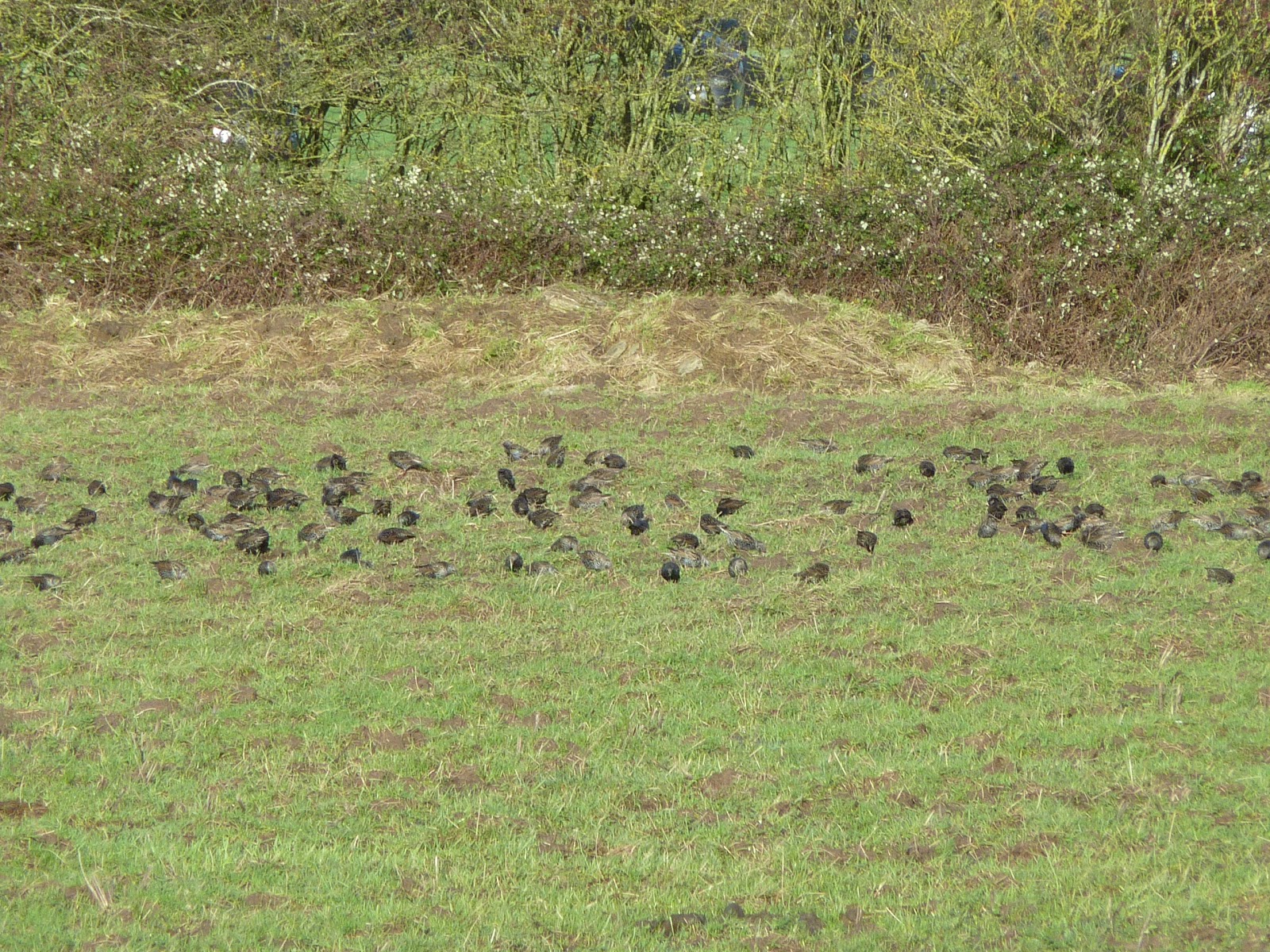
A very muddy horse and some happy starlings feeding away


Woodspring Priory area has always been a sheep area and it always makes me feel uplifted seeing these in fields in sunshine.


Eventually making it to the National Trust land, but I kept walking to the Priory for the time being


Not having a car, my need for the car park was limited, so sloshing through the puddles, I arrived at the Priory which standing on a mound, was surrounded by a soggy field.

 
Being New Years Day the Priory is closed but it is still an impressive building

 
Looking back from the Priory back the way I'd walked.

 
A bit of an arty shot below - seems so isolated yet just 10 minutes drive from the centre of Weston super Mare

 
Retracing my steps I then headed back to the National Trust land of Middle Hope (sounds very Hobbit-ish)

 
This is a very isolated spot and a cracking site for birdwatchers, or would be if there was access. This is all private land and frustratingly I could see dunlin, redshank and curlew on the mudflats, but there probably would be a lot more species to view with a telescope.

 
Just to prove I was there - Wessex Reiver's shadow. By now it was 1.30pm so time to head back.

 
On the way back I spied these which are probably a cultivated variety, but that doesn't matter, it is yet again a sign of how mild this winter has been so far.
 

A good walk. Happy New Year