A

A

Sunday, 4 September 2011

The twilight of a summer sun

I guess the embryonic development of this post began in high summer, although for many years I have watched the phenomenon of sunsets and developing twilight from my house with never ending fascination.


Back in mid June I was up in Northumberland for work. After a busy day on the Farne Islands I took 3 colleagues up to Lindisfarne, to show them the Cradle of Christianity (or as they all thought culture ended at the Watford Gap - the Cradle of Culture). They were bowled over by the fantastic scenery of the Northumberland coast and the island itself. But after a rather terrific supper at the Manor House Hotel, we had to drive back to Bamburgh. The time, 20.45 hours.


As we drove down to the causeway, the view above literally stopped us in our tracks. And so the seeds of this post were sown. What is it about sunsets in particular which ignite something both artistic but also primeval in us all? We'll all happily watch a sunset develop for hours, while exploding into explosive irritation at being forced to stand in a queue for 1 minute. Is it that timelessness which makes sunsets so all absorbing to the viewer? Or maybe something else related to our hectic modern life. As you read this, I wonder what it is you yourself gain from watching a sunset?


Holy Island 20.55 hours


Two emotions ripple through me. Firstly I love the developing colours and cloud combinations a sunset brings to a sky. That ever changing kaleidoscope of colours often associated with vanishing clouds as the energy in the atmosphere subsides with the diminishing rays of the sun. but secondly it is that calm end of a day feeling that I love. The day draws to a close, I muse on the waking hours just passed and think ahead to the new day dawning. On many occasions I've sat in the garden with a nourishing glass of wine watching a sunset develop and fade, only to realise it was dark, so full of empty thought I'd been for that hour or so.


Budle Bay 21.15 hours


And so it was on that June evening with my work colleagues. We could have stood there for hours watching the sun set, but an early start the following day brought us back to earth, until that is we drove past Budle Bay, between Bamburgh and the A1. Yet again we were literally stopped in our tracks by the two images here.


Looking at these photographs in early September, I can recall every detail of this view. It also makes me realise that now, sunset is about 7.45pm. In Northumberland in mid June it was 21.45pm. Celestial motion stops for no man.


By the time the above and next two photographs below were taken on Bamburgh beach, it was well after 10pm. The colours intensified with the passing minutes. In all it had taken us nearly 2 hours to drive the 20 or so miles back to Bamburgh. The four of us were reluctant to head back to the hotel, and even at 11.30pm I looked out of the bedroom window and an orange glow still emanated from the north. I do miss the long day length Northumbrian summers.


So what is a sunset? Well I'm sure most of you know, but in essence as a ray of white sunlight travels through the atmosphere to be viewed by us, some of the spectrum of colours are scattered by particulates in the atmosphere. Blues and greens being of shorter wavelength than other colours scatter quite strongly and are in effect removed further from the visible light spectrum than say the warmer red colours. Along comes a sunset when the distance the white lite has to travel to your eye is longer than at mid day. The short wavelength blues and greens are scattered almost completely, leaving the warmer long wavelength warmer hues to dominate the sky. This warm red light is then further dissipated by clouds (which also have additional atmospheric effects) and dust particles allowing the intensity of the light to, well, intensify. It is these latter dust particles which generally make sunsets more dramatic and longer lasting than sunrises, as usually more dust is in the atmosphere in the evening than in the morning. and of course once the sun sets, what we are viewing then technically becomes a twilight.


Back to my sunset images from this summer.

I'm not sure whether it has been the unseasonal nature of this summer's weather but I feel I have witnessed some dramatic skies after what appeared to be inauspicious days.


From the house. July 1st 20.39 hrs


I've mentioned before that my house looks west towards the Black Mountains of Wales. To get to the horizon, in the middle distance is the estuarine Bristol Channel. Ever since moving down to Somerset, I've been aware of sunsets of staggering magnitude and proportions, often after a wet day. The light intensity in this part of the world is very strong, with the prevailing wind straight off the Atlantic. However the Channel itself is muddy in colour, I've often wondered therefore whether this brown sea adds something to the atmospheric colouration. After all the sea does reflect blue light back to the atmosphere, making the sky blue, or at least that's what my grandmother told me!!


From the house. 17th August 19.39hrs


Being on the west, sunrises of note are few and far between, however sometimes just before sunrise produces fantastic cloud formations for a few minutes, until like a magician with an illusionary trick, the clouds dissipate and the sun rises again.


It is as I've said, sunrises which fascinate me. and so the following photographs have all been taken from my house in the last month. I've added the date and time just for interest.


20th August 19.11 hours


20th August 19.12 hours


20th August 19.30 hours


20th August 19.37 hours


The next two photographs illustrate what is a regular occurrence here. This was August 26th. It had rained all day, not just any old rain, but a torrential downpour, which finally ended about 6.30 in the evening. I was in the office working away when all of a sudden a shaft of bright light illuminated the room, such brilliance after a wet, dark and quite frankly depressing August day.


26th August 19.41 hours


As often happened after a wet day, just before sunset the clouds seem to lift up from the horizon, just enough for the sun to almost say, well that's your lot for today, see you tomorrow. Which in turn provides some dramatic and as in this case Apocalyptic skies.


26th August 19.42 hours


This final raft of sunsets have been taken this week. I'm on holiday and this week at home with my parents visiting me. After a hard day chatting and catching up, what better way to relax than watch a sunset develop over the Bristol Channel.
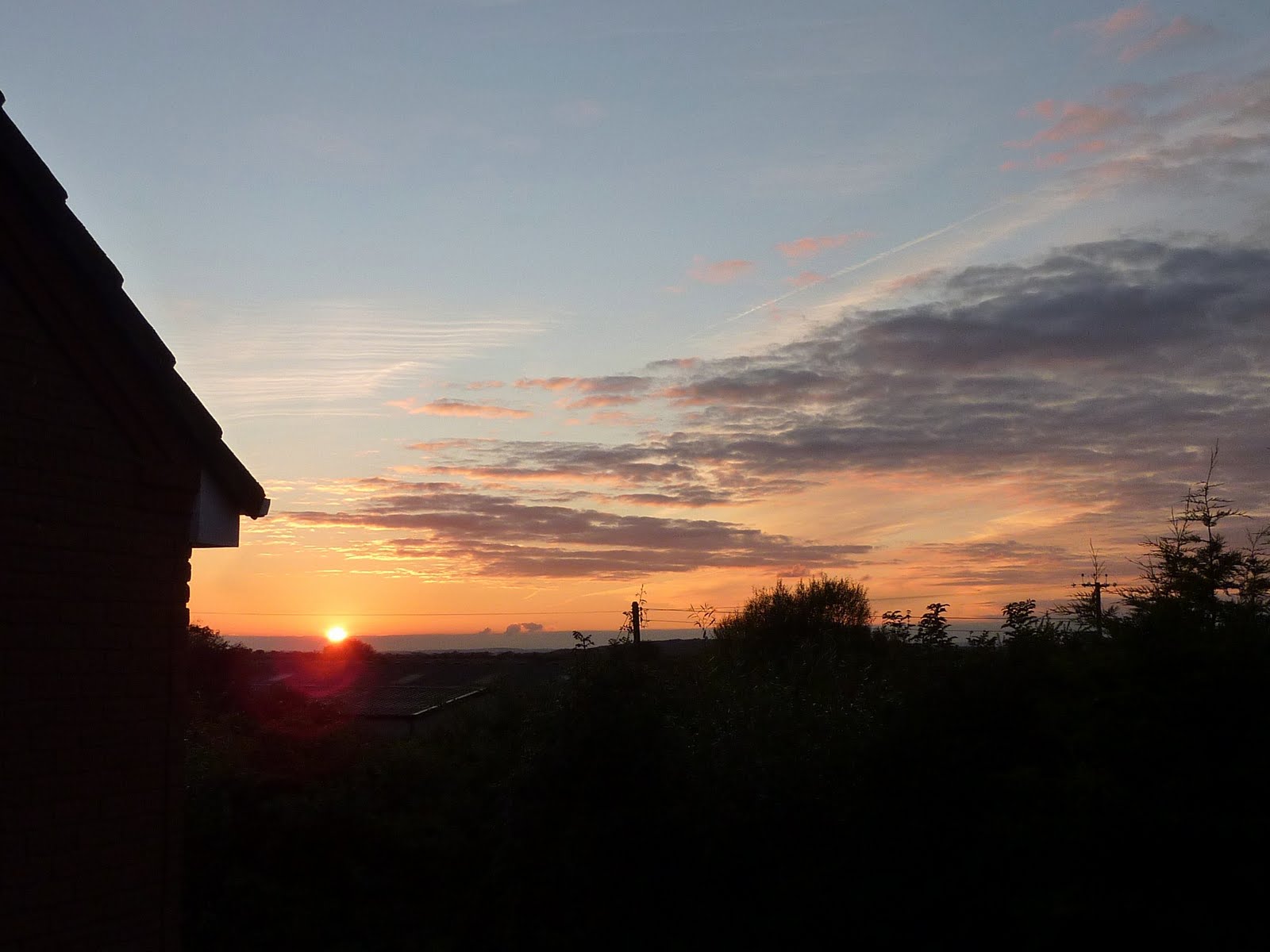


30th August 18.55 hours


30th August 19.16 hours


30th August 19.19 hours


1st September 18.13 hours


1st September 18.43 hours


And so as we head into autumn and then winter we will of course experience more sunsets, but I do feel the summer of 2011 has been an exceptional sunset year, for me at least.


~~~~ POSTSCRIPT ~~~~~


As if to prove my point in the above post, this afternoon it began to rain, torrential rain (why I came indoors to blog). But just now at 19.45 the clouds parted near the horizon as they often do in bad weather and this was the view out the back of the house just a few minutes ago, yet it was still raining on the house. Another magical sunset on a wet evening in September. So I'll let the photograph I've just taken below end the post..............


4th September 19.45 hours

Thursday, 25 August 2011

Empty Nest Syndrome

Today is a mixed feeling day as I'm suffering from empty nest syndrome. As I mentioned in my last post, my house is home to a house martin nest, sadly just the one, but being colonial nesters, all the houses around me with suitable eves also have a nest. It was quite sad this spring because in the middle of that very dry spell between March and May they arrived back and attempted to build another nest on my house but there just wasn't enough mud about to build one. The solitary dawbs of mud now splattering my wall are all that is left of their gargantuan attempt to beat the unpredictable British weather.


Most mornings (and evenings) I'm serenaded by the squabbling and activity of my martins. This morning though it was especially noisy. From the bedroom window, constant sleek bird shaped shadows darted hither and yon to the nest. Sounds of increasing activity drove me outside to have a look at what was happening, or at least what I thought was happening. And I was right.


The fledgelings were leaving the nest, with encouragement from the adults and already emerged young birds. House martins when fledging strictly speaking don't permanently leave the nest, they vacate it and can come back at night to roost, or in bad weather can seek shelter there. But this morning, I think was the second brood's first foray into the wide open skies of Somerset. And a good morning too, blue skies after a night of deluging rain of Biblical proportions.


It's always difficult knowing how many house martins are fledging. Normal brood size is 4-5 eggs and generally mortality of chicks is quite low. Today I think 5 fledged as at one time there were 7 birds around the nest, both flying and clinging to the wall. It was absolutely fantastic watching them as individual birds flew to the nest, around the nest, went into the nest and emerged out of the nest in very rapid succession. Occasionally a head would be seen at the nest entrance and another bird would fly up to it, chattering away, before both birds flew off in a wide downward arc and away, only for the whole process to be repeated again.


Last year my pair managed to raise 3 broods, they finally left in early October. I don't think this year is suitable for three broods, and in a way I hope they don't lay again because if the weather deteriorates they'll just abandon the chicks and head south to Africa. I will have a think over the winter whether there's a way of providing ledges of something on the house to help more nest be built next year, as I'd love to have half a dozen on the house, no matter how messy they make the windows.


It's a worrying time for lovers of house martins. Although there are about 3-400,000 pairs in the UK at the moment, this is actually a 60% or more drop in population from the 1980's and why the bird has been amber listed in the IUCN system since 2002. No one really knows why they are declining so fast, but as they are intricately linked to human habitation (even their scientific name urbica and colloquial name refer to dwellings) there may be a link to modern houses being less suitable, having fewer eves and overhangs. Certainly fledging data suggests pairs of adults are raising chicks with no change in mortality. But then again, insect numbers are fluctuating, and with climate change the Sahara is expanding. Is it just too far now to fly south to their wintering grounds. However on the plus side if winters continue to warm in Europe, which after the last 2 winters seems astonishing, potentially martins may follow a small percentage of their swallow cousins who increasingly seem to be able to overwinter in north Africa rather than fly across the Sahara.


Originally martins were cliff dwellers much like their cousins the sand martin, although the latter make nest holes in soft sediment and not nests. At some point now lost in the depths of history, they took to nesting on buildings, attaching their mud nest cup under eaves, presumably when houses began to be stable enough to replace the rigidity of rock. If you think about it the first solid houses built were castles and they were built often on rocky outcrops. So did the martins just make an obvious leap, when natural nest sites were exhausted. The nest is just fabulous and takes up to 10 days to build, and over 1000 beak sized pellets of mud. So that is 2000 flights from and to a nest in 10 days. An enormous effort. And that's possibly why this year other birds failed to make new nests on my walls. My theory is as everywhere nearby was parched earth, the nearest mud is the river, a quarter of a mile away, just too far to be worth while. But it is worth it as if a new nest successfully fledges chicks, the adults will return each year to re use it with just a light renovation each spring.


The other interesting thing with the martins around me is there are a lot of nests around my house but few elsewhere in the estate. The house and a few others around me were built in 1997 and half a dozen used to be the show houses. Show houses tend to be built literally in a building site. My theory is then that the martins again spotted an opportunity and built on these new show house cliffs surrounded by the mud of a building site. A perfect habitat and they have kept coming back ever since. Whereas in other parts of the estate they never got established and as the mud was built over, they could not colonise beyond this initial colony. I don't know either why martins never seem to build nests on dark eves, always one painted white. Most of the houses here have dark eves.


References to house martins in literature and folklaw are surprisingly few and far between. Which I find odd given that the swallow has been a writers muse for generations. but I think we should change that because they are such beautiful birds. Christians think the bird is lucky, possibly as it has connections as a servant of god, and in olden days it was thought lucky to live in a house with a martins nest if the young fledged successfully.


I'd agree with that, I'm a very lucky man to share a house with such wonderful birds of the air.

Tuesday, 23 August 2011

Solitude of an Autumn Fire

I always think there's something magical about heading into Autumn. At the weekend dew covered lawns shrouded in dawn's rolling mists, gave way to clear blue afternoon skies, rising from the landscape like a Phoenix to create a hot and yet quiet day. Only in Autumn do these days occur, when by mid afternoon everything is quiet, sounds travel for great distances producing that special stillness Autumn provides. It is hard to believe it will become cool again by nightfall. But it does.


I had a weekend on my own this weekend, and decided by choice not to leave the house. I occasionally do this when feeling jaded with the modern world, or exhausted. By nature I'm quite a solitary person, but also love being part of a social group, often found holding court in the midst of a gathering. But growing up an only child, spending time on my own and not having to perform the mental agility of genteel conversation with friends or family is a real joy for me.


And so it was this weekend. I spent a lot of time just relaxing, thinking, emptying my mind of all thought. Avoiding the news both broadcast and printed helped, best of all though, not driving for a whole 3 days. We all rush and bustle about too much and never take time to stop and stare. Sometimes in this mood I will wander the countryside by myself, often heading to West Dorset or down into Devon, but this weekend with the warm weather I just sat and read, sat and thought, relaxed outdoors in the sun, generally doing absolutely nothing. I know I'm lucky being able to do this, when many other people have family responsibilities or work commitments, but then again why not enjoy being able to do this. One day I will not be able to.


My job is fantastic, but can be exhausting. On Thursday I spent a most enjoyable day watching stone curlews at a secret location in Wessex, a busy 15 hour working day. But to hear those thick-knee birds calling in the night as they woke from their day-roost was worth all the planning and the miles. Even the creeping tiredness as I drove back down the M4 at 1am on Friday morning, failed to dampen my mood. But even when I arrived at home, the wildlife thrill hadn't stopped. Unpacking the car at the dead of night, the second brood nestlings in my house martin nest were twittering. I stood in front of my house. No other sound could be heard in the area except the gentle squabbling of baby house martins, fidgeting in the nest. Young birds that in a few short weeks will head a long way south on their first migration, much as the stone curlews, I'd seen earlier in the evening. Wildlife encounters never ever make me feel other that uplifted.


On Saturday, for once I had time to idly scan across long forgotten books in the office and by chance pulled out a book by Ralph Wightman, called Watching the Certain Things. This book had been withdrawn from a library years ago and I bought it for the lino cut images but then, had never read it. Opening the book idly the penultimate chapter was entitled "Solitude". I love these coincidences when a feeling in the hear and now often manifests itself as an action or deed which exactly mimics the beholders view or thoughts at that time. I read this chapter; he lived in Dorset and described wonderfully the area of West Dorset I go to for solitude at times of worry. So 50, 60 years before I read this book, he too had the feelings I, and many others have had, in that part of Wessex. Small fields, high views and a feeling no one lives here. I love it.


But for me this weekend the absolute treat was having an outdoor fire in the evening, from which these photos came from. I lay there letting half of my body roast slowly like a chicken, the other half bathed in luxurious coolness as the night became darker. By 10pm the stars were out and I lay back in a reclining chair in the middle of the garden, watching a satellite pass overhead. Just the one shooting star made its appearance tonight, but that's enough for me. My wish? Well to be bathed in the scent of woodsmoke, watching bats as they hunt, stars as they shine, and to witness the simple pleasure of gazing at shapes made by the dying embers of a fire on a cool Autumn night, for a very long time to come.

Sunday, 14 August 2011

And the harvest comes in

This afternoon Julie and I went for a walk around the lanes and fields of her village. A glorious afternoon walk of about 5 miles made all the better for being adjacent to a field as the combines came in. I love watching combines, takes me back 30 years to when I used to work in the fields at this time, both as a schoolboy and later as an agricultural journeyman.


Wilton Windmill from East Grafton

I didn't have my camera with me but the following images were taken on my Blackberry. I'd never used the black and white or sepia settings before, not bad for a mobile phone. Shame I hadn't my camera though as these would have made super subjects for black and white images.


Up the hill they go


Disgorging their work ready for the mill


Apart from the fact these are modern combines, black and white works for farming shots I feel, makes them seem timeless.


The same in sepia


And 2 colour ones, just for the record.

Wish I could drive one of these, looks like fun.......!!

Monday, 8 August 2011

New Research on young puffins

I've just read a fascinating new piece of research on the movements of Puffins after fledging.


In an article published on 2 August 2011, by Tamera Jones, young Atlantic puffins migrating for the first time scout out their own routes, rather than relying on genetic programming or help from their parents, the latest study reveals. Studies in Skomer reveal some birds go to waters off Greenland or Iceland for the winter, while others stay closer to home or head out in the opposite direction into the Mediterranean.


I love the way new ways of carrying out research are helping discover more and more about the birds we know and love.

If you'd like to read the whole article, then click here : NERC On-Line

Wednesday, 3 August 2011

Blimey.........it's August already......gulp !!!

Well I notice it has been months and months since I have daned to post on the blog.....time and tide has no respect for a blogger. But today, I have time for a photo journey over the last few weeks as I have crossed England in the pursuit of the mighty airwaves.


June saw me on the Farne Islands. A fabulous day although we had to get off pretty sharpish as the wind picked up and we were in for a choppy return to the mainland.


The view from the hotel in Bamburgh wasn't bad either!


Nor the sunset on the causeway at Holy Island


And apparently there is a roseate turn in the middle of the arctic terns at the Long Nanny site up there.


further south I popped into Weardale for a botanical foray into the vampires of that dale


Later in June I popped up to Ingleborough to run about on slippy clints and deep grykes in limestone pavement country.


While in mid June we both managed to snatch a long weekend in Boscastle in Cornwall


The famous Valency river which although tranquil this visit, flooded Boscastle in 2004


The beaches of St Ives were stunning in 50mph winds but blue blue skies


The waves were therefore quite impressive around St Ives and seem to have washed up this mermaid cum seal on the rocks..........


July saw me back in Yorkshire, this time on Malham Tarn taking part in a research project to find Britain's rarest caddisfly, which is only found here.


Being given permission to be out in the Tarn at night with a light trap was just magical, as thousands and thousands of grouse wing caddisfly emerged from the lake all around us.


And I even managed to get to Newcastle to record the kittiwakes on the Tyne Bridge, or as our lovely Geordie contributor said.... kitti waaaaarks


Well just a flavour of where I've been, and why sadly the blog took second place to being out there and doing it as they say.


And so, if you want to hear more; the following Living Worlds are coming up on Radio 4;


Puffin - Broadcast last Sunday


Limestone Pavements - 07.08.11


Vampire Plants - 14.08.11


Caddisfly - 21.08.11


Go on......have a peek................ http://www.bbc.co.uk/programmes/b007qyz3