
What a commotion there was yesterday morning. I was idly sitting on the bed looking out of the bedroom window while we debated whether to head over to Wells for lunch or not; and while doing so my eye (and ears) caught sight of a noisy gathering in the hedgerow trees in the back field. With my binoculars always at the ready I had a quick scan.

There was indeed a corvid conflagration taking place. The back field is a strange L shape and on the elbow of the L is a mature oak tree. Most years a carrion crow [Corvus corone] pair nest in the branches and with my telescope I've even watched young birds in the nest. Today however there were a pair of carrion crow battling with upwards of 20 magpie [Pica pica], and there was a real tussle going on. I tried to count the magpie accurately however the action, being both fast and furious, meant I struggled to confirm more than 20, I suspect though about 25-30. We do see large 'mischievous parliaments' of magpie here every winter, yet this one has to be up there with the largest.
What these mobbing magpie were actually doing I couldn't quite make out. It isn't impossible that the carrion crow had already built a nest and laid an egg, but that would be really very early (even in this mild part of Somerset) given mid March is more usual. And I couldn't see any nest. Was this a turf war with the carrion back on their old tree and the magpie taking offence? Or vice versa? Sometimes I've seen such crow mobbing around mature trees or hedges if a tawny owl is day-roosting. Today however this was a definite direct mobbing of the carrion crow, who repeatedly flew at whichever magpie was incoming while also shooing away a few others nearby waiting in the wings. And not just in this one tree, the skirmishes went on all across all the adjacent hedgerow trees, both carrion crow working together wave after wave back and forth.
It was fascinating to watch and I have to say the crows gave up a tremendous fight, so much so that even with numbers against them after ten minutes or so the magpie dispersed and two flew into our fir tree to noisily complain of their failed squabble. A fascinating observation of inter-specific behavioural exchange.

All of which didn't speed up our plans to head over to Wells, meaning it was just after noon by the time we arrived at the city, with a first visit to Waterstones for some ordered books, a bowl of soup to follow, and then with a lovely early spring day in the offing we headed into the Bishop's Palace to see the snowdrops. Virtually everywhere February is snowdrop month and the Bishop's gardens are no exception with guided walks and family days throughout the month. Today though was simply come and have a wander, which we did. Though the bulk of the snowdrops were not fully out, there was something pleasing in that they looked fresh and undamaged, newly emerged. On this visit 90% of the snowdrops were emergent but in tight bud still with just those in odd sheltered areas open. Next weekend there is a tour with the head gardener, we may have to return now we've purchased our annual ticket.

The Spring Room with Cathedral beyond
(Wells being named after the springs which bubble up through the rock)

One of the few clumps that were open and looking fresh and fabulous.

One of the spring fed ponds in the garden

Snowdrops awaiting to emerge en-masse in a few days

And a lovely quiet space where, as in Anglesey Abbey in Cambridgeshire, a woodland of silver birch provides a dramatic foreground to the looming lump of the Cathedral.
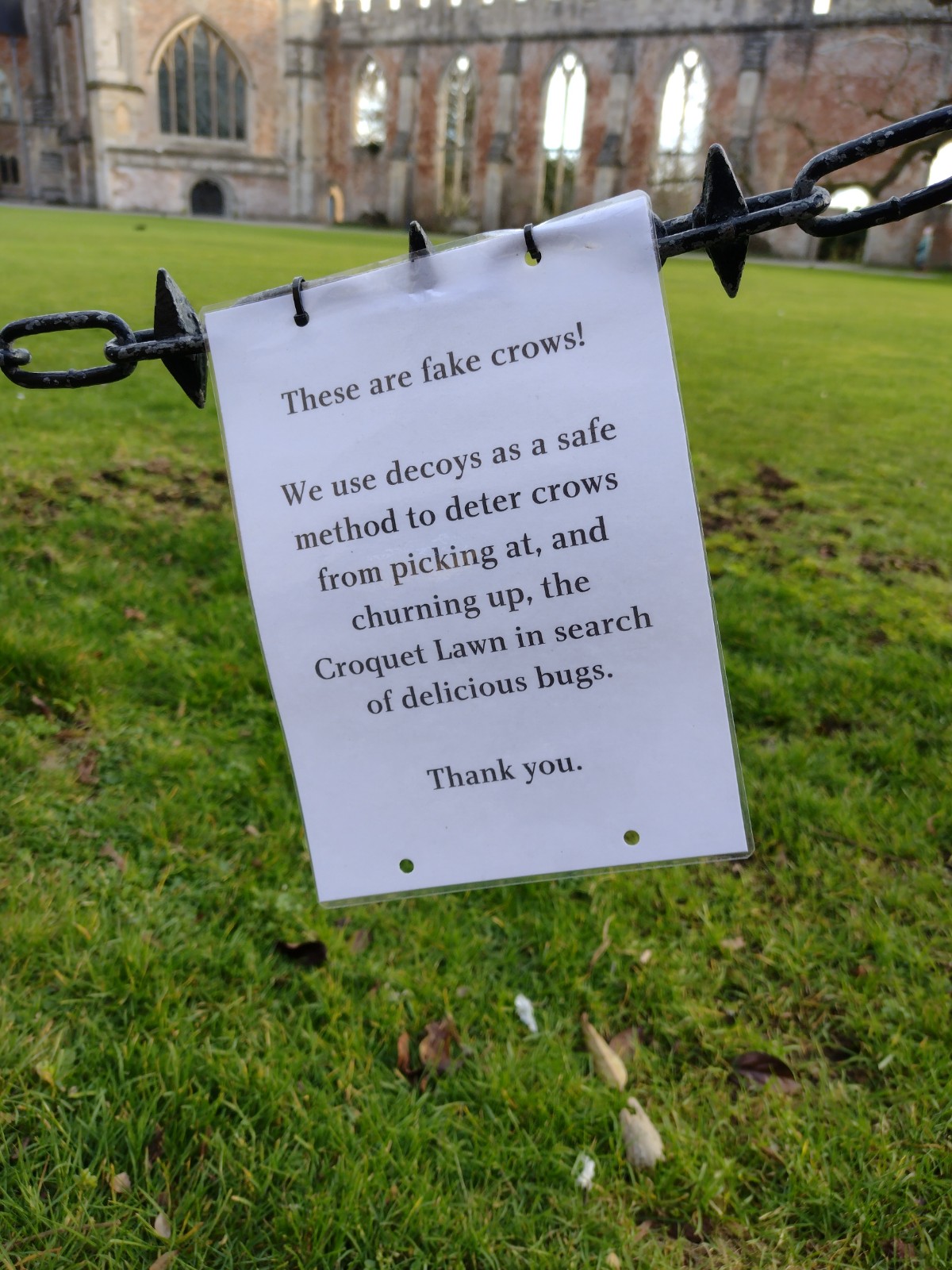
It was however on the way out that this notice caught my eye. I'd seen a couple of what looked like black plastic bags on the croquet lawn on the way in. Little did I know there were fake crows. Given the intelligence of corvids I'm not entirely sure half a dozen wooden rook on a lawn will prevent living and breathing corvids taking part in leatherjacket digging up. But it amused me the Bishop's Palace are at least trying an non-lethal way of pest control. Though I'd have thought removing the leather-jackets would be beneficial to a lawns' long term survival. Amusingly, inside the garden a dozen jackdaw [ Corvus monedula] were having a rare old time digging up another lawn.
So fake crows in Somerset eh? Some would say the magpie pitching in against the carrion crow today were not true crows, but they're not fake, and I suspect if they ever flew the 20 miles to Wells they'd simply ignore the signs and mob those wooden rook anyway.


