A

A
Showing posts with label Northumberland. Show all posts

Sunday, 31 December 2023

Christmas On The Move

It has, for want of a better phrase, been a mad-dash Christmas week. Those of a pedantic disposition could argue it was nine days rather than a week, but I for one am not counting the days, just the season. However I did do a lot of driving.

And so it began on December 23rd.


Sunrise was almost two hours away as we set off from Somerset at 6.35am. By the time we reached this road up to the village of Slaley in Northumberland it was half an hour to sunset and getting dark.  Not only dark but wet and quite windy. That wind would accompany our week in this remote cottage, all of which added to the atmosphere of festive escapism.


Our home for the week sat in splendid rural isolation hard by Slaley Forest. So rural at one point a flock of crossbill flew over the garden and on Christmas Day the sad remnants of a woodcock slain by a passing vehicle interrupted our visit to Tyneside with the fatted goose. Located on a hill farm of suckler cattle and sheep (plus four alpaca) the landscape was alive with wildlife, even in December. Rook roosted in the Scots pine shelter-belt, with the usual garden species on the feeders. A kestrel was a daily visitor but due to the volatile weather proper observation was tricky, however over the woods a regular scrap took place between a buzzard and carrion crow. Fieldfare, redwing and a single mistle thrush added variety to the huge gull flocks heading to roost each evening to what I assumed was to Derwent Reservoir about four miles away. 


Not everything involved wildlife. We managed to stagger down to Hexham a couple of times taking in and enjoying the Christmas atmosphere of the Abbey and catching up with friends.


We were fortunate to be staying during a full moon period. This is dark skies country and on Boxing Day morning at 4am I couldn't resist a short walk in the moonlight, moonlight which was strong enough to read a book by. It made for quite atmospheric walking too. Of course what this image does not show is the wind. Without exception every day provided strong winds, on a couple of days gales with sustained windspeed nudging 50mph, gusting higher. It simply never stopped blowing and as the farmer said they'd had three weeks of what the weather forecasters called volatile, I'd call it stormy, and rain, the rain was a frequent accompanying phenomenon with occasional breaks often at night. The last time I'd been in such relentless wind was on Orkney, very similar.


We also had snow. Admittedly this was wet snow, not enough to make a snowman but as with the Met Office's definition of a white Christmas, on our cottage one snowflake fell confirming a white holiday stay. How we realised it was snowing came by chance. Mrs Wessex-Reiver was looking out the bedroom window while it was still dark. I looked to where she was and thought the light coming in looked odd but then the moment passed. It wasn't until half an hour later when some daylight had appeared that we realised snow had fallen. Not crisp and even sadly as by mid morning it had mostly turned to rain.


It was the same day as the snow fell that we headed to Tyneside to see my father for a second day, the first being Christmas Day. On the North Sea coast by Whitburn we still had the wind, the sea was rough, however it was 11oC (7oC by the time we'd returned to the cottage). Quite a contrast to the morning.


All too soon our week was over, possibly as we'd had enough of the weather and returned south a day early. Not before another visit to Hexham where we not only discovered a fantastic independent bookshop where we could have spent hours perusing their stock but quirky little asides such as this advertisement for a clock restorer - these clocks are all broken but used in an alleyway display. And, as in many places these days the post box had a knitted hat. Hexham is a lovely market town.


By Saturday the 30th we were back in Somerset and after the eight hour drive the day before a quiet morning was required. We stayed local in Weston Super Mare having brunch at the Revo Kitchen which now occupies the former Sealife Centre. A bustling place a million miles from the remote area around Slaley and remarkably in the garden we have three daffodils in flower and a snowdrop almost about to open. Springtime in December.


Which all neatly brings me to New Year's Eve. We needed to stretch our legs so where better to head to than the Hawk and Owl Trust reserve on the Avalon Marshes. I'd heard short eared owl were here before Christmas, though on this visit despite there being plenty of other activity, no SEO's were to be seen. I'm fond of this reserve having watched it develop from arable farmland and peat workings. On our short four mile walk I realised I'd not been here for about a year, and therefore witnessed many changes including the maturity of the dragonfly pond which I'd last seen newly dug. Some nice hedge laying going on too. And the sun was out.


And so we reached the end of our walk, and the end of the year. A year in which many wildlife watching trips were curtailed due to other commitments, something I plan to rectify in 2024. How on earth we got to the year 2024 is beyond me. I'll be sixty in April and so need to rekindle the childlike naturalist spirit of encounter as I become Wessex-Reiver the sexagenarian. In fact it's starting tomorrow in earnest as I'm off to Slimbridge to kick start the birding year with some friends, I can't wait.

Happy New Year.
 

Saturday, 30 September 2023

Interesting Times : Loss and Renewal

The tree has been felled. What do I think?  


Like millions around the world I was alerted to breaking news last Thursday at breakfast time. The iconic sycamore tree at Sycamore Gap on Hadrian's Wall had been felled. At that time mis-information suggested it had simply blown over during Storm Arwen. But even I, a man who'd not held a chainsaw in anger for 30 years, could see this felling was at the hands of a much lesser force, Mankind.  

Like many I was angry, more angry than I could have possibly imagined.  I was upset, it really troubled me that this had happened. Who could be so crass as to have done this to a beautiful landmark. My best friend was on holiday in southern Spain. He lives literally on top of Hadrian's Wall, it runs underneath the kitchen of his converted Chapel, only a stone's throw from Sycamore Gap. I texted him. His replied was immediate and simple "Eh????". Exactly my reaction on hearing this. I couldn't believe what I was reading.

Quite a bit of that reading was hilarious as journalists who had no idea about this tree sprang into action. One copy in the on-line edition of the Daily Mirror had the headline,  "Beautiful 300 year old tree planted between 1840 and 1860 felled by vandals". Even with my mathematical incompetence I think they had the dates wrong. It was soon changed. The BBC Website ran a headline for a few minutes "Medieval tree visited by Robin Hood felled near Hadrian's Wall". Obviously that journalist's only fact gleaned from the press releases that speed around broadcast media's newsrooms was that Kevin Costner in the 1991 film Prince of Thieves travelled from Dover to Sycamore Gap on foot in one day.  Some copy was even more bizarre. The New York Times initially ran with Sycamore Tree felled near Scotland. I read on, realising how isolated the American press is. Northumberland was mentioned in the third paragraph and apparently Hadrian's Wall is a short drive from Scotland's beautiful capital home of whisky and Robbie Burn's. Of course American's only know about Scotland, so in modern terms it was simply click bait.

But all this smoke and mirrors aside, there is a real sense of anger prevailing over this felling of a single tree. I completely understand this sentiment, for many the tree stood for something, whether that was personal, aesthetic, natural history, a symbol that represented the north east or simply a focal point for a lovely photograph. But why was I so angry? I'd never been there.


Northumberland is a beautiful county and littered across this landscape are magnificent sycamore trees such as those I photographed above near Matfen in mid Northumberland a few years ago. Every farmstead, field and village has mature sycamores as a permanent symbol living in and of the landscape. Most, like the one now lying on it's side, are 200-300 years old. They are majestic and I love them, as they remind me of being a child, lazy sunny summer days when I'd be out for a wander near Rothbury and often found myself resting with my back on the trunk of a sycamore while I drank my ginger beer or ate a massive gobstopper. However I'd never been to 'the' sycamore at Sycamore Gap, a name which is itself fairly modern, as it was allegedly just made up by a Lawrence Hewer when an Ordnance Survey team visited and wanted to know what the feature was called. 

I'd driven past the Gap many times while on the 'Military Road', in the same way that many motorists on the A303 pass Stonehenge but don't stop but admire the view. I'd even stopped the car once when my Canadian cousins were visiting on their whistle stop tour of Britain so we could take a quick photo out of the car window. But although I've walked sections of Hadrian's Wall, I'd never got to the tree. And that is what interests me in two ways. Firstly it was a difficult place to reach even in daylight, so how on earth was a hefty chainsaw carried over there in complete darkness? It really is dark up there. But secondly, why did the loss of a tree I only knew of from a distance affect me?

I think answering that latter point is easy. As we age, loss becomes a larger part in our lives as our own mortality comes over the horizon, and trees themselves are meant to be permanent - we don't lose them - but if we do it matters. 

Take the image below, the oak on the right of this hedge line is known as Julie's tree.


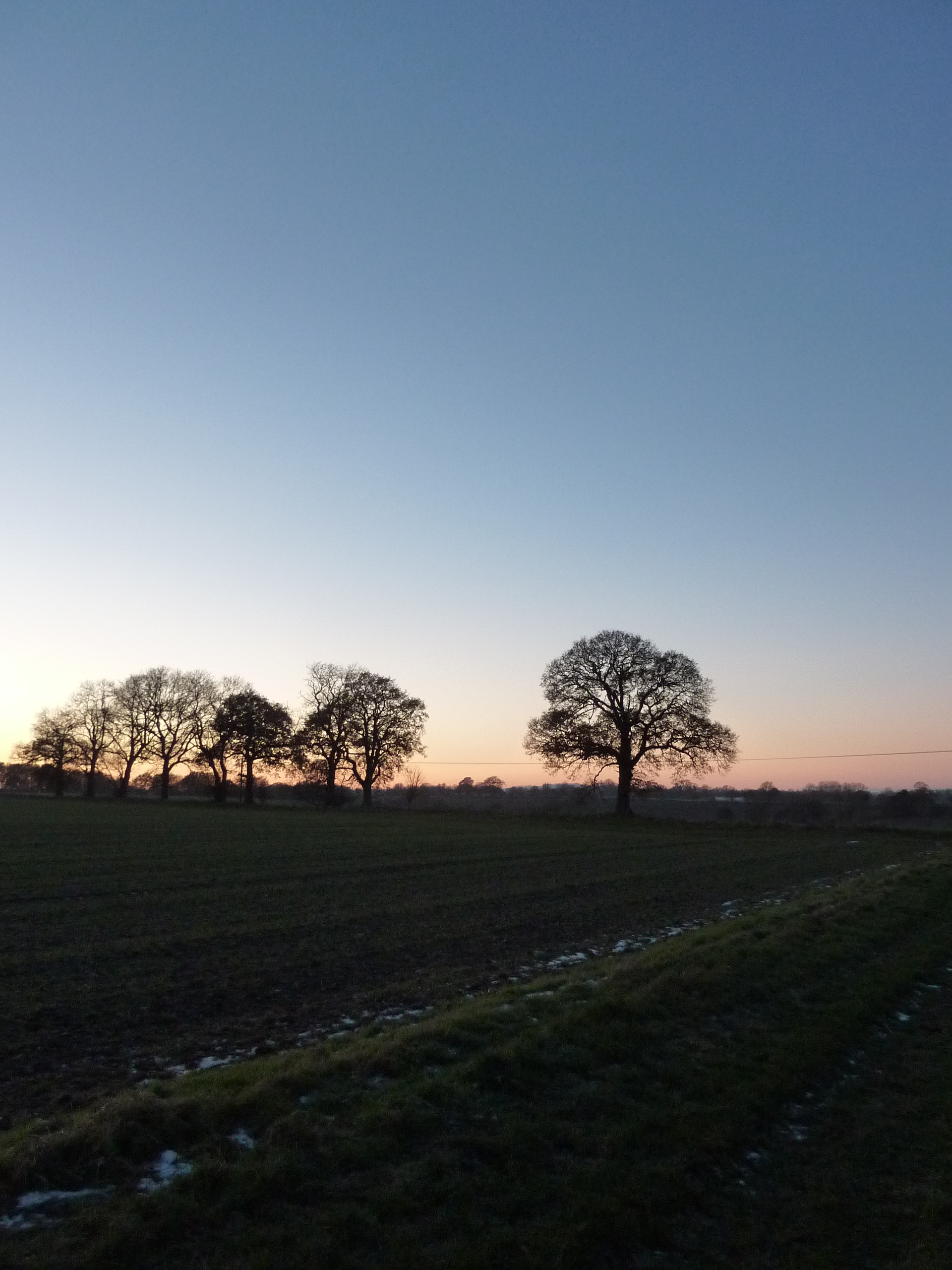
Nobody calls it Julie's tree apart from my wife, the very same Julie and myself. This was a landscape I got to know when we first met, the wide rolling landscapes that surrounded her village in Wiltshire. We walked up here on one of my first visits and while almost identical to every other tree for miles around this tree, (along with another in the village that was fenced off and we couldn't visit anymore), became "our" tree. And that is the answer. Permanence in the landscape grabs hold of the soul and never escapes. Julie moved to Somerset in 2014 and since then we've not been back to 'our' tree. I hope it still stands and hope it is well, but in my mind it is a permanent symbol of a happy time for both of us in Wiltshire.

The image of me at the top of this post is of Blindburn at the head of the Coquet Valley in Northumberland. I love it up here but have absolutely no connection to it other than it means something to me as a casual visitor. But I feel protective towards it. Oddly though, my wife owns a house further down the valley at Harbottle which we have no spiritual connection to. Julie may own it but it is occupied by a long term tenant and his family, a local family with children which is a wonderful addition for the village. But as we don't live there, that full blown spiritual connection will be focussed on those children growing up in this wonderful part of the world, not me. But I still have some connection.

Academic careers have been made analysing what it is to have a memory, what it means to experience spirituality or a Spirit of Place, that historical record of a time and a place that means something in that precise moment of time to an individual when we are there, alive and living. In a similar vein the below image of me as a volunteer warden at the National Trust's property of Cragside in Northumberland in the 1980s is another example. I didn't perform paid work there, I never lived on the estate, but for about six years, I spent every weekend there doing something I absolutely loved, being out in nature, learning how wardens (now rangers) operate and meeting the public. I forged fantastic long term friendships there, but then I moved south and I've only returned a couple of times as a visitor. But if anything catastrophic happened to Cragside, as happened to the sycamore at Sycamore Gap, I'd be devastated. 


The wanton destruction of the sycamore on Hadrian's Wall was an abominable act.  Why someone thought it was a good idea to illegally fell a beautiful tree is not something I think anyone will find out soon. But it's gone. Many people are suggesting what happens next. An Anthony Gormley sculpture in its place. I personally hope this doesn't happen. A wooden sculpture of the tree made from the trunk. Maybe, but can this be in a museum or arts centre. I worry the site may become a bizarre shrine to something that was once loved but has gone, eradicated and will never ever come back. Nature carries on if we let it, but what replaces it will never be what was there.

There was an excellent comment by Gary Bartlett I read, who perfectly summarised my thoughts on what may happen to one option.  The National Trust and many others are suggesting the coppicing of the stump will preserve the tree. I don't know Gary, but he writes......

" It's a nice thought.... But let's be realistic. I first met this particular tree in 1990 when surveying the trees on sections of Hadrians wall. This Sycamore was in it's unadulterated natural form, three centuries in the making. It had a twin stem which added to it's aesthetic appeal.

Sycamore will respond to hard pruning but a coppice or a pollard never take on the appearance of the natural form... You can go to Sherwood forest and see 700yr old oaks that haven't been pollarded for well over a hundred years... And they still bear the signatures of the woodman's saw. There is a reasonable possibility that this tree will soon throw multiple shoots up from the stump - it will have the appearance of a scruffy thicket for a few years. With careful selection of maybe 2 or 3 dominant stems (& their protection from further vandalism); a new tree may be crafted... After 10yrs of nurture, a new multi-stem tree with a natural habit may be visibly appreciated & in 40 to 50 years it may have the appearance of a reasonably mature tree. It will be 80+ years before it has anything like the stature of what was lost & another 50yrs beyond that until it has any sense of grandeur. In the meantime, the tree will be vulnerable to pathogens - especially fungal.

It is exposed to fairly strong winds - and sucker shoots in maple species are prone to tearing out at their union with the stump or stub. This structural weakness will be ever present for the first 20-30yrs at least. Sycamore don't tend to send up daughter plants / clones away from the stump like many Prunus or Poplus species will... So new shoots will be limited to the stump - which will in time decay from the centre... There is a risk that the shock of losing the main stem might kill the tree (at this age), so regeneration is not guaranteed.

Planting a replacement will be challenging as the site is a scheduled ancient monument - so a planting site would need to be identified for a new tree - agreed by Historic England / English Heritage and the National Trust (whichever have jurisdiction on this section of Hadrian's wall). An archaeological dig would likely be required before a new tree could be planted.

The tree that has been lost will never be replicated - it was unique.

Northumberland has many tens of thousands of Sycamore trees; many of which are older, taller, broader and arguably more magnificent than this one (I urge you to seek them out - they will warm your soul).

But this tree was the iconic "Sycamore Gap" tree... It cannot be replaced by a tribute act. 
This tree seems to have become a metaphor for man's relationship with all trees... From the Amazonian rain forests, to trees being felled for access to building sites or new infrastructure. It's loss feels like the assassination of Martin Luther King or Kennedy... Senseless."

Gary Bartlett ended his piece with these words on the desire to coppice.

[I admire the optimism.... ]... Unfortunately few of us will be around to discuss this by the time this tree may become anything reminiscent of the original."

Other people will have many other views and that is how it should be. But for me now some forty eight hours into the story, this is how I'm increasingly feeling. The anger I felt at that tree's destruction has softened. I'll now never visit the tree, but, and this is important, if it had been such an important part of my life, I'd have made the effort to visit it while it still stood. Now, my mind is focused on change and the future. Let the fallen tree decay at it's own rate into the landscape, help dead wood invertebrates and plants thrive for a few decades in this most treeless of landscapes. Plant something new, maybe not in the same place, but nearby. The loss felt by my generation by this criminal act could benefit generations to come. I remember visiting Kew Gardens while on a botanical course in February 1988, just months after the October 1987 storm had ripped through the gardens. Many much loved trees from their specimen area had fallen. It was while on a walk around the site, then still closed off to the public, with Kew's arboriculturalist that he said something I've never forgotten. 


"[sic] Arriving at Kew on the morning after the storm he cried and cried for the lost trees there, many of whom he thought of as family. But then as the weeks passed he realised this was a moment to embrace change and plan for the future." 

Looking at Kew Gardens now it's almost impossible to imagine the damage caused on that October night. My hope then is the same fate befalls the toppling of this sycamore. Over the months and years we'll see change at Sycamore Gap. We as a society must and can look forward. What can we do as a society to make the landscape better for children being born in 200 years time? We have benefited from a tree being planted in the 18th Century maturing in the age of Social Media. Much like the trees below in the field next to the aforementioned friend's house only a stone's throw from Sycamore Gap which I photographed while on a walk before breakfast last November. They're just trees, no one except the odd walker will notice them. They stand there quietly removed from the consciousness of collective society. Would anyone miss these unknown trees if they were felled one night? I doubt it, and that is a most sobering thought. 


Monday, 20 July 2015

Coquetdale Moves With Spirit

The applause from the back of the bus was deafening. As I looked out of the window at the Three Wheat Heads in Thropton I half waited for cheers and dancing to join the applause, but then again this is the Coquet Valley in Northumberland. They do it differently here. They do it well.
 
I've followed the fortunes of Spirit Buses since they began last year by local Rothbury lad Steve Hurst. I've never met Steve before, but from people I know living here I realised he was someone who is admired and they want to see succeed. Rothbury has a long tradition of doing things their own way and from what I'd read and heard he had a passion to provide a bus service to this area and do it one better. A simple aim - to provide a real modern view of what a bus service should do in a rural area by providing the people with what they need, not what other bus companies see as a minimum service. And I have to say, from my first ever encounter with Steve he has achieved this without question.
 
I'll put my cards on the table and admit that I know the Coquet Valley well. For 20 years my parents had a static caravan up on the Coquetdale Caravan Park 'just up the hill', every spare moment was spent here allowing me to wander the Coquet landscape unhindered from the age of 6. Later I volunteered for many years as a warden at the Cragside Estate just outside Rothbury which completed my education of this Northumbrian jewel. I may have never actually lived in Rothbury, (now living 400 miles away in Somerset) but the Coquet Valley means a lot to me, in many ways provides my roots, my soul and my spirit.
 
Apt then that Steve Hurst should name his company Spirit Buses.
 
This weekend I was up with my partner Julie for the Rothbury Traditional Music Festival, but I have long wanted to support Steve and go up the Valley on his bus. The hour of departure arrived. Taking a break from the pipes and fiddles, at 14.45hrs the bus arrived in the centre of the village. A newly purchased (and as yet unliveried) Spirit bus.
 
 
We were going on the 'Coquetdale Circular'
 
 
This Coquetdale Circular route follows somewhat in the footsteps of the Royal Mail Post Bus Service which ran until January 2009 up the Coquet Valley to the last village of Alwinton. While the National Royal Mail service provided a lifeline to the many hamlets and farms up this remote valley by ferrying passengers while delivering the post, it received thousands of pounds in subsidies from Northumberland Council to keep it running. When the subsidies stopped the service stopped and for anyone living west of Thropton, the terminus to a national provider, public transport ended.
 
The similarity stops there. What Steve Hurst is doing is running a service without any financial subsidy, using his own money and driven enthusiasm. Not only up the valley, but to Alnwick (Rothbury and Alnwick have never been connected by public transport), Morpeth and other areas. How he has done this can be read below in an article in the Guardian.
 
For me last Saturday I solely wanted to experience this bus journey for what it is, which is now also becoming tourist service in its own right.
 
 
The bus was nearly full when we set off. Half the passengers were local. Steve greeting each one by name, a smile and a few words. The rest were, like me,  tourists excited at being driven on this 20 odd mile round trip for little more than the cost of a skinny latte in a city centre bistro. As I got on the bus I asked Steve if it would be okay to take photos on the way.
 
"No problem, I'll stop at Alwinton too and you can get out and take one there"

 
And we were off. Up the valley. Thropton 2 miles away, then Snitter a mile or so further on. As a car driver I have to concentrate on the road, but released from the rules of the highway my eye was caught by myriad views of the passing landscape newly seen from the height of a bus. Ohh that's what's over that hedge then? Just fabulous.
 
Onward the bus went, after Snitter, Netherton. The scenery is getting wild now. Behind me tourists 'ohh-ing and ahh-ing' at this huge, vast skied breath-taking scenery. Camera's clicked, people pointed. One lady, obviously local, had brought two guests with her and began pointing out places of interest or where she went to school. Quietly in front of me a local couple sat with their shopping, another man read a book to his little girl and an elderly lady sat next to me. More on her later.

 
Biddlestone next and it's red quarry scar, before the long drive into the remote valley near Alwinton, where the bus turned round to head back on a different route.


Alwinton: population 71:
 
This is the last village in the Valley. It has the last pub in the valley and is a centre for walkers and cyclists heading up Clennel Street in search of fresh air and freedom on the Cheviot Hill. Had the spirit bus continued, after about 6 miles it would have passed the last tea shop in Northumberland, at Barrowburn. Possibly the most remote café in England which is well worth a visit. Sit in the garden of this café and take the view. Nothing but hills and the odd passing sheep oh and absolute silence (providing the NATO Ranges are not firing at Otterburn). 6 miles or so beyond Barrowburn the road slowly ends close by the Scottish Border. It's a remote landscape loved by me and historically frequented by the Reivers.
 
Alwinton is home to another last, the Alwinton Border Shepherds Show which as the last country show in the calendar takes place this year on October 10th. Sometimes I sit daydreaming about the Alwinton Show while working in Bristol or at home in Somerset, its what keeps me going.

 
However my daydream was broken on Saturday by Steve. Having picked up half a dozen walkers they now filled the bus. Steve's head popped round the side of where he was sitting.
 
"Do you still want a photo here?"
 
I'd not forgotten (honestly) I just didn't want to get in the way. I got off and photographed his bus by the stop hard by the Rose and Crown
 
"Can I take a photo of you Steve as I want to write about this"
 
"No problem, I get a lot of these now from tourists, happy to do it"
 
Photographs done, I rushed back on passing the tourist information Steve has on his bus. Aside from the regular scheduled services, I'd been reading how Steve operates special events and also ties in with people like Shepherd Walks who have developed walks based on where his bus goes to and from and his timetable. 
 
This is what makes this such a special service. It's a bus service run to a very professional standard, on time and in clean friendly buses. Yet it is also a community hub, a link to other areas and people, provides tourist transport and as I was about to witness, a rural delivery service.

 
We were off, through the wonderfully named Harbottle then on into Holystone, chance for a photo of the long gone Salmon Inn in the far distance (where I spent much too much of my early years). An about turn and retrace our steps into Sharperton and a halt.
 
 
Out Steve got and walked over the bus stop where various items were. He was dropping off a delivery. Out here the community look out for each other and the additional services this bus provides is apparently well used by locals. The delivery made we left Sharperton back into the lower Valley and heading to Thropton, leaving me with plenty of time to take an artistic image of the ever smiling Steve at the wheel of his office while waiting at some traffic lights. 

 
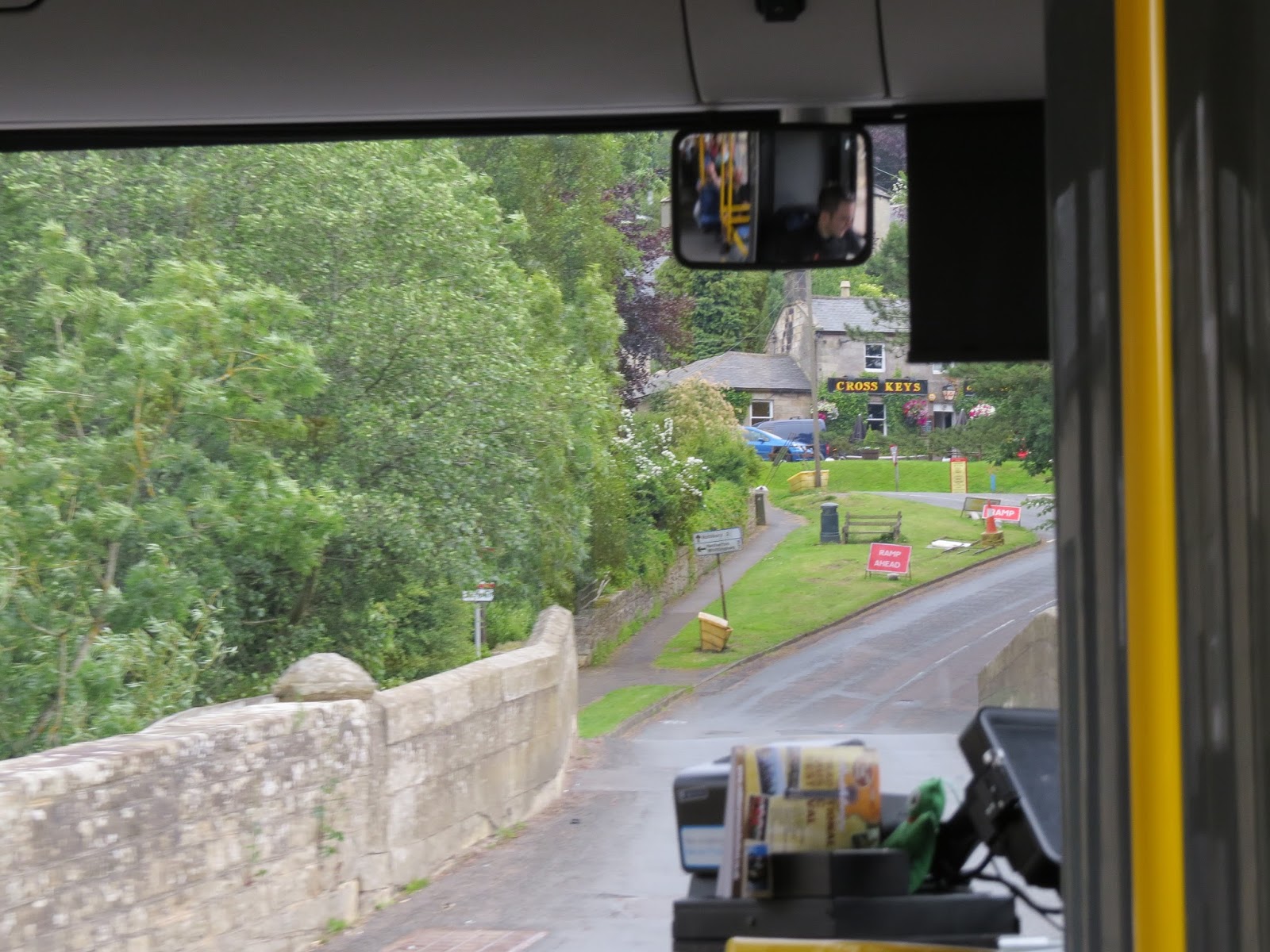
Roadwork's in Thropton distracted everyone including Steve who accidentally drove by the regular stop where the elderly lady next to me hoped to get off.  Apologetic he pulled up as soon as he safely could, switched off the bus and walked the lady the few yards back to her home, returning to his seat accompanied by a huge round of applause from the locals (and tourists) for his act of generosity. Then we were off, Steve waving at a chap by the roadside who I later discovered was Henry, someone I'd not seen in 30 years, not since those days when the Cross Keys in Thropton and the Salmon in Holystone swapped clientele. Moving on ....
 
 
All too soon we were driving into Rothbury, time for a few last images of the Simonside Hills and the Festival from the bus.  


Matching reality to words often fails but during this short 1 hour journey I'd seen more community spirit, heard more laughter, witnessed more good will towards people, more waving at passing motorists, than I've seen for a long time. I don't know Steve but a conversation with one of the locals after we arrived back in Rothbury summed it up beautifully.
 
I was taking the photograph below and she stopped me.
 
"Did you enjoy your ride on the bus?"
 
I recognised her as one of the locals who'd been on there. Explaining how it was fantastic and more people should come to Rothbury and experience this she said (and I'm paraphrasing)
 
"Steve has brought this valley to life again. Without him we'd not be able to get anywhere. I don't drive so relied on friends for lifts. Now I can get on here and go to friends, go to Alnwick, or Morpeth and know I'm with someone who I can rely on. He's such  a good man, I only hope he can keep this service going"
 
 
I hope that too and why I've written this. As I've stated, I don't know Steve (who I hope doesn't mind my writing this), I have no connection to him other than by word of mouth, but I feel what he has achieved against mounting opposition in some areas is quite simply phenomenal. To run a bus service unaided, unsubsidised and on his own takes guts. He has guts, but he also has a charm and a sense of I am here to help the community, all with a sense of humour. Financially it must be a struggle. This is not a well populated area and running buses I should imagine isn't cheap. I hope then that more people come to the Valley and use his service. It is liberating to get out of the car and be part of a community on the move. I loved it and will do it again.
 
That lady I chatted to for over 5 minutes spoke of Steve in such warm tones, about a man who loves his village and its surrounding area and is actually doing something positive on his own for the good of others.  Steve Hurst, is in many ways the real Spirit of Coquetdale.
 
 
Spirit Busses website - http://www.spiritbuses.co.uk/


Saturday, 24 September 2011

21 Years Ago

Well well well....... back in the mists of the last Century I began my conservation-cum-wildlife career. In those days I was here there and everywhere in Durham and Northumberland learning my craft. But by 1990, as a lot of my work was voluntary, I'd realised I needed to get a degree to move on, and get paid for doing a job I love.


L-R John Middlemiss (Head warden), Dave Edwards (Warden), Damian Rana (Warden), Me (Volunteer), Julie Rana (wife of Damian and wardened at weekends)


Sorting out the office tonight I came across this photo. Not that I'd lost it, just I didn't know where it was these days. This photograph was my last day as "official" voluntary warden at Cragside in Northumberland, hence why we're all standing like lemons in front of a sign I'd quickly written at the end of the day. I was at Cragside last week and mentioned this photograph to Julie, strange then to see it again so soon after that conversation. Strange too to see the ramshackled uniforms. These were the days before corporate identity came to the fore. We just wore whatever we worked in.


I began there in 1986 and clocked up over 1500 hours of voluntary wardening experience there in the 4 years before this photograph was taken. Not a bad achievement considering I had a full time job too. I was also working as co-ordinator for the North Northumberland Otter Project, conducting various surveys for NGO's as well as Nature Conservancy, working for and on behalf of the National Trust's Northumbrian HQ of anything which needed doing in the Durham area, as at that time there was no NT staff down there, such as NT rep on members groups, involved with the Neptune 500 project, and heavily involved during for the hand over of Souter Lighthouse from Trinity House to the National Trust.


This latter work was fascinating as I was invited into the lighthouse by Trinity House 2 weeks before it was handed over and shown round to make notes for the National Trust's land agent, prior to being myself the NT rep on site after handover. What was lovely was that the keepers lit the lamp for me and I was allowed into the lamp room while the huge lens floated past me on a mercury bath. Something the public were banned from doing. But as I was representing the new owners, it was an absolute privilege to be in a lighthouse in those days when still an operational building run by 2 keepers. An experience no one will ever be able to get again now that lighthouses are unmanned and fully automated.


Although I kept going back to Cragside as a volunteer warden on an ad-hoc basis until 1994, it was never the same. So this photo marks both the end and the beginning of an era. It was the end of my time at Cragside, but six weeks later I started my Countryside Management degree at Newcastle. Graduating from there in 1993, I applied for and got a job with the BBC's Natural History Unit in Bristol, moved south and 18 years this November, I'm still there making wildlife programmes on the radio.


But seeing this photo brings it all back to me, that excitement of developing a career in wildlife conservation in my early twenties. If I had my time all over again, I'd do exactly the same. But where did I have the energy to do all of that work and have a full time job.....and where has the time gone!!


Great Days, great days indeed.

Wednesday, 3 August 2011

Blimey.........it's August already......gulp !!!

Well I notice it has been months and months since I have daned to post on the blog.....time and tide has no respect for a blogger. But today, I have time for a photo journey over the last few weeks as I have crossed England in the pursuit of the mighty airwaves.


June saw me on the Farne Islands. A fabulous day although we had to get off pretty sharpish as the wind picked up and we were in for a choppy return to the mainland.


The view from the hotel in Bamburgh wasn't bad either!


Nor the sunset on the causeway at Holy Island


And apparently there is a roseate turn in the middle of the arctic terns at the Long Nanny site up there.


further south I popped into Weardale for a botanical foray into the vampires of that dale


Later in June I popped up to Ingleborough to run about on slippy clints and deep grykes in limestone pavement country.


While in mid June we both managed to snatch a long weekend in Boscastle in Cornwall


The famous Valency river which although tranquil this visit, flooded Boscastle in 2004


The beaches of St Ives were stunning in 50mph winds but blue blue skies


The waves were therefore quite impressive around St Ives and seem to have washed up this mermaid cum seal on the rocks..........


July saw me back in Yorkshire, this time on Malham Tarn taking part in a research project to find Britain's rarest caddisfly, which is only found here.


Being given permission to be out in the Tarn at night with a light trap was just magical, as thousands and thousands of grouse wing caddisfly emerged from the lake all around us.


And I even managed to get to Newcastle to record the kittiwakes on the Tyne Bridge, or as our lovely Geordie contributor said.... kitti waaaaarks


Well just a flavour of where I've been, and why sadly the blog took second place to being out there and doing it as they say.


And so, if you want to hear more; the following Living Worlds are coming up on Radio 4;


Puffin - Broadcast last Sunday


Limestone Pavements - 07.08.11


Vampire Plants - 14.08.11


Caddisfly - 21.08.11


Go on......have a peek................ http://www.bbc.co.uk/programmes/b007qyz3