A

A
Showing posts with label Raven. Show all posts

Tuesday, 6 December 2022

Mixed corvid roosts


A couple of days ago I was entertained by what can loosely be described as 'a murmuration' of corvids. Of course that noun is mostly used in reference to starlings, yet on that morning what I witnessed was perfectly summed up by the word murmuration.

Corvid roosts are well known for providing spectacular displays overhead. I was once invited to view the famous Maddingly roost in Cambridgeshire with scientists from that University. On that wonderful day it was breath-taking to watch thousands of rook and jackdaw not only alight en-masse at dawn, but provide unbelievable aerial displays in the evening as they came into the roost site. What a privilege to be in amongst them, and what a noise!

And it was the noise earlier this week which caught my attention as to what on earth was going on. It was a few minutes before dawn, and in that half light a cacophony of rook and jackdaw calls drifted to me from the fields behind the house. I watched from the bedroom window. This mixed flock of around two hundred was moving swiftly and acrobatically over the fields. Some birds alighting on trees, others simply playing with the wind. Repeatedly they grouped together like black snow, twisting and turning before moving out over the landscape only to then return moments later and repeat this acrobatic show. On the side-lines carrion crow joined in and at one point a raven flew through the melee cronking loudly. I've seen these mixed flocks many times before, as I mentioned above, but always at or near to the roost site. This more recent event was across flat fields and over 2 miles from the nearest roost site on Worlebury Hill just to the south. It was all very much part of the normal behaviour of corvids at dawn as they reaffirm social bonds, however in the 20 years I've lived here I've never seen this over these particular fields. Had this flock been disturbed in the roost site and amassed over fields awaiting dawn? I wasn't sure but it was a wonderful fifteen or so minutes as the light improved.


I mentioned what I'd seen on Facebook and my friend Chris Sperring came back with an open invite to come and see his roosting corvids. These are 15 miles north of me (as the crow flies) and he mentioned that he has observed a number of ravens 'herding' jackdaw as they arrive over the woods, herding them to a specific area of the wood and therefore presumably the right part of the wood, in raven terms, to roost in. Raven have increased dramatically in this area and so later he posted a Facebook Live where indeed a dozen or so raven seemed intent on chaperoning the jackdaw to the part of the woodland the ravens wanted the smaller corvid to use that night. Time and time again watching that video, raven rose up from their perch in trees and flew with and around the jackdaw until the latter settled, with the raven then returning to their tree and waiting the next influx of jackdaw. I'll have to visit and see this for myself.

I'd not heard of this ravens providing a guard or a herding behaviour with jackdaw, or rook for that matter, so later in the evening I did a little research. Mentioned within Raven in Winter by Bernd Heinrich is an intriguing mention of Raven in Wales by W. A Cadman. In this observation from 1947 mixed flocks of corvids were observed coming to a roost with the ravens at the periphery of roost activity. This led me to another article by H. G Hurrell, A Raven Roost in Devon from 1955-56.  This was fascinating. A raven pair held a 5 acre wood as territory. While they did, they had the wood to themselves. Eventually they disappeared and a number of raven began using the wood as a winter roost, eventually over 80. However once the number of raven at the roost increased jackdaw then came to the wood and roosted there too. The summary therefore suggests that ravens provided security and support for the smaller jackdaw, both benefitting through collective feeding and roosting behaviour.

All very intriguing and leaving me wanting to know more. Are corvid roosting patterns, and indeed behaviour changing as the number of raven in lowland Britain increases? Certainly in the raven roost north of me, when I lived up that way in the mid 1990's you'd never see a raven, or maybe once a year as it flew by. Now Chris tells me 20, 30, 40 are not uncommon at night, every night.  Do these intelligent birds have a threshold number after which their influence to smaller corvids is triggered. I have read studies of ravens at a roost and there seems to be information intelligence happening, with some observations suggesting as one raven arrives one raven departs to prevent overcrowding, in other words they, the collective ravens at the roost maintain the numbers there at any one time through observation and communication amongst themselves. Society in fact. 

Whilst persecuted in the past, ravens were often describes as solitary pairs, driven to upland and wild areas. In fact throughout history ravens have been gregarious, lowland inhabiting birds, and who knows, the catalyst for extraordinary mixed corvid flocks, and behaviour as seen recently at the roost site? I simply don't know nor have the answers yet, but I have a feeling this question is going to return to me over and over again this winter, and so, I must visit that roost in the Gordano Valley and see for myself.

Tuesday, 19 March 2019

Corvids at Dyrham Park


Anyone who knows me understands that while I'm a wildlife lover, corvids are my main interest. All of this stems from my days down in Dorset a decade or more ago, when rooks would flood into the garden on blustery mornings and I'd sit mesmerized by their behaviour. Often for hours on end. Around the same time I recorded and produced a Living World on jackdaw research at Cambridge and became absolutely fascinated at how intelligent these relatively common birds are. 


Which may seem odd that this image is of a buck fallow deer at Dyrham Park near Bath. I was here for a meeting and after this decided instead of pootling back home I'd wander about this estate, somewhere so close yet for all the time I've lived down here I'd never visited until last November, again for a meeting. So, meeting over, I got the bus back to the carpark, hurled my laptop into the car and decided to walk back down to the house. My journey was interrupted by a small herd of fallow deer running hither and yon across the estate. A couple of bucks and maybe a dozen females. I know they're not a native species, but nice to see nonetheless. However it was while watching these I heard the first soft crooooop cruooop of a raven.


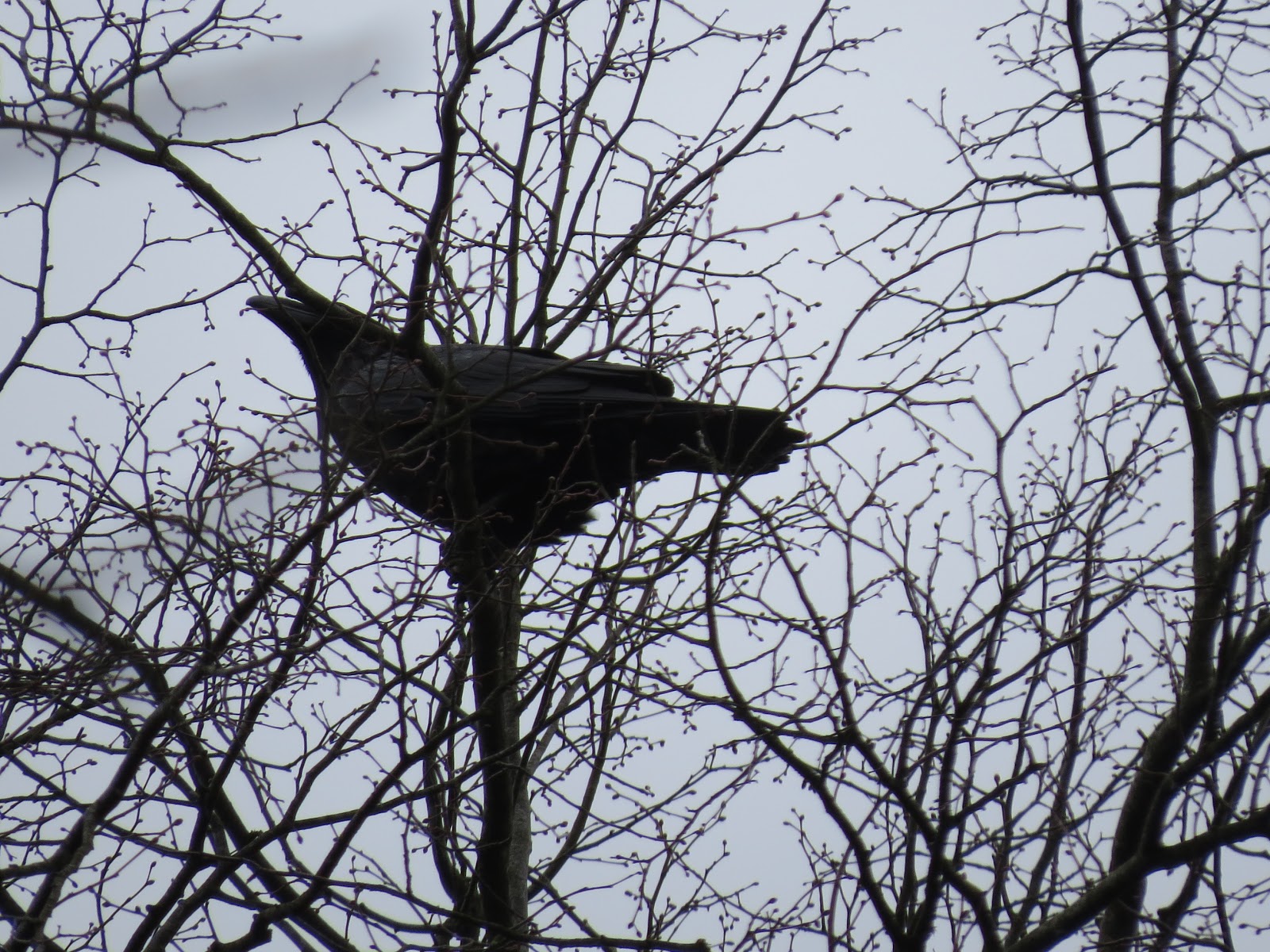
At first I had absolutely no idea where this was coming from other than behind me. I spun around and coming down the valley was this big fella. All the while soft contact calling to an bird which I never saw. But I think it might have been in a large Cyprus tree. Why did I think that? Well this raven alighted in the Cyprus and let out a number of contact calls. I couldn't see anything else as the needles were too thick, but given in the lowlands ravens love to nest in big conifers, an educated guess makes me think. After five or 10 minutes this raven then flew to neighbouring trees, calling again, then flying past the Cyprus and back to another tree. Amazingly ravens are thought to have over a hundred contact calls and today this chap was using a number of them. Soft whistles, a range of varying croop croop, a sort of low pitched whistle and many more.


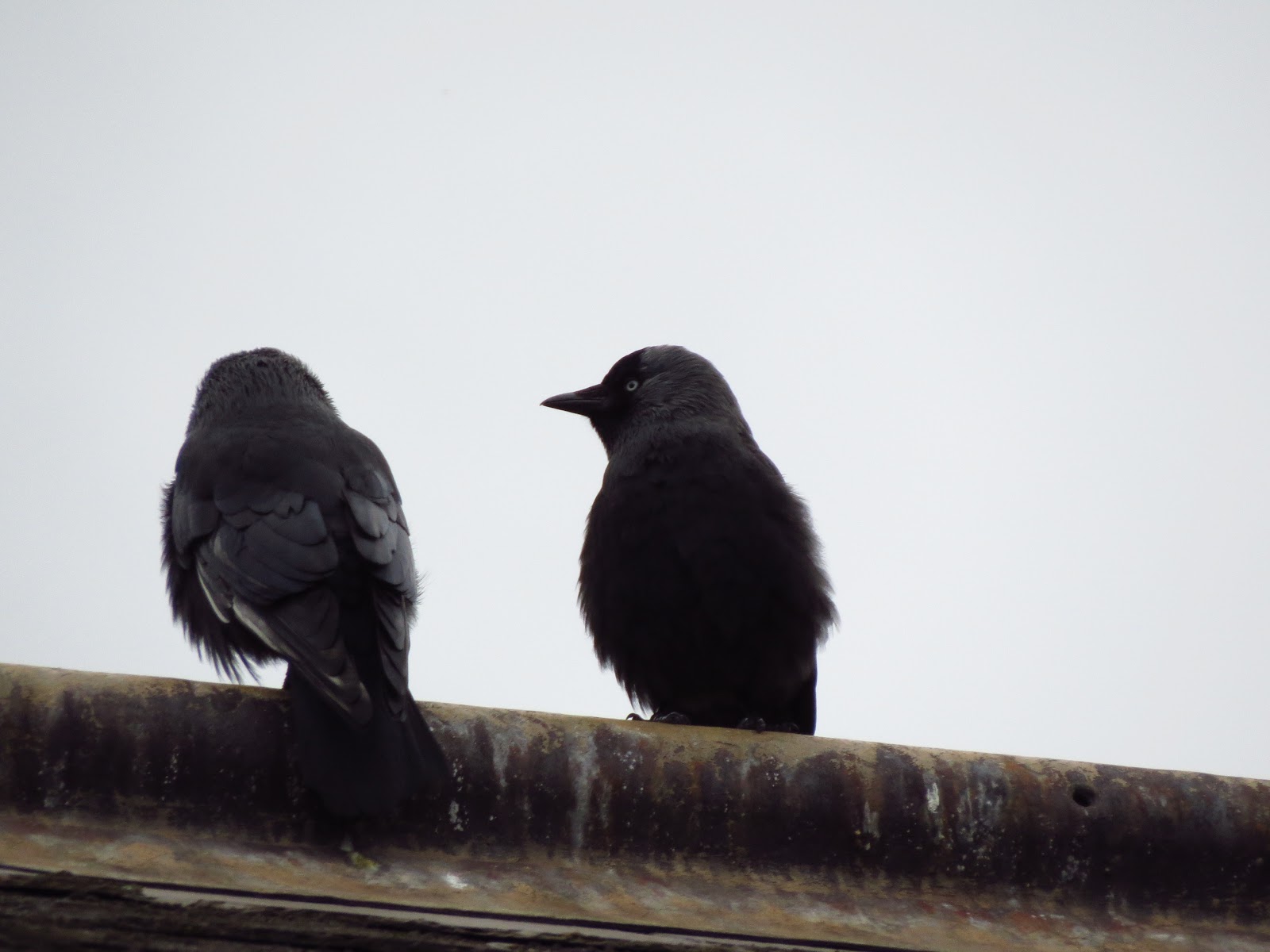
This image I love. The tree was immense, and tall, well over 50-60 feet or more. And on a slope. I stood under another tree and using my camera's fancy electronics managed a few images. But this one is my favourite. It just says, don't mess with me. Though of course we should never use anthropomorphism. Joining in with the ravens regalia, a general corvid cocophany was taking place where a number of rooks and jackdaw were either holding territories or like this pair down by the cafe, pair bonding. Impossible to show in a still image but the top bird was doing a lot of tail waggling to her mate below. This chimney stack is obviously prime real estate and a good display is definitely needed. Recently it's been suggested that jackdaws can interpret a human stare (Jackdaws are almost unique in birds in that they use eye movement for communication). I wonder then what they thought of me sitting below them, staring up at all this intimate behaviour... human voyeurism I bet!


Saturday, 1 July 2017

Corvid moments on the Mendips


My nature blogging has been a bit lapse recently. I say lapse, I really mean non existent. Increasingly I've felt the pull of blogger.com and so todays observational nature experiences prompted me to once again put finger to keyboard.
 
 
I found myself on the Mendip Hills in Somerset this afternoon, a sunny and clear blue skies day, marred somewhat with the strong winds blowing off the sea, not quite gale force, but lively. I had four hours to spend up there between chauffeuring the current Mrs Dawes for a horse trek to the pub and back. Ample time for a bit of a nature ramble myself. Or so I thought.
 
 
Birds were on the wing, but that wing was an rocket in the making with the strong wind. Time after time I observed little brown jobs clinging to posts, wobbling like fruit jellies, before exhausted they flew off in an pirouetting arc. The swallows loved it in the wind, as did this buzzard.
 
I've seen buzzards hover like kestrels many times, but this one using the strong winds blowing in from sea level to 1000 feet was a superb hoverer. Can't really show what mastery it had of the air in stills photographs but the passing swallow helps show its immoveable position. Great to see. 


It was while watching and attempting to photograph the buzzard that about half a mile away in a Forestry Commission plantation I heard the unmistakable jack-a-jack-jack of alighting massed jackdaws. A quick count revealed around 100 jackdaws hurling themselves into the air, wheeling and jack-a-jack-jacking, family groups of adults and this years young, bonding, learning where the land lies and knowing corvids, just having a nice bit of fun. They rose and then landed back in the conifers twice, before the whole flock roe and flew overhead at speed in the wind. I never saw them again. Given corvids penchant for being site faithful this new area for me bodes well for winter corvid-roost-at-dusk dusk soirees.


But that wasn't the end of it. Jackdaws may be my favourite corvid, but they are closely followed by the raven. Or as todays treat became, 4 ravens, a pair and two juvenile. How I wished I'd been closer than about half a mile as through the binoculars their behaviour was fabulous, sadly the imagery less so.  At first all I heard was a buzzard 'mewing' and that familiar cronk cronk somewhere in the same trees as the jackdaws. But then four ravens flew out. Their typical languid flap and glide interspersed with dangling legs postures and wheeling in the wind , calling.  Nearby was a huge beech which all four flew into separately. I could hear their contact calls, a sort of muted carrion crow caw is my only way of describing it. I had some recording equipment with me but it was too windy and they were too far away to record.

 
Eventually the two younger birds flew out and landed on the fence posts splitting the field. One flew off almost immediately and back into the tree, but one stayed around for a while, allowing a long shot or two.  The adults flopped down onto fence posts under the beech tree, and at this point had little interest in the younger birds. All the while I could hear their contact calls, though not able to see which bird was making them to which bird. It's such a pleasure to watch ravens, possibly our most intelligent native wild bird. Their communication vocabulary has been estimated at over 100 different calls, many so subtle they are heard only in captive birds.

 
Eventually through boredom, change of location, fancied a change, I don't know but the two adult birds flew off and for around 10 minutes flew around, over and wing touching branches flyby the beech tree. Still calling their subtle contact calls, never the cronk cronk, I watched mesmerised through the binoculars - they were definitely enjoying the strong wind, but a bit of family bonding behaviour was adhered to the joy.

 
All too soon all the ravens departed and that was that, I was left with the chittering swallows and jelly wobbling sparrows on the gate.
 
A brilliant afternoon waiting for the horses to return.


Friday, 8 April 2011

A busy wildlife week

Spring is always like this. We go through winter longing for something different to happen each week, then spring arrives and it's 0 to 100mph in a few days. New species coming in as migrants, everything is emerging faster than it can be counted and this week as many of you bloggers also know, soft southerly winds have made the days feel like summer, at last.


I have been all over the place for work and pleasure, so a busy time, but never too busy not to be thinking about a blog posting or two. So herewith a short synopsis of the wildlife this week (Even Milton Keynes on Monday produced a few birds on the journey, red kite was good - but that's the last I'll mention that town here).


This morning, after a well earned farmhouse breakfast at Cobb's Farm Shop near Hungerford, I headed off to Wiltshire Wildlife Trust's Ham Hill.


This is a small linear reserve on the Berkshire / Hampshire / Wiltshire border. I'd read about it a while back and one evening a week or so back located it. Its main attraction is that it is a Saxon sunken walkway through chalk downland. Absolutely fascinating to think people have walked this way since Saxon times.


The site is well known for orchids later in the season, including the rare musk orchid and the Duke of Burgundy butterfly. It isn't too bad in early April. I watched a male and female blackcap singing their wonderfully melodious song, other passerines were about and on the downland next to the scrub skylarks serenaded newly arrived swallows.


Not bad views either back towards Wilton and Marlborough


Quite a few plants were on the move in the warmer weather including this unusual Moschatel (Adoxa moschatellina). Nothing else looks like this, as when in flower, there are 4 tiny flowers in a square and a fifth on top.


Quite a few cowslips and violets in flower too, although the latter were starting to turn. Sadly I didn't seen any Duke of Burgundy caterpillars feeding on this host plant. I'll make sure though to return soon and attempt to see the butterfly itself.


At a separate location in Wiltshire I came across a Raven nest this week. I'll not say exactly where it is, but I was sitting in the car planning to leave another area of chalk downland when the familiar cronk of a raven alerted me to its presence, then the calls changed and I realised it was the male call as it came in to the female on the nest. This nest was on a clump of Scots pine and with a bit of searching through the binoculars I found the nest (the dark mass in the middle of this photo)


The male spent a lot of time flying between this clump of Scots pine and another about 300 meters away.........


..........from where on the latter tree he set up a continuous cronking (can you see him on the tree below?), probably because I was there, so after a few minutes I made my retreat to leave them to it and then watched them for a while longer from within the car.


Earlier this week I was in Devon looking for oil beetles. And what a glorious day it was too. There is something fantastic about standing on a Devonian cliff and watching swallows fly in over the sea and over one's head. They must have got a shock seeing me as their first piece of England at the end of their migration. But I was happy. It was so special to witness their arrival, as well as painted ladies as they came in over the English Channel on a soft warm breeze.


Back to the oil beetles. We'd set ourselves a task of seeing all 4 oil beetle species in the UK in a day, the black, violet, short necked and rugged. The short necked is very rare and indeed only found in one location on mainland Britain. And the rugged is unlike the other 3 in that it is an adult in the winter between October and late March, but we thought we'd give it a go. However I was optimistic as with me was one of the UK's best field biologist, John Walters who is studying the ecology of these beetles for Buglife.


We began in unimproved meadows near Dartmoor, where almost immediately we saw a male violet oil beetle (poor photo from my blackberry) - males have kinked antennae, though not 100% diagnostic. The host plant of these is celandine where the complicated life cycle involving celandine's, solitary mining bees and hitching a lift take place.


In a simplistic way, oil beetles have a very complex life cycle. The emergent female after mating lays thousands of eggs in an underground chamber. These hatch as minute larval clones of the adult. They then climb onto celandine flowers and wait for a passing insect. Any flying insect can be the vector, but only certain solitary mining bees can play host to the next stage of its life cycle. Anyway a flying insect lands on the flower, the larvae climb on board and are carried away.


If the flying insect is a solitary mining bee, they are taken into the bee's burrow where the larvae detach themselves, eat all the eggs of the bee, pupate and then emerge in a few weeks or the next spring, depending on the species. So a true parasitoid. This is a very simplistic synopsis as the life cycle is under researched, so John is learning as he studies them.


Eventually we found a black oil beetle too, which was fabulous as this meant 2 down 2 to go.


John has also been trying to discover the mating of these beetles and to do so has been collecting females and then introducing a male to them in a Tupperware box. All a little bit too voyeuristic really. But it is all legal as he's working on a research site and the beetles come from and are returned to the same area, hopefully to lay eggs successfully. The male in this photo (on right) grabs hold of the female by her antennae (which is why his are kinked so he can get a good hold), they have a tussle and then mate. The photo below was just after mating.


So after that excitement we headed down to the coast where at a secret location we found the short necked oil beetle, which for some reason I didn't photograph. That was three species found, just the rugged to go, which is known to be in this dry stone wall.


We looked and we searched but there wasn't any rugged oil beetles to be seen. Just too late in the year we think. We did however see a lot of common lizards which were taking advantage of the warm spring sunshine. Just goes to show if you stand still long enough, and look long enough, wildlife comes to you.


But the best was left to last. We'd been in the field for 7 hours and just about had enough energy to head back to the car. However John thought he'd seen some violet oil beetles making holes in a pathway last week and wanted to check if any were being used for egg laying. We hunted for about 20 minutes and then lo and behold, a female violet oil beetle was in the actual process of laying eggs. Just her head and one antennae were visible out of the soil, with her body completely buried. Absolutely fantastic to see this happening there and then. A great way to end an fabulous day in Devon.


Sadly not great photos as I still can't get my new Lumix to be pin sharp on the macro setting. I think it needs to be on a tripod. But there she is, egg laying with abandon.


Wednesday, 9 February 2011

The hare and the raven...

Well I'm back from my little subjoin to Hertfordshire now and what a cracking day was had by all yesterday. We couldn't have picked better weather if we had tried. In the middle of an unsettled grey, wet and blustery week, we had sun, clear blue skies, hardly a breeze and after a light frosting, warmth on the winter ravished skin. It really did feel like spring was in the air. I even heard skylark song ascending, the first of the season while sitting quietly watching the wildlife I'd come to see, the Brown Hare. (click on an image to enlarge - they spot humans well before we can get close to them)

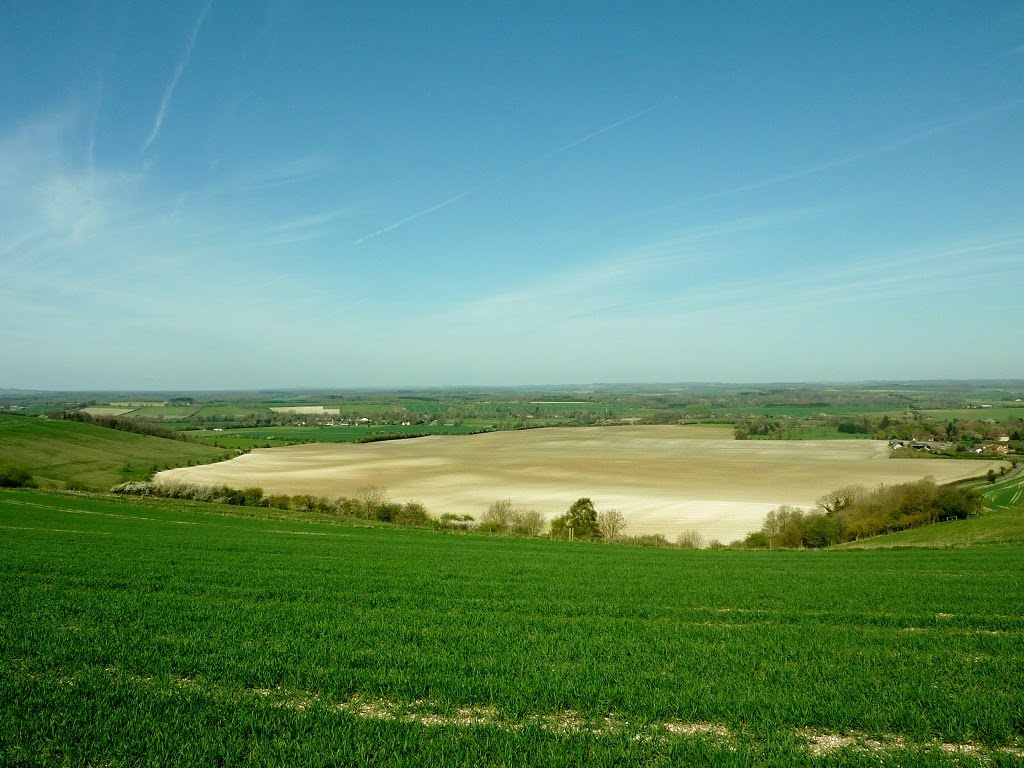
I don't know Hertfordshire very well, although I did spend a lot of time as a child not far away in Essex, a place called Rickling Green if any of you know that area. I have to say though, being so close to London, apart from the traffic on the main roads, this area was very rural. I liked it, as I'm fond of farmland landscapes and the wildlife they contain. Such a glorious morning, as witnessed by the view as we began our day (above).

So off we went, in search of the hares. Our guide has been studying hares on this farm for a few years now and can count up to 100 individuals, all was excitement. No sooner had we emerged from the woodland edge, but there in front of us was a hare, in its form (below)

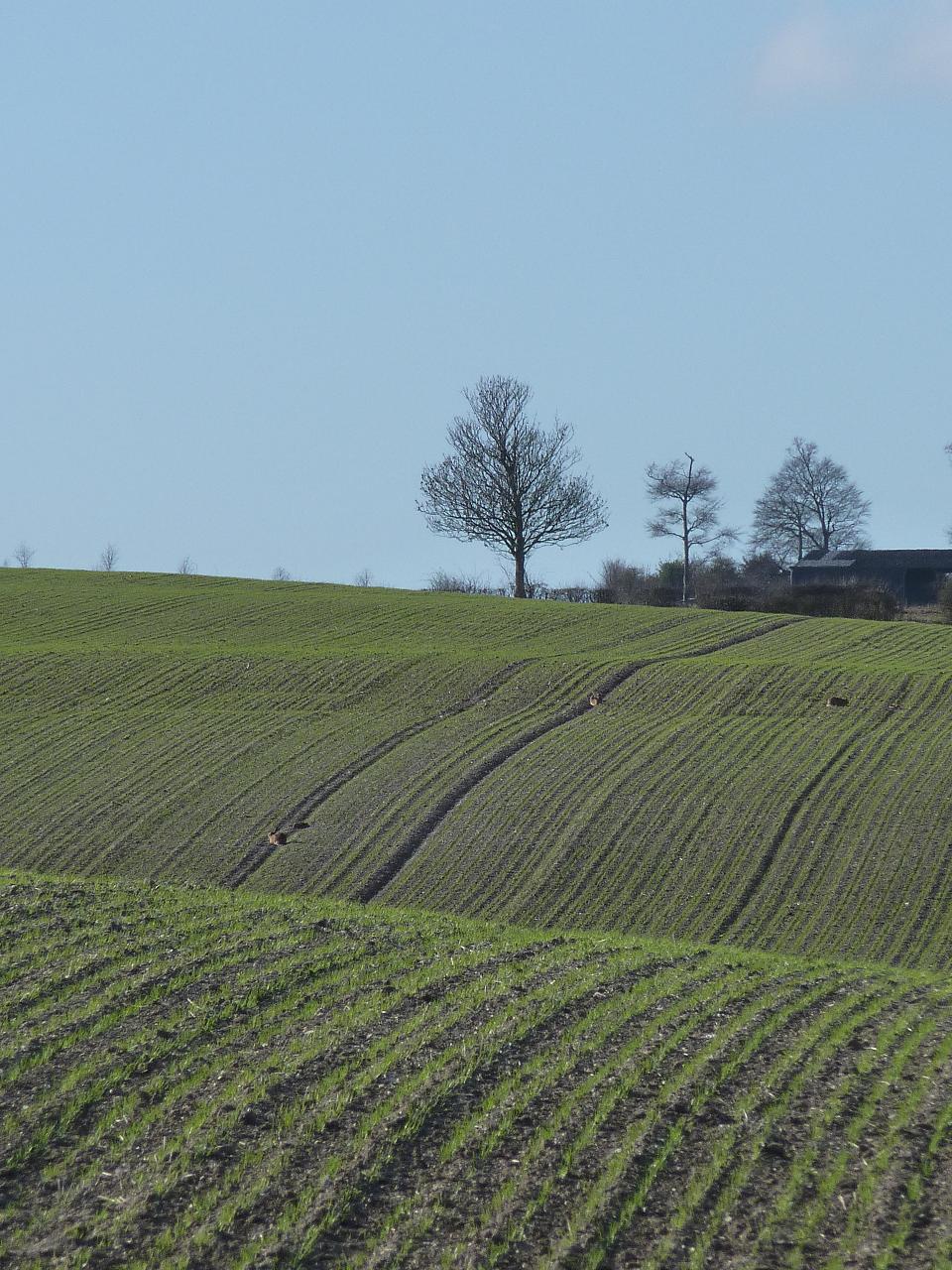
From this vantage point our guide then spotted 10 hares around us, all lying in their forms, resting, and easy to overlook if just out for a stroll. We had to plod on though, and so as we did they began to move away from us, not too far though, just enough to see them on the skyline. Sadly, this being open arable farmland, getting close to the hares was impossible, and my camera will not zoom that much, but what you see here is pretty much what I saw. Through binoculars fantastic.

But the best action apparently was to be found further on, this part of the farm being just the warm up act. However moving further on had some risk taking involved - take a peek at the sign (and there was me thinking hare watching wasn't risky)

But the risk taking was worth it, despite the risk of being shot. Mating hares, boxing hares, running hares, as far as the eye could see there were brown objects dotted about the winter cereals.

The farm also has a wild herd of fallow deer, including a white individual. The herd are truly wild arriving in the winter to munch through the farm before dispersing in the spring. I liked this farm, which has to remain secret, for obvious reasons. This farmer is just keen on wildlife. He doesn't get any subsidies, or ask for help in conserving nature, he just loves wildlife. No shooting is allowed on his farm, unusual around these parts, and possibly this is why hare numbers are high. All very good news, as even with the hares and the fallow deer rampaging through his land he still makes a profit. An enlightened hero, who avoids publicity or acknowledgement, as do many other farmers across the UK. They're not all bad.

Above is a view of the fallow deer and infront of them a little group of hares, and if I turned 180 degrees behind me (photo below) more hares. I guess in total we must have seen 25 - 30. Just brilliant.

But that wasn't the only wildlife. Sitting still in the lee of a hedge is the only way to observe wildlife in the wild; in my book anyway (a long way off from being written) which would also include a flask of tea, a groundsheet, and a good pair of binoculars. Skylarks were just everywhere, singing and ascending. Buzzards, linnets, corn bunting, and even a few buzzy wuzzies making the warmth on my face feel like later in the year with their drone like buzzing. As I sat, I heard a cronk. And another. 4 ravens, 2 pairs actually flew over and in front of me for a good 15 minutes. They were sky pairing in a synchronised silhouette flight, tumbling, barrel rolling and a few times flying in formation as a foursome. I never ever tire of ravens in flight.

Can you imaging how I felt sitting there on a warm spring day, hares everywhere, ravens above, peace and quiet, not a soul around us, just magical. I'd forgotten I was there to work, well almost. Oh nearly forgot, one mammal we didn't see, but very common on the farm is a fox. Funny that, a predator of hares in a place full of hares, I wonder why? I did see signs of a fox though, marking its territory.

All too soon I had to pack up and we headed back to Bristol, but just time for one more hare, if you can spot it........

...... and this view of the copse area of the farm, just because I loved the composition of the fields, hedges and trees.