A

A
Showing posts with label Garden. Show all posts

Friday, 7 July 2023

Meadow Brown with more spots than it needs

Looking out of the bedroom window before 9am today a brimstone butterfly could be seen flying around the garden. I headed out to see if I could photograph this probable second brood individual. Of course by the time I got out there it had long gone and in its place a couple of holly blue butterflies were wafting about. We've had these in the garden for around ten years now and it amazes me as the only holly we have are two clipped pom-poms in one border. In the past I've watched them laying eggs on the holly leaves, size of holly tree doesn't matter then.

While I was out here then I had a wander around and saw a meadow brown feeding on one of the Helenium. Nice, we don't get that many in the garden though they are increasingly being seen.  Then I looked again. The black eye-spot on the wing contained two white spots. I did a double take, this was definitely not a gatekeeper, a similar looking species which does have two white spots on its black eye-spot. No this is definitely a meadow brown which should only have one white spot within the black eye-spot. This quite well worn individual was to be honest a little larger than normal. Was that significant? Are meadow browns with two white spots genetically a little larger than their species? Questions. 

At some angles the twin white spot were not visible, though this was simply the wing covering the second spot. I took a few more images then after reading up on the variability of meadow brown spots I confirmed in my mind it was this species but to be sure I got in touch with a friend by email attaching these images. He confirmed this was indeed a meadow brown quoting from the book The Butterflies of Britain and Ireland by Thomas and Lewington;

"in both sexes there is much variation in eye-spot and other markings"

He even sent me a photograph he'd taken a few years back of what is called a 'blind' ringlet - with uniformly brown wings showing no visible spots at all, a rare aberration on this usually spotty butterfly. A fine example of how variable some individuals can be in all species. I thanked him and left him to head off for the day to hopefully watch many purple emperor butterflies at Grafton Wood in South Worcestershire.


After yet more reading around I discovered that the prevalence of twin white spots on the meadow brown generally increases north of the Midlands. Though that's too simplistic. Of the four recognised sub-species they are localised ranging from the Scilly Isles and Cornwall to Ireland to Scotland and northern England with smaller localised variations elsewhere. Twin white spot meadow browns do occur further south, for example in Dorset these variations are rare but recognised. But this all tends to be localised presumably genetic populations and the spots may be of variable intensity or even missing.  What this individual was doing in a Somerset garden I'm not sure. Thinking about this however, we've had strong north west winds for days. Was this individual picked up elsewhere, caught in the slipstream and dropped into the garden? I'm not sure but it is one theory.

I'd not seen a two white spot meadow brown before and learning something new each day about butterflies is proving very energising and it is keeping me very much on my toes while providing a new impetus to my wildlife observations.

Sunday, 7 May 2023

The Diminutive Wildflower Meadow....

I have what can laughingly be described as a wildflower meadow. But it works. In the middle of the circular lawn in our small semi rural garden, over the last five years I've developed this meadowland. I say meadowland but in reality it is a 2m circle of not cutting the grass until August with additional planting. 


The planting here is a mix of naturalising garden bulbs, snowdrop and crocus first, followed by daffodil and tulip. Lesser celendine, primrose, dandelion and cowslip are also present and encouraged. Later in the year fox and cubs will dominate before the grasses overtake everything. This year I was thrilled to see my alba fritillary in flower. This was especially joyous as I bought 12 dried shriveled corms last October for 50p, mostly as I don't like to see garden centres throwing out unsold stock. Despite these dessicated specimens looking truly dire, I planted them and crossed my fingers.


Of the twelve corms planted seven flowered. I'm hopeful then they will survive in the heavy clay, though not waterlogged, soil under the lawn.


Despite its insignificant size I love this little slice of unkempt in the garden, it changes by the week. To be honest the entire garden is wildlife friendly as Mrs Wessex Reiver being a professional plantswoman is of the organic persuasion. As am I.


The longer grass allows a small yellow meadow ant (Lasius flavus) colony to exist. Their soil 'molehill' is on sunny days alive with activity as the ants emerge from underground. Snails of all differing shapes and colours love the cover and humid vegetation too, a topic maybe for another day. But it is the accidental finds that enrich this corner of Somerset's biodiversity.


Yesterday after watching a little of the Coronation we spent an hour or so fettling the garden. It was while doing this I noticed a pair of orange bugs upto naughties in the long grass. I had an inkling what they were but thanks to the power of Google Lens, which is an amazing bit of technology, they were confirmed as cinnamon bugs (Corizus hyoscyami). I've never seen this bug species in the garden before. Difficult to photograph in situ so after they'd ahem finished I tried to do better by placing them in a plant saucer. Not great but enough to identify them. I then returned them.


I'm no entomologist so reading up on these beautiful looking bugs I noted that until recently they were localised in sandy habitats around the coasts of southern Britain, but recently (climate change?) this species range is expanding north and into an eclectic mix of habitats inland. So that's why they're in my garden. It's an eclectic habitat! And they weren't the only recent arrival to the garden.


Earlier in the week I stood admiring the cowslip,  which from one self seeded plant three years ago now number around a dozen. On one stem was a jewel-like blue beetle, resembling a dark blue marble with legs. Various ground beetles went through my mind but I had a notion this was different. 


And it was. Thanks to my go-to encyclopaedia of all British wildlife, Brett, he confirmed what I'd half thought; (Agelastica alni), the alder leaf beetle. Wow. I say wow as this beetle was thought extinct in the UK. Then in 2004 it was found in Manchester, seemingly brought in on plant stock imports. From there it slowly spread across the north midlands, before being found in a second area in southern England around a decade ago. It is spreading.

Brett informed me there is a very healthy population on the Somerset Levels where there is unsurprisingly a large number of alder. As they fly he suggested, despite no alders being near our garden, the one on my cowslip would be flight-resting between alders. Fascinating.


Definitely a first for the garden. I've not seen it since that day, assuming therefore its onwards travel to an alder has taken place.

But all this goes to show, a tiny bit of wild meadow even in a small garden can attract the most interesting of discoveries. I wonder what the next rarity will be? Osprey maybe on the 40cm pond?

Friday, 21 April 2023

North East Garden Wildlife

I've been spending a few days up in the North East as my father has been in hospital. What with hospital visiting and working full time the days have simply been a blur. No sooner have they dawned over the North Sea then the sun is setting over Newcastle, sun which at this time of the year is as strong and warm as we'd have in August. However in the few gaps of my rushing about like a headless chiff-chaff I've been doing some wildlife window watching.


My parents garden has always been good for wildlife. In the thirty plus years they've lived here no chemicals have ever been applied. Before that the two spinster sisters who lived here had let the garden revert for decades, and when my parents moved in it was impossible to get to the bottom of the garden. My parents have never liked a tidy conventional garden anyway - it is mainly trees, shrubs and borders which now are semi-wild as my father rarely goes into the garden now. The wildlife flourishes here, and with the garden being two hundred years old I'd like to think it has matured gently over time into a little mini nature reserve. As far as I'm aware nothing unique makes this 30m by 90m garden its home, but that doesn't distract from the joy I get observing what goes on outside while at the kitchen sink.

Take these jackdaws for example. This pair are now nesting in one of the disused chimneys. I sat in the garden one evening watching them fly in and out of the hole in the side of the chimney, while making a mental note to ignore this property decay. Each time they arrived at the chimney, one, which convention would suggest the male, (but I'm not sure as females also tail wag) would sit on the chimney pot, wagging it's tail as a sign of communication, while the other popped into the void to be followed by the first bird, but only briefly.  Then they'd both fly out sit on the chimney in the glorious evening sun and repeat this behaviour a number of times. The nest presumably is built and eggs inside, it is impossible to tell, though I'd have though the female would be nest sitting if that was the case. This pair may simply be late prospecting after all, with the tail wagging all part of a ploy to speculate in this real estate. But they are fun to have around.

I'd put a new bird feeder up as the old one had been trashed by the grey squirrel which has it's drey in the ivy covered rowan tree nearby.  I know these mammals are despised but I like them and this individual is as fit as a lop. I watched it last night sitting high on the pub roof next door. Suddenly it leapt into the large holly tree which dominates this garden. A distance of 3 maybe 4 meters, a crash into the branches and then a scampering up and along the branches out into an acer, then a jump into the rowan and disappeared. Brave little chap, no fear then of launching itself into the prickly holly tree. 

That holly tree itself is a micro habitat - we've long speculated how old it is. I'd suggest close on a hundred years as the trunk is about a meter in circumference, all gnarled and covered in those nodules older holly is known for. Over the years a magpie has nested in there, blackbirds and pigeons have foraged on the berries and it is also a place to watch holly blue butterflies. I can't remember the exact year I first saw holly blue in the garden but at that time they were spreading north and on reporting it to the local recorder, it was only the second or third record in this area. Most days this week half a dozen have be seen flying about in the sun. Along with a lot of bees and flies. Down at the lower end of the garden is a hawthorn which has been consumed by ivy, it looks like a huge green mushroom now. Stand there in the warm sun and the sound of hundreds of insects is evident from a gentle hum. Later in the year this will be a butterfly magnate. Oddly though while I've been here, aside from the holly blue,  I've seen no other butterflies or moths. That's probably observer error rather than lack of species. 


Next to the hawthorn is an ancient pear tree which is now in blossom. In the past I've seen bullfinch here, but not for many years since houses were built on the fields behind the house. It is a favourite spot though for the wood pigeon and often I've seen a sparrowhawk sitting here waiting to ambush, though not this week. One evening though I watched a blackbird nest building near by. Arriving at regular intervals with leaves or twigs it popped into the ivy and while I couldn't see exactly what was going on, the shuddering and juddering of the ivy gave the game away. A most enjoyable observation, which went on for at least half an hour as I sat in the evening sun with my mug of tea. I did think though at the time that while a good safe location concealed from most predators, the resident squirrel may have other ideas. 


However a lack of species was not my issue at 4.30am mid week. I'd had a restless night, thinking of this and that, so having woken I thought time for a cup of tea. Before heading downstairs and although quite dark still, I heard birdsong. I popped into the back bedroom where there are windows that open to almost the floor. As I opened them and sat on the window ledge the birdsong of a Tyneside conurbation dawn chorus hit me. The predominant bird was a blackbird, and as I listened there were at least three dotted about. But also in this soundscape, at least one song thrush, carrion crow, jackdaw, blue and great tit, and I'm sure a greenfinch, a smattering of house sparrows and a coal tit which are resident in the garden. A dominant wren added to the chorus as did a dunnock and later some passing herring gulls. No summer migrants yet. Dawn is getting earlier now and the soft apricot glow to the east added to the sense of peace and quiet after my restless night.

Yesterday however there was very little peace and quiet. The garden is home territory to a pair of collared doves with presumably a nest nearby. They sit for hours on the garden chairs cooing gently. But they are aggressive too. 


I'd discovered a handful of early Roman era crumpets lurking in the freezer, so having a sort out I threw them onto the lawn for the birds. First down the jackdaws. That was fascinating. I'm not sure crumpets are a staple diet of these birds, but immediately one hopped over and having quickly looked at it stood on it, before beginning to pull and peck at the crumpet - and of course standing on the crumpet meant it didn't move, clever. The jackdaw then moved around in a circular motion taking small bites on each pass. That was until the collared doves began attacking the innocent corvid. A bit of a tussle took place before the harrying doves chased the jackdaw away. All was calm, for a while at least. 

Half an hour later I heard a raucous commotion and looking out a carrion crow was in the garden eyeing up one of the crumpets. It was a matter of a few seconds before I saw the doves fly at the crow in a territorial attitude. Unlike the jackdaw the much bigger carrion crow was having none of this and before I realised it had either hit the dove with it's feet or its bill, but whatever had happened there was a flurry of dove feathers billowing in the air, with the dove flying off to look a little non-pulsed on the pub roof. Meanwhile its mate sat in the acer tree in an attitude of, I'm not going near that big lad. Calm restored once more the carrion crow picked up the whole crumpet in its bill and flew off, leaving a carpet of downy feathers as the only evidence of a battle.

Later in the evening this was repeated, but now with rook. Three rook dropped into the garden, with a similar number perched nearby. In came the doves cooing and flapping wildly. One rook perched on a chair was repeatedly dive bombed, a risky business for the dove given that a rook's bill is more like a pickaxe. The rook still perched on the chair but with its neck stretched upwards parred and stabbed at the repeatedly passing dove. Meanwhile the other two rook were making tidy progress with the crumpets. Eventually all three rook, presumably fed up with the collared dove, flew off while being chased by the doves who were still dive bombing the rooks as they flew away. The doves soon returned and sat on the table looking all innocent and delicate, cooing softly. 

Innocent and delicate, I don't think so. I know what goes on, I've observed all of this out of the kitchen window this week. So after all that, I think it's time for a bacon sandwich for breakfast.

Wednesday, 1 February 2023

Simple Pleasures From The Office Window

February is here at last, I can feel the days relaxing, just a little, as the sun gains strength and lengthens the daylength.  Like many people I'm trapped in front of a computer most days, however since the Covid pandemic I've been able to work at home for three days a week. Three days which usher in the most simple of pleasures, watching garden birds from the office window.


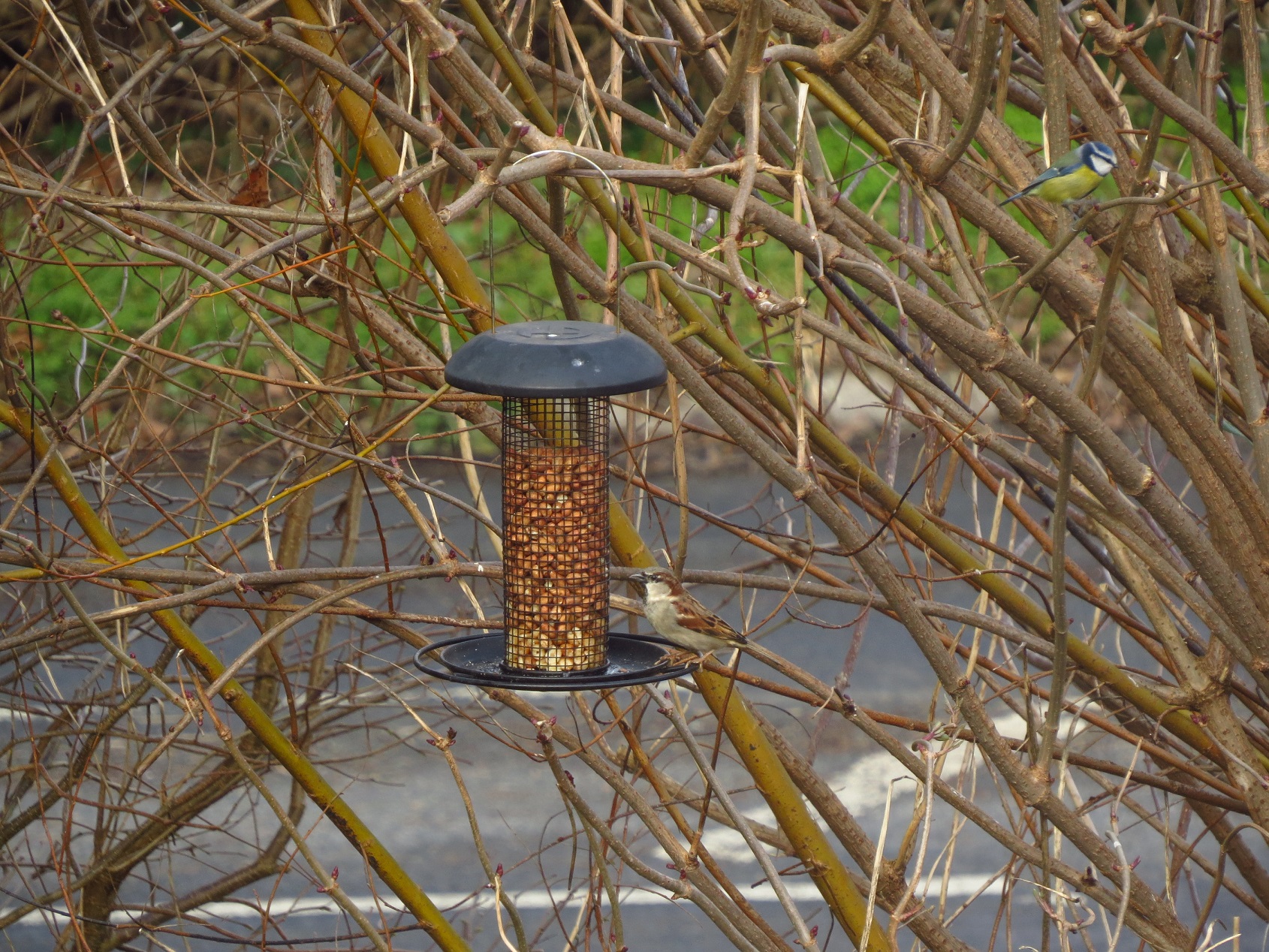
This male great tit [Parus major] is in fabulous breeding form. His colours really pop in the dull beige-ness of a late winters day, especially the wing coverts which now are an almost lime green against a slate grey. In the garden I only ever see a single pair of great tit, therefore I can assume these are a resident pair. Although our own cat Gingernut has absolutely no interest in birds, we have neighbourhood cats marauding with intent within the garden. This means most of my feeders are high in shrubs outside the garden wall to keep preying moggies well away. Similarly I don't have a nest box which would invite trouble, but neighbours do. Hopefully then come the late spring there will be a few juvenile great tit coming to the garden, as I love watching them quiver on the wall waiting to be fed. 


My office is located in what can be comically be called the third bedroom. You'd have to be very thin to use this as a bedroom. As an office however it is perfect, book shelves, my desk and what I ostensibly call my reading chair, a much loved Cintique arm chair that the cat sleeps on when not being used as a storage facility. However from the desk where I'm writing this I have a view out over the countryside or look down to the feeders, from where all these photographs were taken. Adhering to strict health and safety guidelines while working on a laptop my regular long distance views are mandatory to save my eyesight, though to be honest there are maybe more views than close work script writing on some days.


Exotic and rare birds are always a fascination, yet for me I obtain just the same pleasure watching the birds using my garden as a territory. I love watching the house sparrows [Passer domesticus] bicker and squabble at the feeders. They've been a little in decline recently. They roost and nest in the roof space not just in my house but in a few neighbouring properties.  Not so many years ago I could count forty or fifty sparrows in the garden. Today half a dozen or maybe a few more is the norm. It's worrying as house sparrow are a species which require a colony to maintain a threshold size to remain viable as a breeding group. Here in the northern parts of Somerset there are whole areas which do not have any house sparrow present, and so those areas with sparrows are isolated refugia populations. Although not present in February of course, house martin [Delichon urbicum] too have all but disappeared from this area, with 2019 being the last time they nested successfully on my house. Last year I counted only a handful flying overhead in the evening and no active nests in the street. 


While this male house sparrow is easily identified from the female, the blue tit [Cyanistes caeruleus]  patiently waiting top right could be either sex.  Identifying male and female individuals of some common species is a tough ask.  Great tit males have a broader chest stripe to that of the female, but blue tits are pretty much identical. The books say females are not as brightly coloured as the male. In the field though this is a pointless piece of information when you have a single bird on a feeder. We get a lot of goldfinch [Carduelis carduelis] in the garden and while the males and females can be identified with a decent view, mostly they fly off before that occurs. Same with long tailed tit [Aegithalos caudatus].


Another bird exhibiting more or less sexual monomorphism [as it is called where both sexes look identical, as opposed to sexual dimorphism where they look different] is the collared dove [Streptopelia decaocto]. Now technically the males and females only look different close up, with males having a 'pinker' colouration to the neck and upper body, the female a more grey-sandy colouration. In the two images below I think - note think - the female is the one below looking left, and the male the one below that is looking right. But I may be wrong.  My inability to be certain of which sex these are by no means diminishes the joy of watching these doves with their gorgeous ruby eye during my frequent screen breaks. The same goes for the other species coming into the garden today, a pair of male robin [Erithacus rubecula] vying for domination of a feeder, or the male and female blackbird [Turdus merula] duo, the male having a well defined yellow eye ring, which at this time of year may mean it is a European migrant rather than a resident. Even the five magpie [Pica pica] cackling their annoyance in the fir tree could be of either sex, and no silver was offered either.


None of what I've noted really matters, what does for me is taking time to properly study these very common species of bird from the comfort of a warm house. In other words, detailed observation. Of course putting feeders up encourages their arrival and use of the garden but that's part of the joy. That and really studying what happens a stones throw away. How blue tit will not come to the feeders if great tit are there. Female house sparrow also dominate the feeders to the almost exclusion of males, often the latter only nip in when the females have gone, or the stand off between two male robins, or the beautiful colouration of a great tit. These really are for me quite simple pleasures on the first day of February.

Monday, 26 September 2022

The Quiet Garden


The sun is out, Gingernut the cat relaxes on the shed. Our sunflower triffids look terrific in the morning sun - and yet - It is that time of year already. 

Summer memories of no rain for weeks and temperatures reaching record breaking levels seem a long way distance. The garden is still in bloom, though this is an illusion. Emergent growth is largely absence, developing growth too. Decay is arriving as the garden moves imperceptibly into that state of stasis between summer bountiful and winter famine. And while the light levels have remained good with temperatures above average, the status quo which ostensibly allowed us to enjoy these few precious days has changing. We've passed the Equinox.


At the weekend we took down the runner beans. The last few pods were blackening and unappealing. A mound of jumbled sticks appeared on the patio. One of my favourite jobs - creating order - cutting off all the string and other attachments, assessing cane structural integrity and putting them neatly away for another year. At sometime in the near distant I or Julie will have tied in the runner beans new foliage. Struggling with rampant growth we'd have tied in tendrils with string after string for days. Now in late September that long forgotten effort to control is no longer needed, the string's supporting time, like that of the beans is at an end. Sorting and unravelling the activity of summer is a pleasant job on a sunny September afternoon, but it reminds painfully that the days shorten.


The garden is quiet of wildlife now. Birds do still come to the feeders but in ones and two's, unlike in spring when the rush to breed saps avian energy, energy eagerly replenished at the smorgasbord we provision like a bandit gang of unruly teenagers. Garden snails have been a nuisance this year, if only we could encourage a song thrush. This mature one with gorgeous markings is wedged into the middle of the greenhouse door, happily sliding back and forth as we wander in and out sorting through the pots.


The tomatoes have now all been removed. Cane tops back in the storage plant pot alongside those bits and bobs we find are very useful to keep 'just in case' but in reality are never ever used again. Not much now fills the greenhouse, some lettuce seedlings are coming up on the ground bed and a lone spinach seedling fights for freedom on the bench.  Mostly it is simply quiet contemplative sorting. Pots washed and stacked up ready for a proper sort out on one of those days when in mid-winter we want to be outside but in reality it's too cold and too dark. A few hours in such a mood in the mid December greenhouse satisfies the most primeval of our needs. 


Garden spiders are ever present too - every gap decorated with a web of huge proportions. Today is the first for a while where the wind has picked up. With each gust they jostle and gyrate but remain steadfastly on station in the hope a passing fly will entrap itself. In the summer we had numerous nest explode with spiderlings. They are amazing at that stage where the slightest threat sees hundreds dart away in all directions only to slowly return to a formation of safety in numbers. Those minute humbug spiders, now demand respect in the foliage.


It's that time of year already and a time of year many people enjoy. Quiet reflective times. The heat of summer has gone, the bare nature of winter is yet to come. A time to reflect, to take stock, and plan ahead. Next week I shall be sowing the sweet peas whose seed I harvested on the 9th of August this year. All being well, come early May they will begin to bloom, a past continuity to the future. 

I really do like this time of year and just occasionally in the silence of the garden is broken. The robin reminds me his territory is being established with song, reminding us all that it is not long then until nature begins the cycle of rebirth once more. 

Christmas first though, 90 days away today. Time to light the candles.

Tuesday, 8 March 2022

Greenfinch Distraction

Sometimes the simplest of distractions bring the most complexity of joy. Not the best photograph I've ever taken but a quick snap (out the office window before it flies off) of a greenfinch on the feeders this morning. The second time I've seen a greenfinch in the garden this week, but the first time in many years.


As with many common birds in my childhood the greenfinch has suffered a dramatic decline in numbers, though unlike some other species where habitat loss or disturbance are at play this mournful songster has been hit by a parasitic disease known as trichomonosis. It's a common disease in other birds but began to be noticed in garden visitors around 2005-2006, with the thought being that increased bird feeding can accelerate the spread picked up from dirty garden feeders. Ironic really that we put food out for the birds, and inadvertently make them ill. 

What's for certain here in this area of Somerset is that I'd not seen a greenfinch around the house for many years, nor chaffinch come to that. Looking through my wildlife diaries, these two species were here regularly until around 2010. After that just the occasional sighting and in the case of the greenfinch that soulful song of theirs on a windless day, and so reminiscent of my childhood, simply disappeared.  Astonishing to comprehend that in my lifetime a species that when I was growing up used to be quite numerous in our Country Durham garden now languishes on a red list due to the severity of declining numbers.

The disease affects many other species; chaffinch as mentioned which has also suffered a 25% decline recently, sparrows, dunnocks and great tits, the latter of which I saw with physical signs of the disease last year. The parasite affects the throat and gullet and can be physically deforming with growths on the feet or beak. Affected birds struggle to eat, becoming emaciated and although not necessarily fatal and birds do recover, many die through poor condition, starvation or increased predation which in itself can spread the disease into birds of prey and then back into the food chain. 

All pretty miserable stuff, but today I managed to get a quick photograph of this greenfinch and it brought back the positives. I'd also noticed a couple of chaffinches in the garden recently, maybe then this disease is either less prevalent in this region, or those birds now returning are carrying a certain level of immunity.  I've still not heard a greenfinch calling, but only last week a 'pink pink' of a chaffinch could be heard. Later it's song drifted across the garden. As a child my parents had a permanent caravan which was surrounded by trees. There chaffinch were very common and that 'pink pink' sound they make when alarmed takes me right back to that time. Happy days with not a care in the world. Todays greenfinch looked in super condition, there's hope then others are lurking in the fields beyond the garden wall to bolster the numbers this spring. Spring is definitely arriving here with this newly constructed carrion crow nest in the back field too.


This carrion crow nest must be a quarter of a mile away from the house, but in the last few weeks I've been watching it being built twig by twig. They nested in the same tree last year with that nest being destroyed in the winter winds. This pair of crows use the fir tree at the bottom of my garden as a lookout post and I watch them fly back and forth to the nest, which I think is now complete. I get better views using my telescope and I've seen the female head poking over the rim in the last few days, though she wasn't there today so not sure if there are eggs in there yet as it is still a little early. I hope then they raise a good brood this year. Last year they raised four, who after fledging would noisily come to a neighbours roof to be fed by both parents. It was highly entertaining to sit and watch these youngsters scrabbling about on the roof, wings flapping as they slid and fell down the tiles before flapping back up to the ridge. Eventually though they got the idea and would sit on the roof ridge waiting for the parent to return which was always heralded by noisy squabbling. At night they roosted in the trees just beyond the house and stayed in the area until late autumn.

Spring is here, birds are returning, nests being built, something to look forward to and a welcome distraction as I gaze out of the office window before getting down to work. What better than a few minutes nature fix before the day begins.

Friday, 25 February 2022

Is That A Spider I See Before Me?

Sometimes I stagger myself at how hopeless I am. Yes, I'm absolutely hopeless when it comes to identifying what turns out to be a common species in the garden, if only I knew. 


It being a lovely sunny morning I opted to take my elevenses and computer break out in the garden, sit on the bench and absorb some warm rays on the aged physique. However my allocated fifteen minutes screen break became a little longer than planned. Poised on the bench with a beverage of choice it was while reading the newly pushed through the letterbox Spring edition of Butterfly (Butterfly Conservation's Members' Mag) that I became aware of tiny spiders lurking on the shed. Not one or two, but dozens. Turning my attention away from thoughts of a summer trip to see the newly re-introduced chequered skipper, I got down on my hands and knees to have a closer look. They were everywhere, I counted over forty.  Less than 1cm in length I notice they were only on the sunniest side of the shed, always low down, or on the gravel, and by and large remained motionless for extended periods. But now and again one would dart towards another, they'd rush together then before meeting veer off before resuming a sun kissed posture well away from each other. Interesting to observe. 


Viewed with the naked eye they looked uniformly velvety black, no distinctive markings. However after taking some images and looking at these lovely spiders close up, they have quite distinctive markings, although I didn't know what these spiders were. Some sort of hunting spider I suspected given their rapid movement, but exactly which species, not a clue.  They were exquisite to watch close up and not intimidated by my presence at all. After half an hour I had to haul myself back indoors and to work, but over lunchtime I had a go at identification based on my photographs, as by now they'd disappeared. Well that hour went well.

My Boys Book of creepy crawlies was no help, neither the i-Spy book of arachnids. I was stumped, nothing came close, even flicking through the Spider recording webpages I wasn't really seeing what I had seen. So I posted onto Facebook and two of my friends on there got back. Brett, probably the best naturalist around, replied,

"these are probably Pardosa species...the wolf spiders that appear early in spring. Hard to ID from photos alone but the commonest in most gardens is Pardosa amentata."

While Richard who knows Brett and one of the best entomologists in the UK, added;

"As Brett says, Pardosa sp. - they're variable and hard to ID so basically impossible without checking specimens under a microscope.

What I later discovered is that this investigation to species level under a microscope involves close examination of genitalia. Presumably (and hopefully) just the spider's.

Doing lots of reading around on the web, two species stand out for consideration. My hot to trot pick is Pardosa pullata, very common and widespread with records of adults starting in March. Or, as Brett mentioned, Pardosa amentata, which is the commonest Pardosa in gardens.  Certainly looking at what seemed hundreds of images of these two species, they are really variable, and I was warned on-line identification is often serious misidentification. Either are likely, though I guess I'll never be absolutely sure which species.

It was while reading through details of various Pardosa species that I came across Pardosa purbeckensis, described as, rare, local, but numerous in suitable coastal habitat; though there seems to be a raging discussion as to whether P purbeckensis  is actually a coastal living P agrestis. Oh lordy, I can't even identify the common ones. What seems evident however is that looking at regional maps, one of the small numbers of places P purbeckensis is allegedly found is on the coast just over the fields from me. So as well as popping to Northamptonshire for the chequered skipper this summer, I need to walk to the coast. It'll be easy to identify, the only spider wearing Speedos and carrying a beach towel. Even I couldn't get that one wrong.


All I know is that I like not knowing what I'm seeing. We all learn from a little bit of observation, a little bit of brain work, and of course knowing a few experts who can guide me out of the fog. That said, my thirty minutes watching the antics of these largely sedentary spiders was most entertaining. What the genera don't seem to have are common names, other than wolf spiders. So I'm naming my observed forty individuals of this species, The Friday Elevenses Spider. Catchy and certainly caught the moment!

Saturday, 26 November 2011

Who invented decking?

Okay, who invented decking for the garden? I have loads of the stuff, it came with the house when I moved in 2 years ago. It had just been put in by the vendor that year so was in effect new, and I have to admit it looked smart when I viewed the house, and, along with a hot tub (oh yes!) and the 14 decking lights (which worked for exactly a week after I moved in) it did look stunning in the evening. But the hot tub was sold before I moved in (good) and the lights failed (water in the electrics and the cost of fixing is more than installing) and to be perfectly honest I'm not a decking fan, never have been. I did have a plan to rip it all up when I first moved in, but a mix of the cost of laying a patio and complete lack of time meant it has been left on the to-do list. And it looked okay, so why rip up perfectly good hard standing for the chairs and so on.


Anyway this decking is slowly becoming lethal. I wont use chemicals in the garden, so I try and keep the moss on the wood at bay by regular cleaning with a brush. However last week when going to top up the bird feeders I nearly came a cropper, it literally was like ice and only by clinging onto the silver birch did I avoid slipping down the 3 steps and into the shed, but in doing so pulled a muscle in my shoulder which still niggles. I could use a chemical moss cleaner, but don't like doing so for the birds and wildlife, or nail chicken wire everywhere which works well in a nature reserve, but looks a mess in a garden, so I think I will bite the bullet in the spring and rip it up. But what to do before then?


Well I'm ashamed to say I have relented and the decking has had a through scrub with Jayes Fluid. It's not the most environmentally friendly product on the garden but it works, and the smell takes me back to my agricultural days.


So after giving the decking a through coating of Jayes Fluid during the week, this afternoon I was out there with a stiff brush and the hose to give it a really good scrub.

Its sort of worked but it's not by any means moss free yet. But at least I can walk on it. Having the feeders over it is good in one way as the spoil is picked up by ground feeders, but their "after mess" is also causing a problem. I may have to go for a radical rethink with the feeders, but I like them being there as I can sit in the conservatory and watch the birds antics.

Speaking of which while writing this posting in the fields out the back a huge rook flock and carrion crows have been getting very restless. Can't see why but often if corvids start getting agitated by a hedge, there's possibly an owl roosting there.

But while spending a few hours in the garden it gave me the chance to have a mooch about. It's been a very hectic week and I've not seen much daylight since last Sunday. So it was very welcome to go and see what was happening. And, as many of you have mentioned, it's unseasonably mild and as a consequence, odd things are happening.

I'll begin with the paperwhites. I know these are not early, but they came into bud at the end of October. So I've had them in cold storage for a month but no longer can I keep them cold, as I always love having paperwhites on display at Christmas (alongside daffodils from Jersey - makes me think spring isn't far away). But today finally one pot has flowered, so I've brought it into the conservatory. 2 more pots are not far behind but I'll try and stagger them.


But out in the garden, strange going's on. A pair of great tits were calling their territorial call this morning, and in the plant kingdom.......... I have a honeysuckle out.


And lavender!!


One of the pots containing tere a tete narcissus is showing good growth too


All quite odd for the end of November, especially when one thinks a year ago today Britain was shivering in a very unseasonal snowfall which brought most of the country to a standstill. Personally I like a nice bit of cold winter, but not for too long. Just enough to sit in front of a log fire and while away the long winter nights with a whisky or two ........ mmmmmmmmmm!!


Speaking of winter, my last Living World of the year goes out tomorrow, a surprising take on the holly story. If you miss it at 06.35hrs, you can listen again HERE.

Sunday, 1 May 2011

Broad Bodied Chaser

I spent yesterday catching up on gardening and housework duties, and was very happy to see this female broad bodied chaser resting herself on the willows at the back of the border.


These may be one of the most abundant dragonflies in Europe, but they're still wonderful. And emerging in April is quite early.


A holly blue butterfly also entertained for a while as did a willow warbler. Above my head swallows and house martins prospected for nesting sites. Not a bad wildlife tally, just working and relaxing at home.

Monday, 18 May 2009

Gravelling for fun

In a moment of madness a few weeks ago, I thought about having a gravel patio at the bottom of the garden. Andrew and DIY don't really mix. I can do most things, but don't enjoy the struggle and realise there's always a tool I need I haven't got. Those around me don't enjoy the fragrant language and resulting chaos. But feint hear never won a coconut at the fair, so during the last Bank Holiday I set to.

Where this feat of civil engineering was planned had been a patio of sorts. About 3 years ago I was trying to be environmentally friendly, so built a seating area using wood chips and while for 2 days after putting this down it looked fine, for the next 3 years it became a breeding ground for slugs, snails and anything wet and slimy. And sitting there for any length of time became an acrobatic performance as the chairs sank into the developing compost. Hopeless.

So the whole area was dug out to 4 inches, compost put on the flowerbeds and a treated wood box with membrane was created to befriend some gravel. Slight problem there as I hadn't bought the gravel yet. I wanted red chippings to remind me of Biddlestone in Northumberland, but everyone down here just sold cream or grey stuff.

So once the membrane was down I couldn't go any further, thoughts did pass my mind just to leave it like this, but maybe not.

This was Bank Holiday Sunday.

Bank Holiday Monday saw me at the North Somerset Agricultural Show, far too many llamas there this year for my liking, they kept pinching the best views with their long necks. However almost the first stand I saw was Nailsea Patio Supplies, lo and behold they did tonne bags of red quartz, not quite Biddlestone red but close enough. And a 10% discount if bought at the Show. Go on admit it, you've all been to a show and bought a tonne of gravel in a dumpy bag. Getting it home on the back of my bike was entertaining....


...... no I'm joshing, I had it delivered. And duly it arrived on Monday last week plonked on the drive. For various reasons I couldn't move this until Thursday but on that morning at 7am, you would have found Andrew on his drive, shovel moving like a flashing blade, wheeling gravel round the back at a speed Jenson Button would be surprised at, and so by 8am, that tonne of gravel had been moved, and not even a bacon sarnie had been consumed. But disaster. I was about 6 small bags of gravel short. I thought a tonne would be plenty, it was only 4 inches deep after all, so a career in quantity surveying is maybe not for me.

Saturday morning therefore took me back to Nailsea Patio supplies, 6 bags of Red Quarts and the job was done by lunchtime. I can't believe there is a tonne and a 6th of gravel there, where does it all go? But it allowed for this arty shot of the finished product in the evening as I supped a flagon of tea.

I like it but blimey...... £83 for the tonne of gravel plus £17.94 for 6 additional bags, £5 for a lump hammer, £18.00 for treated timber, £4.20 for membrane and £29,00 for a wheelbarrow. Everything else was priceless... there must be more to life than DIY!!

And if I see a slug, there'll be trouble, trouble I tell you