A

A
Showing posts with label snowdrops. Show all posts

Sunday, 18 February 2024

James Allen; Snowdrop King

As days go, a thick fog across the Mendip Hills, dark clouds without energy blanketing the sky, and a half light creating a scene of dullness across the countryside, is not on everyone's list as perfect conditions to venture outdoors on a late winter exploration. But venture out I did to visit the Shepton Mallet Snowdrop Festival, and even in such desolate conditions as this that visit uplifted the spirits. This Festival, which I believe is now in its seventh year (it began eight years ago but I understand it didn't run during the Pandemic) has amongst its objectives to promote both James Allen and the town of Shepton Mallet to a wider audience. In a small way then it has achieved this goal as after a 45 minute drive from home, myself and Mrs Wessex Reiver found ourselves in this mid-Somerset town looking for snowdrops. For over thirty years I've driven through or around Shepton Mallet, this visit would be the first time I'd actually stopped and looked about the town on foot.


As strangers to the town we had no idea where anything was, however spying the church tower of St Peter and St Paul's, thrusting itself into the gloom, that seemed a good a place as any to begin. Walking along a cobbled alleyway I asked a lady "How far is the school?" I particularly wanted to find the school as within its four walls, according to the events listed on the Festival website, were plant stalls selling snowdrops. This lady was very helpful, and as we discovered later in our visit, we were actually speaking to Amanda Hirst, the Festival Director, who couldn't have been more helpful. 

In many ways the Festival could be called the James Allen Festival, yet most of the population will not know of this exceptional plantsman. Born in 1830 to a wealthy mercantile family in the town, Allen would go on to be dubbed the Snowdrop King for his drive and enthusiasm for the humble snowdrop. By the mid 1870's and 1880's Allen had built up an enviable reputation amongst fellow Galanthophiles through the sourcing of new varieties, bulb swaps, breeding and the sharing of knowledge taking place both here in Britain but also across Europe, with Allen as something of a hub from which this activity revolved. He wrote many articles, initially under the journalistic pen name of 'Hesperus', only finally writing under his own name in 1885. Allen's collection was believed to number hundreds of varieties yet today only two remain that are purported to be directly attributed to his collection, Galanthus 'Magnet' and G. 'Merlin'. It was an outbreak in 1889 of grey snowdrop mould, Botrytis galanthina which over the following years wiped out virtually all of his collection. One can only imagine how distraught he must have felt in losing his life's work.


We received a very warm welcome from the volunteers within the church, it was physically warm too which was welcome on such a damp dark day. Ahead of us at the end of the nave was a most eye catching display of 'common' snowdrops against the matt-black pyramid of wooden crates. I've seen similar displays of auriculas, sometimes succulents many times, but I think this is the first time, for me at least, seeing a stunning indoor display of snowdrops. Elsewhere there were snowdrop based poems by local children, a storyteller, leaflets to browse through and craft stalls selling snowdrop-themed artworks. 

Many snowdrop events take place outdoors, either walking through snowdrop filled landscapes or as we experienced recently at specialist gardens such as East Lambrook Manor. Shepton Mallet's is mostly an indoor Festival which, having begun in 2017 as a much shorter event, is growing year by year so that this year it runs across a full week. There were a couple of walks around the town during the week but it is not an event to come and see drifts of snowdrops, well not yet, as I've read the Festival volunteers have now planted over 500,000 bulbs around the town. That will be a stunning sight in years to come. I can't remember where I'd first heard of this Festival, a couple of years ago I think, then quite recently I'd read about plantsman Alan Down's visit in 2022, which spurred me on to actually put my coat on and go and visit.

From the church we headed to St Peter and St Paul's school, where the serious business of plant sales was taking place. For a while now I've had an inkling to add G. 'Fly-Fishing' to my small collection. Avon Bulbs who were in the school hall discovered and cultivated this variety, sadly though they didn't have one in stock today. Neither did another stall, Elworthy Cottage Plants from near Stogumber, who did have an impressively large number of other varieties. It is a garden I'd like to visit next year when it is open under the National Garden Scheme. Mrs Wessex Reiver also had a long and fascinating chat with Juliet Davis the owner of Kapunda plants near Bath. She is a hellebore specialist and only opens her garden twice a year in March. This year it is March 3rd or 10th, I have a feeling we may be going there in a couple of weeks.


From the school, our penultimate stop was the Baptist Chapel, mostly as this was where the teas and coffees were to be found, a display board of Allen's life and work, plus a memorial tablet to James Allen with a nice simple snowdrop display in front of it. Entirely run by volunteers I do think this is an impressive feat to bring this Festival off successfully, an awful lot of hard work has taken place. In another venue in the town pre-booked art and craft workshops were taking place. We were just looking through the window when the aforementioned Amanda Hirst came out. We had a long and fascinating conversation with her, she really seems to be someone who gets things done.

I wanted to end my visit by visiting Allen's grave, which I'd previously been informed was in the town's cemetery about five minutes walk away, and not at St Peter and St Paul's church where I'd first thought. We set off into the mizzly weather.


I walked right past it. I'd been told to look for a newly created obelisk erected in 2022 by the Festival. In my mind I was looking for a bright sandy-coloured gleaming piece of stonework although as I walked by this huge memorial right by the entrance I did wonder if that might be it, aged prematurely by the damp weather in this part of the Mendips. I should have looked, as it was Mrs Wessex Reiver who spotted it after I'd wandered off. A simple beautifully carved obelisk, detailing the plants Allen was known for, on top of the original memorial base from the Edwardian era. The original obelisk fell to pieces some years earlier. Apparently on the day of Allen's burial in 1906 there was a tremendous snowstorm, swirling around the spring flowers brought in pots and tubs to accompany the funeral cortège. That must have been one impressive sight for a man who devoted his life to these snow-piercers of spring joy. It was nice too to visit an important grave to find it not festooned with information boards or garish tributes, just a simple resting place in a small town in Somerset.


I'd not finished my day however. While in the school one of the stalls, which I can't recall the name of,  was selling freshly-dug-up G. 'Merlin' for £10. As one of the only two of Allen's varieties still in cultivation it seemed apt to buy it here, in Shepton Mallet, only a stone's throw from where Allen lived and is buried. Now finding myself back home it needed potting up quickly. During the week I'd actually bought some terracotta pots, John Innes No.3 compost and grit to pot up the snowdrops I'd bought at East Lambrook earlier in the month. Despite the torrential rain now settling in for the day I popped into the greenhouse. Merlin, with its inner segments entirely green, is now safely potted up in its new home. Only next year will I know whether this and my other pot grown varieties, (part of a new plan), will be successful or not. 

I may need help though, I think I'm fast becoming a Galanthophile.


References : 

Shepton Mallet Snowdrop Festival : https://www.sheptonsnowdrops.org.uk/

James Allen Biography : https://www.sheptonsnowdrops.org.uk/james-allen-snowdrop-king-galanthophile/

Alan Down's Blog : https://down-to-earth.co.uk/bulbous-plants/shepton-mallet-snowdrop-festival/

Kapunda Plants : https://www.kapundaplants.co.uk/

Elworthy Cottage Plants :  www.elworthy-cottage.co.uk

Sunday, 12 February 2023

East Lambrook Manor Garden : Snowdrops

In a book published in 2014, The Galanthophiles: 160 Years of Snowdrop Devotees by Jane Kilpatrick and Jennifer Harmer, they describe snowdrops coming of age "between 1854 and 2014". The book  "explores not only the discovery of new variants and species during that time but also the stories of the ardent enthusiasts who sought out, cherished, and shared these deceptively fragile white flowers." And I think that's it, that is why I love snowdrops, those deceptively fragile white flowers that contain a botanical anti-freeze allowing them to emerge in the coldest of winter months and bring promise to the late winter landscape.


I cannot recall the first time I visited East Lambrook Manor near South Petherton in Somerset and while not an annual visitor I have been here a number of times, to look at snowdrops in particular. This Grade 1 listed garden, while important in its own right as the foundation of the cottage style garden, is a mecca for the Galanthophile.  I do not class myself as one, I simply like snowdrops. 


Much has been written of the origin and history of snowdrops in Britain, therefore I'll only briefly mention some of that here as there is no definitive answer to that question, and I like that vagueness. 

The accepted wisdom is that the species referred to as the native snowdrop Galanthus nivalis is not native to Britain at all.  That is probably true, however the origins of this snow piercer in the British Isles is a little murky, with its first recorded mention in literature being within General Historie of Plantes by John Gerard printed in 1597. However these were snowdrops already growing in gardens and monasteries, and they were not called snowdrops by Gerard but described as Leucojum bulbosum praecox minus –  or as he called them ‘Timely flouring bulbous Violet’. 

Some references head further back into history, citing that with the retreat of the last Ice Age, snowdrops may have colonised Britain naturally from their core regions today of the Caucasus and Western Asia, with records being lost in the historic pollen samples. This may possibly be true, though it could be argued why did they not survive this colonisation in temperate Britain? But it is highly probable that the Romans at least knew of snowdrops and may have brought them to Britain as their Empire expanded. It is natural for people when living away from home to have a little reminder of their native area. All the more intriguing given that Galanthus the general name for snowdrops is derived from two Greek words meaning ‘milk’ and ‘flower’ referring to the white petals and Nivalis from the Latin word for ‘snow’.

The ability of snowdrops to push through snow is also suggested for the explosion of snowdrop records in Britain in the mid Victorian era when it is thought soldiers returning from the Crimea War brought with them snowdrop bulbs found naturally in the region, as a reminder of the first sights of spring during a bitter war.  

Or maybe it was the Vikings, who we now know traded extensively with southern Europe and the middle east. Or the Normans as they arrived on Britain's shores. It is intriguing and what garners my thoughts is we now know a lot more about early history, how populations traded and moved about a lot more than previously thought.

It is well documented that religious sites were possibly a nucleus of snowdrops in Britain during the Medieval period, especially out to the west in Wales and Ireland. Those monasteries, abbeys being the centre of not only learning but mediaeval medicine, were associated with the local, shall we call them native, physicians. Monks and religious followers travelled widely across Europe and Asia bringing with them knowledge of botanical medicine, with a chemical (an alkaloid galantamine) derived from the bulb of snowdrop being first mentioned by ancient Greeks for its mind-altering properties and used for centuries in the treatment of headaches, nervous tension and to ease migraines. Is it then a simple leap of faith to suggest snowdrops have a longer history in Britain than wisdom decrees, through ancient medicine and monastic herbal gardens.


My historical context with East Lambrook Manor is not as long and as I have mentioned I don't have any documentation to confirm when I first visited.  History is a funny thing. This is not a garden to come and walk amongst the drifts of snowdrops through woodland. It is a modest garden which displays over 100 cultivars of the twenty or so species of snowdrop known. There may be 21 species now, I'm sure I read somewhere on my visit a new species has been discovered. Margery Fish (1892 –1969) who bought this manor and garden to get away from the London Blitz admitted herself she was not a gardener when she arrived. Yet in a few decades she became a leading authority on the informal cottage style garden planting which broke the mould of the more rigid and formal Victorian and Edwardian bedding. 


She also liked snowdrops, though her first interest was the Hellebore genus. Eventually though she became an avid galanthophile which was explored in her book A Flower for Every Day, which includes an account of the giant snowdrop variety "S. Arnott", first exhibited at a Royal Horticultural Society exhibition in 1951.  Probably the most common species of snowdrop is the native snowdrop, Galanthus nivalis, the giant snowdrop Galanthus elwesii and the  pleated snowdrop Galanthus plicatus which sits in the middle, size wise. From these three species hundreds of cultivars and sub species have emerged either naturally or through breeding, with it being estimated there are over 1000 cultivars of all snowdrops.


The more I looked at the very well arranged and labelled cultivars in the garden the less I realised I knew. From a distance they are low growing white flowers, but close up, snowdrops are unique, sometimes subtly sometimes not. Petal markings, leaf shape, growth habit are all different. I found myself eavesdropping the gardener at East Lambrook chatting to a serious Galanthophile, with them discussing that this variety is like that variety but you can tell them apart by the length of the green edge on a single petal, but only when the flowers are mature. I'm not sure I'm ready for that level of interest or knowledge.


As a simple rule though, of the three species above the best way to tell them apart is to examine the leaf. G. elwesii has a rounded (‘supervolute’) leaf base, while G. plicatus leaves have a folded (‘plicate’) lip along the edge. The leaves of the much bigger overall G. elwesii are fleshier and wider. I bought a species snowdrop myself G. gracillis which is tiny and has a characteristic twisted leaf. I think I may be getting obsessed.


What I enjoy about this garden is that it is well laid out, every clump of snowdrop is labelled, so as we wandered about I could take notes or photographs. At the time of our visit the garden wasn't too busy, but it was obvious those who came came for a reason, to discover more of these delicate little flowers arranged in a showing border like fairy hats on green stalks.


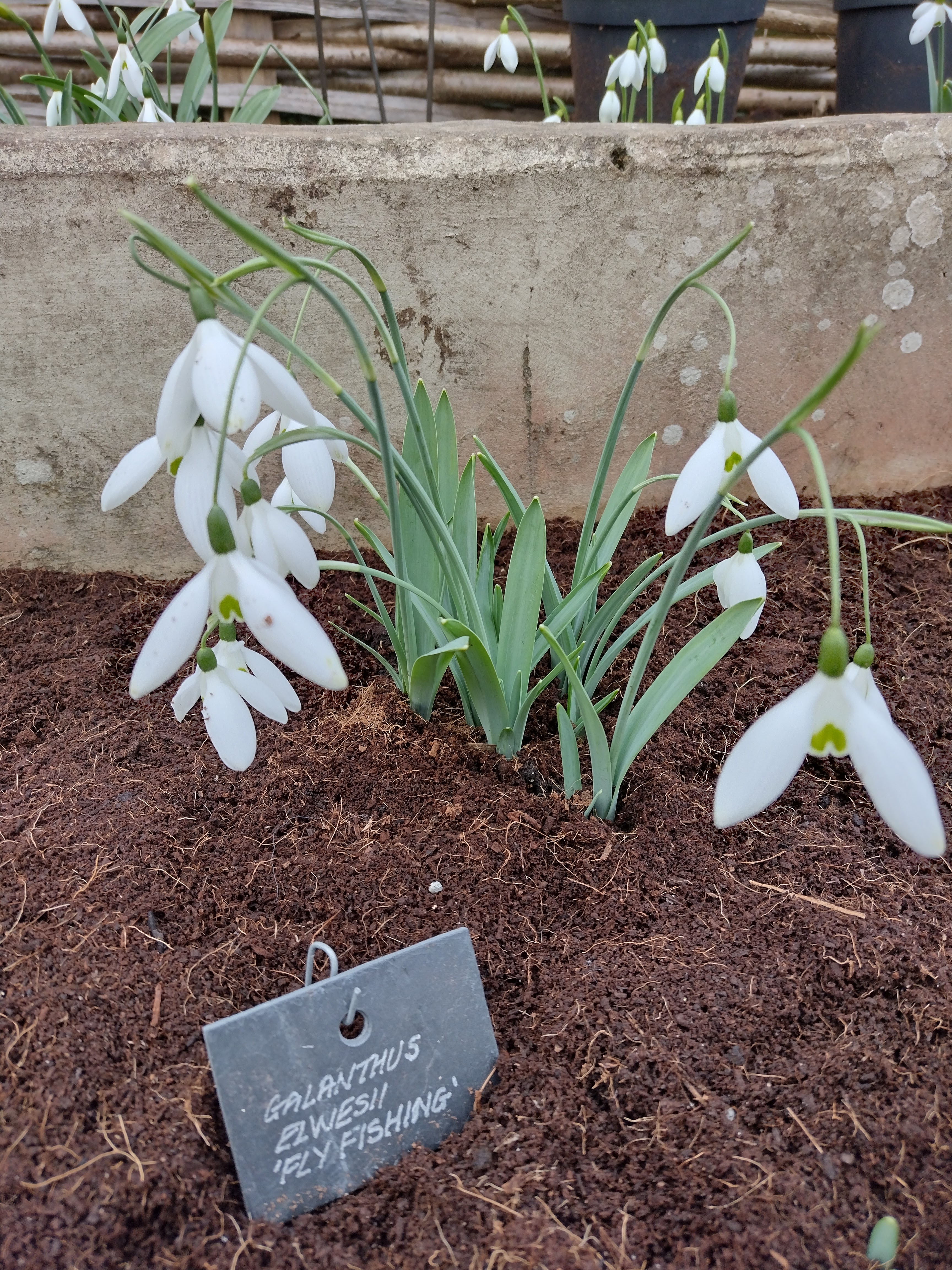
This cultivar I especially liked as it really did feel like white fishing fly on a rod and line, sadly though they'd sold out. 


This was the most expensive variety on sale, though recently I read that at auction a single snowdrop bulb Galanthus plicatus 'Golden Tears', sold in February last year for a record-busting £1,850.


While it is not advisable to grow snowdrops in containers, this single specimen is breaking free and has emerged between the cracks in some steps. How it got here made me wonder.


I did like the way the gardeners here displayed cultivars in these terracotta pots. They were not here permanently, just for the snowdrop month of February, but it allowed a closer inspection than getting onto hands and knees in the garden. This one above G. gracillis is one that I bought - a species snowdrop, the one with the twisted leaves. It may have cost £12.50 for a pot, but there are a dozen or so bulbs developing that I can see.


This variety I also liked, though a lot more expensive to buy, therefore I resisted. The green shading to the petals is a strong feature on this and another cultivar I liked G. philippe andre meyer whose green markings were very much like an exclamation mark. I really am becoming an obsessive. The variety below G. elwesii 'Natalie Garton' was one which Julie my wife loved, so we managed to purchase a pot of these to bring home, with a third variety G. elwesii 'Marjorie Brown' completing our spending today. In fact we bought these as Valentine gifts between us, something to look forward to in the years to come.


We'd spent nearly two hours wandering about in this gem of a garden. It made me think though that even though snowdrops are seen as ubiquitous today it was not until 1753 that the Swedish botanist Carl Linnaeus reclassified the snowdrop using the Greek and Latin term we still use – Galanthus Nivalis and in doing so, split this from another favourite of mine which I've long grown in my own garden for later spring show, the snowflakes or Leucojum species. Then in 1805 snowdrops were moved into the Amaryllidaceae family where they remain to this day, though a lot of chopping and changing is going on botanically at the moment.


After all that excitement I took our purchases back to the car and then returned for a well earned cup of tea, next to some snowdrops of course. 

Monday, 6 February 2023

These Are Fake Crows

What a commotion there was yesterday morning. I was idly sitting on the bed looking out of the bedroom window while we debated whether to head over to Wells for lunch or not; and while doing so my eye (and ears) caught sight of a noisy gathering in the hedgerow trees in the back field. With my binoculars always at the ready I had a quick scan.


There was indeed a corvid conflagration taking place.  The back field is a strange L shape and on the elbow of the L is a mature oak tree. Most years a carrion crow [Corvus corone] pair nest in the branches and with my telescope I've even watched young birds in the nest. Today however there were a pair of carrion crow battling with upwards of 20 magpie [Pica pica], and there was a real tussle going on. I tried to count the magpie accurately however the action, being both fast and furious, meant I struggled to confirm more than 20, I suspect though about 25-30. We do see large 'mischievous parliaments' of magpie here every winter, yet this one has to be up there with the largest. 

What these mobbing magpie were actually doing I couldn't quite make out. It isn't impossible that the carrion crow had already built a nest and laid an egg, but that would be really very early (even in this mild part of Somerset) given mid March is more usual. And I couldn't see any nest. Was this a turf war with the carrion back on their old tree and the magpie taking offence? Or vice versa? Sometimes I've seen such crow mobbing around mature trees or hedges if a tawny owl is day-roosting. Today however this was a definite direct mobbing of the carrion crow, who repeatedly flew at whichever magpie was incoming while also shooing away a few others nearby waiting in the wings. And not just in this one tree, the skirmishes went on all across all the adjacent hedgerow trees, both carrion crow working together wave after wave back and forth.

It was fascinating to watch and I have to say the crows gave up a tremendous fight, so much so that even with numbers against them after ten minutes or so the magpie dispersed and two flew into our fir tree to noisily complain of their failed squabble.  A fascinating observation of inter-specific behavioural exchange.


All of which didn't speed up our plans to head over to Wells, meaning it was just after noon by the time we arrived at the city, with a first visit to Waterstones for some ordered books, a bowl of soup to follow, and then with a lovely early spring day in the offing we headed into the Bishop's Palace to see the snowdrops. Virtually everywhere February is snowdrop month and the Bishop's gardens are no exception with guided walks and family days throughout the month. Today though was simply come and have a wander, which we did. Though the bulk of the snowdrops were not fully out, there was something pleasing in that they looked fresh and undamaged, newly emerged. On this visit 90% of the snowdrops were emergent but in tight bud still with just those in odd sheltered areas open. Next weekend there is a tour with the head gardener, we may have to return now we've purchased our annual ticket.


The Spring Room with Cathedral beyond 
(Wells being named after the springs which bubble up through the rock)


One of the few clumps that were open and looking fresh and fabulous.


One of the spring fed ponds in the garden


Snowdrops awaiting to emerge en-masse in a few days


And a lovely quiet space where, as in Anglesey Abbey in Cambridgeshire, a woodland of silver birch provides a dramatic foreground to the looming lump of the Cathedral.


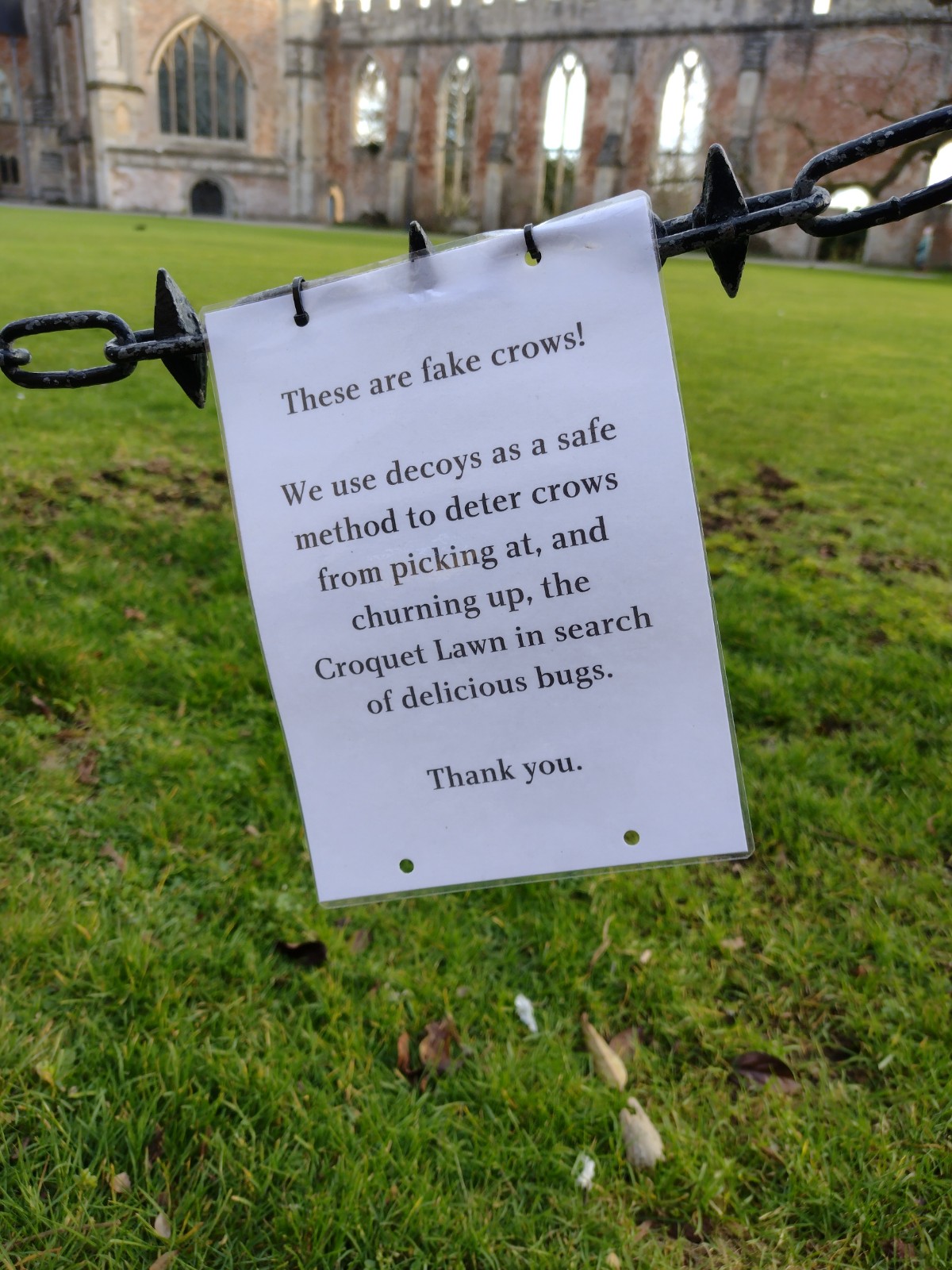
It was however on the way out that this notice caught my eye. I'd seen a couple of what looked like black plastic bags on the croquet lawn on the way in. Little did I know there were fake crows. Given the intelligence of corvids I'm not entirely sure half a dozen wooden rook on a lawn will prevent living and breathing corvids taking part in leatherjacket digging up. But it amused me the Bishop's Palace are at least trying an non-lethal way of pest control. Though I'd have thought removing the leather-jackets would be beneficial to a lawns' long term survival. Amusingly, inside the garden a dozen jackdaw [ Corvus monedula] were having a rare old time digging up another lawn. 

So fake crows in Somerset eh? Some would say the magpie pitching in against the carrion crow today were not true crows, but they're not fake, and I suspect if they ever flew the 20 miles to Wells they'd simply ignore the signs and mob those wooden rook anyway.

Sunday, 28 January 2018

Composting Sunday

January in the sun kissed South West has been, weather wise, as depressing as a depressed thing under the weight of the World. Dull days, damp days, hardly a day of sunshine. Of course it IS January and the winter is in full force, but constant grey skies make me a grey person.  But this morning despite the light drizzle accompanying the grey skies, I hot footed it out into the garden as a well overdue job was on the cards. Compost spreading.  


We love compost. It is like alchemy. Every day we hurl stuff from the kitchen into the green bin and for 6 months no matter how full the bin seems each day, 24 hours later there is a good six inches of space, with hundreds of brandling worms wriggling in the light, alongside woodlice, millipedes, centipedes and all manner of beasties. Eventually though even this legion of devourers can not cope and it's time to spread all their fabulous produce. Unlike some gardeners who work on a 6-8 week cycle, turning compost regularly to afford a quick product, we work on a 6 month slow compost route. We do put garden waste in the plastic composter but most of this goes into the wooden one next door, again on a 6 month cycle. 


First job then to strip off the top layer of material still waiting to the broken down, that'll make a lovely base layer when it goes back in. Then the black gold as many call it comes out. Three wheelbarrow loads from the wooden bin and nearly three from the plastic composter. We don't grow vegetables, purely an ornamental garden and wildlife friendly - it's never had chemicals. The ornamental perennials, biennials and annuals are mostly grown for pollinators with the odd exception for a bit of riotous colour. But that's in May or June when the first summer flush is dazzling the neighbourhood.


But in late January it is the spring bulbs that will dazzle the neighbourhood. Ours at least. These Iris reticulata were planted in September and I remember us packing the bulbs into the pots thinking, spring is around the corner. Of course it was months away, and these only flowered yesterday, but that riot of blue did really brighten up the grey day...by the time the photo was taken it was drizzling even harder.


Snowdrops of course are now coming into their own. Although they have sporadically been out down here in Somerset since the first week in January, the massed Galanthus show is just coming into its peak. Yesterday while heading into work at Tyntesfield the massed snowdrops by the quarry wall seemed incongruous, beacons of light in the mist, like miniature headlights in the gloom. I love snowdrops and have a few in pots which I look after all year like these Galanthus woronowii, known commonly as the giant snowdrop; not so much for the size of the flowers, but the leaves, more bluebell leaf in shape and rich green colour than the spear like sage green leaves of our 'native'  snowdrop. Look closely and the colouring inside the flower is just sublime.... Every One A Winner on these grey January days.


Sunday, 20 February 2011

Up and down the Chutes

Its a good job we don't let the weather spoil the day. February may be turning out to be one of the mildest on record with average temperatures 3 degrees above the norm (Philip Eden in the Telegraph on Saturday) but with pretty much continuous dull, wet and miserable days, it still feels like the dark days of December to me. So much so in fact that on Saturday we popped over to Stow in the Wold and with all the shop lights blazing across the streets, people bustling about shopping, and it feeling cold, it really did feel like the run up to Christmas.

So yesterday, undeterred by the cold grey start to the day, herself and I pootled off to do a 2 hour walk around the Chutes. The Chutes are a collection of villages on the Wiltshire/Hampshire border and a favourite area of mine. Back in 1983, when I still lived in the North East, we had a holiday at Hurstbourne Tarrant and stumbled across the Chutes by accident. I find it strange these days that from Julie's home they are just 8 miles away.

I digress. So armed with a book of walks, we arrived at Lower Chute. The walk we were going to follow began at Upper Chute, but Lower Chute has a fabulous pub, more of that later, so I felt it was a good start and more importantly end to the walk.

So off we started. Now because we began the walk mid flow, so to speak, trying to work out exactly where we were on the planned route in the book was a lot more problematic than we envisaged. However after a couple of false starts, we headed past the war memorial above and turned right up a hill and onto the open landscape.

The soil here is amazing, it is nearly 50% flint shards, very heavy soil but very productive. Must be a nightmare to work though. There was little wildlife of note here but a Jay held our attention for a while crarrcking in a tree, and a lone buzzard. Interesting too how once one stops looking at the miserable weather from inside and actually goes outside, it seems much more cheerful.

Even these snowdrops just by the side of the road we'd now turned onto were cheery. Mind you herself eclipses the snowdrops, especially in that hat.

Eventually we arrived in Upper Chute where the churchyard of St Nicholas was awash with snowdrops. Not far from here is the settlement of Chute Forest. Now here's a thing. The word Chute dates back to Norman times and means forest or wood, and in those days this area was an extensive forest, which joined up with the huge hunting forest of Savernake, also owned by the Crown, just a few miles away to the north, and to the south the Salisbury Forest which then joined onto the New Forest. Deforestation began in the reign of Charles 1st when he granted parcels of the forest to favoured noblemen. So here's my conundrum. The hamlet of Chute Forest actually translates as Forest Forest. A bit more imagination was needed back then I feel, in hamlet nomenclature.

Continuing through Upper Chute we then headed down a wonderful track, which dipped and weaved through the landscape. There were more birds here, flitting about, mainly the common species, but a welcome diversion.

But I love these ancient tracks for the history they bring to the present. How many people and for how long have been using these tracks? My guess is they're at least 500 years old and probably a lot older, as this area was inhabited in the iron age. We often take landscape at face value, but what we see today is a result of centuries of management and change. This wood by the track is a good example of this. Those trees by the fence were coppiced at some point, but are now at least 100 years old mature trees, albeit with multiple trunks. Beyond these bluebell foliage was beginning to show, again indicating an ancient woodland. We made a note to return when the bluebells are in flower.

Further along the track we turned uphill and began walking along a muddy track called Breach Lane, alongside which we came across this ancient hazel coppice stool. Still healthy on the outside but completely hollow in the middle. Looking around there were other ancient hazel stools, in a line. Presumably then a boundary hedge along the track. I'm no expert in dating such features, but I'd guess about 200+ years old as the hollow area was at least 18 inches across. I find such permanent reminders of our past in the landscape inspiring. As for whatever happens, wars, famines, economic growth and decline, these sentinels to permanency bring me back to earth and make me realise there are bigger and longer lasting forces at work than me. Nature will always be supreme.

Further along the lane a sight not often associated with mid February, windfall apples. I love the fact that this apple tree was possibly the result of some passing wayfarer tossing his apple core into the hedge, from where it then germinated and grew. There's a rising phenomenon along trunk roads in Britain in that apple cores thrown from cars as they speed past, now mean there are a lot of apple trees growing alongside our roads. Over in Dorset a viewpoint in Duncliffe Wood now has an orchard around it, just from the discarded apple cores of walkers after the climb. Next autumn keep a look out for apple laden trees in our hedgerows and you will be surprised how many there are.

Not far from the apple tree we spied a group of deer, miles away across a field but at least I managed a record shot photo.

Eventually we joined the so named Chute Causeway. Today it is a country lane, but originally it was a Roman road connecting Winchester with Mildenhall, near Marlborough. On our walk it was quiet, so quiet in fact we disturbed 2 roe deer, one a stag in full antler, which was surprising but not unusual. We watched these for a while before they bounded over a fence. The photo above shows a well used deer jump over the fence. I know deer are becoming a bit of a problem at the moment as their populations are expanding rapidly, but no matter what damage they cause to wildlife sites, farmland and gardens, they're still magnificent to see. As was the marsh tit pchew pchewing in a tree beside us.

We'd been walking nearly 2 hours now so it was time to head back to the pub, via Conholt Park, which I later discovered has an interesting past, and is one of the most important conservation estates in southern Britain as they marry conservation (the biggest downland restoration project in England), farming and shooting in a very profitable way. The house also has a fabulous garden apparently, open occasionally to the public. Our main concern however was would we make it through the Park........ mmmmm worrying sign that!

All was well though, phew! We then passed by a small woodland. I'd love to know the history of this. Its marked on the Ordnance Survey map as Mafeking Clump. The name suggests it was planted in response to the Mafeking Siege at the turn of the 19th Century, but why here? Its difficult to see in the photo, but the periphery of the clump is delineated by regular spaced conifers, almost like soldiers in a circle laying siege to the broadleaved trees inside. A flyte of fancy or a meaningful memorial to a fallen soldier. I must investigate further.

One last hamlet to walk through, Chute Cadley, who's entire woodland seemed to be taken over by snowdrops. This is a wonderful area for snowdrops, every village is just a sea of white at the moment

And then we were back to the car which we'd left at the Hacket Arms, Lower Chute. Its nearly 30 years since I first visited this pub and it has never changed. Still tucked away and hard to find, inside is all beams, open fires and relaxed. A welcome end to a walk, as was the cider and cheese and onion crisps. Never let it be said a dull day is wasted in the country.