A

A
Showing posts with label Gardens. Show all posts

Sunday, 12 February 2023

East Lambrook Manor Garden : Snowdrops

In a book published in 2014, The Galanthophiles: 160 Years of Snowdrop Devotees by Jane Kilpatrick and Jennifer Harmer, they describe snowdrops coming of age "between 1854 and 2014". The book  "explores not only the discovery of new variants and species during that time but also the stories of the ardent enthusiasts who sought out, cherished, and shared these deceptively fragile white flowers." And I think that's it, that is why I love snowdrops, those deceptively fragile white flowers that contain a botanical anti-freeze allowing them to emerge in the coldest of winter months and bring promise to the late winter landscape.


I cannot recall the first time I visited East Lambrook Manor near South Petherton in Somerset and while not an annual visitor I have been here a number of times, to look at snowdrops in particular. This Grade 1 listed garden, while important in its own right as the foundation of the cottage style garden, is a mecca for the Galanthophile.  I do not class myself as one, I simply like snowdrops. 


Much has been written of the origin and history of snowdrops in Britain, therefore I'll only briefly mention some of that here as there is no definitive answer to that question, and I like that vagueness. 

The accepted wisdom is that the species referred to as the native snowdrop Galanthus nivalis is not native to Britain at all.  That is probably true, however the origins of this snow piercer in the British Isles is a little murky, with its first recorded mention in literature being within General Historie of Plantes by John Gerard printed in 1597. However these were snowdrops already growing in gardens and monasteries, and they were not called snowdrops by Gerard but described as Leucojum bulbosum praecox minus –  or as he called them ‘Timely flouring bulbous Violet’. 

Some references head further back into history, citing that with the retreat of the last Ice Age, snowdrops may have colonised Britain naturally from their core regions today of the Caucasus and Western Asia, with records being lost in the historic pollen samples. This may possibly be true, though it could be argued why did they not survive this colonisation in temperate Britain? But it is highly probable that the Romans at least knew of snowdrops and may have brought them to Britain as their Empire expanded. It is natural for people when living away from home to have a little reminder of their native area. All the more intriguing given that Galanthus the general name for snowdrops is derived from two Greek words meaning ‘milk’ and ‘flower’ referring to the white petals and Nivalis from the Latin word for ‘snow’.

The ability of snowdrops to push through snow is also suggested for the explosion of snowdrop records in Britain in the mid Victorian era when it is thought soldiers returning from the Crimea War brought with them snowdrop bulbs found naturally in the region, as a reminder of the first sights of spring during a bitter war.  

Or maybe it was the Vikings, who we now know traded extensively with southern Europe and the middle east. Or the Normans as they arrived on Britain's shores. It is intriguing and what garners my thoughts is we now know a lot more about early history, how populations traded and moved about a lot more than previously thought.

It is well documented that religious sites were possibly a nucleus of snowdrops in Britain during the Medieval period, especially out to the west in Wales and Ireland. Those monasteries, abbeys being the centre of not only learning but mediaeval medicine, were associated with the local, shall we call them native, physicians. Monks and religious followers travelled widely across Europe and Asia bringing with them knowledge of botanical medicine, with a chemical (an alkaloid galantamine) derived from the bulb of snowdrop being first mentioned by ancient Greeks for its mind-altering properties and used for centuries in the treatment of headaches, nervous tension and to ease migraines. Is it then a simple leap of faith to suggest snowdrops have a longer history in Britain than wisdom decrees, through ancient medicine and monastic herbal gardens.


My historical context with East Lambrook Manor is not as long and as I have mentioned I don't have any documentation to confirm when I first visited.  History is a funny thing. This is not a garden to come and walk amongst the drifts of snowdrops through woodland. It is a modest garden which displays over 100 cultivars of the twenty or so species of snowdrop known. There may be 21 species now, I'm sure I read somewhere on my visit a new species has been discovered. Margery Fish (1892 –1969) who bought this manor and garden to get away from the London Blitz admitted herself she was not a gardener when she arrived. Yet in a few decades she became a leading authority on the informal cottage style garden planting which broke the mould of the more rigid and formal Victorian and Edwardian bedding. 


She also liked snowdrops, though her first interest was the Hellebore genus. Eventually though she became an avid galanthophile which was explored in her book A Flower for Every Day, which includes an account of the giant snowdrop variety "S. Arnott", first exhibited at a Royal Horticultural Society exhibition in 1951.  Probably the most common species of snowdrop is the native snowdrop, Galanthus nivalis, the giant snowdrop Galanthus elwesii and the  pleated snowdrop Galanthus plicatus which sits in the middle, size wise. From these three species hundreds of cultivars and sub species have emerged either naturally or through breeding, with it being estimated there are over 1000 cultivars of all snowdrops.


The more I looked at the very well arranged and labelled cultivars in the garden the less I realised I knew. From a distance they are low growing white flowers, but close up, snowdrops are unique, sometimes subtly sometimes not. Petal markings, leaf shape, growth habit are all different. I found myself eavesdropping the gardener at East Lambrook chatting to a serious Galanthophile, with them discussing that this variety is like that variety but you can tell them apart by the length of the green edge on a single petal, but only when the flowers are mature. I'm not sure I'm ready for that level of interest or knowledge.


As a simple rule though, of the three species above the best way to tell them apart is to examine the leaf. G. elwesii has a rounded (‘supervolute’) leaf base, while G. plicatus leaves have a folded (‘plicate’) lip along the edge. The leaves of the much bigger overall G. elwesii are fleshier and wider. I bought a species snowdrop myself G. gracillis which is tiny and has a characteristic twisted leaf. I think I may be getting obsessed.


What I enjoy about this garden is that it is well laid out, every clump of snowdrop is labelled, so as we wandered about I could take notes or photographs. At the time of our visit the garden wasn't too busy, but it was obvious those who came came for a reason, to discover more of these delicate little flowers arranged in a showing border like fairy hats on green stalks.

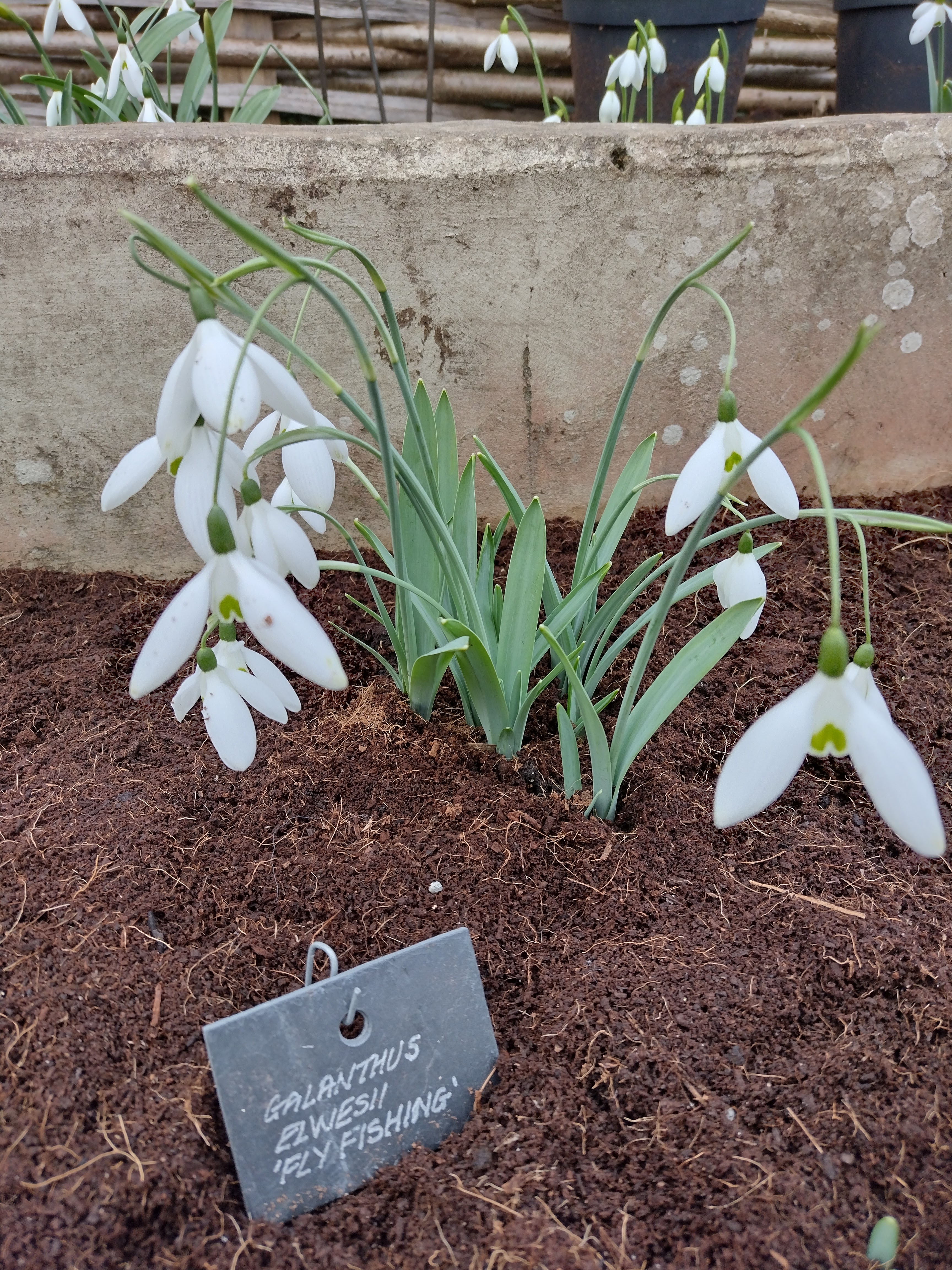

This cultivar I especially liked as it really did feel like white fishing fly on a rod and line, sadly though they'd sold out. 


This was the most expensive variety on sale, though recently I read that at auction a single snowdrop bulb Galanthus plicatus 'Golden Tears', sold in February last year for a record-busting £1,850.


While it is not advisable to grow snowdrops in containers, this single specimen is breaking free and has emerged between the cracks in some steps. How it got here made me wonder.


I did like the way the gardeners here displayed cultivars in these terracotta pots. They were not here permanently, just for the snowdrop month of February, but it allowed a closer inspection than getting onto hands and knees in the garden. This one above G. gracillis is one that I bought - a species snowdrop, the one with the twisted leaves. It may have cost £12.50 for a pot, but there are a dozen or so bulbs developing that I can see.


This variety I also liked, though a lot more expensive to buy, therefore I resisted. The green shading to the petals is a strong feature on this and another cultivar I liked G. philippe andre meyer whose green markings were very much like an exclamation mark. I really am becoming an obsessive. The variety below G. elwesii 'Natalie Garton' was one which Julie my wife loved, so we managed to purchase a pot of these to bring home, with a third variety G. elwesii 'Marjorie Brown' completing our spending today. In fact we bought these as Valentine gifts between us, something to look forward to in the years to come.


We'd spent nearly two hours wandering about in this gem of a garden. It made me think though that even though snowdrops are seen as ubiquitous today it was not until 1753 that the Swedish botanist Carl Linnaeus reclassified the snowdrop using the Greek and Latin term we still use – Galanthus Nivalis and in doing so, split this from another favourite of mine which I've long grown in my own garden for later spring show, the snowflakes or Leucojum species. Then in 1805 snowdrops were moved into the Amaryllidaceae family where they remain to this day, though a lot of chopping and changing is going on botanically at the moment.


After all that excitement I took our purchases back to the car and then returned for a well earned cup of tea, next to some snowdrops of course. 

Sunday, 8 January 2023

RHS Rosemoor - Eventually

Way back in 1995 when I found myself living in East Brent in Somerset, my then landlady Mrs Jean Williams, visited what was then the newest Royal Horticultural Society garden Rosemoor in Devon. I remember her returning and knowing of my interest in gardening said I should enjoy it suggesting maybe we could go together regularly and watch the garden, which opened to the public in 1990, develop over time. Sadly none of that suggestion happened and it took me nearly three decades to finally make the hour and a half drive to north Devon and finally visit. It has also taken over a week to write up this visit. A pattern of delay is emerging.


How had it taken me so long to visit? I'm not sure, life just gets in the way, but over the Christmas period despite the weather being so dire the effort was made. To be fair the weather wasn't awful, just perpetually wet, very dark during the day and basically a smorgasbord of grey enveloped the landscape. Each time I ventured outside I seemed to return like a wet rag. Two days before Christmas our walk around Cheddar Reservoir was, well quite wet. Christmas Day saw Julie and I down on the Somerset Levels as has become a little of a Festive tradition now, and we were soaked through. On Boxing Day we simply abandoned another walk before it began as the rain started to fall heavily and never stopped. However on December 29th the forecast for Devon was for heavy blustery rain blowing through quickly overnight followed by sunshine and showers during the day, before more rain would arrive before midnight. A dry window of opportunity then, and I'm so pleased it allowed the visit.


Back in 1995 when Mrs Williams visited RHS Rosemoor the garden was still very much in an on-plan development stage. RHS Rosemoor is still developing, despite the garden and adjacent pastureland being gifted to the Society in 1988 by Lady Anne Berry (1919–2019). This mini estate had been her family home having been bought in 1931 by her father Sir Robert Horace Walpole as a salmon fishing lodge. Its then 8 acres of gardens were of standard Victorian inspiration, lawns, formal flower beds and it was not until her mother installed the stone garden just before World War 2 that any semblance of garden design began to take place. Lady Anne herself is credited as having caught the garden bug in the late 1950's having met the well respected ornithologist and plant collector Collingwood Ingram. He received a moniker 'cherry Ingram' for his knowledge of Japanese cherry trees, he also knew quite a bit about Asian bird species. I digress.


It is 87 miles from home to the garden just outside Great Torrington in north Devon, and as had been expected the rain never stopped on the entire journey, until that is we arrived and the sun came out. Perfect. A sun kissed visit was in prospect to explore the garden for the very first time. We were not disappointed. Julie is a professional horticulturalist so after the obligatory cup of tea and a bacon butty (for research purposes) we split up for a while to explore the garden in our own ways. Of note Julie said when we reconvened was the exceptional labelling of every plant in the garden, a gigantean task given the RHS have expanded the garden to cover 65 acres today. I studied horticulture with the RHS myself thirty years ago as an amateur interest, today however I simply enjoyed the views and took the photographs accompanying this record.


Even in the depths of winter this garden is beautiful with an awful lot to take in, much too much for one visit if truth be told. The long walk above seamlessly splits the formal garden from the visitor centre. There is something magical in a tightly clipped winter structure I feel. Yet buried amongst the formality nuggets of informality, such as the catkins emerging on to the chaotic structure of this corkscrew hazel.


I've lost so much knowledge of plants over the last few years as I now rely on Julie to identify everything for me while we're out and the home garden is her domain. But despite diminishing memory my love for gardens has not weakened and I am increasingly drawn to the feel and atmosphere of a garden, such as the Winter Garden below one of the many rooms within the formal garden, rather than the individual plants therein. 


The climate in this part of Devon is a moist oceanic influenced one, winters are generally mild with summers warm rather than hot, and not as dry as across in eastern England. Perfect conditions to grow some of the more tender species, that Atlantic derived weather influences air quality too. Everywhere there is evidence of how unpolluted the air is with lichen and mosses covering every structure, even the marker signs.


New structures are still being built around the garden, such as the Cob Shelter which provided the perfect frame for a view back towards the Learning Centre which though it was closed on my visit looked fascinating in its own wooden design. Glorious too to see blue skies overhead adding to the bright winter atmosphere.


The rain almost kept off during our visit, a brief squall when we were in the Foliage and Plantsman's Garden didn't dampen our spirits. Even as the light levels dropped the clever planting here flashed colour into the rain.


That squall soon passed and allowed more time to be spent in what for me was the highlight of the formal areas, the Herb, Potager and Cottage Garden. I loved the centrepiece of a simple round pond with child in repose from which the four main quadrants emerged. The winter structure made this garden a delight to visit in December, yet what this garden would look like in spring or summer is intriguing. I feel another visit is a must this year not least as being an RHS member entry is of course free.


Local Devonian craftsmanship is evident everywhere including this easily overlooked Devon Hedge, this one a drystone wall with the traditional chevron design with herb and potager planting on top. A nice touch indeed.


The Cottage garden has a lovely permanent structure, which on the map is shown as simply 'shelter'. It is so much more. I sat there for a while just enjoying the peace and quiet, on this day we visited there were only a handful of other visitors. In the near silence I could hear birdsong easily, great and blue tits, a robin and somewhere behind me a wren. A gloriously restorative moment here.


A sculpture exhibition was taking place, with this cat on a ball taking my eye, albeit with an eyewatering price tag. Not this year I fear. 


It may be midwinter but the signs of spring were pushing through - by the Wisteria Lodge drifts of snowdrops were already in flower and these daffodil 'Rijnveld's Early Sensation' bursting through the grass were a welcome site.


Outside the formal garden the Lake is apparently regularly frequented by otters so the sign said. Not today sadly but the blue skies reflected well the birch planting on the opposite bank, flanked by various cornus species looking as if they were on fire in the weak sunhine.


Further into the less formal areas of the garden, this display of colourful squash in the 'shelter' of the Fruit and Vegetable garden also brought a fiery brightness to the well organised and frankly stunning working part of Rosemoor. I was impressed, not least when I discovered later there are only eight gardeners, plus volunteers. 


Though there may be a lot of hard work to keep this garden looking so stunning, there is a fun element too with their recreation of Mr McGregor's garden from Peter Rabbit to entertain the younger visitors, such as myself.


The second tranche of rain during our visit arrived quickly and was beginning to settle in for a longer spell. We'd been walking for two hours and not really explored more than half of the garden. Chatting to a couple and their friend as we all sheltered from the deluge they let it be known that they come regularly and suggested when the rain eased we head to Upper Woodland Walk to look back onto the whole of Rosemoor from the highest point. Watching the rain fall quite heavily now Julie and I made the decision to abandon any more exploration for the day and plan to complete that walk on our next visit. Which I hope won't be in three decades time, late spring this year, maybe?

Sunday, 20 February 2022

The Mock Nightingale In Winter

As I began writing this, the second storm of the week, Storm Eunice, was beating down onto this often windswept part of the Somerset coast. Out the window the only bird visible on the feeders is a male blackcap. With each energetic gust he clings onto the bird feeder as it sways and gyrates in the maelstrom, determined to feed on the fat balls no matter what a named storm throws at him.  How different this day is to Tennyson’s poem, The Progress Of Spring…


Across my garden! and the thicket stirs, The fountain pulses high in sunnier jets, The blackcap warbles, and the turtle purrs, The starling claps his tiny castanets.


It is mid-February and therefore a little early in the year to hear such warbles, yet Tennyson’s poem subtly sets the scene. 

In Britain, the blackcap is mostly referred to as a summer migrant. Their arrival from the end of March is heralded by its melodious song, which the poet John Clare called in his sonnet The March Nightingale “a rich and such an early song “.  While Gilbert White wrote on the 19th May 1770  “Black-cap sings sweetly…it is a songster of the first rate… called in Norfolk the mock nightingale".

And that is all well and good, but it’s still winter. While overwintering blackcap in the Mediterranean regions are known to sing outside the breeding season, the male and female blackcap visiting my garden since before Christmas have been very much silent. Come sun, rain, frost or wind the male blackcap has been visible most days, more often than not the only bird on the feeders,  whereas the presence of others - sparrows, starlings, tits and chaffinches - is one of safety in numbers. 

Blackcap are smart looking little birds too. Richard Smythe said of the male blackcap, “The cock-blackcap is a dull grey scrap of a bird with a smart, forward-tilted black cap”.  A scrap of a bird indeed! I’m not sure about that. I think this true warbler is a neat little chap with his sooty black cap and mostly uniform grey body washed with a watercolour tint of raw umber. While the male has been the regular visitor to my garden, his female companion with her chestnut cap has been less frequent. I’ve possibly seen her half as often as him, or more possibly she tends to spend less time at a feeder so I’ve probably just missed her while writing this.

Small numbers of blackcap have long overwintered in England, especially in the milder South West. Records go back to the 19th Century and possibly further, though unrecorded. Yet in the last few decades numbers have increased and reading a 2003 article in the online site Birdguides it notes around 10,000 blackcap now overwinter here, mostly in gardens.

Casting my mind back fifty years or so my interest in natural history, like many of my generation I suspect, was awakened by reading books such as Observer’s Book of Birds, which lists blackcap thus,  “This warbler is a summer visitor [April to October] though like the chiffchaff, it has been known to winter in the South West of England”. Another bedtime reading book back then (under the cover with a torch) was my Collins Pocket Guide To Nests and Eggs, a book singly failing to even mention overwintering blackcap, “…summer visitor, with range of garden warbler, but breeds locally further north in Scotland”. 

I saw my first overwintering blackcap around the turn of the Millennium. The reasons why overwintering numbers have gently climbed are still not fully understood, although climate change, weather patterns and available food are thought to play a part.  That article in Birdguides neatly summarises this, noting that it is the sheer number of blackcap “that now choose to spend the winter here, rather than their usual wintering areas in southern Iberia and North Africa.” Deeper into the article the town of Weston Super Mare, a few miles from me, receives special attention as a wintering blackcap hotspot. Which begs the question, ‘why do blackcap now prefer to spend their winters in Weston-super-Mare rather than the Costa del Sol or Morocco?’ 


Watching what I refer to as ‘my’ blackcaps in the garden on a winter’s day, I could be fooled into thinking these were simply resident birds, summer visitors from last year who for reasons of their own, (like increasing numbers of swallow now overwintering in England), decided it’s far too much effort to fly south for the winter when there’s a smorgasbord of food being laid on in this garden. Well that’s what ornithologists thought for a long time, and they, and I, would be wrong.  These birds, with a few exceptions, are not a resident population but winter migrants.

Back in the 1990s the mystery of why blackcap were flocking to Weston Super Mare (and of course elsewhere) was finally revealed. A Germain scientist, Professor Peter Berthold, and his team captured 40 Blackcap on the Somerset coast during the winters of 1988-1990. These birds were then taken over to his research station in southern Germany where they were observed and held until the following autumn when they began to show ‘migratory restlessness’ (or simply - the birds hop in the direction they want to migrate). Professor Berthold concluded that “in contrast to most of the Blackcaps breeding in southern Germany (which migrate [in winter] in a southwesterly direction towards Iberia and North Africa), the British birds he had captured orientated in the direction of the UK (northwest), meaning that the breeding origins of the UK wintering population were most likely to be in south central Europe”. In other words the blackcap I’ve been watching all winter have probably come from breeding areas of Germany, Poland or the Netherlands. And the birds I saw in the summer are now sunning themselves in North Africa and the Med. 

It must be a tough choice for a blackcap. One morning in October they wake up and ponder life’s big questions; shall I head south to my warm Mediterranean winter quarters? Or head northwest and be storm lashed next to the Bristol Channel? Foregoing to head south, those birds choosing to migrate to Somerset for the winter, are here for a reason. Seemingly part of the reason is food, or correctly, supplementary food we all put out in our gardens.

Studies by the British Trust for Ornithology ( BTO ) suggested that in British gardens the increase in overwintering blackcap coincided with the increased provision of wild bird food in our gardens from around the 1960’s. Not just quantity but quality. I remember as a child pestering my parents to put up feeders, all that was available was dusty floor sweepings of seed from the local farm suppliers or pet shop. Today there is a dazzling array of fat balls, suet treats, seeds of every description, with an estimated 150,000 tonnes of bird food sold annually. That’s a lot of food being regularly made available, providing much needed energy-rich feeding in the lean times over winter. Many resident birds have adapted well, tits, chaffinch and so on and have seen their populations increase as a result. In this regard, it is these birds known as generalists who are able to adapt to changes, feed in gardens, and potentially benefit from increased body condition, energy, survival and maybe come breeding time just be that much fitter. Didn’t Darwin have a theory about that or something? It seems blackcap are one of the bird world’s generalists, after analysis of the BTO’s Garden BirdWatch data found strong evidence that the rate and numbers of occupancy of gardens in winter [by winter migrating blackcap] is directly influenced by both supplementary food provision and temperature. 

One of the fascinating discussions at the moment is with Climate Change, which species will win out. A study by Van Doren et al said “[blackcap] is a migratory songbird thriving in the face of environmental change”. Climate change is making British winters warmer and all this food is providing vital mid-winter energy. Simple? Well maybe. 

I’m returning to my Weston Super Mare question – how do blackcaps in Germany know I’ve a garden overflowing with sunflower hearts? Have they a food miles map? Are the BTO providing fat ball Sat-Nav trackers? Does a lone blackcap find the sunflower hearts, pop over to Freiberg to tell his Germanic lady friend and a week later they’re back? I don’t think there’s a definitive answer here and the detailed mechanisms behind why birds alter inbuilt migratory behaviour is a wide-ranging topic of discussion, but not today. 

However bird migration routes are mostly genetically inherited. It could be argued then that this increasing trend in wintering blackcap in England was one of a slow burn from a few Victorian individuals being simply opportunist to a full on parent-to-offspring inheritance.  However, what is fascinating is that over time these winter migrants from Germany are showing subtle morphological changes. It seems that blackcap wintering in Britain have developed relatively narrower and longer beaks than those wintering in Spain, the assumption being this is a result of needing  beaks to be narrower and longer to simply get into the gaps in the feeders. There’s that ability to adapt and survive again. Additionally further German studies even suggest that over time the British wintering and North African wintering blackcap may develop into separate subspecies, and all because I’ve popped some fat balls into a feeder!

Why the overwintering birds do not stay here to breed and maybe grab an earlier more suitable territory isn’t known fully, though it seems that a tiny number of blackap are truly resident. One study found that only 6 individuals out of over 1000 studied in the UK one winter stayed put. But will this change? Patrick Barkham writing in the Guardian newspaper put forward a theory that with climate change [many species] birds will no longer need to migrate south in the winter. Why burn a lot of energy to find food when there’s food here. It’s an interesting thought as I fill up the sunflower feeder yet again and sit back to watch Mr Blackcap come and have his elevenses.

I’ve really enjoyed watching blackcap on the feeders this winter, and they are selective over which feeder they use too. My blackcap only feed on sunflower hearts and fat balls, rather than seed or other treats, and this ties in with other studies of overwintering blackcap. These studies show that when blackcap arrive for the winter they firstly prefer open farmland and scrub, and only later in the season, or during times of bad weather, will they come into gardens. Watching the male in particular, he has a routine. First seen in the fir tree beyond the garden, he will fly direct to the feeder of choice. Unlike other birds which flit back and forth into cover with each morsel, the blackcap remain at the feeder for a considerable amount of time, often many minutes. Either he is  sure of not being nobbled by the large female sparrowhawk resident in the area, or simply unawares. And because he stays out in the open so long it affords lengthy observation.  One thing I’ve noticed is that he tends to start feeding at one point and slowly move in a circular direction around the feeder until back to where he started.  So familiar has he become with coming to the feeders that on the rare occasions he doesn’t turn up (or I failed to observe him) I feel a real sadness. Where has he gone?

Well maybe they’re all feeding on mistletoe. I’ve noticed over the last decade that nearly every tree around here is now festooned with large verdant pom-poms of this parasitic plant.  Mistletoe does prefer mild moist climates and I do live in the centre of the preferred range for this plant, but especially during winter where once there were bare branches, those trees are now ostensibly evergreen. And I’m not alone. Since the 2000’s there have been suggestions that mistletoe is spreading faster than it used to in Britain, especially so in the less favourable eastern half of the country where previously established mistletoe populations have been slow to spread. Part of this might be due to warmer winters, but blackcap is a major culprit in this spread.

I’ve not tried this myself but apparently sticky mistletoe berries are not easy to eat, most birds avoid them. Another winter visitor, waxwing, will eat mistletoe and of course so will the mistle thrush (and other thrushes). But despite their name, mistle thrush are not great at spreading mistletoe as they swallow the berry whole, the seed of which is excreted about 30 minutes later often dangling below a branch trapped in the sticky excreta. Blackcaps however only swallow the berry skin and pulp, leaving the seed needing to be wiped off its beak on, well you guessed it, a branch, a perfect spot to let it germinate. And of course it’s an ever increasing circle if you think about it, mistletoe is a source of food during winter for blackcap, they help germination success, so more mistletoe means more berries to feed on over winter, fitter blackcap, I could go on.

All I know is that in the next few weeks these overwintering blackcap which have entertained me all winter will head back to their European breeding grounds, to be replaced by their summer-arriving cousins from north Africa, arriving fresh and ready to take up breeding territories with song.

So let’s hear it for the blackcap then. Though it still doesn’t answer my question about why on earth they chose to come to Weston Super Mare? 


Selected Reference : 

S. Vere Benson,  The Observers Book of Birds; Warne London (1972)

R.S.R Fitter and R.A Richardson  Collins Pocket Guide To Nests and Eggs. Collins London (revised ed 1968)

Smythe, Richard  A Sweet Wild Note: What we hear when the birds sing. Elliott & Thompson, London. (2017)

Witherby, H. F, Jourdan, F.C.R, Ticehurst, Norman F. and Tucker, Bernard W (1940) The Handbook Of British Birds, Vol 2. H.F & G Witherby, London (1940)

Fisher, James,  The Shell Bird Book. Ebury Press and Michael Joseph (1966)

Tennyson : The Progress of Spring.  – [fifth stanza] http://www.poetryatlas.com/poetry/poem/348/the-progress-of-spring.html

Flegg, Jim  Oakwatch : a seasonal guide to the natural history in and around the oak tree. Pelham Books (1985)

Charles S Bayne  Exploring England. Collins London (1944)

John Clare’s Poem The March Nightingale “and while the blackcap doth his ears assail” can be found in the book Midsummer Cushion ed. Anne Tibble. Ashington. Carcanet (1978) 


ON-LINE REFERENCES 

Birdguides (2003) : Wintering Blackcaps – Where Do They Come From and Why?

https://www.birdguides.com/articles/wintering-blackcaps-where-do-they-come-from-and-why/


BTO : Why we are seeing more Blackcaps wintering in Britain? 

https://www.bto.org/understanding-birds/species-focus/blackcap


RSPB : Blackcap Mirgation 

https://www.rspb.org.uk/birds-and-wildlife/wildlife-guides/bird-a-z/blackcap/migration/


Smithsonian (2021) : Bird Migration Patterns Are Changing—and Climate Change May Be to Blame

https://www.smithsonianmag.com/smart-news/bird-migration-patterns-are-changing-and-climate-change-may-be-to-blame-180979054/


Van Doren, B.M., Conway, G.J., Phillips, R.J., Evans, G.C., Roberts, G.C.M., Liedvogel, M. and Sheldon, B.C. (2021), Human activity shapes the wintering ecology of a migratory bird. Glob Change Biol, 27: 2715-2727. https://doi.org/10.1111/gcb.15597


Barkham, Patrick. Guardian. 25 Oct 2021 – Migratory Birds May Stop Flying South For The Winter.

https://www.theguardian.com/environment/2021/oct/25/britains-migratory-birds-may-stop-flying-south-for-winter


Oxford study

https://www.ox.ac.uk/news/2021-04-14-bird-feeders-have-reversed-blackcaps-migration-fair-weather-visitors-wintering


Mistletoe website http://mistletoe.org.uk/

Thursday, 29 December 2011

Snowflakes, daffodils and still December

I'll begin this short posting with a photograph from last night. This is he hamlet of Wilton near Great Bedwin in Wiltshire. This is the next village to where Julie lives and we drove through it last night enroute to looking for owls (we found a wonderful tawny watching us in a tree as it happens). Anyway for a tiny hamlet of about 40 houses they do go to town with their lights at Christmas.

Anyway the main reason for the posting was a birding free day today, as a result we headed off to the Hillier Garden in Hampshire, one of Julie's favourite. The weather sadly was diabolical, rain both heavy and not so heavy, but that didn't stop us. What did surprise us though was that so many spring flowers were out, considering this is December 29th.

Like this camellia (above) and daphne (below)

or these daffodils, called January gold....

or these snowflakes.....

But what he Hillier Gardens are best known for is their Winter Garden the biggest in Europe. Because of the weather opportunities for photography were limited, but these dogwoods against a deep purple Tom Thumb pittosporum caught my eye.

Well worth a visit if you're near Romsey. Tomorrow I'll be back on the bird cup race. Currently I'm on 79 species (thanks to a pair of mistle thrushes on mistletoe and a nuthatch at the Hillier Garden). If the weather's good, a coastal trip beckons methinks. In the meantime I'll sign off with a robin at the gardens today.