
This Sunday is World Sparrow Day, organised by Nature Forever Society who are one of the partners in this event along with the RSPB and the BTO. Link to the event can be found here World Sparrow Day.
Ahead of that the BTO have released new and exciting results from the last world Sparrow Day, which I'm posting in it's entirety here from a BTO press release.
World Sparrow Day: new results The British Trust for Ornithology’s (BTO’s) Garden BirdWatch survey has provided exciting new results for World Sparrow Day. House Sparrows are increasingly being lost from gardens between summer and autumn. However, House Sparrows have only really struggled in English, not Welsh or Scottish, gardens.
House Sparrow populations are no longer considered to be secure across Europe and, on the 20th March 2011, World Sparrow Day will highlight the plight of this charismatic and confiding bird. To coincide with the big day, BTO’s year-round Garden BirdWatch has provided illuminating new results, charting the House Sparrow’s decline.The results, which have been welcomed by wildlife expert Chris Packham, show big seasonal and geographical differences in the downward trend of this species. Overall, however, almost one in four British and Irish gardens that hosted a House Sparrow in 1995 no longer have any visiting. Summer and autumn: critical times.
The number of householders who have lost their House Sparrows between summer and autumn has doubled since 1995, supporting the theory that this is the crunch period. The BTO’s Nest Record Scheme shows that brood sizes of House Sparrows have declined steadily since the 1960s, with a shortage of invertebrate food with which to feed young in urban areas thought to be an important factor. Food scarcity can also cause chicks to fledge in poorer condition, thereby reducing their survival prospects. With increased demand for off-street parking and so called ‘garden grabbing’ (development of gardens for housing), feeding areas for urban sparrows have been reduced. Moreover, use of pesticides and planting of non-native evergreen vegetation are likely to have diminished invertebrate availability for these birds further. Regional differences.
The House Sparrow’s demise has been most marked in England, with an average of 86% of gardens visited between 1995 and 1998, down to 66% over the past four years. Over the same period, however, only around one in 20 Scottish and Welsh householders have lost their House Sparrows, with 74% and 78% of gardens still occupied in each country, respectively. Preliminary results from gardens in Northern Ireland and the Republic of Ireland suggest that House Sparrows may be faring quite well here too.
Having read this I can't see much of a decline in my own garden which is visited by 20 - 30 house sparrows each day (as witnessed by my vanishing seed and peanut stocks). I long to see a tree sparrow at home but while they are in the area, they are only in single figures, sadly. But both species of UK sparrow are delightful to look at, with their chestnut backs.
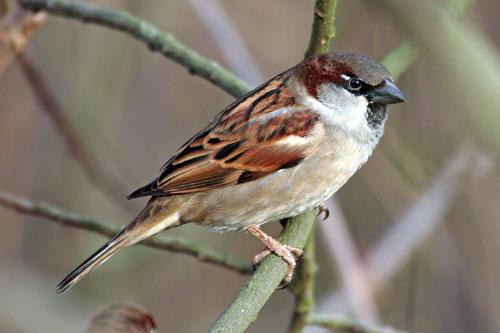
House Sparrow above, Tree Sparrow below

In response to Shysongbirds comment, here is a link to a DIY sparrow terrace nest box
